


AR Sponsor

Member
Joined:
Jan 2026
Posts:
153
EE: 0% (0)
 NC, USA
Posted: 9/8/2026 7:52:54 PM EDT
[Last Edit: AR-Zen][Edited]
|
I've read somewhere that one should pay attention to the shape of the bullet holes on paper. Here are two groups, that I shot from the same rifle, about 10 minutes apart. Both groups are pretty tight, well under 1 MOA, shot from AR-15, indoor rifle range, 100 yards distance. The first group is with 6mm Barnes Precision 105 grain:  The second group is with 6mm Hornady Black 105 grain:  Notice that the holes of the second group are more round, with much better defined edges, compared to the holes of the first group. Is there something to it, or am I reading too much into it? |

|
I'm curious about your observations and see what is said. My initial thought is it is more dependent on the bullet construction but ??? What I mean is the M855A1 makes the sharpest cut holes than any I've seen. So I ASSUME its because of the bullet? Otherwise I'm more curious about the 3 and 2 shot group for both. Thoughts? first? last? rds fired???? |

You are are looking for stuff more like this (which is an extreme example):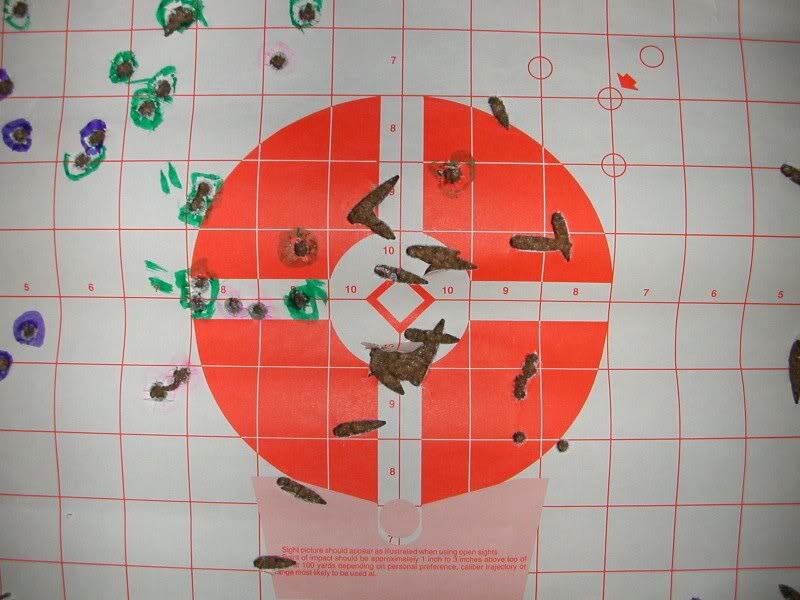 Pulled from the web, not mine. Keyholing or crooked, oblong holes indicate tumbling. The funny part, is the sideways bullets actually got on target. |
Mercy on the criminal is cruelty to the innocent.

Member
Joined:
Jun 2022
Posts:
14472
EE: 100% (30)
TX, USA
| Any difference in the backing to either target? Targets both from the same batch? I see the difference but have no idea what caused it as it sounds like similar caliber and most likely velocity. |
“That’s not how it works. You buy more tools and power than you need and as you fuck everything up you gain the knowledge to become a better carpenter.”
Tveddy
Tveddy

Member
Joined:
Jan 2026
Posts:
154
EE: 0% (0)
NC, USA
|
Originally Posted By Curmudgeon762: Any difference in the backing to either target? Targets both from the same batch? I see the difference but have no idea what caused it as it sounds like similar caliber and most likely velocity. Both groups were printed on the same paper target, with cardboard behind the target. Here is how it looked: 
|
Member
Joined:
Jan 2026
Posts:
155
EE: 0% (0)
NC, USA

Member
Joined:
Apr 2024
Posts:
593
EE: 0% (0)
USA

|
Originally Posted By AR-Zen: That's right. I am wondering if my first group was the result of the bullets not perfectly stabilized. You can glean some information in this way, but In this case you are reading to much into it. The Hornady bullet is actually a little longer than the Barnes. Theoretically the shorter bullet should fly with less yaw, thus making rounder holes. |
Member
Joined:
Jan 2026
Posts:
156
EE: 0% (0)
NC, USA
|
Originally Posted By AR-Zen: I've read somewhere that one should pay attention to the shape of the bullet holes on paper. Here are two groups, that I shot from the same rifle, about 10 minutes apart. Both groups are pretty tight, well under 1 MOA, shot from AR-15, indoor rifle range, 100 yards distance. The first group is with 6mm Barnes Precision 105 grain: https://i.imgur.com/7gZRpYK.png Some of the Barnes bullets are tipping. As demonstrated, the tippers are outside the major group. As range increases the dispersion will increase and increase randomly, that is to say not geometrically. I presume that the Barnes bullets are solid copper and are likely too long for the twist in your bore. Tipping bullets have no place in your tool box. The second group is with 6mm Hornady Black 105 grain: https://i.imgur.com/Wm8LJGE.png Notice that the holes of the second group are more round, with much better defined edges, compared to the holes of the first group. Is there something to it, or am I reading too much into it? |

|
Originally Posted By Mindless: Originally Posted By Mindless: Originally Posted By AR-Zen: I've read somewhere that one should pay attention to the shape of the bullet holes on paper. Here are two groups, that I shot from the same rifle, about 10 minutes apart. Both groups are pretty tight, well under 1 MOA, shot from AR-15, indoor rifle range, 100 yards distance. The first group is with 6mm Barnes Precision 105 grain: https://i.imgur.com/7gZRpYK.png Some of the Barnes bullets are tipping. As demonstrated, the tippers are outside the major group. As range increases the dispersion will increase and increase randomly, that is to say not geometrically. I presume that the Barnes bullets are solid copper and are likely too long for the twist in your bore. Tipping bullets have no place in your tool box. The second group is with 6mm Hornady Black 105 grain: https://i.imgur.com/Wm8LJGE.png Notice that the holes of the second group are more round, with much better defined edges, compared to the holes of the first group. Is there something to it, or am I reading too much into it? Mindless: The bold are your comments? Just trying to follow along. |
Member
Joined:
Jun 2022
Posts:
14473
EE: 100% (30)
TX, USA
|
Originally Posted By AR-Zen: I wonder if the rough shape of the bullet holes from Barnes Precision is cased by the bullet shape: it is open tip match. The Hornady bullet is boat tail hollow point. I was wondering that as well. |
“That’s not how it works. You buy more tools and power than you need and as you fuck everything up you gain the knowledge to become a better carpenter.”
Tveddy
Tveddy
Member
Joined:
Jan 2026
Posts:
157
EE: 0% (0)
NC, USA

|
Originally Posted By Mindless: The Barnes are not solids. Op, I can pull some of my remaining Barnes and compare to the 105bthp, but I would think that the bearing surface and length will be relatively similar. If you have a 1:7t, there should be no issue stabilizing (iirc you have an 18”). I’ve ran both in a 1:7.25t, albeit a 22” gasser, and two 26” 1:7.5t bolt guns with no issues with stabilization. You may also want to flatten out the back of the target on the Barnes ammo to get a better idea of the holes, as it looks like the paper is folded slightly under. |


|
Originally Posted By AR-Zen: I've read somewhere that one should pay attention to the shape of the bullet holes on paper. Here are two groups, that I shot from the same rifle, about 10 minutes apart. Both groups are pretty tight, well under 1 MOA, shot from AR-15, indoor rifle range, 100 yards distance. The first group is with 6mm Barnes Precision 105 grain: https://i.imgur.com/7gZRpYK.png The second group is with 6mm Hornady Black 105 grain: https://i.imgur.com/Wm8LJGE.png Notice that the holes of the second group are more round, with much better defined edges, compared to the holes of the first group. Is there something to it, or am I reading too much into it? The issue is caused by differing distance between the target paper and the backing. Uneven stapling, wind, chad from earlier holes, all of this makes for varying "cleanliness" of the holes. Glue will fix it. |
Member
Joined:
Jan 2026
Posts:
158
EE: 0% (0)
NC, USA
|
Originally Posted By lysanderxiii: The issue is caused by differing distance between the target paper and the backing. Uneven stapling, wind, chad from earlier holes, all of this makes for varying "cleanliness" of the holes. I think you are right. I examined the cardboard behind the target, and realized that it's well worn out. There are hundreds of bullet holes in it, and it has seen rain and heat. So, I shot several groups of Hormady Black all over the target to see how it would look:  As can be seen, with the same ammo and same target, some bullet holes are perfectly round, and some are ragged and irregular-shaped. So, my conclusion is that it's not the ammo, and there is no yaw/tumbling. It's just that the bullet holes reflect the imperfections on the target back, and the imperfections of the contact between the paper and the backing. Mystery solved. I'll just get a new cardboard. Thanks all. |

| In benchrest shooting, reading the shape and edge quality of a bullet hole on paper helps reloaders and shooters evaluate bullet stability, barrel tuning, and powder charge. Famous Hall-of-Fame benchrest gunsmith Thomas “Speedy” Gonzalez emphasizes that precision tuning relies heavily on interpreting these target signs. Gonzalez and Eric Cortina discussed this during a podcast a couple years ago. Of course, you need consistent target paper and backing orientation in order to make sure you're judging apples to apples. |
|
Some of my mentors from years past who were nationally ranked competitive shooters used to speak about bullets "settleing" . they talked about a bullet yawing and then at some point calming down and flying straight . If one only shot at one distance (usually 100 yds) the results might not be as expected . In other words the best group at 100 yds is not always does not always produce the best group at 200 or 300 yards. Might be interesting if the OP took the same bullets and loads and fired them at longer ranges . |
|
Originally Posted By AR-Zen: I wonder if the rough shape of the bullet holes from Barnes Precision is cased by the bullet shape: it is open tip match. The Hornady bullet is boat tail hollow point. They are basically the same design, just named differently for marketing. Shooting small groups with an AR isn't easy. I can shoot 1/4 MOA groups with my heavy bolt gun equippped with a light trigger, but struggle to shoot under half MOA with an AR, and am typically 3/4 MOA. This makes it difficult to determine if it is a load issue, or a shooter issue. |
|
Originally Posted By Curmudgeon762: Any difference in the backing to either target? Targets both from the same batch? I see the difference but have no idea what caused it as it sounds like similar caliber and most likely velocity. This was my thought too. The variance there looks more like the difference in the firmness of the target backer. Is one over s shot up piece of the backer that is more spongy and less supportive and the clean holes over a more virgin area of the backer? Very common for that to look like that. Another way to get the more raggedy looking holes is the backer has curved in the weather which is quite common if a lot of the support of the backer is from below Ieresting ona board or the ground. Staple target on a curved surface and it has less support in the middle. |
|
Originally Posted By AR-Zen: I think you are right. I examined the cardboard behind the target, and realized that it's well worn out. There are hundreds of bullet holes in it, and it has seen rain and heat. So, I shot several groups of Hormady Black all over the target to see how it would look: https://i.imgur.com/rK1syB1.png As can be seen, with the same ammo and same target, some bullet holes are perfectly round, and some are ragged and irregular-shaped. So, my conclusion is that it's not the ammo, and there is no yaw/tumbling. It's just that the bullet holes reflect the imperfections on the target back, and the imperfections of the contact between the paper and the backing. Mystery solved. I'll just get a new cardboard. Thanks all. Originally Posted By AR-Zen: Originally Posted By lysanderxiii: The issue is caused by differing distance between the target paper and the backing. Uneven stapling, wind, chad from earlier holes, all of this makes for varying "cleanliness" of the holes. I think you are right. I examined the cardboard behind the target, and realized that it's well worn out. There are hundreds of bullet holes in it, and it has seen rain and heat. So, I shot several groups of Hormady Black all over the target to see how it would look: https://i.imgur.com/rK1syB1.png As can be seen, with the same ammo and same target, some bullet holes are perfectly round, and some are ragged and irregular-shaped. So, my conclusion is that it's not the ammo, and there is no yaw/tumbling. It's just that the bullet holes reflect the imperfections on the target back, and the imperfections of the contact between the paper and the backing. Mystery solved. I'll just get a new cardboard. Thanks all. Ok, I answered before reading the whole thread. You found the why, less support behind the paper target. |
|
Originally Posted By nhsport: Some of my mentors from years past who were nationally ranked competitive shooters used to speak about bullets "settleing" . they talked about a bullet yawing and then at some point calming down and flying straight . If one only shot at one distance (usually 100 yds) the results might not be as expected . In other words the best group at 100 yds is not always does not always produce the best group at 200 or 300 yards. Might be interesting if the OP took the same bullets and loads and fired them at longer ranges . |
|
Originally Posted By nhsport: Some of my mentors from years past who were nationally ranked competitive shooters used to speak about bullets "settleing" . they talked about a bullet yawing and then at some point calming down and flying straight . If one only shot at one distance (usually 100 yds) the results might not be as expected . In other words the best group at 100 yds is not always does not always produce the best group at 200 or 300 yards. Might be interesting if the OP took the same bullets and loads and fired them at longer ranges . I'm not challenging you when I say this............ The ONLY written place I've seen any real mention of this "Settling" question is IIRC, Precision Shooting Reloading Guide (1995 Precision Shooting Inc). Chapter titled "Magnums" by Jay turner page 204-ish. And that was more of a statement and it was based on a specific situation --- Large Magnum shooting light bullets--- which is not the case here. |
|
Originally Posted By TGH456E: I'm not challenging you when I say this............ The ONLY written place I've seen any real mention of this "Settling" question is IIRC, Precision Shooting Reloading Guide (1995 Precision Shooting Inc). Chapter titled "Magnums" by Jay turner page 204-ish. And that was more of a statement and it was based on a specific situation --- Large Magnum shooting light bullets--- which is not the case here. I think he means this:   I've also heard it about longer rounds like 77gr SMK/TMK. that they take longer to "settle" than 69gr |
|
Originally Posted By mcantu: I think he means this: https://live.staticflickr.com/65535/52669965712_ab1f4aa1f0_c.jpg https://live.staticflickr.com/65535/53649245102_2cb23a1e8c_z.jpg I've also heard it about longer rounds like 77gr SMK/TMK. that they take longer to "settle" than 69gr A lot of people misread those graphs. They do not understand that that graphs are the YAW ANGLE, not the bullet path. The yaw angle is the angle of the bullet's long axis to its flight path. The center of gravity of the bullet moves in a nice smooth arc defined by the laws pf physics. The nose of the bullet points all over the place during flight. |
|
Originally Posted By mcantu: I think he means this: https://live.staticflickr.com/65535/52669965712_ab1f4aa1f0_c.jpg https://live.staticflickr.com/65535/53649245102_2cb23a1e8c_z.jpg I've also heard it about longer rounds like 77gr SMK/TMK. that they take longer to "settle" than 69gr Originally Posted By mcantu: Originally Posted By TGH456E: I'm not challenging you when I say this............ The ONLY written place I've seen any real mention of this "Settling" question is IIRC, Precision Shooting Reloading Guide (1995 Precision Shooting Inc). Chapter titled "Magnums" by Jay turner page 204-ish. And that was more of a statement and it was based on a specific situation --- Large Magnum shooting light bullets--- which is not the case here. I think he means this: https://live.staticflickr.com/65535/52669965712_ab1f4aa1f0_c.jpg https://live.staticflickr.com/65535/53649245102_2cb23a1e8c_z.jpg I've also heard it about longer rounds like 77gr SMK/TMK. that they take longer to "settle" than 69gr I'm not NHsport of course so I dont know, valid question. But I have a question for you: To be honest I've always ignored those graphs. Mainly two reasons: -these seem to come up when talking about terminal ballistics where those minute differences in CofG etc could mean the bullet is more likely to tumble. -the next being that I've always understood those to be VERY minute "wobbling" where as to get a bullet to visibly seem off at say 100yds, you're talking, maybe, 1/10th inch + of wobble?? So you're saying that max of 4 degrees of attack angle can be seen by the common person on a paper target???? Or in this case, the OP, at 100yds, where the yaw is even less ? PS: Just an observation.... that 2nd graph is based on a m855 bullet- just about the worse bullet you could shoot. It defies logic that say a SMK - which far far better constructed and consistent- would have as much "Scatter" as a M855 bullet. |
|
Originally Posted By TGH456E: I'm not NHsport of course so I dont know, valid question. But I have a question for you: To be honest I've always ignored those graphs. Mainly two reasons: -these seem to come up when talking about terminal ballistics where those minute differences in CofG etc could mean the bullet is more likely to tumble. -the next being that I've always understood those to very minute "wobbling" where as to get a bullet to visibly seem off at say 100yds, you're talking, maybe, 1/10th inch + of wobble?? So you're saying that max of 8 degrees of attack angle can be seen by the common person on a paper target???? PS: Just an observation.... that 2nd graph is based on a m855 bullet- just about the worse bullet you could shoot. It defies logic that say a SMK - which far far better constructed and consistent- would have as much "Scatter" as a M855 bullet. there's a lot of turbulence where a bullet exits a barrel 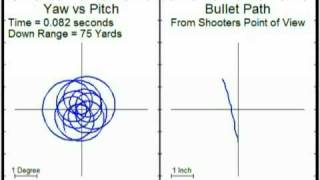 Pitch, Yaw and bullet path |
|
Originally Posted By mcantu: iirc, those graphs both originate from powerpoints by Euro defense contractors there's a lot of turbulence where a bullet exits a barrel  https://www.youtube.com/watch?v=KH9SCbCBHaY https://www.youtube.com/watch?v=KH9SCbCBHaYGreat thank you! That certainly is a better bullet than a M855. But the question remains: "So you're saying that max of 4 degrees of attack angle can be seen by the common person on a paper target???? Or in this case, the OP, at 100yds, where the yaw is even less ?" And yes, there is "a lot of turbulence where a bullet exits a barrel." Which can affect the bullets flight. But how much of that can realistically be seen on paper? In that fraction of a millisecond where the bullet physically goes thru the paper- Who's to say the bullet isn't neutral (0 Deg yaw) as it "wobbles" down range? PS: This is why I ignore these graphs. They make my head hurt. Instead I look at the paper, chrono results and shoot them at the distances I'll shoot them to see if they work. |
|
Mcantu: In other words- to simply state my question- the OP was shooting 6mm bullets at 100yds. The bullets are approx 0.243" diameter. So your thought is that 100yds those bullets were "wobbling" more than 0.1215"? Is that correct? Because, obviously, anything less than that will not "show" as it will still appear circular. PS: I mathematically answered my own question. I made an assumption in my calculations and used the Barnes 6mm 105gr Match bullet. The one assumption is that the center of the yaw rotation is at the middle (length wise) of the bullet. Using that to get the tip past 0.1215" yaw would require ATLEAST 11.45D of yaw. Considering the bullet involved and distance, that is WELL ABOVE any shown in the graphs etc. Now the base is more problematic - harder to figure out- you'd need the EXACT coordinates for the center point of the yaw and the bullet dimensions at that point. But I'm even more skeptical of these graphs providing useful information for the OP. And me personally going back to ignoring them. |
|
Originally Posted By TGH456E: Mcantu: In other words- to simply state my question- the OP was shooting 6mm bullets at 100yds. The bullets are approx 0.243" diameter. So your thought is that 100yds those bullets were "wobbling" more than 0.1215"? Is that correct? Because, obviously, anything less than that will not "show" as it will still appear circular. PS: I mathematically answered my own question. I made an assumption in my calculations and used the Barnes 6mm 105gr Match bullet. The one assumption is that the center of the yaw rotation is at the middle (length wise) of the bullet. Using that to get the tip past 0.1215" yaw would require ATLEAST 11.45D of yaw. Considering the bullet involved and distance, that is WELL ABOVE any shown in the graphs etc. Now the base is more problematic - harder to figure out- you'd need the EXACT coordinates for the center point of the yaw and the bullet dimensions at that point. But I'm even more skeptical of these graphs providing useful information for the OP. And me personally going back to ignoring them. |
|
Originally Posted By TGH456E: Mcantu: In other words- to simply state my question- the OP was shooting 6mm bullets at 100yds. The bullets are approx 0.243" diameter. So your thought is that 100yds those bullets were "wobbling" more than 0.1215"? Is that correct? Because, obviously, anything less than that will not "show" as it will still appear circular. PS: I mathematically answered my own question. I made an assumption in my calculations and used the Barnes 6mm 105gr Match bullet. The one assumption is that the center of the yaw rotation is at the middle (length wise) of the bullet. Using that to get the tip past 0.1215" yaw would require ATLEAST 11.45D of yaw. Considering the bullet involved and distance, that is WELL ABOVE any shown in the graphs etc. Now the base is more problematic - harder to figure out- you'd need the EXACT coordinates for the center point of the yaw and the bullet dimensions at that point. But I'm even more skeptical of these graphs providing useful information for the OP. And me personally going back to ignoring them. Well, the actual yaw angle would be through the bullet's CG, which is aft of the middle of the bullet. But, I doubt that it would negate your argument. |

|
Originally Posted By RR_Broccoli: You are are looking for stuff more like this (which is an extreme example): https://4.bp.blogspot.com/-R3nxKsah8Gw/VROiBu_OGmI/AAAAAAAACsQ/BNqR0vgZx80/s1600/keyholing.jpg Pulled from the web, not mine. Keyholing or crooked, oblong holes indicate tumbling. The funny part, is the sideways bullets actually got on target. Many years ago a buddy had a rifle that was keyholing bad. Being younger we tested several items from the home... for science seeing a heyholed 223 round in a cooking pan is fun |
PROUD AMMOSEXUAL
Founding father Tench Coxe
“Their swords, and every other terrible implement of the soldier, are the birthright of an American."
Founding father Tench Coxe
“Their swords, and every other terrible implement of the soldier, are the birthright of an American."

AR Sponsor