


Armory Sponsor


Member
Joined:
Dec 2023
Posts:
11881
EE: 100% (7)
 USA
USA
Posted: 9/8/2026 7:17:56 PM EDT
|
I'm curious if anyone has done scientific, controlled experiments on how sacrificial brakes protect the blast baffle of various silencers? I just bought a Polonium, for use on my NV rifle and I'm torn as to whether increase the weight and length of the gun (11.5" 5.56) or to keep it simple with a direct thread. The firing schedule will include FRT use, though I don't intend to fire extreme round counts in short periods. Some amount of wear and tear is fine, I just want to get some opinions on whether a brake is worth the weight. Thank you for any insights. |
I don't see no Americans. I see trespassers.


Joined:
Nov 2022
Posts:
203
EE: 0% (0)
KY, USA
|
Not really scientific but I did one for my own curiosity. I used a Hydrogen-K 6.5 and a 10.3” barrel. Paired with a rearden SPB and rearden atlas. I set aside 3000 rounds and ran the gun just like normal. A few carbine matches and 2 gun matches, some night vision shooting, general range and practice use. Nothing crazy. After 3000 rounds even with the brake the blast baffle was showing a pretty decent amount of erosion. The brake might have helped some but not enough in my opinion. Titanium suppressors shouldn’t be used on short barrel 5.56 period. Any company that tells you differently is trying to sell you something banking on the fact you won’t shoot it enough for issues to arise. |

|
Originally Posted By Glocked: You can use a DTA with a built in brake if you’re wanting to play it safe. Best of both worlds. AFAIK there’s really no documented testing. This. Check out Geist who is coming out with a new version soon. 2.5oz and recesses the can about a half inch. |
|
I am not aware of any studies that A-B'd identical round counts on the same model silencer, but mounted with a brake/comp vs. a direct thread. Colloquially, people have posted a lot of blast baffle photos, and I've seen a bunch of repair cans that had various mount types... from those sorts of things, I'd draw some conclusions or at least make some generalizations: • Pronged, open-tine flash hiders often channel the superheated gas jet right at the blast baffle. Probably the worst option for straight on, focused blast baffle wear. • Flash hiders with closed tines don't seem to exhibit that jet cutting as much. • Brakes/Comps do, indeed, get in the way of, and catch some forward blast, protecting the blast baffle a bit. But no one ever seems to mention that these gases are instead directed sideways towards some ~sixty-thou-wall tubing instead of into a big honkin' chunk of inconel probably designed to take those gases on the chin. If you figure a blast baffle might be 3.5 mm to 5 mm thick, and a tube/tubeless design wall is maybe 1.5mm to 2mm thick... Hmm. I'd like to see tube wall erosion studies done. • Direct thread* leaves the largest empty volume inside the blast chamber. It is the shortest, therefore quickest, route for gases to expand away from the bore aperture in all directions. Is this going to soften the impact on the blast baffle simply by diffusing the pressure it a bit? I'll bet it does a little. (*I suppose those featureless Plan B types that have no prongs or comps also act this way). |
|
Originally Posted By NorthPolar: I always just figured blast chamber walls would be thicker so it wouldn’t matter. But with modern designs that’s a good point. Some makers do have a thicker blast chamber. Some don’t. Tube designs often use the same diameter all the way through. Some designs look pretty thin on the sidewalls vs. the blast baffle (or chamber walls) thickness: 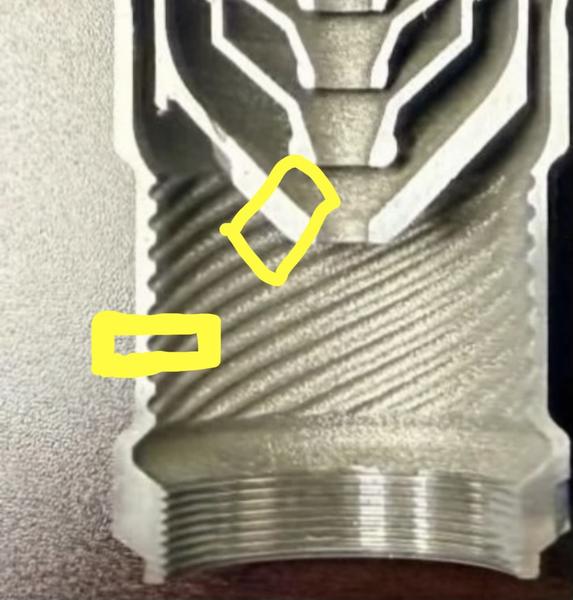 Otter Polos have a chunkier sidewall because of the construction method: 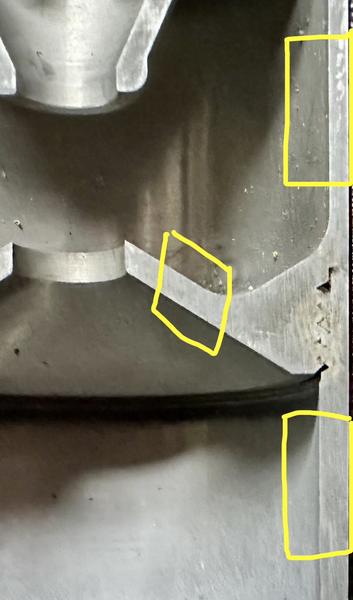 Again: I’d like to see studies done. I’ve never seen a tube erode here, but I have seen them pop here. Mostly because heat and pressure period, not simply because a comp shoved gas here more than the other mount options. |
I have a used muzzle brake that the previous owner had used on an unsuppressed 7.5" AR, and there is noticeable erosion on each of the muzzle brake chambers. I think there's definitely some merit to the concept, but I wouldn't be too worried if your suppressor has a Stellite or Inconel blast baffle. |
|
This is one of the questions that is filled with anecdotal experiences but no hard evidence. We have seen muzzle breaks with wear and tear on the muzzle device itself, so its defintely doing SOMETHING. We also have evidence that some muzzle devices (Flash hiders) cause accelerated erosion by focusing the blast into a single spot repeatedly. Anyone with 1000 rounds through a surefire will likely see the imprint of their three-prong cut into the blast baffle. I don't think there is a free lunch here. Muzzle breaks might eat some of the damage, but like the flash hiders they are redirecting most of the blast into the same spot on repeat which is likely causing accelerated erosion. The only thing that changes is where the accelerated erosions is occurring, would you rather have it at the baffles or the side wall? |
|
Originally Posted By UMP45_Enthusiast: This is one of the questions that is filled with anecdotal experiences but no hard evidence.... Muzzle breaks might eat some of the damage, but like the flash hiders they are redirecting most of the blast into the same spot on repeat which is likely causing accelerated erosion. The only thing that changes is where the accelerated erosions is occurring, would you rather have it at the baffles or the side wall? Honestly, back when I was more in the silencer industry, I looked into it. But when I looked over our repair records to try and get some historical data-feel of wear, I gave up pretty quickly. I'm a pragmatic kinda guy, and mostly interested in mode of failure. I can't say I ever saw a silencer "wear out". Almost all the repairs and damage were either • User error (cockeyed install/loosening + drooping during firing.) • Abuse (high heat + pressure beyond what the suppressor was designed for, stuff that would have destroyed the can without factoring in normal wear.) • Ammo problem (Bullet jacket separated, squibs, squirrelly reloads, someone put a 7.62 through a 5.56 hole (see "User error :) ), unjacketed lead filling up or occulting flightpath hole, etc. Can't say I recall seeing a repair can come in that was shot so much that the blast baffle eroded or caved so hard it blew out, unless it was also coupled to the "Abuse" reason above. |
Member
Joined:
Dec 2023
Posts:
11888
EE: 100% (7)
USA
|
Originally Posted By kel: Honestly, back when I was more in the silencer industry, I looked into it. But when I looked over our repair records to try and get some historical data-feel of wear, I gave up pretty quickly. I'm a pragmatic kinda guy, and mostly interested in mode of failure. I can't say I ever saw a silencer "wear out". Almost all the repairs and damage were either • User error (cockeyed install/loosening + drooping during firing.) • Abuse (high heat + pressure beyond what the suppressor was designed for, stuff that would have destroyed the can without factoring in normal wear.) • Ammo problem (Bullet jacket separated, squibs, squirrelly reloads, someone put a 7.62 through a 5.56 hole (see "User error :) ), unjacketed lead filling up or occulting flightpath hole, etc. Can't say I recall seeing a repair can come in that was shot so much that the blast baffle eroded or caved so hard it blew out, unless it was also coupled to the "Abuse" reason above. Originally Posted By kel: Originally Posted By UMP45_Enthusiast: This is one of the questions that is filled with anecdotal experiences but no hard evidence.... Muzzle breaks might eat some of the damage, but like the flash hiders they are redirecting most of the blast into the same spot on repeat which is likely causing accelerated erosion. The only thing that changes is where the accelerated erosions is occurring, would you rather have it at the baffles or the side wall? Honestly, back when I was more in the silencer industry, I looked into it. But when I looked over our repair records to try and get some historical data-feel of wear, I gave up pretty quickly. I'm a pragmatic kinda guy, and mostly interested in mode of failure. I can't say I ever saw a silencer "wear out". Almost all the repairs and damage were either • User error (cockeyed install/loosening + drooping during firing.) • Abuse (high heat + pressure beyond what the suppressor was designed for, stuff that would have destroyed the can without factoring in normal wear.) • Ammo problem (Bullet jacket separated, squibs, squirrelly reloads, someone put a 7.62 through a 5.56 hole (see "User error :) ), unjacketed lead filling up or occulting flightpath hole, etc. Can't say I recall seeing a repair can come in that was shot so much that the blast baffle eroded or caved so hard it blew out, unless it was also coupled to the "Abuse" reason above. Very helpful, thank you. |
I don't see no Americans. I see trespassers.
I would definitely be down to test this and make a video on my channel, but it would require a lot of time, product, and effort. I think the only way to do a test that would be anywhere close to scientific would be to take two or three identical cans and do something like the SOCOM test through each on the same upper; one with a brake attachment, one flash hider, and then I’d want to do a third with a direct thread mount. I would of course take detailed photos before and after. This would obviously require 2-3 suppressors, a bunch of ammo, and would take a lot of time to film and edit. So if anyone wants to donate 3 cans and/or a few thousand rounds, let me know. 
|

|
It’s a real thing, if that’s what you’re asking. Some study specifically in the context of suppressors and muzzle devices? No. But the key concepts at play, blast dynamics, metallurgic properties, etc, they’re pretty well understood. All this is, is putting them into interplay in the context of a gun. The specifics will depend on muzzle device, flow dynamics, metal composition, thickness, firing schedule, ammo, etc. But is the concept of a sacrificial baffle a sound concept? Of course. I use brakes on cans in general, because as a generality it helps suppressor performance, but it gets a lot more relevant when using Ti, as barrel length goes down, and firing schedule goes up. |
Member
Joined:
Dec 2023
Posts:
11983
EE: 100% (7)
USA
|
Originally Posted By doty_soty: It’s a real thing, if that’s what you’re asking. Some study specifically in the context of suppressors and muzzle devices? No. But the key concepts at play, blast dynamics, metallurgic properties, etc, they’re pretty well understood. All this is, is putting them into interplay in the context of a gun. The specifics will depend on muzzle device, flow dynamics, metal composition, thickness, firing schedule, ammo, etc. But is the concept of a sacrificial baffle a sound concept? Of course. I use brakes on cans in general, because as a generality it helps suppressor performance, but it gets a lot more relevant when using Ti, as barrel length goes down, and firing schedule goes up. I fully believe it's a real thing, I'm just curious about the numbers and data. |
I don't see no Americans. I see trespassers.
Armory Sponsor