


Armory Sponsor

Posted: 12/7/2024 10:34:03 AM EDT
|
Doesn't a 36 yard zero make better sense for a HD SBR? I thought maybe go from my previously RDS mounted lower 1/3, 50 yard zeroed SBRS, 10.3" - 11.5" (5.56 M193) to a 36 yard. Anyhow, for the if it isn't broke don't fix it crowd @200 I can get RDS center hits with a 50/200 zero. Will a 36/300 yard zero improve for a man size in the zone first round probable hits out to say 300 yards. Won't the POI at the closer range be better for HD not having to hold over much up closer CQB 7 - 15 yard distances? Should I change my RDS SBR zeros? Thoughts, should a 10.3 & 11.5 stay at 50 yd or do the 36 yd. Is there that much difference or go for continual improvement? |
USMC 85-'93 Amphibious YAT-YAS

|
Looking forward to the replies of others. In my own assessments and ponderings, I've found that the sight off-set of the AR15 is just tough to get a general-purpose CQB distance zero. Anything close (i.e. 10 yard level) gets way WAY off for any distance other than exactly what it was zero'd for. From my experience, the difference between a 36 yard and a 50 yard zero isn't that meaningful when it comes to 15 yard CQB shots. And a 50 yard zero is more meaningful when it comes to general purpose zero of a 10.3" gun. I've found that ballistically in 5.56, a 50 zero is still basically a 200 zero, and with that, with a red-dot, I regularly plink 200 yard gongs with my CQB 10.5 AR. And with that zero, impact is within 1.5" or so of aim for everything from about 35 to 225 yards (ish). I like that. Where a 36/300 yard zero gives me just more arc of flight than I really want in that 75-200 yard span, which I consider the bulk of my likely "outdoor" level shots. While giving me very little advantage over a 50 yard zero, in that "indoors" 10-15 yard distance. But this is really the classic 200 vs 300 yard zero debate. And for military applications, 300 makes sense, when you are shooting at enemy soldiers. In my life, I'm shooting at things much smaller than an upright man, and suppressive fire (misses) are of less value to me. I want a tighter arc of flight in the likely shooting distances I have, for point-blank-aim. 36/300 starts making more sense when shooting at Somali's raiding my camp from across the fields running upright. For everything else, 50/200 works better for me. So personally, i just gave up, and stick with the standard 50/200 yard zero; which still works fine for "serious business". I will say, I've been playing around with lasers form the CQB indoor usage, which are mounted much closer to the bore and dedicated to closer range usage - and so can be 15 yard zero'd much better than any optic system on an AR15 can. Just my own path. |

|
I've become way to used to a 50 yard zero to have one rifle zeroed for 36. I've watched the Shawn Ryan combat zero video on youtube and although it makes sense overall, I've been using a 50 yard zero for so long I don't need to think about new holdovers and such. Also interested to hear other replies to this thread. |
|
Unless you *know* your velocity and your BC (not the random FPS number written on the box or some generic internet BC figure for a random HPBT) … you don’t know your second zero. Are you bringing a chronograph? Just put the damn target at 100 or 200 or 300 yards (or whatever you want your long zero to be) and shoot it, then adjust accordingly. It eliminates all the variables. If you ONLY care that the gun has the short zero, that’s fine. As long as you know your 50/200 short zeroed gun might be dead on at 50 and several inches off at 200… my 50/200 long zeroed gun will be dead on at 200yd and maybe off <0.5” around 50yd. |
|
Originally Posted By Millennial: Unless you *know* your velocity and your BC (not the random FPS number written on the box or some generic internet BC figure for a random HPBT) … you don’t know your second zero. Are you bringing a chronograph? Just put the damn target at 100 or 200 or 300 yards (or whatever you want your king zero to be) and shoot it, then adjust accordingly. It eliminates all the variables. If you ONLY care that the gun has the short zero, that’s fine. As long as you know your 50/200 short zeroed gun might be dead on at 50 and several inches off at 200… my 50/200 long zeroed gun will be dead on at 200yd and maybe off <0.5” around 50yd. This is actually the correct way to do this. (IMHO) Your 50/200 zero, should actually be done at 200 yards, not 50. |
|
TL/DR When i ran the numbers for 75 grain ammo I saw with the info below, that the 10.3 would be 36/200 or 50/150. I decided on 36/200. If your interested in my OCD, according to the calculator that I used (Vortex) Using 75 gr PPU from 2008 velocity of 2359 10 shot average from a Colt Socom cut to 10.3. I used the Hornady BC that Vortex lists in the calculator for 75 gr BTHP. Which coincidentally is the same that found in a post from Molon regarding PPU. He also mentioned the bullet was essentially the same. I went with 36/200 with 300 being 1 mil drop from 200. I went to the range and zeroed at 36, checked HOB from 3 yards to 20. Then I confirmed at 100 that it was 2.4 high, confirmed at 200, then running out of time, I aimed the red dot at the "neck" of the torso steel plate at 300 yards and hit a little low, but still center mass 10 out of 10 rounds. The 50 yard zero turned out to be 50/150 for that load, yes I verified. I used the chrono numbers from the Colt upper with my Super Duty because I forgot to chrono the new rifle. Height over bore out to 20 yards was essentially the same between 36/50 My setup listed above is Geissele SD 10.3, Aimpoint T2 lower 3rd, Vortex Micro 3x, Polonium K, and blue box PPU from 2008. I am debating running a Razor on the rifle instead. |
|
Originally Posted By RenegadeX: I have never had 50 & 200 be zerod. Usually if it is zerod at 200, the other zero is around 40. some truth. absolute 200 yard zero is a "good enough" 50 yard zero, but rarely spot on heres the table I run from my own gun and tests. there is definatly some noise to this - so don't stress too much if there are inconsistencies. but this is what I get. note my standard practice is to zero for one particular load, and then shoot POI for other ammo, and just note what that zero is, in the same scope settimgs I use for the other baseline load. that way no sight adjustments when I switch ammo. intersting results. ever ones gun (and recoil behavior) is different. but this is mine of note is the blue row in the table. 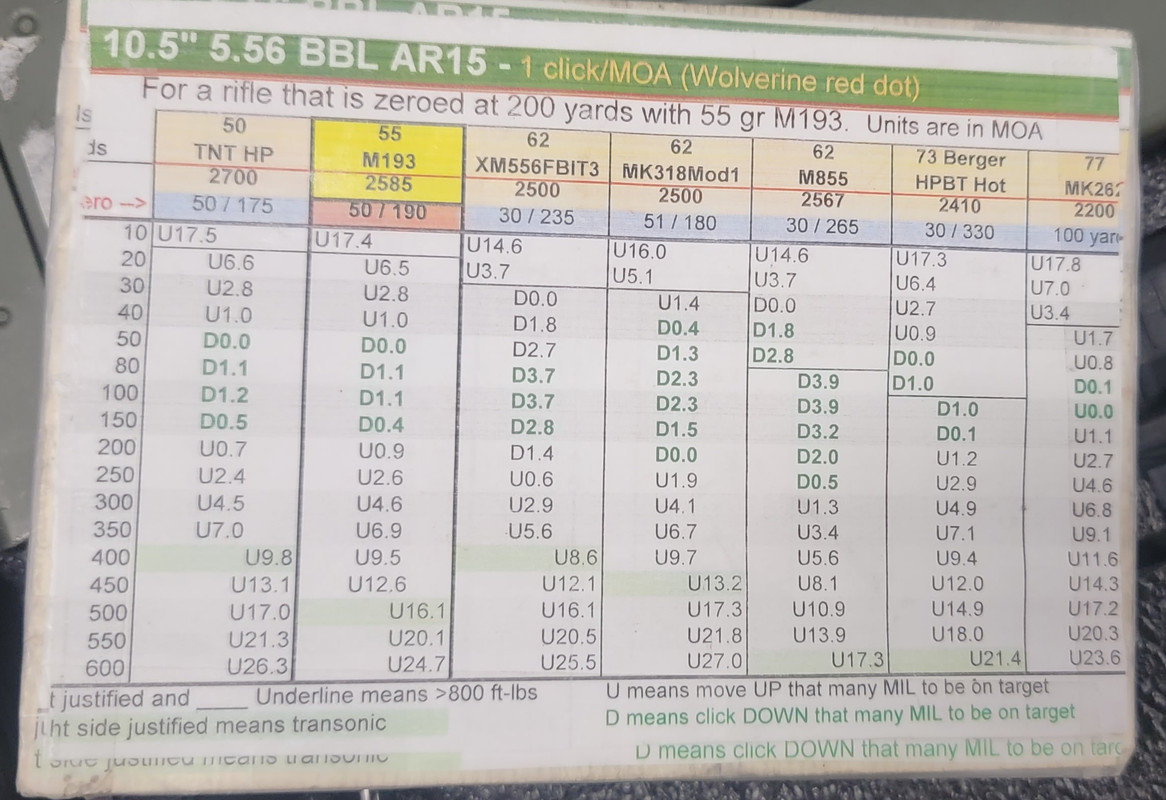
|
|
To me a 36 yard zero has too high of a max ordinate mid trajectory. I start zeroing at 50, then at a 100 fine tune windage and check for vertical offset, and then check windage again on a calm day at 200. I like to keep max ordinate between near and far zeroes under 2”. So for something slow like an 8” blackout shooting 110s at 2050 fps the zero might compress to a 35/150. Otherwise near 50 and check at 100 and 200. Magnified optics usually get dope-optimized zeroes for the reticle holdovers and cartridge. |

| I would stick with a 50/200 zero. It's what I use on my 10.5 and two 11.5 and I take them out to 300 with just a RDS. |
I now have a ban button. Want to see me use it? Keep it up. - Lancelot
You do not fight out of hate, but rather out of the love and compassion you have for those you are trying to protect.
You do not fight out of hate, but rather out of the love and compassion you have for those you are trying to protect.

|
Just watched these two videos on the subject last night. Lot of good info in them. And height over bore really comes into play.  Is there a BEST ZERO for your red dot ( PART 1 )  Is there a BEST ZERO for your RED DOT (PART 2) |

|
height over bore then the rest of the shit that matters, velocity, BC, weight, etc I find with my 12.5 SBR, 75yd zero is the one. eotech on a unity riser. 3.4" height over bore. the shooting low happens from 0-75. 0 from 75-160. then its just low from there to a practical distance where one would typically want a different rifle..let alone the performance of the round at given distance.. more of a "flat line" trajectory. no peaks, large variations. |

Member
Joined:
Oct 2024
Posts:
101
EE: 100% (9)
 USA
USA
|
Originally Posted By RenegadeX: I have never had 50 & 200 be zerod. Usually if it is zerod at 200, the other zero is around 40. That's because the true nature of the Santos 50 yard zero is being lost. Some things that should not have been forgotten were lost. History became legend. Legend became myth. The Santos 50 yard zero has a 200 *METER* cross over. Not a 200 *YARD* cross over. Remember, it was intended to allow M16A2/M4 carry handle sight systems the ability to have the "point-and-click" capability of the 50y/200m zero, yet also retain the sights inherent ability to return to its original sight settings. Which we all know are in military measurements of meters, not yards. Remember the true meaning of the system as well as its intended use. This is how we preserve our history. |
|
Originally Posted By LeviBarAlphaeus: That's because the true nature of the Santos 50 yard zero is being lost. Some things that should not have been forgotten were lost. History became legend. Legend became myth. The Santos 50 yard zero has a 200 *METER* cross over. Not a 200 *YARD* cross over. Remember, it was intended to allow M16A2/M4 carry handle sight systems the ability to have the "point-and-click" capability of the 50y/200m zero, yet also retain the sights inherent ability to return to its original sight settings. Which we all know are in military measurements of meters, not yards. Remember the true meaning of the system as well as its intended use. This is how we preserve our history. The reason an SBR crosses at ~40yds with a 200yd zero instead of ~50yd is not because it’s supposed to be 50yd/200m. It’s because the velocity is so much slower on the SBR versus the 20” rifles of the day when the 50yd/200m zero was established. An SBR with a 200m instead of a 200yd zero will have an even shorter close zero (like 30-some yards) because 200m is about 9% further than 200yd and the arc needs to be bigger to reach further. The original 20” M16 has more velocity so there’s less arc on the shot and that’s why it can cross zero at both 50yd and 200m. Realistically, zeroing that 20” rifle for 200yd instead would probably only change that 50yd zero by 1/4” or so … so it would be fair to say that it has a 50yd/200yd zero too. |

|
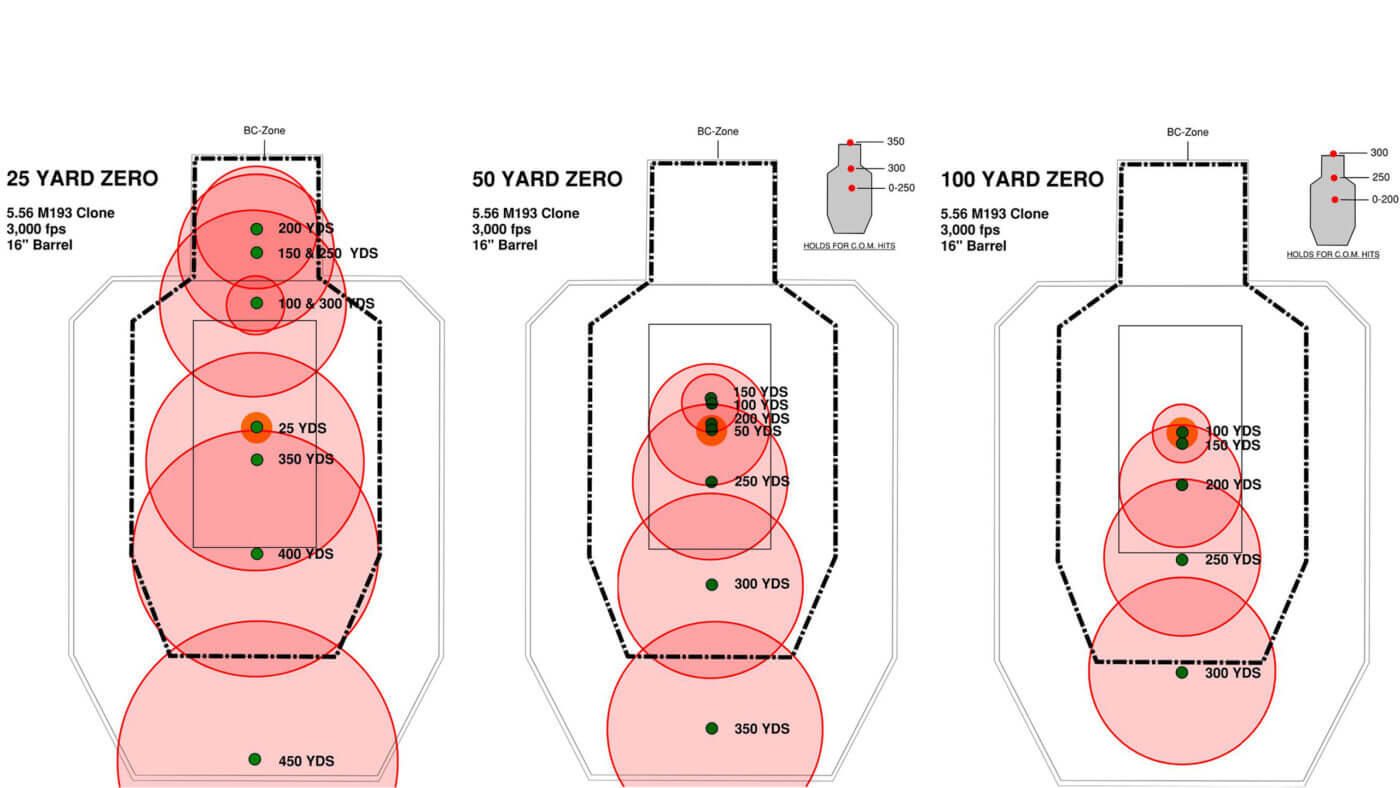
Originally Posted By Voland: Lots of considerations... Hight over bore, typical use case, type of ammo, etc... For me, I use 77 grains with a tall unity mound, t2 dot and 36 years just made more sense. https://www.thearmorylife.com/wp-content/uploads/2020/10/article-is-your-carbines-zero-wrong-1.jpg https://www.thearmorylife.com/wp-content/uploads/2020/10/article-is-your-carbines-zero-wrong-5.jpg Now what do those targets look like with the more typical 75-77gr defensive load at 2300-2500fps from a 10.3-12.5” SBR? |
|
Originally Posted By Millennial: Now what do those targets look like with the more typical 75-77gr defensive load at 2300-2500fps from a 10.3-12.5” SBR? Don't know beyond 200. Point blank to 200 pretty much dead on with an 11.5". I'm sure there's a bigger drop beyond 200... |
|
Originally Posted By Voland: Lots of considerations... Hight over bore, typical use case, type of ammo, etc... For me, I use 77 grains with a tall unity mound, t2 dot and 36 years just made more sense. https://www.thearmorylife.com/wp-content/uploads/2020/10/article-is-your-carbines-zero-wrong-1.jpg https://www.thearmorylife.com/wp-content/uploads/2020/10/article-is-your-carbines-zero-wrong-5.jpg the overall spread of the 36 zero is complete dog shit. too much variation. |

|
Originally Posted By Gordo556: the overall spread of the 36 zero is complete dog shit. too much variation. Originally Posted By Gordo556: Originally Posted By Voland: Lots of considerations... Hight over bore, typical use case, type of ammo, etc... For me, I use 77 grains with a tall unity mound, t2 dot and 36 years just made more sense. https://www.thearmorylife.com/wp-content/uploads/2020/10/article-is-your-carbines-zero-wrong-1.jpg https://www.thearmorylife.com/wp-content/uploads/2020/10/article-is-your-carbines-zero-wrong-5.jpg the overall spread of the 36 zero is complete dog shit. too much variation. That. So very that. Unless you're doing a 200 round count impact analysis with detailed statistically analysis of the impacts and group center, combined with ultra precise scope-off-set measurements, you're projected calculated 350 yard impact, is so very much not going to be where the bullet actually impacts at 350 yards. If you want a 36 yard zero. Set the target at .. what the fuck is that, 272.85 yards? 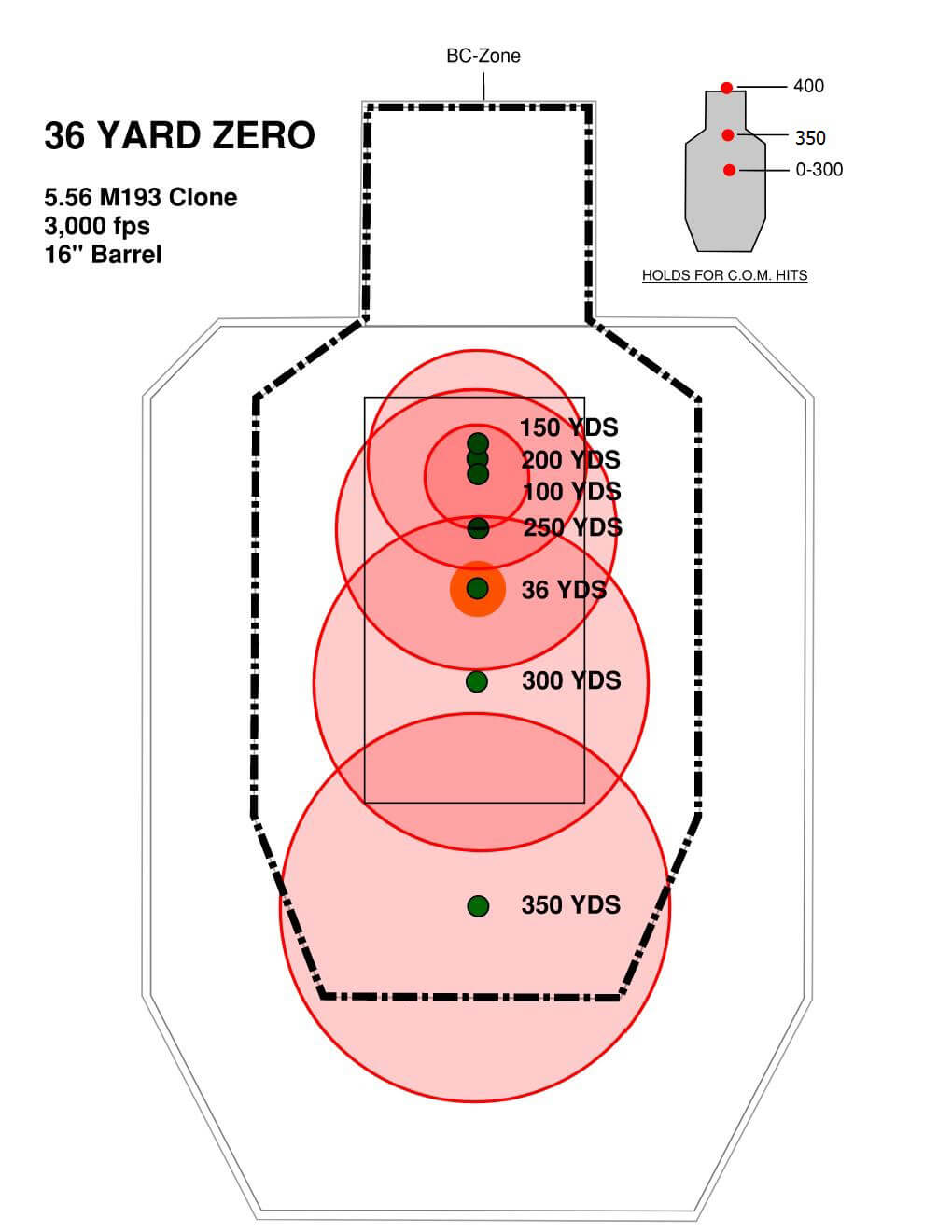 I don't even know. But whatever it is, zero it there. . Whatever, set it there, and run that. Don't actually "zero" at 36 yards, because if you're off by just a half an inch, you will be way the Hell off. Otherwise, that target is so very very not going to be what you actually get with a 36 yard zero. Learned all this the hard way. Also - don't even do that, because a 36 yard zero is stupid. It's only actually useful as a zero-point hold zero for full-on standing adult torso males walking level directly at you. Otherwise, you're going to miss by overshooting or undershooting your non-24"killzone-target at anything other than 36 and 275 yards. |
|
Originally Posted By Nobody69s: I've become way to used to a 50 yard zero to have one rifle zeroed for 36. I've watched the Shawn Ryan combat zero video on youtube and although it makes sense overall, I've been using a 50 yard zero for so long I don't need to think about new holdovers and such. Also interested to hear other replies to this thread. Exactly where I'm at. Across the room? Aim at neck, you'll do fine. |
Member
Joined:
Oct 2024
Posts:
106
EE: 100% (9)
USA
|
Originally Posted By Millennial: The reason an SBR crosses at ~40yds with a 200yd zero instead of ~50yd is not because it’s supposed to be 50yd/200m. It’s because the velocity is so much slower on the SBR versus the 20” rifles of the day when the 50yd/200m zero was established. An SBR with a 200m instead of a 200yd zero will have an even shorter close zero (like 30-some yards) because 200m is about 9% further than 200yd and the arc needs to be bigger to reach further. The original 20” M16 has more velocity so there’s less arc on the shot and that’s why it can cross zero at both 50yd and 200m. Realistically, zeroing that 20” rifle for 200yd instead would probably only change that 50yd zero by 1/4” or so … so it would be fair to say that it has a 50yd/200yd zero too. I'm pretty sure that's what i was getting at. The 50/200 wasn't designed for 10.3 guns. I explained this above pretty well to those who were paying attention. As i said, it was designed for military rifles of the time (M16A2 with an 8/3 drum or M4 with a 6/3 drum) to have a max point blank and still be able to use the gradients on the drum should they be necessary. The fact that people are expecting the 50y/200m SIBZ to apply to 10.3, 10.5, 11.5, or 12.5 guns means they don't understand the reason for its existence in the first place. You appear to fall within this category. The constant assumption that both crossovers are in yards is the single most defining flaw that highlights peoples ignorance on the subject. Believe me, i understand ballistics quite well. Your little childrens table refresher was quite unecessary. |
|
Just like ass holes everyone has opinions, dumb question anyway because common sense says zero for your MOST used distance for the barrel length. Obviously the only way to know at the next distance is to TEST the round, and then what rounds are you using?? 55/69/77/custom loads........... Any change in bullet requires a re-zero duh, really not rocket science but for some I guess it might be 
|
|
I first zeroed mine at 25. I went to range tried 100 and I had to aim a few inches below the steel targets to hit. For some reason my 10.5 didn’t like it at all. I rezeroed at range this time 50 yards and it’s great no real change 50-100 and I can aim too if target and hit 200 yard plate. Yes I know 200 ain’t really effective with a 10.5 and 5.56 but it’s to see if I can hit.most use is under 50 and some To 100. |
Joined:
Jun 2022
Posts:
58
EE: 100% (2)
TX, USA
 I Don't Like Battle Zeros After tying it all I came to the same conclusion as this guy. TLDW 100 yard zero for close range precision hold over at 2 and 3 hundred yards. otherwise you are gonna shoot over the top of close small targets |

|
Originally Posted By inkaybee:  https://www.youtube.com/watch?v=bhp_c5eJhjw https://www.youtube.com/watch?v=bhp_c5eJhjwAfter tying it all I came to the same conclusion as this guy. TLDW 100 yard zero for close range precision hold over at 2 and 3 hundred yards. otherwise you are gonna shoot over the top of close small targets Same. It works well with my brain. All of my rifles are sighted in at 100. |


Member
Joined:
Jul 2024
Posts:
1072
EE: 100% (1)
TX, USA

|
Originally Posted By Captain_Kidd: I built my SBR to use at "in-house" and maybe longer (20-25 yards). If I zero it at 25 yards, what does that do to my shots at closer targets? Probably not much since height over bore is a thing. Instead your trajectory out at range will become a rainbow. |


Armory Sponsor