


Posted: 11/3/2025 9:54:26 PM EDT
[Last Edit: Need4Guns][Edited]
|
To preface, this is going to be an ongoing thread. I've been turning for about 8yrs, mostly hobby stuff. Bowls, plates, vases, pipes, ornaments, etc. Never did much spindle work. I work at a lumber mill (glorified wood shop) as a general mill worker. We've been subbing out our turning work to a retired former employer who's been turning/teaching for 40+yrs. Well the company realizes he's not going to be around forever and if we're going to keep offering this service there needs to be a change of the guard so to speak. I've been training with this gentleman for the last couple of months once a week. Up until now my familiarity with tools has been limited to carbide tipped "beginner" tools. I can do a lot with them but learning how to use more traditional tools are really whats needed, and that's what I'm learning, amoung a myriad of other things. I've got plenty of pics I could share but I'm trying to start this thread at a certain definitive point so we're going with this. I turned this single spindle for work with only a skew chisel and a finger gouge, with a poor sample to boot. Took me about 2hrs which if you're not familiar with production work is absurd. My mentor would have done this in 20-30min. It doesn't help that I have OCD when it comes to turning. I've been told you have to let minute irregularities go when it comes to production. I get it but it's difficult. Also the amount of potential work is beyond intimidating. A handful of balusters is one thing, but my mentor regularly does 40, 60, 100+. I've gotten way off track but I needed to vent/share. Here's the spindle. 
|


|
I think it's grand that you can make old things new. Not everybody has that talent. You're slow at it because you're new. When you learned to drive, you ran right out and hit the NASCAR circuit, right? made the top five? Ha! No. You learned to drive in a church parking lot or something. Barely let you on side streets the first year I bet. After "a while" you got the hang of it and now, driving at speed on freeways is simple easy-peasy, right? Same deal here. Keep at it. Looks to me like you do good work! |

|
I was told in a chairmaking class I took from Don Weber down in Kentucky, that in england/wales where he was from, in production shops the turners never shut off the lathes of disengaged them from the drive belts. The pieces were put on the drive center and then tail stock while the lathe was still running. They would have to turn out leg stretchers and spindles in a few minutes each. Your new spindle does look nice |
|
If I was going to get into production turning I'd be looking at cnc or tracer lathes. I have setup and run both of these types of lathes. Yes, they were for metal working but I'm sure wood working versions are out there. And I'd think metal working ones would do the job too. I'd think that either one of these lathes could spit out a spindle like op shows in less than a couple of minutes. Plus, once programs or template for a tracer is made then the running of the parts could be regulated to a less skilled worker. |
|
how many dollars of work is OP talking about? Here is a large cnc wood turning lathe for sale, 22K 120 inches between centers. Lathe |
|
Originally Posted By JQ66: I was told in a chairmaking class I took from Don Weber down in Kentucky, that in england/wales where he was from, in production shops the turners never shut off the lathes of disengaged them from the drive belts. The pieces were put on the drive center and then tail stock while the lathe was still running. They would have to turn out leg stretchers and spindles in a few minutes each. Your new spindle does look nice That's exactly how the guy I'm learning from operates, the lathe never gets turned off. He showed me how he does that the first day I was over with him and I was  I appreciate the kind replies folks. |

|
Originally Posted By DirtyDirk: If I was going to get into production turning I'd be looking at cnc or tracer lathes. Originally Posted By DirtyDirk: If I was going to get into production turning I'd be looking at cnc or tracer lathes. You'd be amazed at how fast a good turner can whip out a VERY nice piece. A spindle like OK posted, Alan Lacer or Alan Batty would have finished the entire piece in maybe 5 minutes tops. I think you'd be hard-pressed to program in a CNC lathe in that little time. OP, I highly recommend the videos on the skew from both of the Alans I mentioned above. They both have very different styles of teaching, and different perspectives towards the work, but both will absolutely blow your minds. Alan Batty, with a proper English attitude, teaches you all the ins and outs in a measured pace. Pay attention to details, and practice every little thing he does:  The Skew Chisel with Allan Batty (Woodturning How-to) Alan Lacer, I don't see his "dark side and sweet side of the skew" on youtube, you might have to find the DVD, but I HIGHLY recommended it. While he's no less talented than Alan Batty, he comes at it from a production-turning perspective, and is all about getting the job done as efficiently as possible. Among other things, his technique to rough a square blank to round with a skew in just a few seconds is mind-blowing. I was scared poopless to try it, but danged if it doesn't work. The dude knows how to work FAST, while still turning out quality work. At a symposium my friend was at, someone asked him something about which grit he started with for sanding. He said "Doing production turning, I don't have time to sand. Here." Then he proceeded to whip out a turned piece in just a few minutes, then tossed that out to the person who gave the question, and asked "You tell me, does that need any sanding?" Watching Mike Mahoney work is also absolutely mind-blowing. I had the immense pleasure of watching him work and speaking with him while he did for about an hour, and I'll never forget the man's skill and humility. Also, I'm sure you know this, but buy good tools. I have some cheap M2 HSS chisels, and I have some M2 HSS chisels that were forged in Sheffield, England. The ones from Sheffield take a noticeably sharper edge right off of the grinder than the cheap ones, and I can easily turn twice as long before needing to sharpen them again. Get good at sharpening, the peeps using scrapers for everything because they won't learn to (or invest in equipment to) sharpen simply don't know what they're missing. There's absolutely nothing like a nice, sharp chisel, holding at the right angle, and having that steady, heavy stream of wood shooting right down the flute, you're cutting fast, you're cutting smooth, and it's *easy* because you're using proper technique. Any time you find yourself using your muscles, stop and ask yourself why, that usually means you're not doing it right. There's a lot to learn, but the practicing those techniques takes much longer... but it's a SUPER fun journey. Also, you know what a lot of people underestimate? The roughing gouge. Turn it on its side, and take a planing cut with the straightish tips of it, and it can almost rival the skew in cut quality. (Which shouldn't be surprising, a planing cut with the flats of a roughing gouge are essentially like taking a planing cut with a narrow skew, just not as fine of an angle on the cutting edge.) Originally Posted By Need4Guns: I can do a lot with them but learning how to use more traditional tools are really whats needed, and that's what I'm learning, amoung a myriad of other things. The old standby, "Woodturning - A Foundation Course" is still a gold standard in learning to use traditional tools, it goes very slowly through how to use each one, and proper presentation and use. There's a video to go along with it that's also useful. When I started, I read the book, then just started on the lathe, and got more and more frustrated. I finally sat down, took the book, read each section, thought about it, then PRACTICED it... and BAM, it was like night and day. Woodturning isn't like a lot of things, technique is *everything*, and hard work, time, and/or strength won't make up for a lack of technique. |
|
Originally Posted By GlutealCleft: You'd be amazed at how fast a good turner can whip out a VERY nice piece. A spindle like OK posted, Alan Lacer or Alan Batty would have finished the entire piece in maybe 5 minutes tops. I think you'd be hard-pressed to program in a CNC lathe in that little time. OP, I highly recommend the videos on the skew from both of the Alans I mentioned above. They both have very different styles of teaching, and different perspectives towards the work, but both will absolutely blow your minds. Alan Batty, with a proper English attitude, teaches you all the ins and outs in a measured pace. Pay attention to details, and practice every little thing he does:  https://www.youtube.com/watch?v=KfeLAHQSbqk https://www.youtube.com/watch?v=KfeLAHQSbqk Alan Lacer, I don't see his "dark side and sweet side of the skew" on youtube, you might have to find the DVD, but I HIGHLY recommended it. While he's no less talented than Alan Batty, he comes at it from a production-turning perspective, and is all about getting the job done as efficiently as possible. Among other things, his technique to rough a square blank to round with a skew in just a few seconds is mind-blowing. I was scared poopless to try it, but danged if it doesn't work. The dude knows how to work FAST, while still turning out quality work. At a symposium my friend was at, someone asked him something about which grit he started with for sanding. He said "Doing production turning, I don't have time to sand. Here." Then he proceeded to whip out a turned piece in just a few minutes, then tossed that out to the person who gave the question, and asked "You tell me, does that need any sanding?" Watching Mike Mahoney work is also absolutely mind-blowing. I had the immense pleasure of watching him work and speaking with him while he did for about an hour, and I'll never forget the man's skill and humility. Also, I'm sure you know this, but buy good tools. I have some cheap M2 HSS chisels, and I have some M2 HSS chisels that were forged in Sheffield, England. The ones from Sheffield take a noticeably sharper edge right off of the grinder than the cheap ones, and I can easily turn twice as long before needing to sharpen them again. Get good at sharpening, the peeps using scrapers for everything because they won't learn to (or invest in equipment to) sharpen simply don't know what they're missing. There's absolutely nothing like a nice, sharp chisel, holding at the right angle, and having that steady, heavy stream of wood shooting right down the flute, you're cutting fast, you're cutting smooth, and it's *easy* because you're using proper technique. Any time you find yourself using your muscles, stop and ask yourself why, that usually means you're not doing it right. There's a lot to learn, but the practicing those techniques takes much longer... but it's a SUPER fun journey. Also, you know what a lot of people underestimate? The roughing gouge. Turn it on its side, and take a planing cut with the straightish tips of it, and it can almost rival the skew in cut quality. (Which shouldn't be surprising, a planing cut with the flats of a roughing gouge are essentially like taking a planing cut with a narrow skew, just not as fine of an angle on the cutting edge.) The old standby, "Woodturning - A Foundation Course" is still a gold standard in learning to use traditional tools, it goes very slowly through how to use each one, and proper presentation and use. There's a video to go along with it that's also useful. When I started, I read the book, then just started on the lathe, and got more and more frustrated. I finally sat down, took the book, read each section, thought about it, then PRACTICED it... and BAM, it was like night and day. Woodturning isn't like a lot of things, technique is *everything*, and hard work, time, and/or strength won't make up for a lack of technique. I appreciate that reply. I have Alan Lacers DVD on the skew. He is absolutely amazing. Thanks for posting that vid and I'll look into your other suggestions. |
|
Originally Posted By corruptor: @Need4Guns Any updates? Just still going to sessions with my mentor and practicing. Here's the latest project, four column bases 6" thick by 3' diameter. I did the glue up and roughed them out on the bandsaw, my mentor turned them. Not particularly a difficult turn but quite intimidating. Attached File Attached File |
|
Originally Posted By Need4Guns: Not particularly a difficult turn but quite intimidating. Yeah, you get the wood that far away from the spindle, there's a looooooot of momentum there. Your mentor is smart to stay out of the "line of fire" for those. 
|
|
Originally Posted By GlutealCleft: Yeah, you get the wood that far away from the spindle, there's a looooooot of momentum there. Your mentor is smart to stay out of the "line of fire" for those. Believe it or not that was done on a 6" faceplate. He was trying to get a machine shop to make a custom 12" but they were too far out so we made due with what we had. The blanks were actually pretty smooth spinning. We were both worried about how out of balance they would be when we got the first one mounted. My mentor was very happy with how flat and round I was able to get them. Still, they were big chunks of wood and that Powermatic is only 2hp I think, and on a 6" faceplate it seemed super sketchy. We had to help it out when we turned on the lathe, like starting an old prop plane.  Initially we started out at 100rpm and eventually worked up to around 170. On the 4th base I actually did put steel to wood for a few minutes just to get a feel for what it's like working on something that big. Honestly having a freestanding tool rest felt more unnerving than being next to the piece. But yeah, one side or the other, not in front of. Well, except when I was sanding.
|

|
What's it like turning glued pieces like that? (I'm very new and have only worked on solid pieces.) Do you feel the gouge hit the glue? Does the piece act as "one" piece of wood, or do you need to worry about it coming apart at the seams if you hit it wrong? Very impressive BTW! |
Facebook is the Walmart of the internet.
|
Originally Posted By morglan: What's it like turning glued pieces like that? (I'm very new and have only worked on solid pieces.) Do you feel the gouge hit the glue? Does the piece act as "one" piece of wood, or do you need to worry about it coming apart at the seams if you hit it wrong? Very impressive BTW! You don't notice the glue joints while turning and it won't come apart. I have noticed turning bowls that have been glued up, that months later you can feel the glue joints. Almost like the glue expanded or the wood shrunk. This wasn't a concern for the column bases because they were getting painted and well, they're going on the ground under columns. |
|
Minor update. Things have been progressing nicely. So I got a Sorby wobble chuck the first year I got my lathe. I turned a small bowl slightly off axis and then watched some videos. I went to chuck up a small spindle piece, turned the lathe on, said heck no , turned it off and walked away. Well after the above column bases there's not much that I think scares me on a lathe anymore. So I recently broke out the wobble chuck, revisited the prior videos, and got to work. I'm currently infatuated with this type of turning and its all I've been doing the last few weeks. I took the chuck to my mentor and he was blown away. He showed me how he had been doing off axis turning and so that was a learning experience. But the wobble chuck makes it so much easier, especially not having to use the tail stock. Anyhow, this is the little ornamental piece that I've probably made a dozen of so far. Attached File And here's the video's on how to make one.  Introduction to the Robert Sorby Wobble Chuck 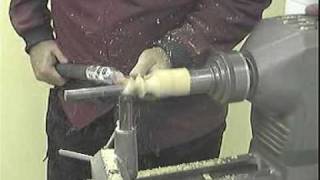 Robert Sorby Wobble Chuck If you're a wood turner and don't have a wobble chuck, get one. 
|