


Posted: 6/11/2014 5:24:16 PM EDT
[Last Edit: UNV][Edited]
|
Review and Comparison of the ATN ThOR 336 3X, FLIR RS32 2.25X, and Armasight Zeus 336 3X So, you want to buy a thermal scope? Now you must begin the task of deciphering technical data, vendor opinions, first hand reviews (from a guy who knows a guy with a thermal scope anyway), and the kicker is that it’s all over the internet. It’s safe to say that the purchasing options for thermal weapon sights are less than desirable. That’s one reason we rent thermal weapon sights and do hands on night vision demonstrations, but I will try to stay on track here. You have narrowed down your budget to under $6,000, but would like to spend as little as possible. There are three front runners in your mind including the ATN ThOR 336 3x, FLIR RS32 2.25X, and Armasight 336 3x. After scouring the forums, watching thermal YouTube videos until 2 a.m. for a week straight, and talking to every night vision dealer on the planet you have seen a wide view of opinions and given yourself a notable crash course on thermal weapon sights. Somehow, the decision still seems…unclear. Is this starting to sound familiar to anyone? Well, it’s your lucky day! We are conducting this review and comparison for people just like you. The purpose of this review is to educate consumers on the differences of commercially available thermal weapon sights through first hand testing and evaluation. We will portray our findings through a series of text reviews, graphics, and videos in the coming days and weeks. The review will be broken down in 4 parts and posted as follows. Part 1 – Near-Eye Displays Part 2 – Lenses and Build Quality Part 3 – Firmware and Features Part 4 – Range Performance, Comments and Conclusions We know that there will be some questions about this review and comparison, so we will try and address as many as we can in the posts beforehand. We welcome your questions, and we know that the review will not be perfect or cover everything that every person wants to see covered. This is the first review of its kind, and there are sure to be improvements to the next. Please post your comments and questions respectfully. PLEASE SUBSCRIBE TO THIS THREAD TO RECEIVE UPDATES ON THE REVIEW A note to the reader When we set out to begin this review and comparison it was immediately realized that we were entering uncharted waters. One reason I am sure that night vision manufacturers, distributors and dealers have shied away from this type of review and comparison is the difficulty level in capturing representative images. At some point (I have reached this point with other digital and thermal image projects) the time and effort spent outweigh the benefit of the information gathered. Even when you do get good information, presenting it in a way that the average Joe can understand and appreciate it is a daunting task. Another major reason vendors have shied away from this type of review is because it makes some companies uncomfortable putting their products side by side with a competitor. There seems to be an inherent distrust that a review will be biased. While I completely understand this sentiment, my loyalty lies with you the consumer. Our goal is not to put down, bash, slander, or degrade any of the three weapon sights used in the review and we won’t. We understand that the amount of time, effort, and money required to bring a thermal weapon sight to market is enormous. That said, we are here to promote all three of the thermal weapon sights used. That doesn’t mean we are not going to tell it like it is and point out issues or weak points. We will do that, but we will also keep in mind that every manufacturer and each one of their products has a place in our line-up and a target customer to serve. While a specific brand or scope may not be the best product for you, that does doesn’t mean it’s not the best product for someone else. The reason I bring this up, is because I see a lot of back and forth about specific brands, models, and vendors about who is the "best", or the "only brand to buy" or the "only place to buy". I want to clear the air and let the readers know that we aren't here to push any specific product or brand. We spent all this time and effort on the review for you so that you can have a better understanding and be educated to the point to make your own decision. Education on thermal weapon sights is my number 1 goal in this review. I would like to personally thank all who have participated in facilitating this review including Ed from AR15.com, Sachal at ATN and Angelo at FLIR. It's been a lot of fun working on the project. I hope that everyone enjoys reading as much as I enjoyed writing. - Tyler Adair Ultimate Night Vision Part 1 – Near-Eye Displays 3 Major Components At UNV, we frequently field calls from customers that contain questions about the image displayed on competing thermal scopes like "which one looks better”, and they are typically followed by "which one costs less”. Like most things in life, you get what you pay for when buying a thermal weapon sight. What are you really getting? What should you look for when buying a thermal scope? If I had to answer this question in three words they would be - lens, sensor, display. These are the three most important components of a thermal weapon sight. Obviously there is a long list of other very important components and features, but the lens, sensor and display are what will determine your overall image quality. All three of the scopes in this review use the same FLIR Tau 2, 17 micron sensor so we can cross that one off the list. This leaves us with the lens and display being the most important determining factors. Here are the major questions we will answer in part 1 of the comparison and review. - Which display is bigger and how can you quantify perceived display size? - Which display looks brighter, and what are the pros and cons of a bright display? - Which display has more contrast, and what are the pros and cons of a high contrast display? Display Specifications ATN ThOR 336 3X 30mm - 800x600 OLED (720 x 512 pixels used) FLIR RS32 2.25X 35mm - 640x480 LCD(640x480 pixels used) Armasight Zeus 336 3X 42mm - 800x600 OLED(720x480 pixels used) NOTE ABOUT SPECIFICATIONS: Although the FLIR RS32 2.25X is listed as 35mm and the ATN ThOR 336 3X is listed as 30mm, there is an issue with comparing the published specifications. If you read between the lines (or just call the manufacturers and ask) you will find that ATN publishes lens diameter, and FLIR and Armasight publish focal length. The ThOR 336 3X actually has a 36mm focal length. The FLIR RS32 2.25x has a 23.5mm, and the Armasight Zeus has a 48mm lens diameter. ATN does not currently have a ThOR 336 2X model, FLIR does not have an RS32 3X model, and Armasight does not have a Zeus 336 2X model. So, given the currently available systems from the three different manufacturers this is the best apples-to-apples comparison possible. Measuring Display Size with a DLSR Camera The best way we have found to accurately compare the size of near eye displays is to use a DLSR camera with the same focal length at the same distance from each eye piece. We set our Nikon D5200 with a variable 18-55mm lens atop a custom constructed night vision image capturing mount. We made sure the distance from the lens to the eye piece was exactly the same distance (0) on every shot and although it does not help determine the display size, we shot manual with exactly the same aperture, ISO, and shutter speed to eliminate as many variables as possible. After comparing the display sizes at different focal lengths, we chose 50mm to be the best focal length. The reason we chose 50mm is because it put the most display area in the images without any of the displays being too big to overrun the edges of the viewfinder. NOTE: For the DLSR images used we will post the original files including Exchangeable Image File Format (EXIF) metadata. In these files your will be able to find information such as the focal length of the camera, aperture, shutter speed, date and time, and other useful information. The images may look slightly different in shape or have some slightly varying EXIF data, but we will also post images that were not used in the review to show you images with the exact same EXIF data. Figure 1 - Here is an image to show exactly how the scopes were positioned during image capturing. 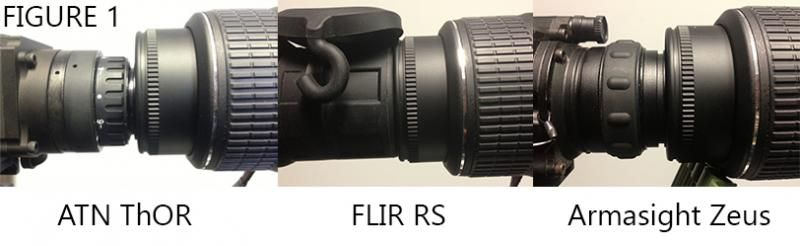 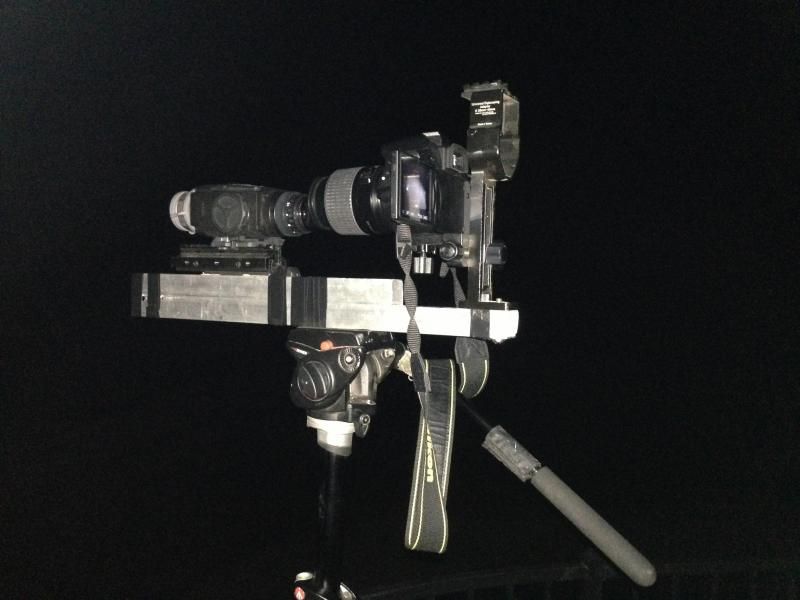 Size with the Naked Eye This may sound subjective, but in reality it’s surprisingly accurate and easy to understand. You can accomplish an overlap effect if you hold two separate units up to your eyes simultaneously. If they are pointed directly parallel to each other the displays do not overlay, but when you tilt the objective lenses towards one another you can achieve an overlapping effect. This is the quickest and easiest way to compare near-eye displays and I use it often when evaluating new thermal and digital scopes. When the displays overlap you can see that the RS display appears smaller. The RS display height spans almost exactly from the bottom of the ThOR display to the bottom of the top icon on the ThOR display. The Zeus display appears slightly taller than the ThOR and noticeable smaller in width. The Zeus display spans from one side of the ThOR display to the inside of the icon on the opposite side of the ThOR display. This is not what we expected because the resolution on the Zeus is listed as the same as the ThOR(800x600), and the sensor is listed as the same resolution. It is my conclusion that we can attribute this discrepancy to the eyepiece magnification and firmware. After further evaluation it was determined that the RS unit is the only unit using every pixel on the display. The ThOR and Zeus are essentially cropping out portions of the display to fit the image on the display without having to adjust the aspect ratio. See figure 3. Figure 2 - Here is a graphic that represents the relative display size differences in the three units: 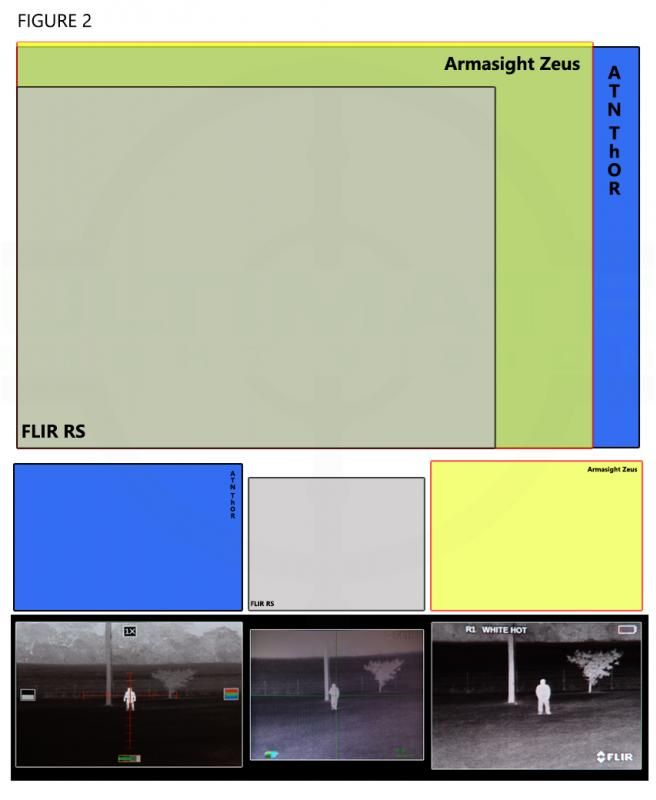 Figure 3 shows that even if the sensor and display resolution are identical, the firmware and eye piece magnification may cause differences in the displayed image size and aspect ratio. The ThOR display is an 800x600 OLED using 720x512px. The Zeus display is an 800x600 OLED using 720x480px. 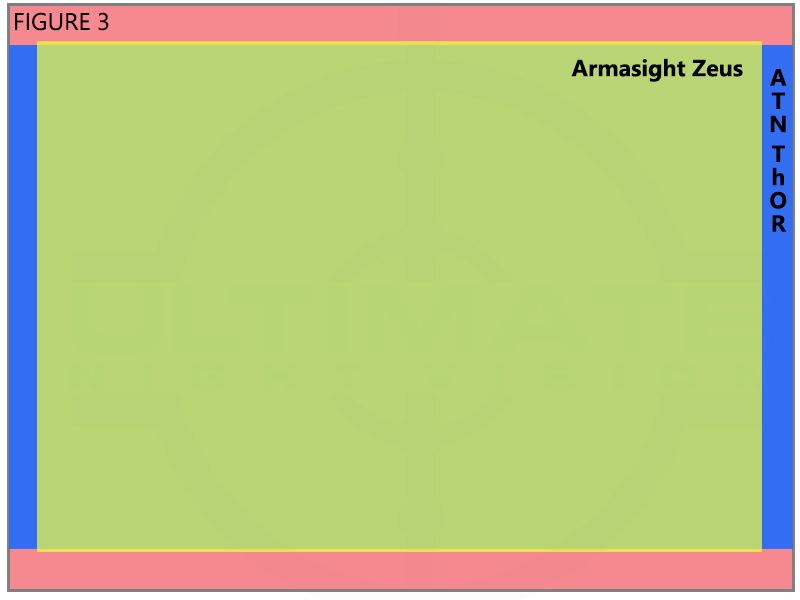 In Figure 4 the scopes were set to the same brightness levels as in our field test and all captured at 50mm, F32, for 20 seconds. What we wanted to accomplish with this set of images is to portray the difference in size, brightness and contrast levels within a consistent scene. All of the scopes have the objective lens covers on in figure 4. 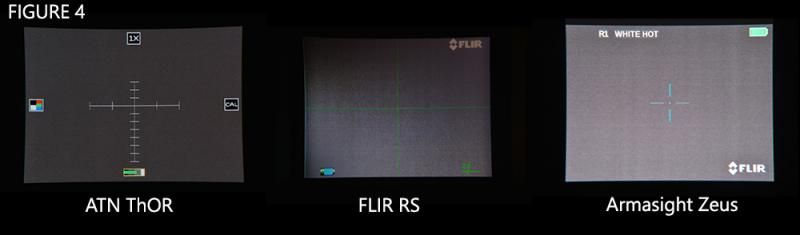 Through the eye piece thermal images The images used in this part of the comparison were taken between 12:31 and 12:55 am on 5/23/2014. It was 86 degrees with a 6 mph SE wind and 54% Humidity. The target is the same person standing at 90 yards. The brightness settings were set at ThOR 50%, RS 100%, and Zeus 25%. These brightness settings gave us the optimum images for our scene and image capturing. We did absolutely everything we could think of to capture representative while maintaining a high level of consistency in camera settings and process. This included shooting on the same or very close settings for each image including aperture, shutter speed, and focal length. NOTE: the PVS-14 style eye piece of the ThOR, and the proprietary eye piece on the Zeus were much easier to capture images through than the RS unit and had less distortion to the shape and size of the image. To get similar images out of the RS we had to open the aperture slightly more (which will increase brightness and decrease complete focus in still images). This is another reason we shot the images in figure 4 to show you what the images would look like with the exact same settings. Figure 5 Comparison graphic 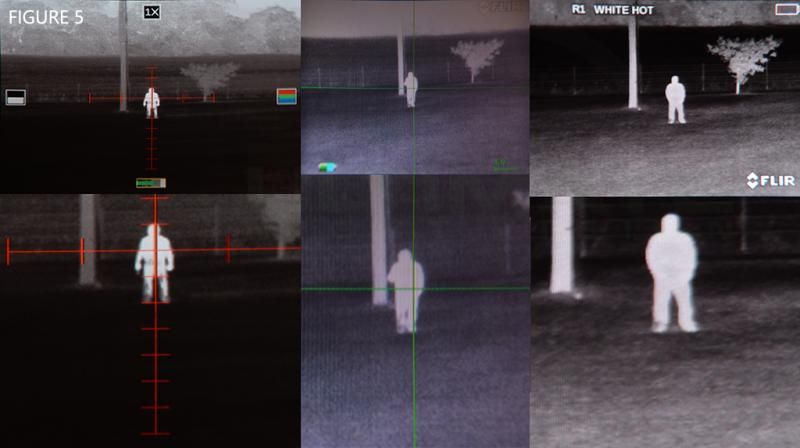 Link to full size figure 5 image. It’s a large 6,906px x 3,870px image, so if you can’t view online try downloading and viewing on your computer. Part 1 Questions Answered Which display is bigger? The displays on the ThOR and the Zeus are actually the same physical size and resolution, however the ThOR uses more horizontal pixels for a wider image. The Zeus uses the same about of vertical pixels to achieve a taller image. This leads us to the logical conclusion that there is more magnification from the eye piece from the Zues, than from the ThOR. Which display looks brighter, and what are the pros and cons of a bright display? The Zeus has the brightest display by far. We know that brightness settings are programmed into the firmware of the scope, and even though the Zeus uses the same display as the ThOR the Zeus display is still much brighter. The draw back to a big bright display like that of the Zeus is battery life. Armasight offers an external battery adapter and the ability to power through the 8 pin connector to increase battery life. We did notice, and it is somewhat evident in the images above that the brightness on the FLIR RS is much dimmer than the ThOR and Zeus. We had to shoot the RS on the highest brightness setting to capture any sort of usable image. Which display has more contrast, and what are the pros and cons of a high contrast display? As seen in the images about, the Zeus display and firmware settings offer a very high contrast image. The issue you run into here is that determining living animals from hot rocks, or in the case of our images a telephone pole, becomes difficult. Note how the person and the telephone pole look almost the same color bright white. When it comes to thermal weapon sights, more contrast is not always the best. As you can see in the images above contrast plays an important role in image quality and detection ability. How will the eye piece affect viewing and capturing images of the display? Each eye piece is going to offer a different amount of light transmission and magnification on the display. The standard PVS14 eye piece on the ThOR was definitely the easiest to work with and capture images through. The Armasight eye-piece has a different cosmetic design but functions very similar to the PVS-14 style eye piece. The FLIR RS eye piece is a completely different animal and increased the difficulty level of capturing images through the eye piece. The FLIR eye piece does allow for a slightly longer eye relief which gives the user more of a "day scope feel" when using the RS. We will discuss this more during the range testing portion of the review. Information about the displays not covered in this section: - MTTF and technology type - this will be covered in part 2. Anything to do with longevity testing will be in this part 2 and 4. |

|
Tyler -
I appreciate the information you intend to publish regarding these thermal weapon sights (TWS), hopefully consumers will takeaway knowledge that proves useful in making their purchase decision on a device that cost thousands of dollars. I can accept that you are posting factual data on the units and compiling the data as a cross-reference document and not with the intent to crown a 1st, 2nd, and 3rd prize and I am sure this is the first of many comparison reviews to be completed by you and others in the Industry and/or user community. With all that said, here are my thoughts on Near Eye displays. Specifically related to the display itself and not how the circuitry that feeds the signal to the display functions or quality of the rear objective used to focus on the display, I would think there are two critical aspects to factor: 1) Screen size - The pixel real estate is important to me as a user of TWS, especially when you account for needing to detect/ID the target and work with a reticle to place shots. From a purely hunting perspective the goal is to aim small shoot small and I am of the opinion that the greater the screen size the more probable the chances that you can execute a "precision" shot. 2) Display technology and mean time to failure in a recoil system - LCD, OLED, VGA, Plasma, etc... Sure cost is a driving force behind what displays are chosen vs what quality of picture is able to be achieved at each technology price point. Publishing information about why each company chose the technology that they did and factoring if recoil effects any of these displays more than the other would be useful information. The MIL sector has been using these technologies for years, do they select one over the other due to battlefield proven durability? Last point here on technology type is are any one of the types more susceptible to "burn in", all of the scopes in this review allow for use of different styles of reticles so if a user primarily uses one reticle for a few years and then changes to another will there be an etched image of the other to obscure the image. Reviewing you preview data, I have the following question: Are the illustrations meant to show physical size of screens or pixel size or the viewing output size used on the screen? Example: Physical property of the screen is 1 inch x 1.25 inch configured to render a 640x480 signal of which 90% of the screen real estate is used to display an image... Again thanks for taking the time to do this for the benefit of the consumer! HTXH |
|
Originally Posted By HuntTXhogs: Reviewing you preview data, I have the following question: Are the illustrations meant to show physical size of screens or pixel size or the viewing output size used on the screen? Example: Physical property of the screen is 1 inch x 1.25 inch configured to render a 640x480 signal of which 90% of the screen real estate is used to display an image... Again thanks for taking the time to do this for the benefit of the consumer! HTXH The results are interesting given that the signal from the sensor on all three of these units are identical. |

|
Originally Posted By 00Spy6: So they use the same signal, but use different displays and different diopter magnification for the display? |
|
Part 1 added to original post. |
www.UltimateNightVision.com
800.769.0159
[email protected]
Thermal - I^2 - Digital - Rentals
UltimateNightVision.com/AR15
800.769.0159
[email protected]
Thermal - I^2 - Digital - Rentals
UltimateNightVision.com/AR15
|
Tyler -
Questions: 1) When using the DSLR cameras, you mention "positioning the DSLR lens at the exact distance from each eyepiece". I imagine that each display screen is set within the scopes at varying lengths from the rear of the eye piece so how does this effect image performance/capture using the same photo settings? Would it not also effect size perceived in Figure 3? 2) I am unknowing on this from experience so here goes - Although all sensors were Tau2 / .17 micron, is it possible that one company obtained early runs Rev.1 sensors that overall don't perform as well as later revisions of the same "model" sensor? Another way to ask this question is if you buy a 2013 version of these scopes and a buddy picks up a 2015 version and there have been no changes to any components, would sensor revisions cause a variance in performance? 3) Under Display Specifications you list the lens diameters with screen sizes and then give a "note" on lens focal lengths and those measured specifications, what does lens diameter or focal length have to do with "display specifications"? Would the lens data not fit better elsewhere in Part 1 to be less confusing to the average Joe... 4) Figure 5 - the human decoy appears to be spaced differently from the pole, was his position the same in all scenes and are we actually seeing differing fields of depth rendered? 5) How do you intend to mark or memorialize the device settings (firmware/sensor revisions/images settings/etc) and account for changes made to these scopes through firmware? If I were Armasight I would explore the contrast settings to adjust, if possible, to be more like the ATN because you hit the nail on the head - if the decoy is inline with the pole you would lose him in the scene (thermal camoflauge) which would defeat the purpose of using a device like this to scan into cover. So if they make the changes based on excellent information such as your review, will you have to redo and would that even be possible given the environmental changes.... Thanks for the information! HTXH |


|
Questions will be answered on part 1 in the next post. Post up any other questions you have and I will try and address them all. Thanks! |
www.UltimateNightVision.com
800.769.0159
[email protected]
Thermal - I^2 - Digital - Rentals
UltimateNightVision.com/AR15
800.769.0159
[email protected]
Thermal - I^2 - Digital - Rentals
UltimateNightVision.com/AR15

|
Excellent review, probably one of the best I've seen yet. I like the comparison of actual real data from a user. I'm debating between the ATN Thor because ATN made some awesome optics I used in the Marine Corps so I kinda had some brand experience, but the Flir just seems to be a bit more affordable and I'm not going to be making many shots past 5 yards where I'm hunting hogs at, it's generally thick underbrush and pretty tight with a few small fields few and far between. |


|
Originally Posted By kilz42: Hey where are the next 3 parts of this? I've search all over.. What am I missing??  We do have some new video footage through the Armasight Zeus 336 3X, ThorHD 384, and the Pulsar Apex:  |
Join the Community
Your next conversation starts here.
Create your free account to join discussions, share your experience, save topics, and connect with the AR15.COM community.
- Join discussions
- Follow topics and replies
- Connect with fellow enthusiasts
Already a member? Sign in
Stay informed by subscribing to our Newsletter