


Posted: 7/6/2026 9:10:20 AM EDT
|
Am reading a novel that is a story of a survivalist/prepper and various other characters and how they manage when the electric grid fails and cities have been hit with an EMP. The book is part of a series that I have been enjoying. Escapist fiction. My questions are prompted by things in the book that I think might be incorrect. (I don't think the writer is a prepper) I'll shoot a note to the author once I am sure of the facts. The great thing about eBooks is that an update can be published much more easily than with printed books, so most authors are receptive to correcting typos, etc. Anyway, I only use HF and have never done anything in the UHF/VHF bands in the 5 years I've been licensed, so have forgotten a big chunk of what I learned leading up to the license exams. So, for 2M, am I correct in my thinking below? 1. It is basically line of sight, except for rare(?) atmospheric conditions. Speaking to someone several hours of driving away would be almost impossible (what about with repeaters? Or a really tall antenna?) 2. Range can be extended via the use of repeaters. By how much? How far? Are repeaters linked to give significant distances? 3. There are no "channels" in the 2M band. 4. If not using a repeater, you might call CQ on 2M, but if using a repeater, calling CQ would be unusual and frowned upon. You might give your call and say something like "monitoring" instead(?) 5. Even though adapters might exist(?) nobody really modifies an ICOM-7610 to transmit/receive on 2M. Thanks for any info! |
Don't confuse where I live with where I'm from.

|
2 meters is mostly line-of-sight, but “several hours away” is not impossible in every case. For normal 2-meter FM simplex, yes: it is basically local/regional, not HF-style long distance. Terrain, antenna height, antenna gain, feedline loss, and the other station’s setup matter more than transmitter power after a point. So: talking several hours’ driving distance on 2m simplex FM is usually unlikely, unless both stations have high antennas, mountaintop paths, unusual propagation, or are using repeaters/links. Bottom line: 1. Simplex 2m FM is mostly line-of-sight/local. 2. Repeaters extend range; linked repeaters can go very far. 3. No official numbered “channels,” but common frequencies and memory channels are used. 4. CQ is okay on simplex, unusual on repeaters; “Your Call monitoring” is normal repeater style. 5 Just use a separate 2m radio. |
“Every man has two deaths, when he is buried in the ground and the last time someone says his name. In some ways, men can be immortal. “ - Ernest Hemingway

|
Originally Posted By Emoto: Am reading a novel that is a story of a survivalist/prepper and various other characters and how they manage when the electric grid fails and cities have been hit with an EMP. The book is part of a series that I have been enjoying. Escapist fiction. My questions are prompted by things in the book that I think might be incorrect. (I don't think the writer is a prepper) I'll shoot a note to the author once I am sure of the facts. The great thing about eBooks is that an update can be published much more easily than with printed books, so most authors are receptive to correcting typos, etc. Anyway, I only use HF and have never done anything in the UHF/VHF bands in the 5 years I've been licensed, so have forgotten a big chunk of what I learned leading up to the license exams. So, for 2M, am I correct in my thinking below? 1. It is basically line of sight, except for rare(?) atmospheric conditions. Speaking to someone several hours of driving away would be almost impossible (what about with repeaters? Or a really tall antenna?) Pretty much, unless the two stations were on mountain tops or high ridges. But you're pretty much on. 2. Range can be extended via the use of repeaters. By how much? How far? Are repeaters linked to give significant distances? With my 991 (base station) 100watts and an High gain antenna, I've reached a repeater at about 35 miles. More so due to its height and power, than my abilities... I've been on 2m nets and had a guy from St. Louis, 2 hours North get in. The same repeater ha Echolink and we have a guy who checks into our Missouri net from Colorado. Also, there is a big club about an hour and a half SE of us, that half dozen or so Linked Repeaters all over SE Mo and now a few a good bit west of us... 3. There are no "channels" in the 2M band. Correct, thought I have heard folks (mistakenly) call programed in Freq, or pairs "Channels"... 60m is the only HF (Amateur Radio) band that has "Chanels" to my knowledge. 4. If not using a repeater, you might call CQ on 2M, but if using a repeater, calling CQ would be unusual and frowned upon. You might give your call and say something like "monitoring" instead(?) Correct, there is no "Official ruling on this, more of a radio Etiquette and sad hams telling folks how to do it their way. 5. Even though adapters might exist(?) nobody really modifies an ICOM-7610 to transmit/receive on 2M. I don't know a out this one. I have heard of folks using a 2m transverter on an HF rig to add 2m. I'd just buy a 2m rig.. There are dozens of Brand/Models to choose from. Thanks for any info! |
LARUEMINATI
NRA Endowment Life Member
Originally Posted By Boom_Stick:
""AKs are for villagers you have to tell not to shit in their water supply.""
NRA Endowment Life Member
Originally Posted By Boom_Stick:
""AKs are for villagers you have to tell not to shit in their water supply.""


|
Our 2m repeater located in Mexico, Mo has one of the largest footprints in the state. We have up to an 85 mile radius of coverage with our repeater. The antenna is on the KWWR backup tower and is at 950 feet above ground. So technically two people can be 170 miles apart with the repeater in the middle and talk to each other. Antenna heights, antenna types, and location plays a big part. We have guys from Western Illinois, southern Iowa, and northern Missouri talk on our repeater. But Wentzville is about the limit going east on I70. Again antenna type/height and local terrain makes the difference. Simplex is going to be more limited, especially FM which is the most common mode. You can get further range using single side band. |
DAV lifetime member
NRA Patriot Life Benefactor
NRA Patriot Life Benefactor
|
Indeed, we have many wide coverage repeaters, ham & a couple GMRS, here in WA due to the mountains. I've regularly talked into repeaters that're 90 miles away from me, in certain locations. In regard to the premise in the book the OP speaks of, I'd say an EMP would be knocking out repeaters like it would anything else electrical, depending on the exact scenario. |

|
“Several hours driving” means something very different if you’re on I70 in Kansas vs I-45 in Houston or I-5 in California. If you were - for example - tooling along headed North on I-25 at ~35 MPH dodging plotholes and your path included passing through Denver you could theoretically be hitting a repeater on a mountaintop to the west for several hours. Unless the radio is a key story element with serious direct storyline effects, I don’t know that it matters. Unless the author has invited feedback? |

|
2M is really line of sight PLUS. And plus a lot. I routinely hit repeaters that I am not line of sight to because I am in a bowl or have a hill between us. Some repeaters have exceptional range due to their height compared to local ground. There is one 2M repeater about 90 miles from me that I can almost get into with a hand held. Getting into it on a mobile and a half decent antenna is usually pretty easy. But, and there is always a but, it is much more susceptible to losing signal due to obstructions than much closer repeaters. |


|
Originally Posted By Emoto: So, for 2M, am I correct in my thinking below? 1. It is basically line of sight, except for rare(?) atmospheric conditions. Speaking to someone several hours of driving away would be almost impossible (what about with repeaters? Or a really tall antenna?) The practical radio horizon is somewhat beyond direct optical line of sight, depending a lot on terrain. More than roughly 1 1/2 hours of driving is likely beyond the range of typical repeaters over flat-ish terrain. Tropospheric ducting does occasionally happen and can lead to contacts over substantial distances but that's not a common or predictable phenomenon. 2. Range can be extended via the use of repeaters. By how much? How far? Are repeaters linked to give significant distances? Completely depends on terrain, and antenna height and configuration. There are linked repeater systems yes. 3. There are no "channels" in the 2M band. No one calls them "channels". FM is semi-channelized based on either the common bandplan or there are some states that have modified bandplans on either 15 or occasionally 20khz steps. FM or FMish modes don't generally just pick free-flowing random frequencies as is common on HF, most FM radios are limited to either 5 or 2.5kHz steps. 4. If not using a repeater, you might call CQ on 2M, but if using a repeater, calling CQ would be unusual and frowned upon. You might give your call and say something like "monitoring" instead(?) That is the normal practice on FM yes. 5. Even though adapters might exist(?) nobody really modifies an ICOM-7610 to transmit/receive on 2M. Transverters are sometimes used but that's generally something done by folks wanting to work SSB/CW/FT8 or similar modes on 2m, not FM. |
This is...a clue - Pat_Rogers
I'm not adequately aluminumized for this thread. - gonzo_beyondo
CO, MI, OR - Please lobby your legislators to end discrimination against non-resident CCW permit holders
I'm not adequately aluminumized for this thread. - gonzo_beyondo
CO, MI, OR - Please lobby your legislators to end discrimination against non-resident CCW permit holders
First, I appreciate all of the informative responses! Good stuff!  Originally Posted By aa777888-2: Link to book? Originally Posted By smullen: I was wondering too. Kind of "Lights Out".. It is a whole series of books by Tom Abrahams. PREPPER: A GRID-DOWN POST-APOCALYPTIC/DYSTOPIAN SURVIVAL SERIES (5 book series) ...which then continues in this series: Prepper Nation (3 book series) My questions in this thread were prompted by things I noticed in one of the books in the second group, which I have not yet finished. Based on what you guys helped out with in this thread, I sent him some info about radio usage/capability and he intends to go through the whole series and make some edits to the radio stuff. The author has been appreciative to receive information from me, although I only gave him the radio stuff yesterday, so no revised editions have been published yet. I expect that will take some time. To be clear, there is not very much radio stuff in the books at all. One of the characters has an IC-7610 that is used a few times to make contact with some old friends after things go bad. I have a Kindle Unlimited subscription ($11.99/month), which I recommend if you like to read a lot. That made all of these books free for me to read. I 'd go broke buying books otherwise as I've already read more than 100 books this year. I recommend starting with the first book of the first group, as they all follow each other sequentially. |
Don't confuse where I live with where I'm from.
|
The questions have largely been answered but I'll throw out a few observations: On #1 -- really depends on the mode, equipment, and location. At the extreme end there's the troposcatter guys that run larger yagis and decent but not insane power using SSB, and they have coverage out to about 600 miles on VHF/UHF. I'm sure AshvilleHippy will be along to point this out as it seems to be a favorite mode of his. Troposcatter is not tropospheric ducting, and it's a mode that works close to 24/7 but can be seriously enhanced by the right weather conditions. It's basically just beaming enough power into a common scattering volume of atmosphere between two stations that a path can be made. Don't dismiss mountaintop paths, though. My old cabin was on a high ridge less than a mile from one of the largest communications sites in AZ. I had a 5W handheld on APRS, and it was routinely (as in nearly every packet) heard at distances over 200 miles by stations that were high but not that far above the average terrain. Mobiles heard it out to about 120 miles. AZ has a linked repeater system that covers NM, AZ, UT, CA. IIRC those are (or were) RF based links, with no dependency on other communications infrastructure. for #5, the "adapter" you're referring to is a transverter. While not very common, they are used a lot more by the troposcatter guys and 2M/70cm SSB than your average ham. If I saw a mention of a few hundred miles on 2M or 70cm using a 7610, I'd start thinking maybe that was the baseband radio for a tropo setup. ETA: On that note, the 7610 specifically had a dedicated transverter port on the back, meaning it comes from the factory set up for transverter use. Mentioning that specific radio model is a huge clue if it came up. |
| A 7610 with a transverter is a pretty involved way to get on 2 meters. |
This is...a clue - Pat_Rogers
I'm not adequately aluminumized for this thread. - gonzo_beyondo
CO, MI, OR - Please lobby your legislators to end discrimination against non-resident CCW permit holders
I'm not adequately aluminumized for this thread. - gonzo_beyondo
CO, MI, OR - Please lobby your legislators to end discrimination against non-resident CCW permit holders
|
Originally Posted By Gamma762: A 7610 with a transverter is a pretty involved way to get on 2 meters. It is, but for weak signal SSB it'd be a possible solution, and for a long time the hardcore 2M SSB guys have used transverters. It's another extreme case but the EME guys are using transverters for the the most part, because they need the best weak signal performance possible. Tropo isn't quite so extreme but it would still be a solid approach. Good performing 2M SSB radios remain pretty rare. A FT-991A or similar can certainly be used but that's not common AFAIK, probably due to receiver specs. ETA: Another big clue would be if the communications described in the book was taking place base to base. Base to mobile using tropo can certainly be done, but requires a suspension of disbelief since you'd have the rover toting around a decently sized yagi. Pic of K5ND's rover linked from his site. 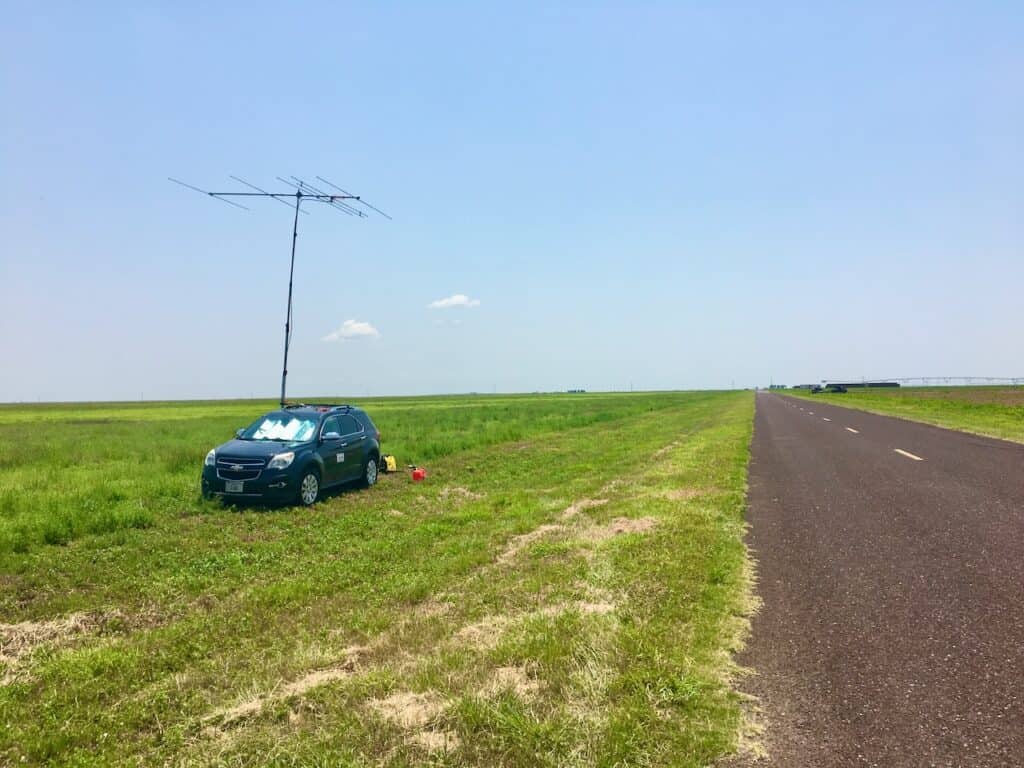
|
|
Originally Posted By seek2: It is, but for weak signal SSB it'd be a possible solution, and for a long time the hardcore 2M SSB guys have used transverters. It's another extreme case but the EME guys are using transverters for the the most part, because they need the best weak signal performance possible. Tropo isn't quite so extreme but it would still be a solid approach. Good performing 2M SSB radios remain pretty rare. A FT-991A or similar can certainly be used but that's not common AFAIK, probably due to receiver specs. Originally Posted By seek2: Originally Posted By Gamma762: A 7610 with a transverter is a pretty involved way to get on 2 meters. It is, but for weak signal SSB it'd be a possible solution, and for a long time the hardcore 2M SSB guys have used transverters. It's another extreme case but the EME guys are using transverters for the the most part, because they need the best weak signal performance possible. Tropo isn't quite so extreme but it would still be a solid approach. Good performing 2M SSB radios remain pretty rare. A FT-991A or similar can certainly be used but that's not common AFAIK, probably due to receiver specs. Tons of IC-9700s have been sold, although few are ever used on SSB. |
This is...a clue - Pat_Rogers
I'm not adequately aluminumized for this thread. - gonzo_beyondo
CO, MI, OR - Please lobby your legislators to end discrimination against non-resident CCW permit holders
I'm not adequately aluminumized for this thread. - gonzo_beyondo
CO, MI, OR - Please lobby your legislators to end discrimination against non-resident CCW permit holders
|
Originally Posted By Gamma762: Tons of IC-9700s have been sold, although few are ever used on SSB. That would be one of the better choices for VHF/UHF tropo only, but I could see someone coming at this from the prepper angle using a HF rig, and again the lineage of tropo is heavily biased to transverters. In the overall scheme of things it's also pretty new and expensive and sort of rare (though I bet more 9700 sell today than transverters do, I still wonder if 7 years ago when it came out what the mix of dedicated VHF SSB rigs was among troposcatter guys, I bet it was fairly small.) Of course all of this could be for naught and the author just f'ed up and didn't do any research. But everything mentioned would be a possible explanation for what was described in the OP, in which case the author found a working but pretty obscure use case and correctly described it but left out critical details on the communications mode. |
|
Originally Posted By seek2: That would be one of the better choices for VHF/UHF tropo only, but I could see someone coming at this from the prepper angle using a HF rig, and again the lineage of tropo is heavily biased to transverters. In the overall scheme of things it's also pretty new and expensive and sort of rare (though I bet more 9700 sell today than transverters do, I still wonder if 7 years ago when it came out what the mix of dedicated VHF SSB rigs was among troposcatter guys, I bet it was fairly small.) Of course all of this could be for naught and the author just f'ed up and didn't do any research. But everything mentioned would be a possible explanation for what was described in the OP, in which case the author found a working but pretty obscure use case and correctly described it but left out critical details on the communications mode. I think we are in the mode of diagnosing some rare exotic tropical fever when it is really just the common cold. The character with the radio at his house is not portrayed as any sort of electronics or radio communications whiz at all, so is unlikely to have anything more exotic than an SWR meter. I am not going to try to question the author on this, but I suspect that he did just enough research to make the radio stuff sound ok to people who aren't hams, and it does. The point I made to him was that this series being about preppers, he was going to attract a higher percentage of readers who are interested in prepping and may be veterans, firearms enthusiasts, and ham radio operators, so errors or questionable things in those areas would mean losing credibility and/or losing readers. To his credit, he took this in the spirit intended. |
Don't confuse where I live with where I'm from.
Joined:
Jul 2024
Posts:
490
EE: 0% (0)
 NC, USA
|
Originally Posted By Emoto: Am reading a novel that is a story of a survivalist/prepper and various other characters and how they manage when the electric grid fails and cities have been hit with an EMP. The book is part of a series that I have been enjoying. Escapist fiction. My questions are prompted by things in the book that I think might be incorrect. (I don't think the writer is a prepper) I'll shoot a note to the author once I am sure of the facts. The great thing about eBooks is that an update can be published much more easily than with printed books, so most authors are receptive to correcting typos, etc. Anyway, I only use HF and have never done anything in the UHF/VHF bands in the 5 years I've been licensed, so have forgotten a big chunk of what I learned leading up to the license exams. So, for 2M, am I correct in my thinking below? 1. It is basically line of sight, except for rare(?) atmospheric conditions. Speaking to someone several hours of driving away would be almost impossible (what about with repeaters? Or a really tall antenna?) 2. Range can be extended via the use of repeaters. By how much? How far? Are repeaters linked to give significant distances? 3. There are no "channels" in the 2M band. 4. If not using a repeater, you might call CQ on 2M, but if using a repeater, calling CQ would be unusual and frowned upon. You might give your call and say something like "monitoring" instead(?) 5. Even though adapters might exist(?) nobody really modifies an ICOM-7610 to transmit/receive on 2M. Thanks for any info! I will answer #1 The information you have been given is incorrect. My personal experience, running 2meter ssb equipment at a EIRP (effective isotropic radiated power) of 5,000 watts (250 watt transmitter, 13 DB gain Antenna) Is working a similarly equipped station direct simplex has 24/7/365 greater range than ANY repeater. An hour drive? 75 miles? Easy peasy with a fraction of the EIRP A typical qso on 2m ssb would be Buffalo NY to Kingwood WVA A very well located Pittsburgh PA station I know had a twice a week cw contact with Johnson City TN. The mode of transmission is "troposcatter", this mode does not rely on "special" atmosphereic conditions, it is a 24/7/365 mode. Rege P.S. if you have a honest to God line-of -sight path, the power required to cover hundreds or thousands of miles is reduced to a fraction of a watt. OSCAR satellites are one of the best examples. |
Joined:
Jul 2024
Posts:
491
EE: 0% (0)
NC, USA
|
A really fascinating effect on signal strength happens on VHF and above that you really don't Notice on HF. Consider a transmitter radiating a signal, no matter the frequency, a antenna with the same pattern (say a simple dipole) will radiate the EXACT same power per unit of area at the receiver. If you receive with the same simple dipole, you will intercept less of that power as the frequency increases because the dipole is shorter, it intercepts less of the wave. But what happens if we keep the size (area) of the antenna the same, and increase frequency. Keeping tx power rx sensitivity and channel bandwidth constant? As we go higher in frequency, the received signal gets STRONGER ! Both antennas will become more directional, the tx Antenna will generate a more focused signal, and the rx antenna will capture the same area, which now has more power in it. Moral of the story, for fixed station use, use the highest possible frequency. The US military used a system called "White Alice" Rege |
|
W9AIU is on the ABC-KDNL toiwer in downtown STL. Around 1050 feet. It has a very broad footprint. 200 miles apart is possible. I talked on the repeater from 100+ miles several times I also do tropo ducting and have 30 something states. There is a place in CA where you can talk to HI on a pretty consistent bases |
|
Originally Posted By Asheville-Hippy: Moral of the story, for fixed station use, use the highest possible frequency. Originally Posted By Asheville-Hippy: Moral of the story, for fixed station use, use the highest possible frequency. In practical usage it doesn't really work out that way IME. Practical size antennas and heights in typical amateur use, along with ground clutter attenuation and tropospheric effects leads to poorer long distance performance out of higher frequencies. 2m/VHF high band generally provides the longest distance propagation over flatter terrains with 222MHz not far behind. 70cm does very well closer in and in urban areas but drops off rapidly at longer distances. 900MHz and 1.2GHz are notably reduced in range from 70cm. 6 meters doesn't seem to get the tropo "lift" that 2/220 get and doesn't seem to keep up unless you have monumental size antennas - or sporadic E skip. Terrain can change everything. Barring sporadic E, for the typical amateur 2m is the longest practical range option over flat terrain most of the time for a VHF/UHF band. If you're in the mountains all bets are off. Originally Posted By Emoto: The character with the radio at his house is not portrayed as any sort of electronics or radio communications whiz at all, so is unlikely to have anything more exotic than an SWR meter. An Icom 7610 is a very expensive enthusiast radio and a whole separate direction of enthusiast would be required to be operating a transverter. |
This is...a clue - Pat_Rogers
I'm not adequately aluminumized for this thread. - gonzo_beyondo
CO, MI, OR - Please lobby your legislators to end discrimination against non-resident CCW permit holders
I'm not adequately aluminumized for this thread. - gonzo_beyondo
CO, MI, OR - Please lobby your legislators to end discrimination against non-resident CCW permit holders

Member
Joined:
Jan 2022
Posts:
2984
EE: 0% (0)
MO, USA
Joined:
Jul 2024
Posts:
505
EE: 0% (0)
NC, USA
|
Originally Posted By Gamma762: In practical usage it doesn't really work out that way IME. Practical size antennas and heights in typical amateur use, along with ground clutter attenuation and tropospheric effects leads to poorer long distance performance out of higher frequencies. 2m/VHF high band generally provides the longest distance propagation over flatter terrains with 222MHz not far behind. 70cm does very well closer in and in urban areas but drops off rapidly at longer distances. 900MHz and 1.2GHz are notably reduced in range from 70cm. 6 meters doesn't seem to get the tropo "lift" that 2/220 get and doesn't seem to keep up unless you have monumental size antennas - or sporadic E skip. Terrain can change everything. Barring sporadic E, for the typical amateur 2m is the longest practical range option over flat terrain most of the time for a VHF/UHF band. If you're in the mountains all bets are off. An Icom 7610 is a very expensive enthusiast radio and a whole separate direction of enthusiast would be required to be operating a transverter. No sir. https://www.qsl.net/oz1rh/troposcatter99/troposcatter99.htm The sweet spot is a co$t i$$ue, it becomes much more expensive to keep "everything equal" as you go higher in frequency. It's much easier to build a killowatt on 2 meters than on 5760 Mhz, Also, consider moonebounce, I could only work a few "super stations" with my 250 watt and 1 Yagi 2meter setup, but I could work those stations anytime we could both see the moon.  A 1000 watt amp and 8 yagis on 432mhz and you can hear your own echos, and you can build this gear with a hacksaw and rivit gun...  Rege |
|
Originally Posted By Asheville-Hippy: No sir. https://www.qsl.net/oz1rh/troposcatter99/troposcatter99.htm The sweet spot is a co$t i$$ue, it becomes much more expensive to keep "everything equal" as you go higher in frequency. It's much easier to build a killowatt on 2 meters than on 5760 Mhz, Also, consider moonebounce, I could only work a few "super stations" with my 250 watt and 1 Yagi 2meter setup, but I could work those stations anytime we could both see the moon. A 1000 watt amp and 8 yagis on 432mhz and you can hear your own echos, and you can build this gear with a hacksaw and rivit gun... Rege Originally Posted By Asheville-Hippy: Originally Posted By Gamma762: In practical usage it doesn't really work out that way IME. Practical size antennas and heights in typical amateur use, along with ground clutter attenuation and tropospheric effects leads to poorer long distance performance out of higher frequencies. 2m/VHF high band generally provides the longest distance propagation over flatter terrains with 222MHz not far behind. 70cm does very well closer in and in urban areas but drops off rapidly at longer distances. 900MHz and 1.2GHz are notably reduced in range from 70cm. 6 meters doesn't seem to get the tropo "lift" that 2/220 get and doesn't seem to keep up unless you have monumental size antennas - or sporadic E skip. Terrain can change everything. Barring sporadic E, for the typical amateur 2m is the longest practical range option over flat terrain most of the time for a VHF/UHF band. If you're in the mountains all bets are off. An Icom 7610 is a very expensive enthusiast radio and a whole separate direction of enthusiast would be required to be operating a transverter. No sir. https://www.qsl.net/oz1rh/troposcatter99/troposcatter99.htm The sweet spot is a co$t i$$ue, it becomes much more expensive to keep "everything equal" as you go higher in frequency. It's much easier to build a killowatt on 2 meters than on 5760 Mhz, Also, consider moonebounce, I could only work a few "super stations" with my 250 watt and 1 Yagi 2meter setup, but I could work those stations anytime we could both see the moon. A 1000 watt amp and 8 yagis on 432mhz and you can hear your own echos, and you can build this gear with a hacksaw and rivit gun... Rege All I can offer is my firsthand experience in VHF/UHF contesting on SSB 6m/2m/222/432/1.2, and FM contests and casual operation on 6m/2m/222/440/927. I understand there is a specific phenomenon where you have two fixed stations that can point high-gain antennas with high power at a common point for what you're calling "troposcatter" as described in that link. And that it works at microwave frequencies. I don't think that's a viable medium for typical amateur communications. I understand it probably works great for links between fixed stations in gov/mil service. It would probably be possible to set up some fixed point-to-point amateur links for specific applications. I'm talking about common everyday power levels and frequencies, with common base station and mobile antennas, not EME grade stations. 900MHz is fun to play with but NOWHERE close to the range of 2m. |
This is...a clue - Pat_Rogers
I'm not adequately aluminumized for this thread. - gonzo_beyondo
CO, MI, OR - Please lobby your legislators to end discrimination against non-resident CCW permit holders
I'm not adequately aluminumized for this thread. - gonzo_beyondo
CO, MI, OR - Please lobby your legislators to end discrimination against non-resident CCW permit holders

|
I think some of y'all are missing the plot. From description in the OP, it's a survival book with amateur 2m radio as a "this is how we all talk to each other" phlebotinum. No one cares if the fiddly details are accurate. As long as it's *reasonably* plausible to the *average* reader. With that said, we aren't talking about sophisticated hardware and huge arrays here. We're talking off the shelf hardware, improvised antennas, and make do with what you can scrounge. It's a survival story. Not a HAM radio story. |
Joined:
Jul 2024
Posts:
506
EE: 0% (0)
NC, USA
|
Originally Posted By TinLeg: I think some of y'all are missing the plot. From description in the OP, it's a survival book with amateur 2m radio as a "this is how we all talk to each other" phlebotinum. No one cares if the fiddly details are accurate. As long as it's *reasonably* plausible to the *average* reader. With that said, we aren't talking about sophisticated hardware and huge arrays here. We're talking off the shelf hardware, improvised antennas, and make do with what you can scrounge. It's a survival story. Not a HAM radio story. The equipment I described was bought with a credit card from a regular brick and mortar store and delivered the next day by UPS... You can set up a similar station for about the price of a good rifle, a nice scope, and a crate of ammo for practice. 6 meters or 2 meters would be the "sweet spot" as far as co$t of equipment vs range. Rege |
How VHF / UHF stations are sometimes heard over distances of more than 1000km. Sometimes listening on the 2-metre or 70-centimetre bands during a hot, settled summer week, you might have experienced it: a band erupting with signals from hundreds—or even thousands—of kilometres away. This is often as a result of Tropospheric enhancements. While VHF and UHF are generally limited to just over "line-of-sight" distances, summer weather is often associated with the perfect conditions to turn the lower atmosphere into a high-performance wave-guide. The "Tropsoheric Lift" Explained: In normal conditions, the atmosphere gets cooler as you go higher and this changes the refractive index of the air giving some bending around the earths curvature. Typically this might be 4/3 of the line of sight. But during settled summer weather - especially under high-pressure systems (anticyclones) refractive index changes can be greater with increased distances achieved. On occasions a "temperature inversion" occurs. Warm air sits on top of cooler air, creating a boundary that can refract the signals back toward Earth giving very much greater distances. How to Spot the "Tropo" Opening: 🔹 The Barometer is Rising: Look for those long, hazy days of high pressure. 🔹 The "Dead Calm": Foggy mornings or extremely still evenings are often the "tell" that an inversion is forming. 🔹 The Coastal Effect: Signals can travel incredible distances over water, as the cool sea air meets the warm land air. For the radio amateur or scanner enthusiast, these "lifts" are the highlight of the season. They provide a rare opportunity to work "DX" on bands that are usually restricted to the local neighborhood. https://www.electronics-notes.com/articles/antennas-propagation/tropospheric/tropo-lifts-ducting-enhanced-conditions.php |
This is...a clue - Pat_Rogers
I'm not adequately aluminumized for this thread. - gonzo_beyondo
CO, MI, OR - Please lobby your legislators to end discrimination against non-resident CCW permit holders
I'm not adequately aluminumized for this thread. - gonzo_beyondo
CO, MI, OR - Please lobby your legislators to end discrimination against non-resident CCW permit holders