Posted: 3/18/2026 11:07:28 AM EDT
|
My kids & I got on a primitive-technology binge over the winter, and really wanted to get into making things out of materials sourced in our back yard. So far, we've been able to use the wet-method to refine/source near-pure clay from our backyard (Filtering out gravel, sand, silt, etc), but now we're struggling a bit when it comes to clay cracking. I've googled, and watched alot. The general consensus is to mix in sand, in various proportions to limit the amount of cracking, as cracking is almost entirely due to the clay shrinking when overly wet, and to use it more as a binder for sand. The alternative being generally to mix larger amounts of silt+clay with some sand, and then to mix in straw/dried grass into the mix to make cob, which severely limits cracking. The downside with cob, and what i'm TRYING to avoid, as I'd like to only use backyard material is water infiltration. If I can make, and fire, proper bricks, by nature they'll withstand rain for many years, however cob won't withstand it at all for long. From what I read online, SOMETIMES you can fire cob to burn out the grass/straw and that CAN make it non-water permiable, but I haven't seen much information on doing this right, without cracking. My plan was just to build a large-size rocket stove, to either fire bricks in, or to just make out of cob, to then fire bricks, etc in (Essentially upcycle material, increasing my ability to fire things). I've already made (Out of metal) a rocket stove that works amazingly well, and gets extremely hot (I don't know how hot, but it'll get high-carbon steel red hot, which I hear is about where you need to get bricks to, in order to properly fire them). So, I'm kind of trying to figure out how to get the first concept done, in order to properly fire things, or if I can just skip ahead with some type of cob mix that can be fired in my back yard. One suggestion was to fire ash at extremely high temperatures, to convert it to *lime*? that i can then mix in with poorly fired clay/terracotta, and use that as a cob coat, that will at least make the whole thing water resistant, but not overly so. Any help/input/thoughts would be appreciate from anyone who's tried this. I live in Central Ohio, where the ground we've tested is generally about 35% sand/aggregate, 35% silt, 35% clay which has the potential to go whichever way I need it. Plus, going through the steps of each process has been a BLAST for the kids. We've managed to wet-refine a very solid amount of clay through drywall mixers, and trash cans, and they've enjoyed the process. The ultimate goal is to make a pizza oven that can cook a pizza in 1 minute (Thus, the oven needs to be able to get HOT). |

| Neat. Needs some pics :) |
www.jrhenterprises.com
In business since 1992- Over 30 Years in business- Thank you for your business!
Quickest ways to contact us-
912.375.1480
[email protected]
In business since 1992- Over 30 Years in business- Thank you for your business!
Quickest ways to contact us-
912.375.1480
[email protected]

|
When doing pottery work you mix in dry fired ground up clay, I assume it is like the sand your using. I am assuming your also trying to fire the bricks when they are still wet, pottery is the same way you really need to dry it before you fire it. Try mixing in the sand and letting it dry a longer than you think before you fire them. You might also want to watch the primitive technology on YouTube, he did a whole series about making clay tile for his roof and some pots. Just peaked he also did a brick video. |
"I am gonna laugh my ass off looking out the air vent of the box car watching some of you shot in the head in a ditch when you finally realize it's time to resist." stolen from RR_broccoli

|
You want a CEB machine like a CINVA Ram press. Making one has been on my bucket list for way to long ETA: Just asked ChatGPT about finding plans and it designed an updated machine for me in about 10 seconds. Not to thread-slide, this is getting creepy |
Not a day passes over the earth, but men and women of no note do great deeds, speak great words, and suffer noble sorrows. Charles Reade
|
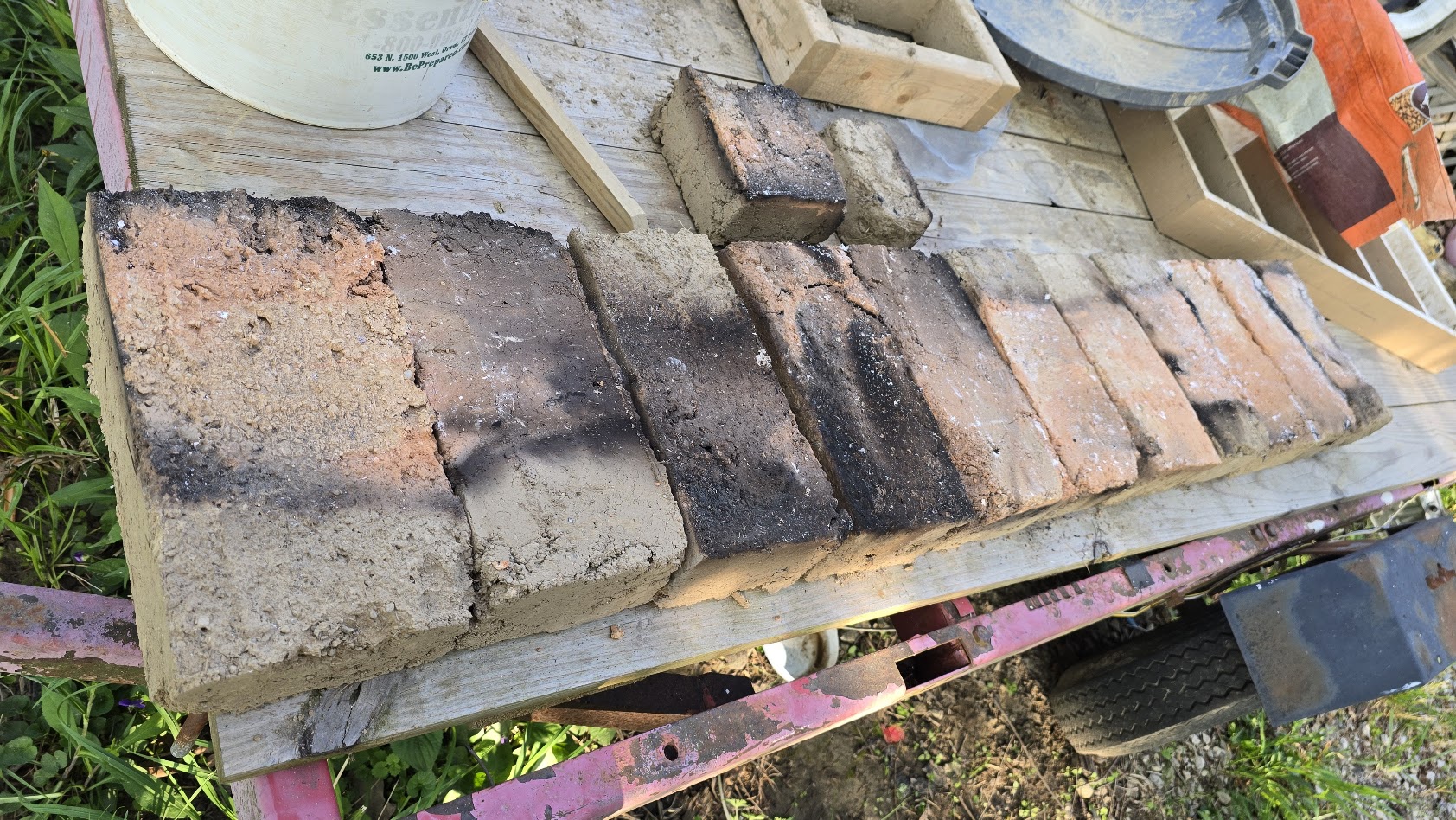
Originally Posted By cmw: You want a CEB machine like a CINVA Ram press. Making one has been on my bucket list for way to long ETA: Just asked ChatGPT about finding plans and it designed an updated machine for me in about 10 seconds. Not to thread-slide, this is getting creepy I haven't mentioned asking ChatGPT brickmaking questions, the following below are my test bricks, taking ChatGPT's advice, from my ChatGPT calculated rocket stove (That I have $15 of sheet metal in). Photos SUCK, but bricks look good in person, and won't crush in your hand, will do a hammer test tonight after getting much better photos. I fired these in my rocket stove, which sits in my home's fireplace, because...why not make bricks in my house? https://photos.app.goo.gl/fRpKMR91tG1zNMFf8 https://photos.app.goo.gl/siQZgdDwdy8h5iiZ8 |
|
No experience with brick or cob... Wife and I are potters. We own and operate a pottery studio as a side gig, making and selling coffee mugs ( with really inappropriate sayings), little trinket dishes, spoon rests and some decorative pottery. To give you an idea of scale, we bought and used a full 2,000 lbs of clay in 2025, and we could make a decent fulltime living on our studio if we wanted to . We're semi retired, and happy to leave it as a side gig... Pottery at least will crack if it dries too fast. It's especially bad is the product has different thicknesses. Example, the thinner exposed handle on a coffee mug will crack because it dries much faster than the thicker, heavier mug body.... The key is slow drying. As soon as we are done making a product, it goes into a highly humid environment. As a matter of fact, the products are either wrapped in plastic to retard drying or are placed in a damp cabinet ( what it's called) between manufacturing steps.... Clay will dry hard over night. It will crack. Using a high humid environment, we let our product dry slowly and uniformly over 4 or five days in high humidity, then additional week or more before firing... This reduces cracking. There's another cause: if you simply mash two pieces of clay together, there is no strength in the bond between pieces. It cracks. The clay must be "wedged": think of it much like kneading bread.... A lump of clay is worked and kneaded and massaged until it's all uniformly "stuck together" before we even start any other process. If you weld, you understand the concept to shitty surface welds ( mashing two pieces of clay together) vs excellent penetration ( fully wedged clay). The analogy isn't perfect, but it's close... Not sure if this will help bricks and the like. I'd pull the clay after refining, and work it. Wedge is up. Look on YouTube for "wedging clay". After wedging, work your clay into shapes. After shaped, try placing bricks into something like a Rubbermaid rough tote. Leave lid on for 48 hours. Then crack lid a little, and let set for another 24. Slowly use larger opening with lid over about 4-5 days. Your bricks should be "leather hard" at this point. Let dry exposed on shelf for at least a week before exposure to heat... Literally, I don't think you can be too slow and gradual... Our stuff is all thin. Wall on a coffee mug is maybe 1/4" thick. The timelines above would work well for us Your bricks are considerably thicker. You likely need longer timelines.. Clay has to be uniform before working, and it's gotta dry slowly.... Hope this helps. |

|
Originally Posted By EMP: From someone who worked in a brick plant for four years... Get your mixture right then slowly dry in a high humidity environment, then fire them. Dry wet brick too fast and they fall apart. Between you and the poster above you, it sure seems you're right : That clay+sand heavy bricks need a good deal of curing before firing. From what I see though, it seems traditional cob doesn't need as significant of a curing time (Although it can be a issue). Part of what I'm trying to understand though, is why cob can't be fired to make it extremely strong, but clay+sand can be? I realize, it might just be best to build it all and see, but ultimately I'd PREFER to not have to use all the clay I've gathered/wet processed on just one of the two. I have about 2 weeks of work in all this clay, granted i've learned ALOT about how to do it. I really, really like the idea of pressed CEBs, I had ChatGPT build a simple system using a HF shop press + compressed powered piston to get 1,000psi of compression on each brick, would just need to find someone to build me a 1/4" *box* to use as the brick mold...but now we're WAY beyond a backyard and in the realm of an almost commercial activity. This would be cool when I build a house (Ideally I want a GIANT rocket oven for pizza) but that's a ways out. |
|
Originally Posted By cmw: You want a CEB machine like a CINVA Ram press. Making one has been on my bucket list for way to long ETA: Just asked ChatGPT about finding plans and it designed an updated machine for me in about 10 seconds. Not to thread-slide, this is getting creepy Wow, holy flashback Batman!!! I remember seeing mention of and ads for "Cinva ram press- make your own building material" in old survivalist and homesteading magazines. Always wondered about that back in the day. Kinda like the ads for the metal star pieces used to build domes- they looked like we used to have on the playgrounds 100 years ago when parents could GAF if we fell (LOL). Would make a great frame for a huge greenhouse. "Star plates" IIRC was what they were called.. Have to pull some old ASG magazines and mother earth news and see if I can find an old ad of them to post. Thanks for the memory |
www.jrhenterprises.com
In business since 1992- Over 30 Years in business- Thank you for your business!
Quickest ways to contact us-
912.375.1480
[email protected]
In business since 1992- Over 30 Years in business- Thank you for your business!
Quickest ways to contact us-
912.375.1480
[email protected]
|
Hoping to get pictures soon, but there's been a lot of give and take on this oven that me and the kids have built. Very much feeling the extreme levels of effort that it takes to put these things together. I realize that I don't have the skill set that many people did back in the day in order to make one of these ovens. Definitely would do things a little bit different, but I would also say it's not extremely terrible either. We have ended up using pine straw as a binder. I can tell you if we would have made up a gigantic batch and let it sit up overnight or for 2 days as I ended up doing with this most recent batch it would have been immensely easier. Now with the Cobb partially drying it is extremely tough. Both the kids and I are impressed at just how strong 3 in of dried pine cob straw is. My 7-year-old then took it upon herself to mix up a batch of the refined clay and then skimmed it over the top of the cop structure with pine straw. She has been watching the primitive technology channels with me and she wanted it to look pretty. And I've got to say on her first attempt it looked really dang good. Unfortunately we had some intermittent drying issues and part of the chimney fell off, but overall it went really well. We used a pizza box as most of the chimney structure which I don't think I would do again, but overall it worked pretty well overall. Ideally I would like to do 100% of the materials from my backyard but we are getting a little further and further away. Where I made the oven structure with scrap one by threes it worked great. When I tried to enter weave branches it did not work nearly as well. Just one of those things where I'm trying to do it more primitive and it's not working out great. So I'm at a point where we do this again, I'm going to get the DeWalt concrete mixer out and then make a gigantic batch. I'm kind of wanting to do a product improved version and just make a cob rocket Mass heater and see what happens if I fire it for the better part of the day. I had been reading a few reviews, also some help with chat GPT. And it says that if I can get it hot hot for four or five hours it should get hot enough to glaze the whole entire thing and then I've got something that I really would use on a regular basis. Of course, this simple easy way to do this that I've seen after weeks of research is to just use chicken wire or wired fencing as your underlying structure to put the cob on which would be immensely easy compared to what I have been doing. I think I might do that at some point but still trying to stick with the primitive methods. The end goal is still to build a truly epic wood-fired stove at the next house. I would like to be able to get good enough at it to make something people would want to use. |
|
About 30 years ago, I lived in South America for a few years. I watched the brick making process over and over. They would flood an area for 2-5 days and then bring in a a young kid, a horse and a bunch of hay. The kid would ride the horse round and round in the flooded area. After an hour or two, they'd throw a layer of hay over the top of the mud, probably 3"-6" thick. The kid would go round and round again mixing in the hay. Sometimes they'd add more water, but this mixing and adding hay went on for a couple of days. They'd then shovel out the mix into brick forms and a few hours later remove the forms. This was repeated over and over until there were a few thousand bricks laid out in a field. The bricks would sit for a week, if I'm remembering correctly. They'd then make a large circular stack of bricks with a large open area inside and a small access area - it was a pretty tight stack, but they would leave a brick sized opening here and there. They'd pack the interior area with firewood and light it on fire. The kid would sit for a couple of days and feed wood into the fire. The bricks would then be used on site or near where they were made to make a house. Almost always a layer of, I assume, cement, was spread over the bricks. I haven't even thought about it much until this thread popped up. I'm probably off a little on the time frame of all this. I was young when I was there and didn't pay attention to the smaller details. It was fascinating to watch the progress. |
|
Originally Posted By Cacinok: About 30 years ago, I lived in South America for a few years. I watched the brick making process over and over. They would flood an area for 2-5 days and then bring in a a young kid, a horse and a bunch of hay. The kid would ride the horse round and round in the flooded area. After an hour or two, they'd throw a layer of hay over the top of the mud, probably 3"-6" thick. The kid would go round and round again mixing in the hay. Sometimes they'd add more water, but this mixing and adding hay went on for a couple of days. They'd then shovel out the mix into brick forms and a few hours later remove the forms. This was repeated over and over until there were a few thousand bricks laid out in a field. The bricks would sit for a week, if I'm remembering correctly. They'd then make a large circular stack of bricks with a large open area inside and a small access area - it was a pretty tight stack, but they would leave a brick sized opening here and there. They'd pack the interior area with firewood and light it on fire. The kid would sit for a couple of days and feed wood into the fire. The bricks would then be used on site or near where they were made to make a house. Almost always a layer of, I assume, cement, was spread over the bricks. I haven't even thought about it much until this thread popped up. I'm probably off a little on the time frame of all this. I was young when I was there and didn't pay attention to the smaller details. It was fascinating to watch the progress. This would be pretty cool to see. I recently ran into a video from the early 1960s in post-war Germany where they were doing something like this. I'm really curious, though, on some of these things, how they are identifying the right soil type to make the mud brick mix. I'm on my second or third iteration of the cob stove, and I'll have to take pictures of it to show you the one that I had as the first major draft design. It got so hot it set the table on fire. Now I'm taking what I've learned and trying to reintegrate it into the new version with an over 4 in thick clay slab base. It's currently drying, and we are on day number three of drying. So far, the clay looks excellent in terms of it being smooth and no cracking. I'm trying to implement compression and slow drying so that we don't have any cracking, which was an issue with my last cob mix. I know it was a poor choice to take the cob mix and do it in multiple batches rather than just take a 50-gallon trash can and make one consistent batch of everything. I started this off wanting to do it as primitive as can be, but now I have settled for a concrete mixer in order to get much more consistency on the mix, which seems to be helping a ton already. |

| Also making videos of your failures as well as success is a better teacher. Try to explain what you think went wrong and read the comments. There is a wealth of knowledge out there like here. My knowledge of bricks is working near a brick plant and owning a brick house. Make videos of the failures and hold them until you have successes. Release about 1- 2 a week in the series and it will get random views until it grows. |
RIP Jeff Reed. Tennessee Squire, Ga. Carry member, NRA,Non-puking 72 ounce drinker 2 of 6 Norcal call sign, Forgotten.
|
Originally Posted By whiskerz: Also making videos of your failures as well as success is a better teacher. Try to explain what you think went wrong and read the comments. There is a wealth of knowledge out there like here. My knowledge of bricks is working near a brick plant and owning a brick house. Make videos of the failures and hold them until you have successes. Release about 1- 2 a week in the series and it will get random views until it grows. My problem is my time, I already film for one channel :D |

|
FWIW, it doesn't seem like cob works in relatively wet northern climates. I have a friend who's Mom lives in a cob/tire dugout house in New Mexico and it has stood for many years. Conversely, there's a school called Yestermorrow over in Vermont that made some cob houses (vids used to be on YT, may still be), and they were severely cracked after a few years. It just doesn't seem viable where there will be moisture coming up from the ground. YMMV |
|
I will need to post photos in the near future, but to my benefit, I have been starting to shoot video of me making the bricks and various things. I did another batch with clay, silt, sand, and a little bit of straw pine as a binder. From what I can tell, this process works pretty well overall. I just tried firing the load of bricks the other night. The biggest struggle right now is getting the heat up to temperature. Traditionally, bricks were made with coal, and I don't have ready access to that currently, but on an interesting note, it seems to work pretty well. We did a batch of 11 bricks last night, and they are partially fired well, partially not fired well, so I'm going to keep going back and refiring them. The goal needs to be, at this point, to have a well-designed brick kiln. Originally Posted By WoodHeat: FWIW, it doesn't seem like cob works in relatively wet northern climates. I have a friend who's Mom lives in a cob/tire dugout house in New Mexico and it has stood for many years. Conversely, there's a school called Yestermorrow over in Vermont that made some cob houses (vids used to be on YT, may still be), and they were severely cracked after a few years. It just doesn't seem viable where there will be moisture coming up from the ground. YMMV This is definitely one of the big downfalls with using a normal recipe for cob. In the northeast type of construction, you put a lot of binder in it, and that doesn't lend itself very well to being fired, which causes the overall mix to be somewhat weak and will easily degrade with moisture. I'm not sure if it's the ground up or the top down, but it's very cancerous to it unless you skim it with either some type of lime or the better version is a more modern concrete. If you do that, then it seems to last forever, almost. What I am trying to do is something more similar to fired cob or a traditional clay brick with some binder in it to speed up the drying process. |
|
Originally Posted By Shockergd: This would be pretty cool to see. I recently ran into a video from the early 1960s in post-war Germany where they were doing something like this. I'm really curious, though, on some of these things, how they are identifying the right soil type to make the mud brick mix. It was very cool. Sadly, I didn't care much back then to ask questions about the process. I wonder now, though. |