


Posted: 2/10/2026 3:02:53 AM EDT
 Les (Jim) Fischer BigJimFish Written: February 10, 2026  Pure Precison 350L with a ZCO 420 scope, some hunting ammo, and a few antlers for inspiration Table of Contents: - How I became interested in this topic - Why straight-walled cartridges and how did we get here? - By the numbers: how straight-walled cartridges compare in potential lethal range - Analysis of the numbers on how straight-walled cartridges compare in potential lethal range - Some numbers on trajectory, energy, and velocity for different cartridges - Analysis of hunting range potential with a SWC and what that is worth - Terminal performance of SWC cartridges - Conclusion  Straight-Walled Cartridge Midwestern Deer Rifles: What, Why, and Do They Make Any Sense? Video version of this article How I became interested in this topic: Several years back, in 2014, Ohio passed a law allowing hunters to use a number of straight-walled cartridge (SWC) rifles for hunting deer when previously only slug shotguns and black powder were permitted. This was a big deal, so my brother, who is an avid deer hunter, and a number of his friends were quite pleased to switch their hunting implements with dramatically improved results. As my brother and I do a good bit of long-range precision rifle shooting together, we became quite curious as to the total potential of such cartridges. Could they perform to a similar accuracy standard as the bottleneck cartridges we used in precision rifle? Are there some that might fit easily into the 700 clone AICS mag platform most common in precision rifle? What range would they be effective to? Do powders exist that work in SWC and that would have good temperature stability and accuracy? Surely options exist that are a bit more pleasant to shoot than his lever action 45-70 and would group better. Our results with that 45-70 certainly weren’t great: at 300yds it would hit a 6” plate…occasionally. The thought of testing the limits of a SWC rifle continued to kick around in my head for a number of years when PurePrecision asked me to review a new lightweight 700 semi-clone action they were making called the SKLTN. This sounded to me like the perfect action for an SWC built to explore the potential of such cartridges. Being from Colorado, PurePrecision was thinking more like 300PRC than 350 Legend, but I convinced them of the popularity of such cartridges in the Midwest and of the PR merits of being a part of an unusual and interesting project. Thanks also to Proof Research, Leupold, Hawkins Precision, XTSP triggers, Hornady, Barnes, Nosler, Bear Creek Ballistics, and Cutting Edge Bullets for providing products specifically for use in this series of articles. Doing this sort of large scale, long duration project would not be possible without their support. No cash payments were made by any of these companies for inclusion in these articles and I have full editorial control of the views and opinions stated. 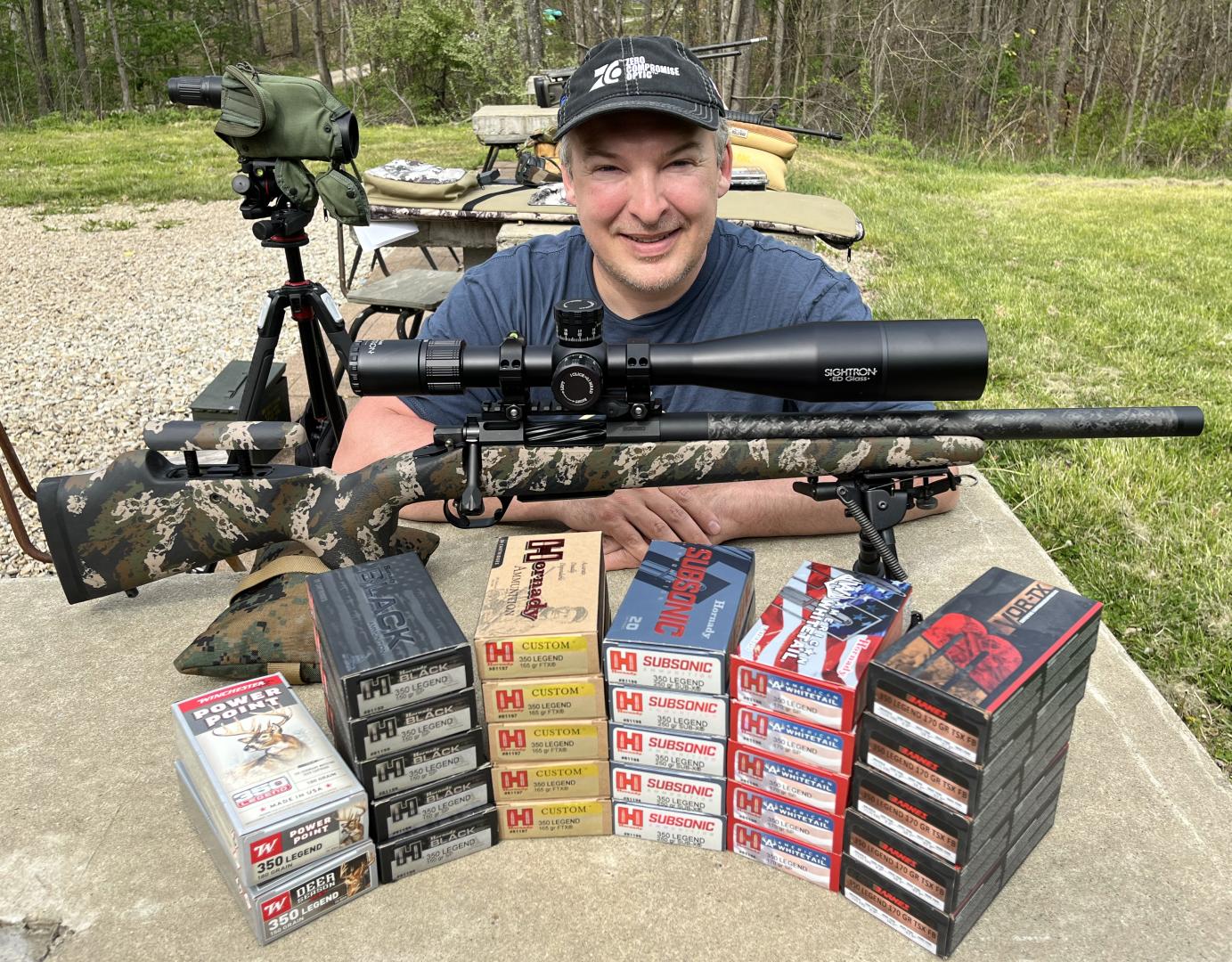 The first day out at the range ammo testing with the PurePrecison 350L and Sightron S6 5-30x56 Why straight-walled cartridges and how did we get here? Midwestern states have long understood they have a quandary. Most Midwestern states have substantial population density just about everywhere, but they also have massive numbers of deer whose population must be controlled, both for the health of the animals and for road safety, as large numbers of hungry deer have the tendency to forage across roads and get hit. My poor wife’s favorite car fell victim to such an animal. It literally glared at her through the driver’s side window and then bounded onto the hood of the car, totaling it. This was on the Ohio State University Agricultural campus in the middle of Columbus, no less. I doubt there is any public hunting there for obvious reasons. I’m not sure if they have the deer professionally culled as public parks in similarly population dense areas do, or if they are just counting on cars to do the job. I suspect they are doing the safe and humane thing, as large powerful liberal institutions are well known for their powers of calm, well reasoned, ethical, and rational decision-making. To most undereducated folks, the need for hunting in at least somewhat populous areas of these states is obvious though, and the equally obvious danger posed by that has led to a number of regulations about what sort of hunting implement can be used where, when, and sometimes (in the case of professional culling), even by whom. I understand the regulation. A friend of mine was actually hit with a stray bullet during hunting season while he was sitting in his house video gaming. He was lucky, if you can call it that for a guy randomly hit by a stray: it hit him in the ass, Forest Gump style, and not in the vitals. The bullet he was hit with was a bottleneck rifle round and he was in a state where hunting deer with those is legal in many areas despite it being a pretty populous state. To cut down on this sort of accident, over the years, bow only areas and areas where hunters were restricted to slug shotguns or black powder rifles have become common, with the clear goal of limiting the potential lethal range of an errant shot. Some states, Ohio included, even became completely rifle free statewide when it came to hunting deer. During this time, slug shotguns, though the most popular hunting option, were also probably also the least liked. Inaccurate, heavy kicking, and expensive to shoot, it was impossible to miss the fact that this type of gun had simply not been engineered for this type of use. If only there were a more effective type of weapon free from these drawbacks but still with the reduced range relative to bottleneck rifle cartridges that made slug shotguns acceptable. Of course, everybody knew there was. People had long hunted with various pistol caliber lever guns, such as the .44mag, and all early rifle cartridges, such as the 45-70, were heavy and slow moving like a shotgun slug. There were also some middle-aged rifle rounds like the .444 Marlin and even recent cartridges like the so-called “thumper” rounds, .450 bushmaster and others, which all fit the bill. The common denominator with almost every round to have these characteristics is that they have straight-walled cases. A straight-wall case configuration makes it difficult to produce high velocities or load long slippery low drag bullets, as the bullet ends up very short, fat, and heavy relative to the amount of powder pushing it. Within limits, and I know hand loaders who have certainly pushed those, the physics of this is unavoidable. A straight-walled cartridge will be heavy, slow, and have a high drag bullet. Indiana was actually the state to begin the movement towards inclusion of straight-walled cartridge rifles in their deer hunting regulations, though Ohio most often gets the credit as, unlike the Indiana law, the Ohio law is simple, straightforward, rational, and decipherable. If you can figure out what to hunt with where in Indiana, you should get a degree. If you can figure out the reasoning behind the rules and caliber choices, you should be committed to a mental asylum. 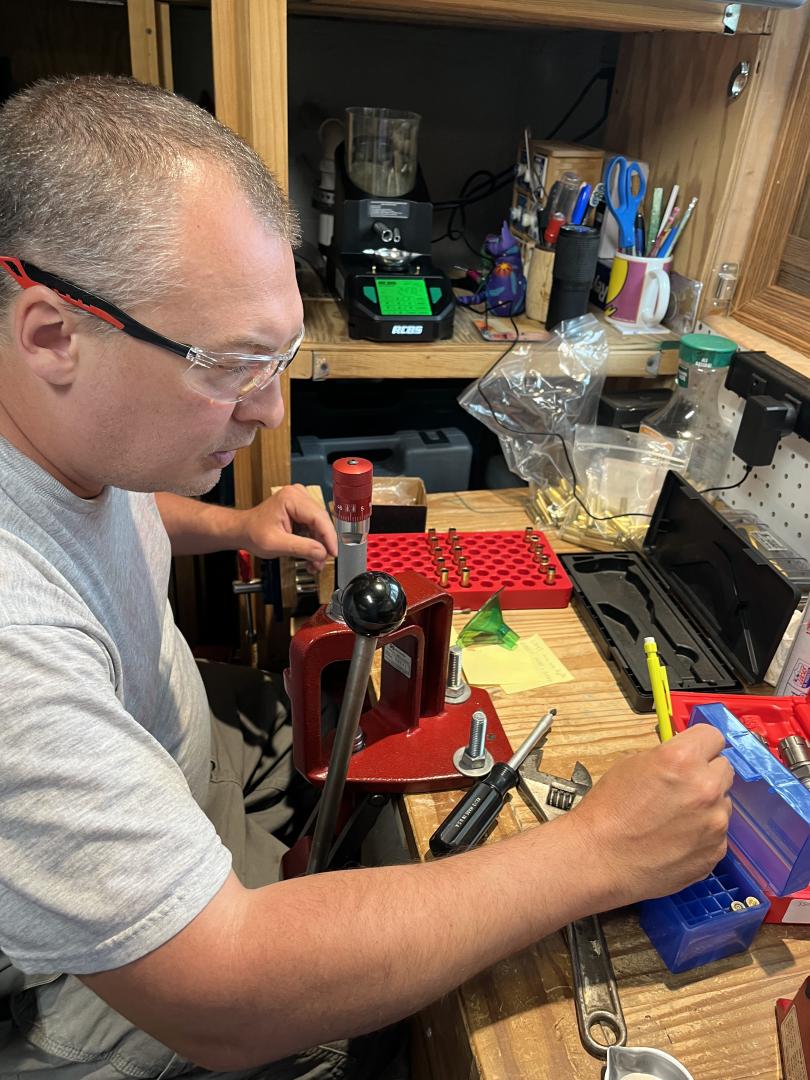 First batch of 350L handloads using the dies and click adjust bullet seating micrometer supplied by Hornady and the RCBS Matchmaster powder dispenser Much of the simplicity of the Ohio law, as well as the popularity of the straight-wall cartridge, and its terminology nationwide can be credited to the folks at the Buckeye Firearms Association who, working in concert with independent wildlife writer Jim Abrams, prioritized such simplicity and language in their proposals of regulation changes. The Ohio law reads simply “All straight-walled cartridge calibers from a minimum of .357” to a maximum of .50” (includes .350 Legend)”. The process of writing and passing this law was very much what you are taught the legislative process looks like in school. It involved input from key stakeholders such as sportsmen groups, ODoW, the Ohio Farm Board Federation, landowners, and a wildlife council advisory board, as well as public comments. I think if we could draft some healthcare legislation that way then perhaps two-thirds of our bankruptcies would not be from medical bills and our fraud spending would not exceed our spending on benefits to our citizens, as it surely does. Thank you to Larry S. Moore of the Buckeye Firearms Association, whose work and writings were key to following the story of this now large trend in hunting regulation. That SWC trend has grown very large indeed. Information is scattered, but from what I can tell, as many as 22 states now have some form of special straight-walled hunting cartridge treatment in regulation on the books, whether that be statewide, in smaller otherwise restricted zones, or with longer seasons. That is a pretty dramatic movement given such regulations have only existed anywhere for just over 10 years. After speaking with ammunition manufacturers, I can also say that ammo sales for straight-walled calibers, especially of hunting specific bullet designs, is rapidly raising and pretty far up their list of overall sales for rifle cartridges. Nearly all the major American cartridge makers are now producing factory ammunition for a number of these calibers and I know of more planning to, with 450 Bushmaster and 350 Legend being the two most rapidly expanding in popularity. By the numbers, how straight-walled cartridges compare in potential lethal range: The first thing to look at as we get a bit deeper into the SWC topic is what these things actually look like ballistically. Do they really deliver on the promise of decreasing potential dangers down range? How much do they increase effective hunting range relative to shotgun slugs and how far behind bottleneck cartridges are they? For this discussion we are going to need some comparison rounds. I’m going to go right down Hornady’s product line because I trust their ammunition quality, their offerings are widely available and popular with hunters, ELD-X is probably the most sophisticated and slippery long range hunting ammunition in existence, and Hornady provides consistency in comparison by offering every type of round I want to look at. It doesn’t hurt that they also provided some ammunition and reloading supplies for this project. 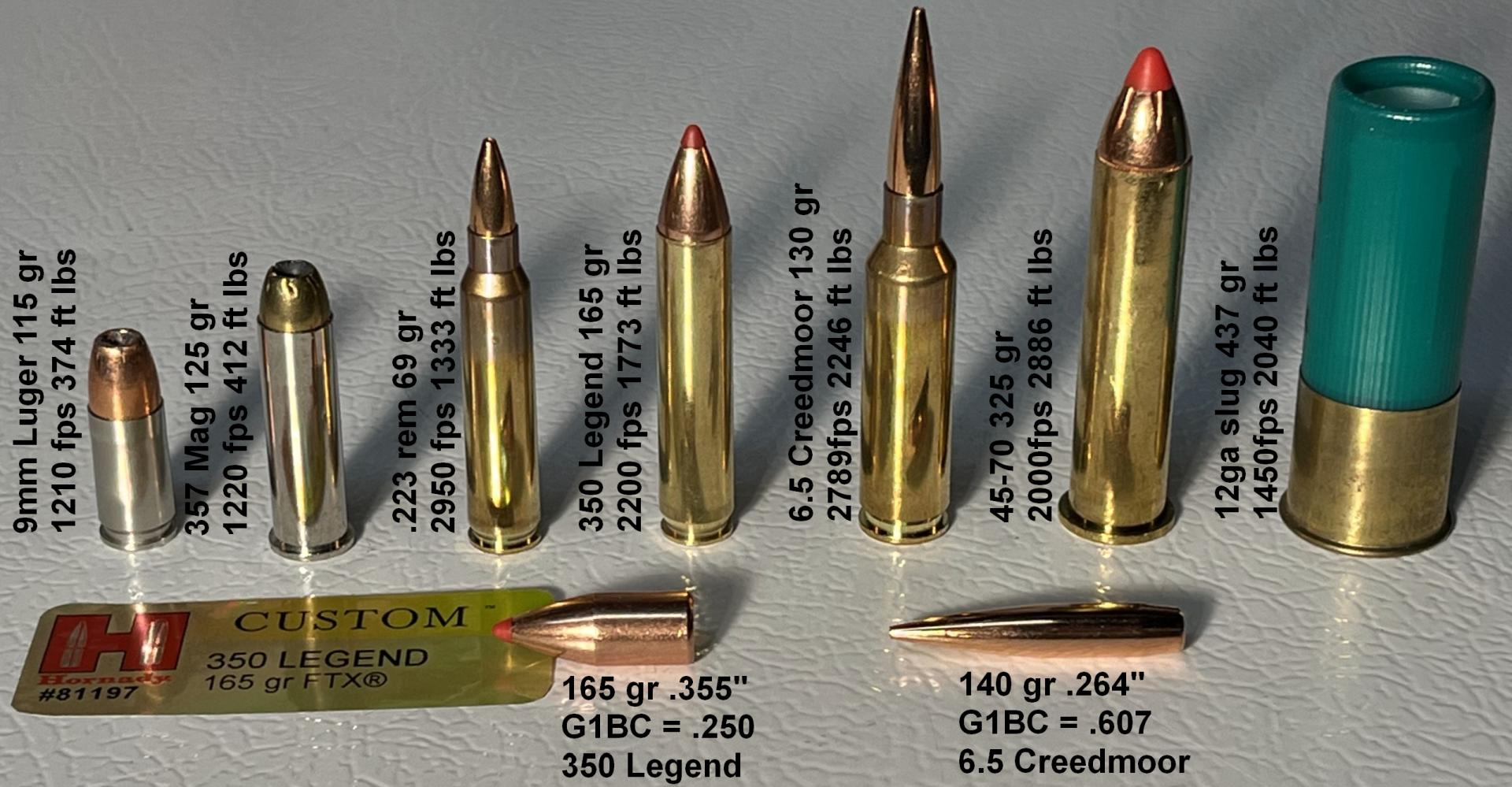 An interesting side-by-side of a variety of different cartridges highlighting how different the modern SWC illustrated by the 350L is from the 6.5CM bottleneck cartridge and how different their bullets are in profile and drag For calibers to compare, I will choose 12GA shotgun because it is the most popular shotgun gauge and has a little more velocity than the also popular 20GA. For bottle neck rifle, I will first choose 6.5CM, as it is a great size for whitetail hunting and has rapidly become probably the most popular choice for new rifles for that purpose in states that allow it. I will add .308 for being the old school GOAT and will also choose to examine the 6.5PRC as a caliber specifically designed for long range hunting. 6.5PRC is not technically the worst-case scenario as far as potential lethal range goes, but it is pretty close and is a common hunting round. Being as muzzleloading is a tremendously popular option for deer hunting and also enjoys a more generous hunting season in many areas, I decided to add a few examples of this. The first of these is what you might see in a modern black powder style reproduction, the next is a sturdy modern smokeless muzzleloader, and the last is something purpose built to be pushed - like the stuff PurePrecison is putting out in that sphere. These are not recommendations for your muzzleloading experimentation but rather examples of what I have seen. If you load to try to push that reproduction gun, you’re going to fire your breech plug right through your head. You have been warned. Finally, for the straight-walled cartridges, I’m going to go with 350 Legend, 450 Bushmaster, .45-70, and .44 mag. Being an Ohioan, I see a lot of SWC stuff at the range and these are by far the most common, with the 350L actually taking the lead lately. I should also note that 350L is one of the fastest SWC cartridges that exists and has some of the higher BC bullets, if you can call any SWC bullet high BC, which you certainly can’t. All that being said, here are the specific factory loads for the metallic cartridge rounds and examples of what people appear to be doing with muzzleloaders (from mundane and period to pretty extreme), all arranged by max lethal range:  Seventeen Eighty - Muzzleloader Shot Beyond a Mile A PurePrecision (formally Mesa Precison Arms) muzzleloader at 1780 yards. Holy smokeless powder, that is impressive isn’t it! For the data table, I will be arbitrarily choosing to place the max lethal range for each cartridge at the range where the velocity reaches 300fps or the maximum possible range if that happens before 300fps. This velocity cutoff is a judgment call based on the point at which I think a bullet is unlikely to cause fatal damage. A paintball goes 300fps and a pointed lead projectile would be likely to cause some painful damage at that speed but not penetrate deeply enough to often be fatal. In addition to calculation of a maximum lethal range, I will also calculate a danger area that represents the area of the circle around the shooter with a radius of that lethal range. Lastly, and most importantly, I was unable to find ballistic calculators capable of calculating trajectory out to the total distance many of these cartridges are capable of traveling. The two longest calculators either have a cut off distance of 4k yards or 15 seconds bullet flight. Furthermore, as I got out to the limits of some of these calculators, their calculations differed dramatically. For example, JBM has the remaining velocity of the 350 Legend at 3000 yards, which is significantly higher than Applied Ballistics does at 2600 yards, and also believes that its terminal velocity will exceed 300fps, whereas AB has it below that cutoff. To work around this, the distance capabilities of the longest cartridges were calculated in two stages. This is simply not correct, as the launch angle for the second stage is off by something like 12 degrees. The top three cartridges required no creativity and are correct. From the 12GA Sabot down to the 350L, I expect the numbers are somewhere around +/-250 yards in their accuracy. For the screaming hot muzzleloader on down to the 6.5ppc, I expect the numbers are more like +/-500 yards in their reliability. I think these values are close enough for purposes of estimation and comparison, but they are not correct. All calculations were done in Applied Ballistics Elite. G1 was used for the slugs, SWC cartridges, and muzzleloaders, and it is a very good ballistic model for these shapes, with the possible exception of the 280gr ELD-X but it’s all I have for that bullet. The ELD-X bullets were modeled using the AB bullet specific model as G1 is a terrible model for their shape. The G1 values for those bullets in the table are only present for your comparison and amazement. 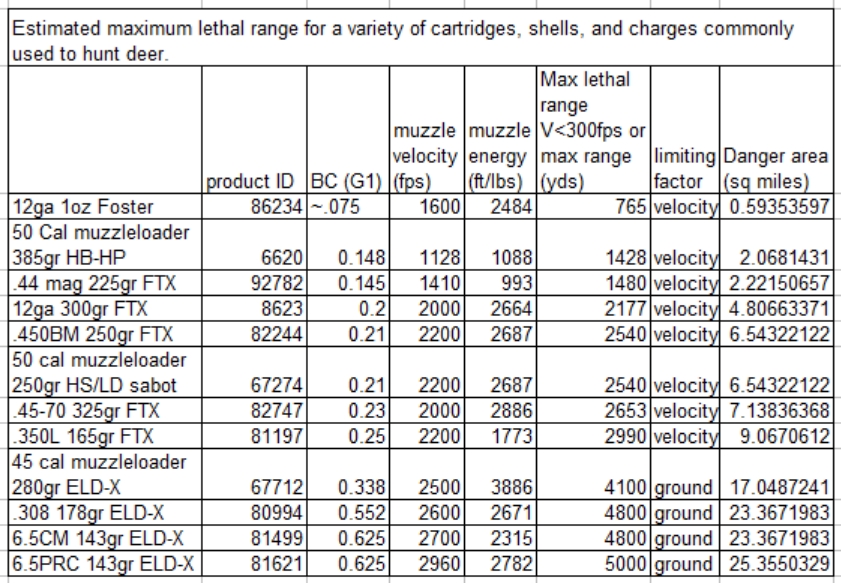 Table showing the maximum lethal range and the area around the shooter that range encompasses for a variety of rounds of different types commonly used to hunt whitetail deer. Analysis of the numbers on how straight-walled cartridges compare in potential lethal range: The first interesting thing I noticed in the table is that the bottleneck cartridges never slow down enough to be traveling below 300 fps since their terminal velocity, when gyroscopically stabilized as they are when fired from a rifle, is faster than 300fps. Thus, these always hit the ground lethal and have launch angles for a maximum distance of something like 40 degrees. The shorter, fatter SWCs and slugs do not appear to have terminal velocities above 300fps, though they are pretty close, and some calculators had them just above that velocity. I guess this indicates that morons shooting guns up in the air are much more dangerous with AK-47s than with Glocks. Not incidentally, deaths due to celebratory fire are commonly documented, especially in areas of the world where people commonly celebrate with rifles. 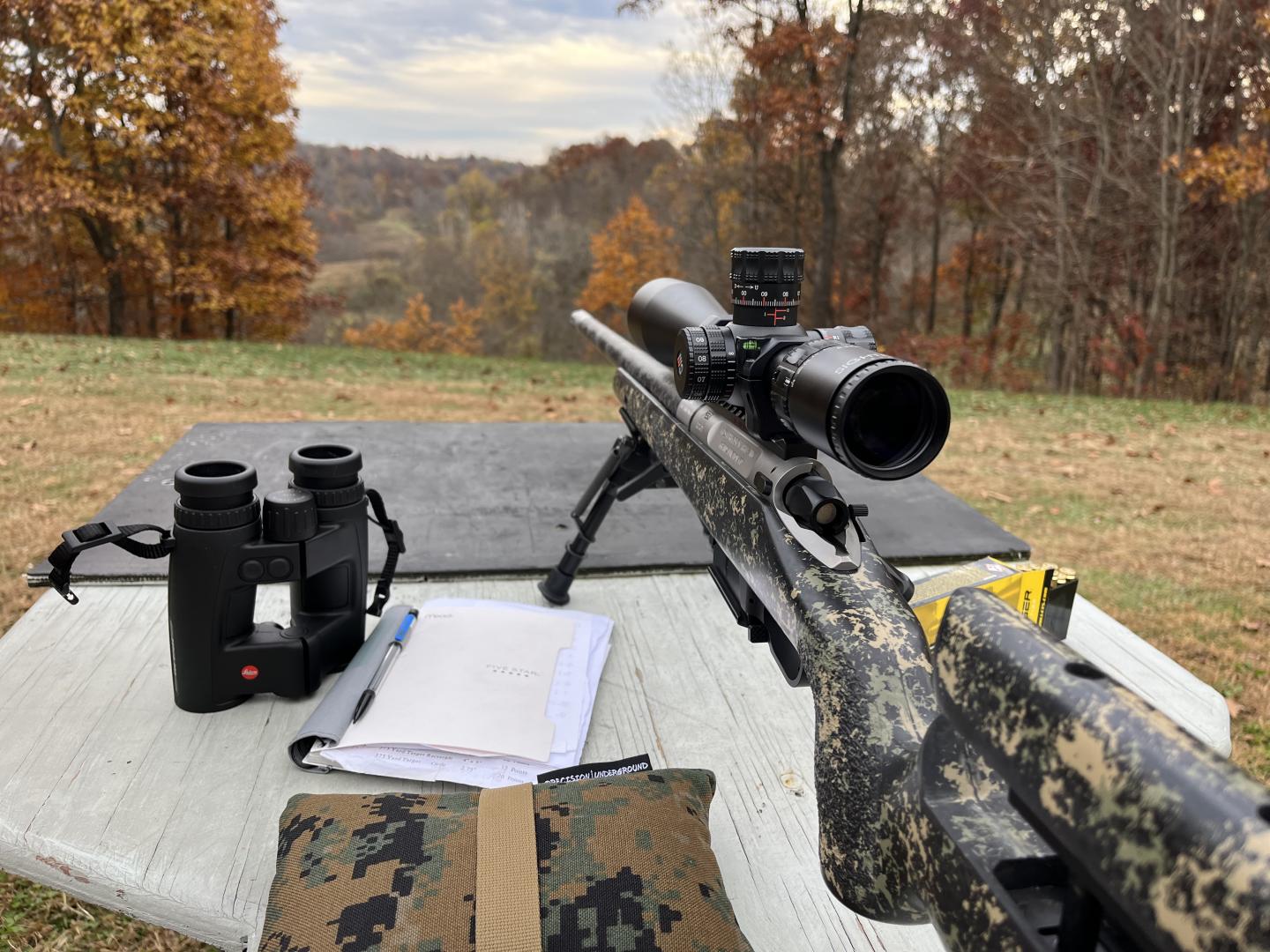 1000yds with the PurePrecison 6.5CM and Sightron SIII PLR 6-24x50 ffp, because those long, fast, slippery bullets go a long way. Beyond that curiosity, the table shows very clear and dramatic differences in the potential lethal ranges of cartridges and classes of cartridges. The flying ashtray that is the Foster slug is remarkably short ranged, with a maximum lethal distance of less than a thousand yards. Next up are the traditional muzzleloader and handgun at about twice that. These are followed by a pileup of the Sabot slug, all the SWC rifle rounds, and what you might consider the more common modern smokeless powder muzzleloading loadout. These are all sort of in a bunch together with 2-3000 yards of potential lethality. Finally, you jump more than a full thousand yards to between 4-5000 yards of lethality for the hotrod muzzleloader and bottleneck rifle cartridges, with the bottleneck rifles all stacking up together at almost 5,000 yards. This was interesting for a couple reasons. First, the idea you could make a muzzleloader look closer to a bottleneck cartridge rifle than a SWC rifle was shocking to me. Equally surprising is that little difference exists between the maximum lethal range of the classic .308 and the blazing fast 6.5PPC. I expected a lot more difference knowing how much further you can reliably hit targets with the 6.5PPC given how much less drop and windage it has at those ranges. What I got instead was all of the bottleneck cartridges piling up 200 yards from each other at 5,000 yards - just about twice as far as a typical SWC. The conclusion is pretty clear as pertains to potential lethal range of errant shots: SWCs have tremendously less potential lethal range than bottleneck cartridges and are very similar in lethal range to options that were already legal in the areas that SWC rifles are now being legalized in. Now that we can see they are doing their job at limiting the range of errant shots, are they also extending viable hunting distances versus shotgun slugs? Some numbers on max viable hunting ranges for different cartridges: Determining a maximum hunting range is even trickier to specify than potentially lethal range, as the cartridge, weather conditions, accuracy of the rifle, stability of shooting position, the skill of the shooter, energy at the target, bullet design, and the shooter’s ethical standards are all widely variable. Instead of trying to make cartridge agnostic rules I’m going to put together a table with velocity (fps), energy (ft-lbs), and drop (mils) at 100-yard increments out to 800 yards. I’m going to cut the table off at 800 because that is asking a lot of the shooter when your target vital area is about 8”. That is a 1 MOA shot at a very long distance. Can you reliably hit cold bore on an 8” target at 800 yards? I’m sure there are a few who can as there are many folks much better than me, but I’m significantly more experienced than most and I am not confident making that shot cold bore with any gun I have (and my PurePrecision 6.5CM is very good), so I’m going to call that optimistic enough to be the final range with any cartridge. 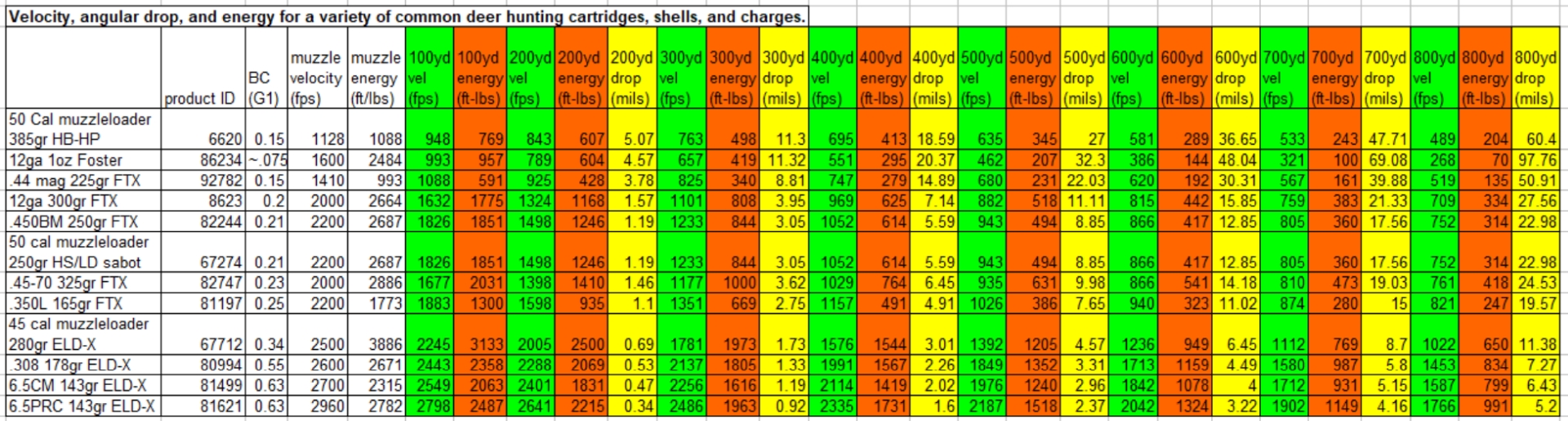 Table showing drop, velocity, and energy out to 800 yards for a variety of cartridges, shells, and charges, commonly used to hunt deer Analysis of hunting range potential with a SWC and what that is worth: All increases in range are not created equal. Any archer can tell you it is a lot easier to get 75 yards from an animal than it is to get 25 yards from the animal, but there is not a whole lot of difference between getting to 125 and 75. This is because deer fear you a lot more the closer you get. On the other end of the spectrum, increasing your range from 100 to 200 yards will put a lot more deer in your kill zone than increasing your range from 700 to 800 yards. This is because you seldom have any 800-yard sight lines or even 700-yard sight lines. All this to say that having a platform (and this includes, rifle, ammo, scope, rangefinder, position building equipment, and trained shooter) that gives you the confidence to add some of the distance from say 100 to 400 yards is tremendously valuable. 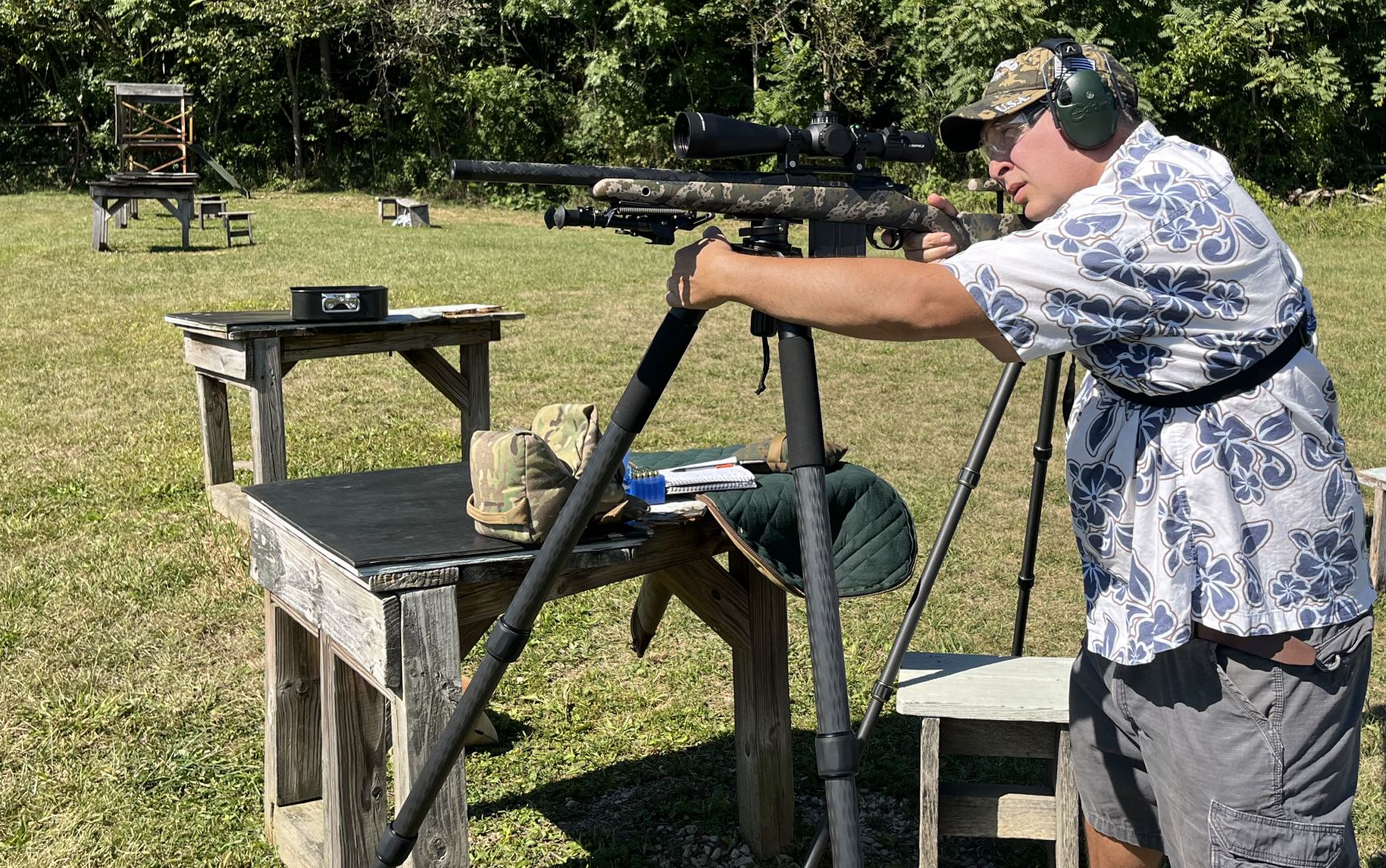 Shooting the Leupold Mark 4HD 4.5-18×52 400yards with the Pure Precision SKLTN 350L off a Field Optics Research Pro39 tripod Now, clearly our table has a lot of values in it that are not feasible for hunting. Foster slug accuracy sucks and they generally struggle to stay in the vitals at 100 yards. My experience confirms the common knowledge on this. With a Sabot and rifled shotgun I understand accuracy is achievable for at least 200 yards shots with the right rifle, and ammo and the ballistics look great even out to 300. My only experience is observing people at the range and that is no guide, as people at the range commonly can’t keep a .308 on a piece of notebook paper at 100 yards, but it is what it is. 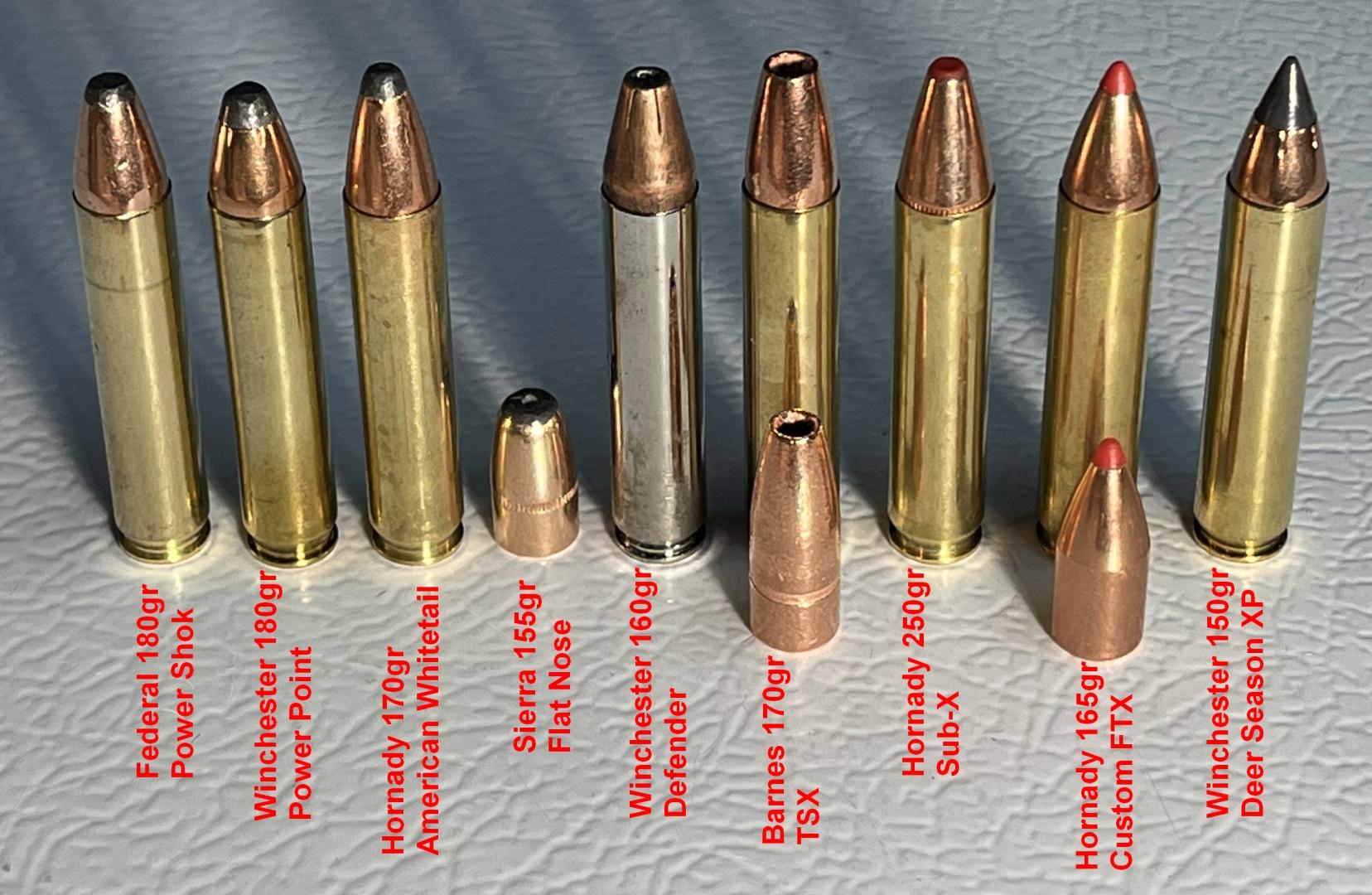 A variety of hunting bullets and loaded cartridges for the 350L I have now spent a good deal of time with the 350L testing ammunition and shooting at the range. I have also spoken with a number of experienced hunters who have taken deer out to 400 yards with the cartridge. The performance of available ammunition varies widely, but ammunition is attainable that will average sub-1” groups at 100 and have a velocity SD below 15fps. This ammunition will group less than 6” at 400 yards in low wind conditions and with a solid shooting platform. The energy is starting to look a little low at this distance, being just below 500ft lbs. I would be quite interested to see the ballistic gel at this range, as SWC bullets certainly have better terminals than bottleneck bullets at the same energy for reasons we will discuss in the next section, but I would like to know the penetration depth. Perhaps we will examine this in a later article. After experimentation and practice, I’m quite confident with the 350L out to 350 yards without wind, even if I’m on the tripod instead of prone. Hey, that’s funny: the 350L out to 350 - that should be pretty easy to remember! Despite the larger energy delivery of the larger .450BM and .45-70, I’m not confident any further than I am with the .350L with them because they are a little slower and less slippery. Consequently, their mils of drop is correspondingly larger, and the wind moves them more as well. 350 yards is a huge range increase over the Foster slugs most hunters were using and over the range most people seemed to be using Sabot slugs as well. 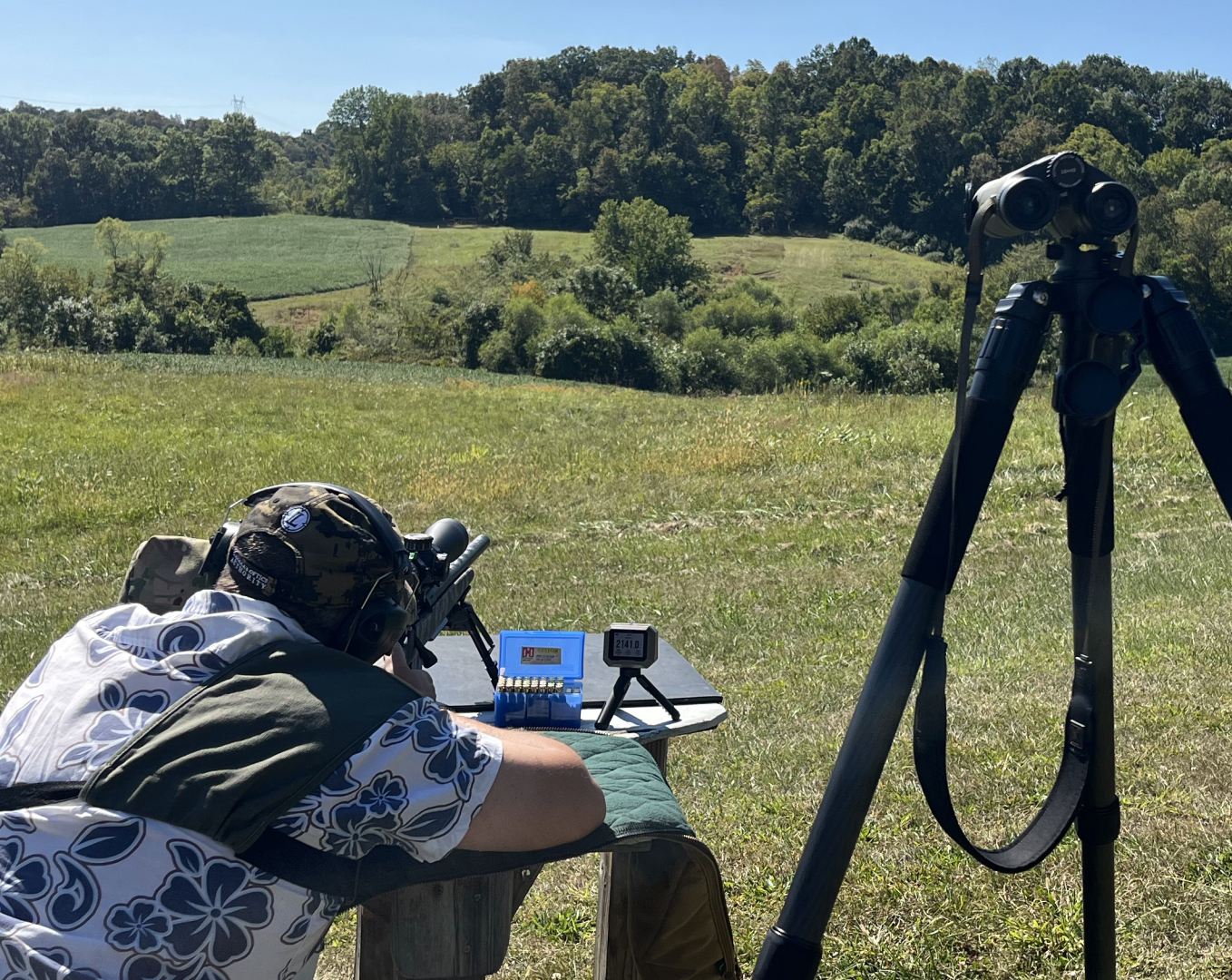 Shooting at 400yards with the Pure Precision SKLTN 350L with the Leupold Mark 4HD 4.5-18×52 As for the bottleneck cartridges, your error cone shrinks some versus SWCs due to the remarkable accuracy and faster travel of these cartridges. My PurePrecison 6.5CM has hunting ammunition that it groups .5” at 100 yards and the drop at 600yards is only 4.0 mils. That is about the drop at 350 yards for the 350L. That being said, the error cone increases with distance far more than the increased platform accuracy and decreased wind drift help. I think that off a tripod my confidence with the 6.5CM at 400yards is about where it is with the 350L at 350 yards. With a solid prone position, I might be willing to do 600 yards with the 6.5CM, but when would that matter: there is no such thing as prone in Ohio because there is tall green stuff growing everywhere and you can likewise almost never see 600 yards. The conclusion here is that SWC rifles give you many times more useful range than a Foster slug, probably also substantially more than a rifled Sabot shotgun. In contrast to that, most of the added effective range of the bottleneck cartridges is illusory as the increased size of the error cone at those distances and sight line limitations combine to leave little in real world gains. I should mention here that the biggest advantage bottleneck cartridges once had was how flat they shot with barrel burning cartridges like the .243 Winchester becoming incredibly popular to hunt with especially in the later 20th century. The range of a target is quite difficult to simply eyeball with any degree of accuracy and faster, flatter shooting cartridges offered a much larger margin for error. The advent of low cost highly effective laser rangefinders and ballistic calculators in the 2000’s removed most of this advantage. Even in bottleneck cartridges the trend has become slower, heavier, bullets that have better terminal performance, and, in bottleneck cartridges, are also much more aerodynamic for better long range performance. Terminal performance of SWC cartridges: Having much further potential lethal range for missed shots is not the only downside of bottleneck cartridges. The energy they deliver to a target is more difficult to properly dissipate in the target than that of larger, slower, shorter, bullets. Bullets can fail in a variety of ways and bullets that are smaller, longer, and traveling faster exacerbate all these. 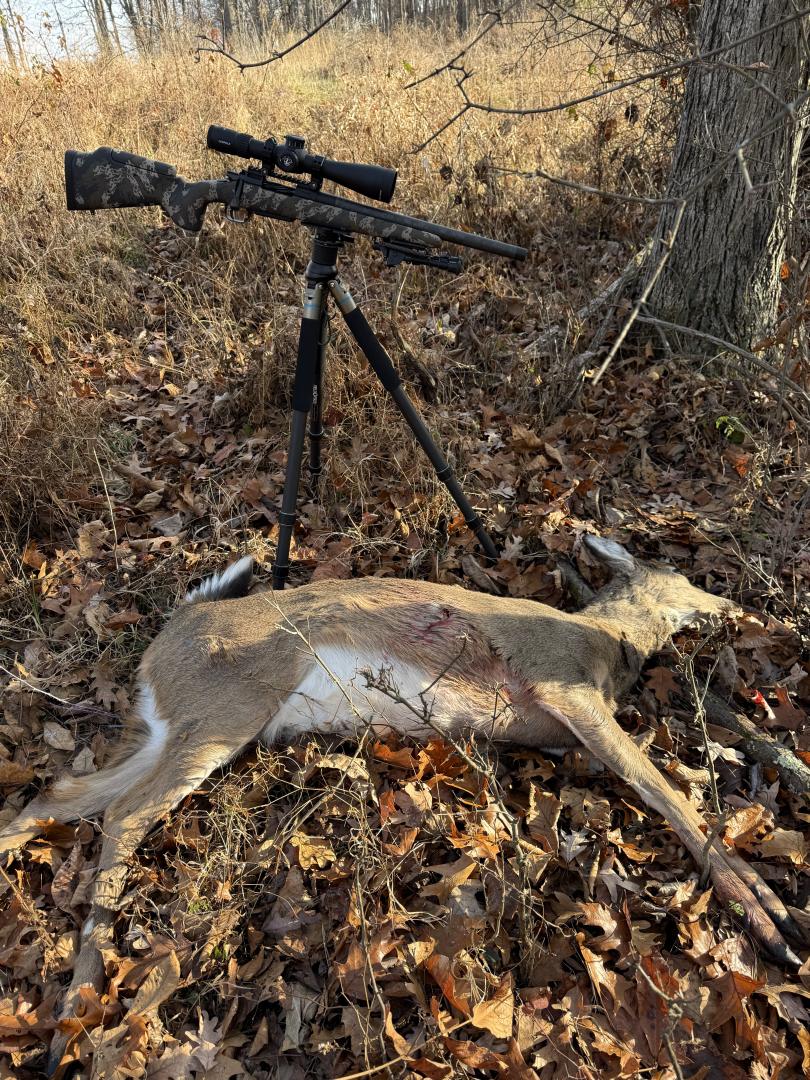 A nice doe my brother took with my PurePrecision 350L this year at 230 yards. It went down in 30 yards. He used some handloads I put together with the Hornady 165gr FTX bullet and VV N-110 powder, the Leupold Mark 4HD 4.5-18x50mm scope, Field Optics Research 32DTC3 tripod, and ranged it with Sig 10k binos with Applied Ballistics baked in for the calculation. The first way a bullet can fail is typically actually referred to as bullet failure. This is the bullet coming apart into pieces or a puff of lead dust. Outside of varmint rounds and bullets designed with peel away petals, this is generally not supposed to happen. When this happens, a lot of energy is spent ripping the bullet apart and the larger remaining pieces often do not track straight or deep into the animal on the original path of the projectile. The results of this can be suboptimal, both when it comes to killing the animal and when it comes to preserving your meat and your teeth. Fast skinny bullets fail in this way far more than slow fat ones, partially because they become very unstable after transitioning from thin air to dense flesh and want to yaw sideways. This motion, the tremendous energy that they hit with, and their long skinny geometry, can rip apart the bullet. They also sometimes fail this way because you are dealing with larger local forces on a smaller surface area of bullet. A bottleneck-hunting bullet has to be carefully designed to avoid the fate of bullet failure through things like bonded cores, A-frame construction, thick jackets, and monolithic designs. Because these bullets are small, however, they still absolutely need to expand to deliver the bulk of their energy to the target. This requires some sort of soft or hollow point that mashes or opens when it hits the denser flesh. This must be carefully calibrated. If it is too fast and aggressive the bullet will fail in the manner just discussed. If it is not aggressive enough, you will get the other big failure mode of small slippery bullets. That failure mode is failure to expand. This would be bad enough if the bullet just punched a very small hole straight though the animal exiting with much of it’s energy still intact. Because the bullet is long, pointed, and consequently very unstable in flesh, the bullet does not track straight though. What it typically does is start to yaw and then plot a curved path due to that yaw and the long length of the bullet. This means it might miss a vital it was headed towards and instead exit at 90 degrees to its entrance, ruining some good meat or just causing insufficient damage. Long skinny bullets often squirt out the side of ballistic gel in testing at longer distances despite the optimal uniformity of this medium. This is why huge, heavy, slow, colossally painful to shoot cartridges like our .45-70 govt and the .450 Nitro Express are still used to hunt large, thick, animals. Fat, heavy, short, bullets are less unstable and plot a straighter path through the animal. Even when short, fat, bullets do invert, as they still often do when they have a spire point, they still track pretty straight as the moment of inertia to flip them is small and the length surface doesn’t present much more drag than an end surface. If your .45 caliber 450 Bushmaster is going too slow for its hollow point to expand and dump its energy, it doesn’t squirt out the side of the animal. Instead, it goes right on through and does so in a pretty straight line. That’s not failure - that is a fairly large .45caliber hole right were you put it. 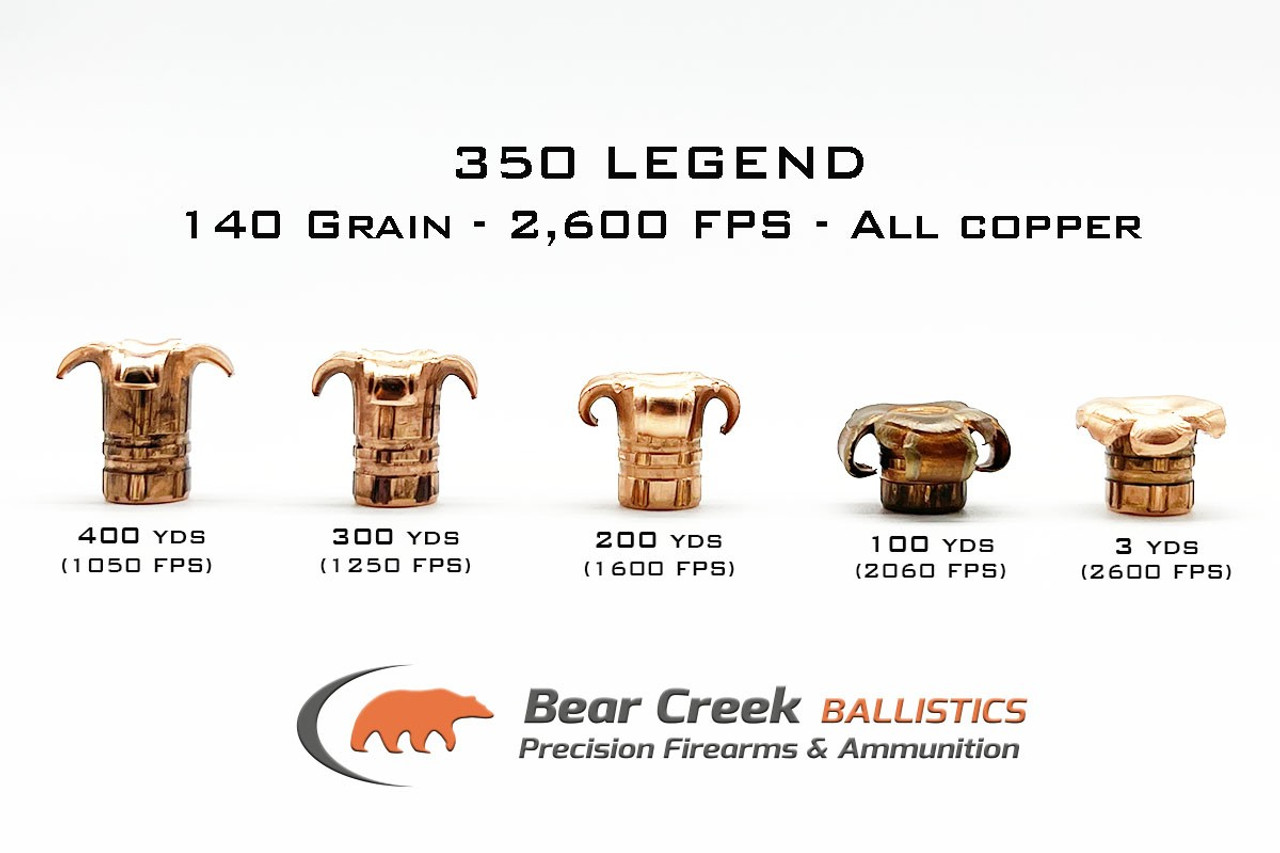 Copper solid Bear Creek Ballistics bullets used in gel testing at a variety of different distances from 3 to 400 yards (Photo courtesy of Bear Creek Ballistics) The consequence of all this physics is that many bottleneck cartridges have specific optimal range windows. If you are closer than this, the bullet may fail by disintegration (cue YouTuber complaining about a failed hunting bullet in gel at 5ft, as if anybody hunts at that distance) and if you are further, the bullet will not expand and consequently will chart an unpredictable path through the animal. SWCs, on the other hand, will perform optimally pretty close in and slowly taper in effectiveness as their expansion and hydrostatic shock decrease with distance, but at no point do they become unpredictable. The constant refrain I got from hunters for the 350L sub 150 yards was that the deer dropped very quickly. What I heard from those over 200 yards was that the deer got 30 or so yards and they found the bullet to have gone through both sides or lodged under the pelt on the far side in line with the entry hole. The one complaint was typically that there wasn’t much blood trail on longer-range shots. I did not find anyone with a story of a deer they believed well struck but that was not properly disabled. The performance with SWC cartridges is more predictable and effective at a particular energy level than is that of bottleneck cartridges. Conclusion: The philosophical value of a given regulation is always debatable. Restricting cartridge design in order to decrease the danger of a missed shot to other hunters, citizens, property, and livestock makes the assumption that hunters are not taking responsible shots for which they have a safe backdrop in the event of a missed shot. That being said, we have seen from our data that the regulation is, at the very least, rational, in that allowing SWCs but not bottleneck cartridges does decrease the danger range of a missed shot - by almost half in fact. We have also seen that the legalization of SWCs does not substantially increase this danger potential over the previously allowed Sabot slug guns or modern muzzleloaders. 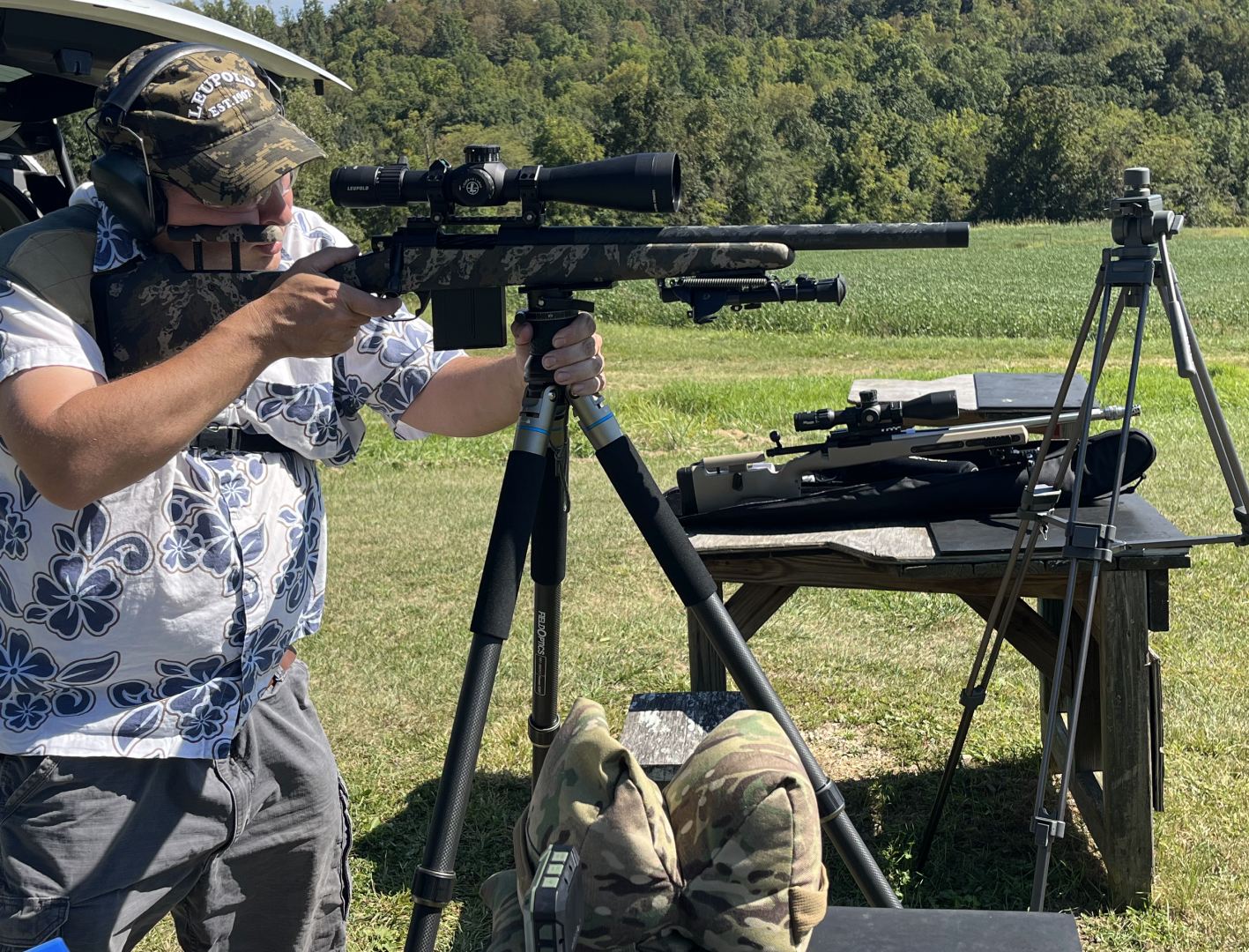 I believe this was also 400 yards, but this time with the Pure Precision 350L shooting off the smaller, lighter Field Optics Research Hunter 32 tripod Through my own testing, it is also clear that SWCs provide better options in terms of cost per shot and recoil than were previously available to most hunters. A 350L is remarkably mild compared to any slug shotgun of any gauge where recoil is concerned. Furthermore, little effective hunting range is lost vs. bottleneck cartridges and much hunting range is gained vs. slug guns due to the ease of obtaining better accuracy and, in the case of Foster slugs, also the ballistics. While I’m sure a few adventuresome tinkerers were taking deer beyond 300 yards using hopped-up modern smokeless powder muzzleloaders or even particularly well built and tested Sabot guns, there was a pretty high bar of competency to get there. SWCs can be accurate out of the box with factory ammo. In the age of quality inexpensive laser rangefinders, common ballistic calculators, and scopes with good adjustments, a little practice makes compensating for a few mils of drop with a SWC a low hurdle. I should also mention here that SWCs have incredible barrel life. My 350L has now seen a good deal more rounds than the 6.5CM I have had for much longer and it is showing no alligator skin at all in the leade area: it looks brand new. I expect barrel life for the 350L to exceed 10x the barrel life of 6.5CM. Finally, while SWCs lag bottleneck cartridges in ballistic performance, they have more predictable and optimal terminal performance per unit of energy. They are really not a bad bargain. 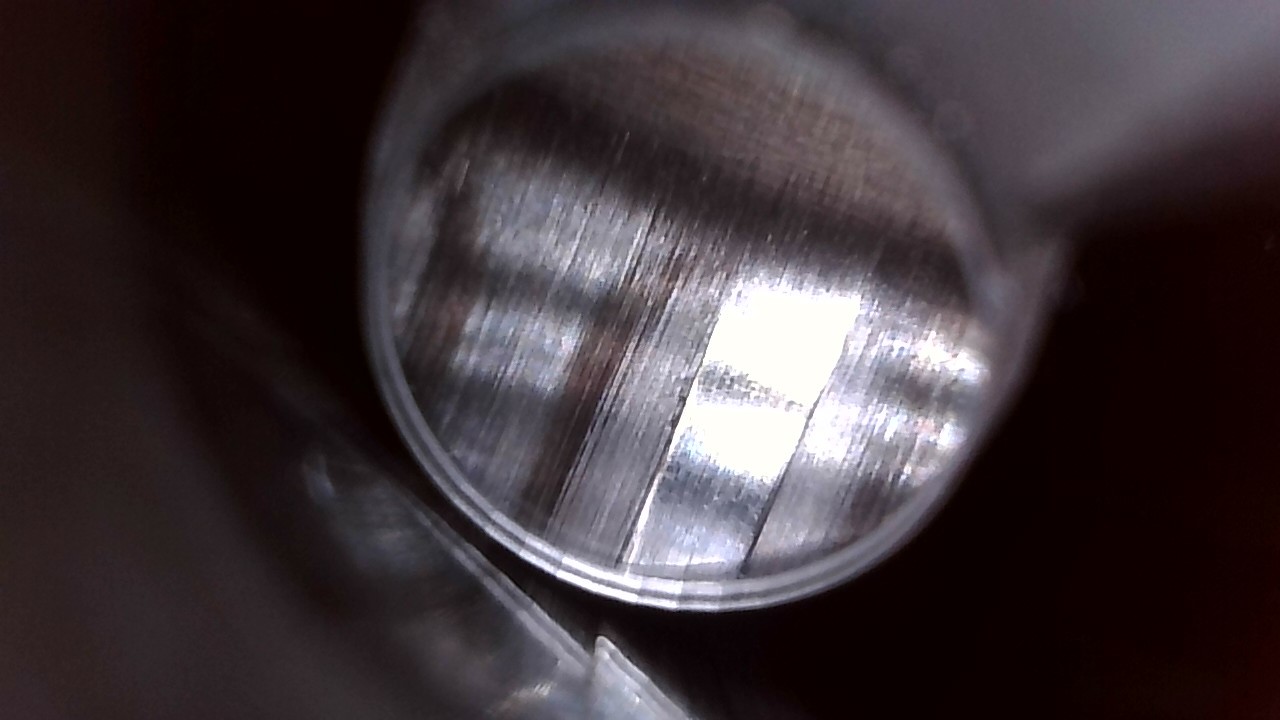 Proof 350L barrel throat with 500+ rounds showing no alligator skin. It looks brand new plus a little carbon. Given my distaste for slug guns, I was very excited when the SWC trend started and my state of Ohio simplified and popularized the concept. I’m happy to say that it lives up to the hype and I expect more states will continue to adopt similar regulations. In my next installment of this article series, we will delve specifically into the 350 Legend cartridge and then move on to articles on factory ammunition performance and reloading SWCs, including how that differs from bottleneck cartridges and straight-wall handguns. |
|
I don't live in a straight walled state. But I picked up a Gen 1 Ruger American Ranch in .450 Bushmaster a couple years ago after I bought a .45 cal suppressor. I converted it to use AR15 mags. Put a 3-9x Vortex scope on it and an adjustable cheek piece. Most of our shots at deer are well under 200 yards, generally 75-100 yards and lots even closer. I use the Hornady Black 250 gr. I've shot nine deer so far with that combo. None have taken a step. It's just bang flop. No plans to go back to my .308 or .30-06. 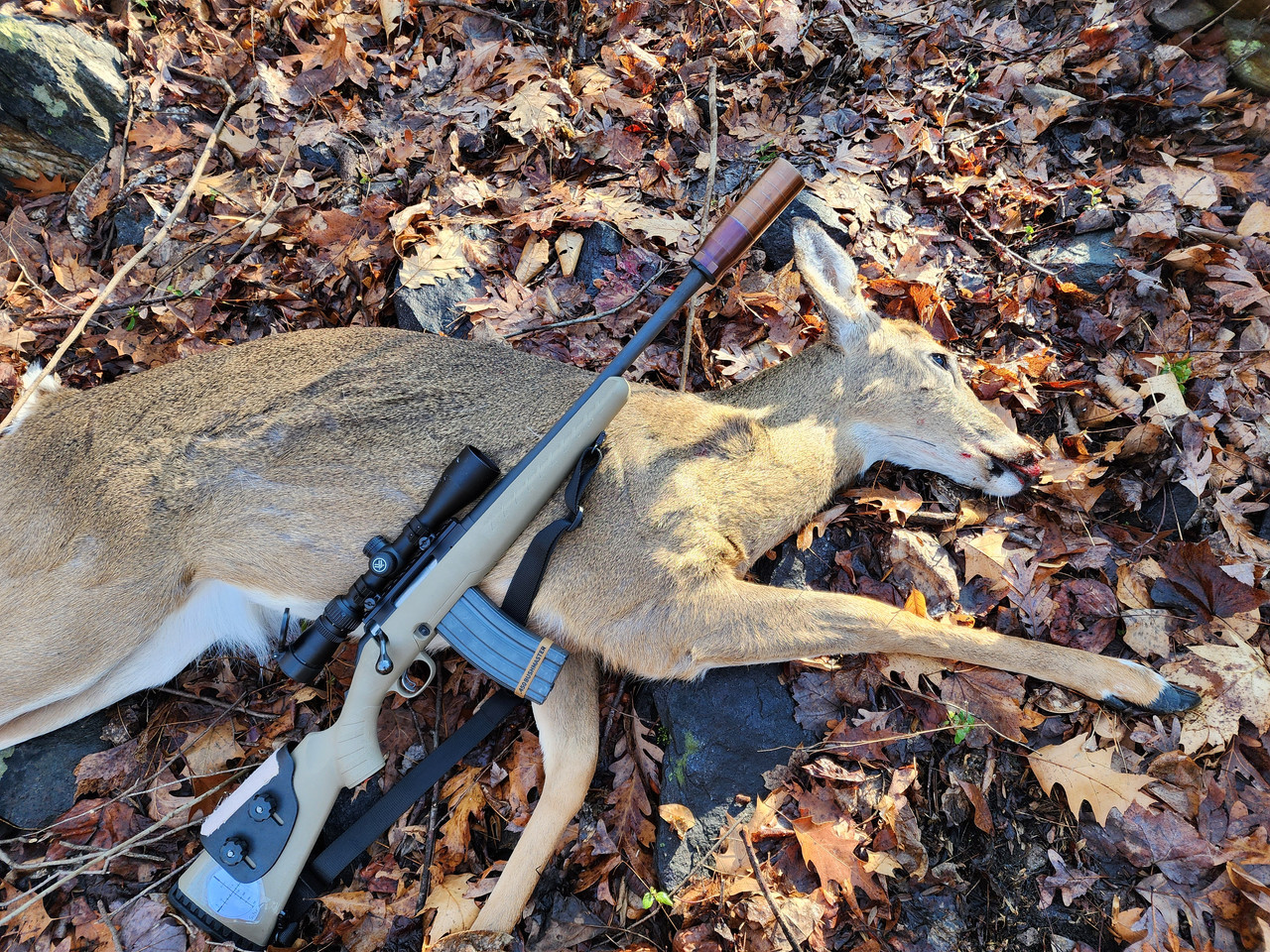 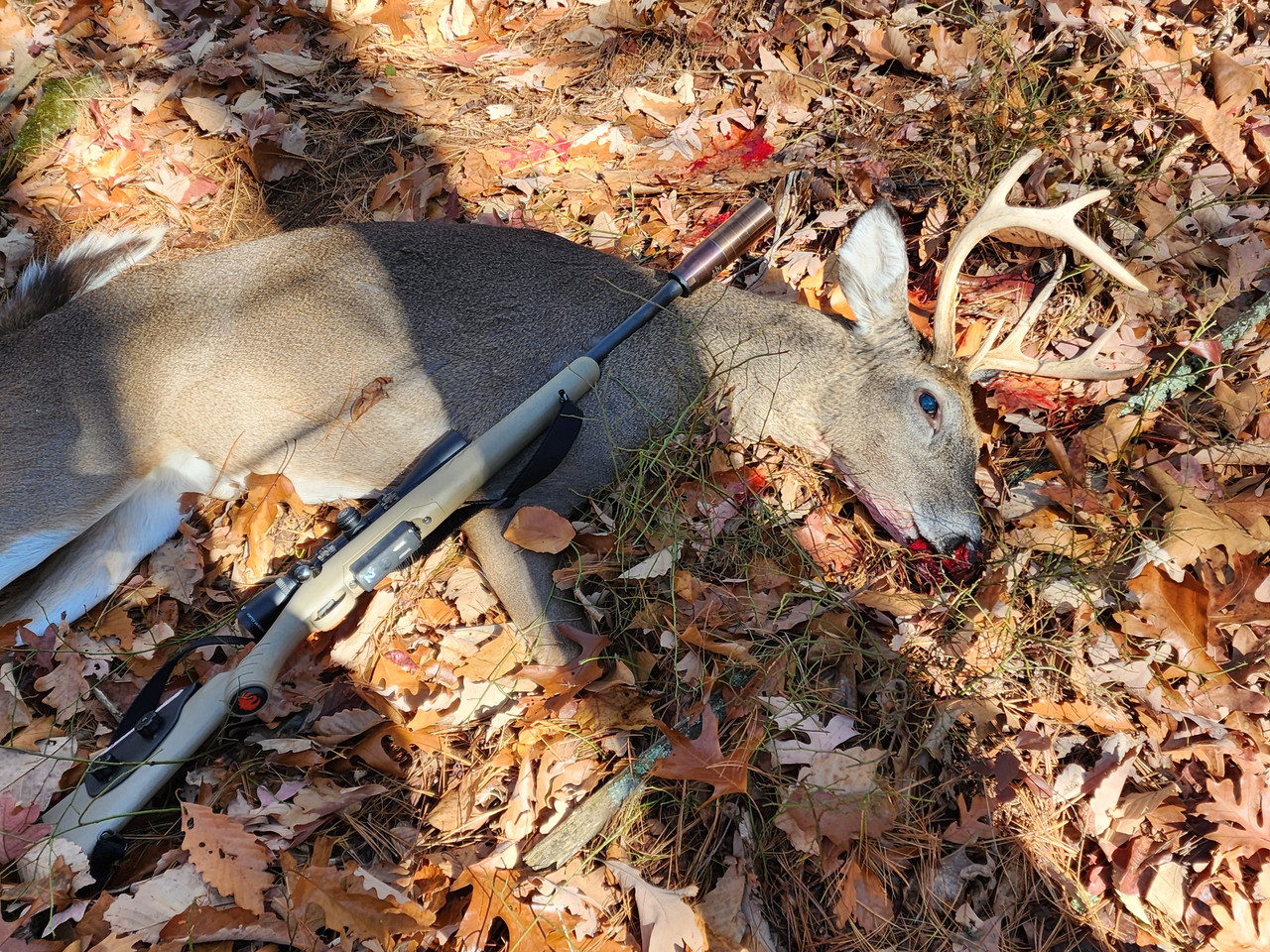 Little one I neck shot. That flap of skin is the only thing holding his head on. 
|