


AR Sponsor

Posted: 11/7/2014 2:42:50 AM EDT
| what are the best bits to get to complete an 80% lower. i mean, carbide drill and end mills? or just high speed steel? i noticed Modulus and 80% say carbide but others say high speed steel. any idea who is correct or does it matter? |
|
For general drilling and milling operations on 6000 and 7000 series Aluminum, HSS is just fine, while Carbide is a much
harder material and wears out much less and is designed to cut harder materials like Carbon Steel and the like...It is also considerably more expensive to purchase vs. HSS, It also stays much sharper than HSS and tends to give a finer cut... For roughing, hogging out material, and general milling work on 6000 & 7000 series Aluminum use a 2 or 3 flute milling cutter...Use a 4 flute only for finish cuts/work cutting or using shallow cut depths, a 4 flute end-mills area not really designed for plunge cuts or removal of large amounts of material...This of course assumes you are using a manual milling machine, a CNC milling machine is a different story as the feeds/cutting depths and spindle speeds can or are pre-calculated... One other note, try to buy American, Japanese, English, Swiss, German, or French made drill bits and end-mills, as they are manufactured with much better grade materials and have much tighter tolerances and thus have a much more accurate cut and thus last longer... Good luck. 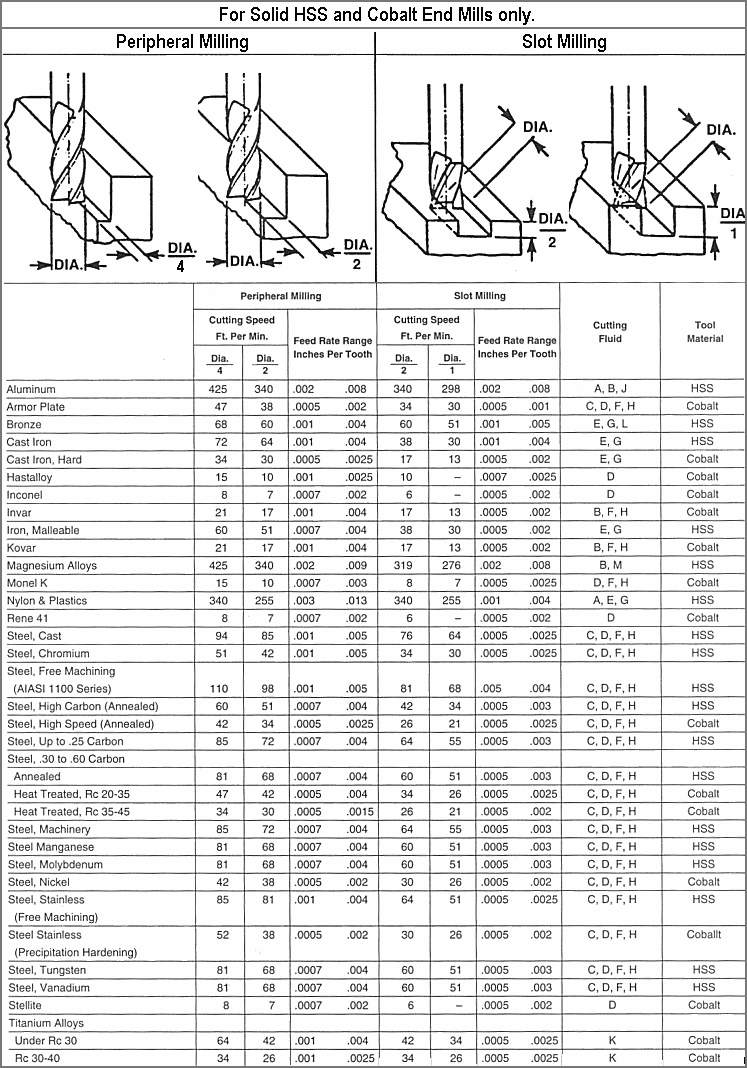
|
|
Six of one, a half dozen of the other. Carbide is far more rigid, so will not deflect, but it'll also snap in a heartbeat, which can cause serious damage. I generally use HSS cutters for aluminum work, save for some of the teeny tiny ones (1/16" and smaller) where I need to hold very tight tolerances.
My suggestion is: Use a 7/16" end mill for the main pocket; it's supposed to have a .218" radius anyway, and a 7/16" cutter is more rigid than a 3/8". If you're working a 7075-T6 lower, you don't need lube/coolant. If 6061, you will. 6061 will clog cutter flutes if cut dry, which will cause deflection or breakage. As mentioned above, chip clearing is important. Not only for visibility, but to prevent damage to the cutter and the workpiece. The selector hole: Either drill it first, or take the lower pocket back a little further than spec. Spec will have your drill bit breaking through the inside on a radius, which can cause deflection even with a jig. Coming back another 0.100" will allow your drill to break through a square interior wall. As an aside, 4 flute end mills work best over the widest variety of applications, IME. |
| You should always use HSS when working with aluminum. Sure, carbide will work if its new. The reality of carbide is its ability to shear. Shearing and aluminum doesnt go together real well. If your in a CNC shop producing 100's of pieces a day carbide is good. Go to a good machine shop and tell a experienced machinist that you want him to fly cut a aluminum surface with the best finish possible and i'll guarantee he grabs a HSS bit. |
|
The reality of carbide is its ability to shear. Shearing and aluminum doesnt go together real well. 
Shearing is a synonym for cutting. Milling is cutting, period. Carbide will cut aluminum same as steel. Many choose HSS for aluminum work because it's cheaper, and because HSS cutters don't chip or break off the way carbide does if you load it too hard or bind it up. I work mostly with 5052-0, 6061-T61, 6061-T651, 2219-T6 and 7075-T6, and I've used carbide plenty, especially smaller cutters, where the cost difference between carbide and HSS is negligible. I get my 1/8" 4 flute carbide cutters for $3/ea. As I mentioned above, one of the big upsides to carbide is rigidity. When milling an AR FCG with a 3/8 or 7/16 cutter, HSS is plenty rigid. But when cutting a 3/32" slot 3/8" deep, the amount of deflection you'll see from HSS can be very problematic. If your in a CNC shop producing 100's of pieces a day carbide is good. Go to a good machine shop and tell a experienced machinist that you want him to fly cut a aluminum surface with the best finish possible and i'll guarantee he grabs a HSS bit. He's going to face a large surface with a face mill or fly cutter, which is almost certainly going to be a HSS head with carbide inserts. An 8" or 10" shell face mill with 10-20 indexable carbide inserts is a popular choice for cylinder head resurfacing on lower speed machines, whether aluminum or cast iron. |
|
Quoted:
what are the best bits to get to complete an 80% lower. i mean, carbide drill and end mills? or just high speed steel? i noticed Modulus and 80% say carbide but others say high speed steel. any idea who is correct or does it matter? I bought a Modulus Jig, a couple lowers and there bit and mill kit. Amazingly good stuff. The edges on the drill bits are like a razor blade. Go for it! |
AR Sponsor
Join the Community
Your next conversation starts here.
Create your free account to join discussions, share your experience, save topics, and connect with the AR15.COM community.
- Join discussions
- Follow topics and replies
- Connect with fellow enthusiasts
Already a member? Sign in
Stay informed by subscribing to our Newsletter