


AR Sponsor

Posted: 7/14/2011 10:22:06 AM EDT
| Are there any big advantages between clamp and set screw gas blocks? Are both GTG depending preference? |
| I prefer the pinned route. Unless the pin actually breaks, there can be no movement. Today's adhesives are amazing and I'm sure many have had success long term, but to me I feel the pinned route is the more foolproof setup. Most of the low profile blocks out there come with the setscrew. But you can still pin them. If you don't feel comfortable doing it, companies will do it for you. I bought my barrel and block from Rainier Arms and they will do the drilling and pinning for you for an additional fee. If you have a barrel with a FSB you are golden. If you keep it that way, great, if you want to go to a low pro setup and covered block, just take the FSB off, do some cutting, grinding and a blue job and put it back on. If it's covered, it doesn't have to be beautiful. Good luck. |
|
I bought an Armalite clamp type on clearance for my DCM style free float .22 cal upper.
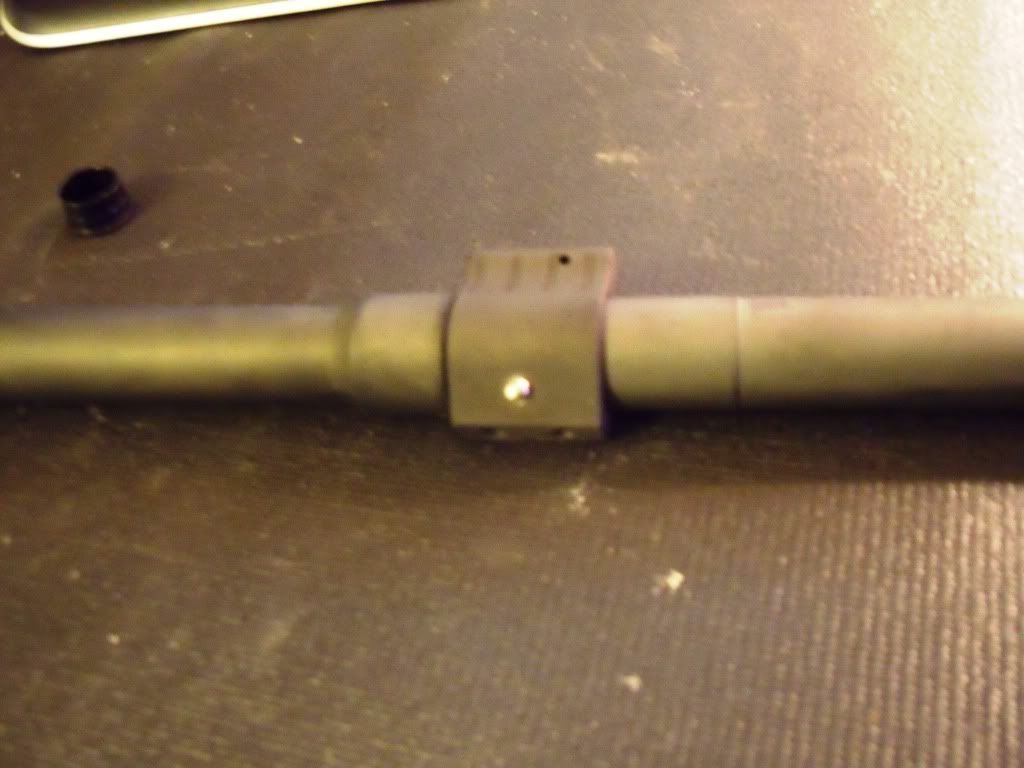
I ran into an interference issue with the bigger diameter on the bottom interfering with the free float tube's sling swivel stud. Not much room to grind to fit without getting too close to the rear clamp screw. Other option is to simply clamp the whole works a half inch farther out on the barrel. For a .22 that works fine as the gas system isn't utilized. |
|
Quoted:
Quoted:
LOC TITE... Nobody mentioned locktite or any other adhesives, and why would you use them? The gas block would burn it up. Because that's what some of the manufacturers recommend, specifically RC 620. One would have to exceed an effective rate of fire to degrade it enough to have it come loose. I prefer clamp-on because they are the least likely to cause accuracy degradation. I do use the RC 620, though. It ain't coming off. |
| I would use the set screws given the choice between a set screw and clamp on. The proper way to do it is to have the barrel dimpled (there is a usually a single dimple if you have a brand that is predimpled, but I do a dimple for the second screw also) for the set screws and use rocksett on the screws. This is generally reliable this way. If you have to buy a dimpling jig (you can use another set screw block as a jig also) and mail order rocksett it may be about the same cost for a locksmith to pin it. Rocksett will hold to the heat where locktite will not. Rocksett is generally considered the correct way to install set screw gas blocks (also the screws on the clamp on gas blocks) and on muzzle threads if your using shims instead of crush washers. Its also the more accepted way to install carrier keys, although the highest temp versions of locktite and staking may be OK. You remove rocksett by saturating with water, you remove loctite with heat. |
|
Quoted:
Quoted:
Today's adhesives are amazing and I'm sure many have had success long term, but to me I feel the pinned route is the more foolproof setup. What adhesives? Others mentioned a couple below. I'm speaking in generality, because some do, not from experience. I chose the pinned route. Would like to hear more about the stress point negative with pinned though and how it may affect accuracy. |
|
Quoted:
Quoted:
Quoted:
Today's adhesives are amazing and I'm sure many have had success long term, but to me I feel the pinned route is the more foolproof setup. What adhesives? Others mentioned a couple below. I'm speaking in generality, because some do, not from experience. I chose the pinned route. Would like to hear more about the stress point negative with pinned though and how it may affect accuracy. a couple things i copied and pasted from around the web from a quick google... there was also i think a thread somewhere around here about which block type to use awhile back.. i think ADCO and the guy from superior barrels both chimed in confirming the possibility of imparting stresses from pinning. don't quote me on that... it was awhile ago. The blocks that are pinned on with tapered pins that wedge against the barrel or the slip on type of block with set screws that push up from underneath (or directly on the barrel) can deform the bore inside of the barrel and can wreck the accuracy of an otherwise great barrel The clamp-on gas blocks avoid creating a stress-point on the barrel. The pinned blocks don't actually "deform" the barrel but instead create a stressed area which can impart a "bump" in the bore and/or alter the barrel's response to the shock wave of the bullet and gasses passing through it. Match-grade barrels are usually completely (or as close as they can get them) releived of any stresses created by the boring and rifling processes. Most top 'smiths do everything they can to prevent any outward stresses being placed on the barrel when mounting in the chassis. makes sense to me. but then again i am of the personal belief that 99% of shooters out there won't be able to tell the difference between shooting a SS barrel and a CLed barrel.. let alone the difference between a pinned or clamped gas block. myself included... but the information is out there so why not share it. |
| I make my own gas blocks for pistol cal conversions and most of my other builds......and all are split clamp. Have yet to have an issue with them either coming loose.....or removing them if I want to for cleaning or upgrade, and I am much more comfortable with them over a pinned block on something like a .45 barrel.....much less induced stress on the barrel.......only time I do a set screw is with a .45 and a Troy industries rail and that is because no way to tighten it with the troy rail.......as it is waaaaaaaaaaay up inside the rail |
|
When I got my WOA barrel, I had them put 2 dimples for me to match my YHM Lo Pro profile. Some locktite on the set screw and it's not going anywhere. I really don't think the loctite is gonna melt off considering I usually have to use a blowtorch to melt Loctite Red |
|
Quoted:
Quoted:
Quoted:
Quoted:
Today's adhesives are amazing and I'm sure many have had success long term, but to me I feel the pinned route is the more foolproof setup. What adhesives? Others mentioned a couple below. I'm speaking in generality, because some do, not from experience. I chose the pinned route. Would like to hear more about the stress point negative with pinned though and how it may affect accuracy. a couple things i copied and pasted from around the web from a quick google... there was also i think a thread somewhere around here about which block type to use awhile back.. i think ADCO and the guy from superior barrels both chimed in confirming the possibility of imparting stresses from pinning. don't quote me on that... it was awhile ago. The blocks that are pinned on with tapered pins that wedge against the barrel or the slip on type of block with set screws that push up from underneath (or directly on the barrel) can deform the bore inside of the barrel and can wreck the accuracy of an otherwise great barrel The clamp-on gas blocks avoid creating a stress-point on the barrel. The pinned blocks don't actually "deform" the barrel but instead create a stressed area which can impart a "bump" in the bore and/or alter the barrel's response to the shock wave of the bullet and gasses passing through it. Match-grade barrels are usually completely (or as close as they can get them) releived of any stresses created by the boring and rifling processes. Most top 'smiths do everything they can to prevent any outward stresses being placed on the barrel when mounting in the chassis. makes sense to me. but then again i am of the personal belief that 99% of shooters out there won't be able to tell the difference between shooting a SS barrel and a CLed barrel.. let alone the difference between a pinned or clamped gas block. myself included... but the information is out there so why not share it. Cool. Thanks for the info. I still have no idea what I'm working with. The Utramatch and MUR-1 "should" shoot great, but I've yet to get to the range to fire shot one. 
|
|
Quoted:
clamped is strongest of the two you mention. Of the three styles clamped is also the one with the least amount of stress points on the barrel. Both pinned and set screw can create stress points. Put me in the clamp camp for these reasons (although I also agree the average user will never notice the accuracy difference). In addition, I feel the clamp style is the best choice for a home builder. To maximize the security of a set screw block, you really need to drill dimples in your barrel. If you don't drill the dimples, the set screw type is going to be less secure than the clamp, which requires no drill press, messing about drilling dimples, or sending barrels off to ADCO etc. Way too much work. Of course, you can get pre-drilled dimpled barrels....but some just don't come that way; I'd rather not rely on it. Also, regarding the use of loctite....seems to be a misconception that once loctite hits its temperature resistant point, it becomes a runny mess and leaks away, and the screws immediately start backing out. Not so....you can heat loctite up like a mofo and it will not ever run, it remains in place. Now, the heat will break its shear strength - i.e. when its hot, you can then twist the screws out (that is how it is designed to work). However, if you do not combine the twisting action to the screws along with the heat....so long as you have proper torque on the screws, they will stay in place. When it all cools down, the loctite will harden again. Over time, of course, repeated heating/cooling above its shear strength will likely break down its effectiveness...but I have never known the high temp stuff break down to the extent that properly torqued screws will just back out on their own without the shearing force also being applied with a screwdriver or wrench. I torque my clamp gas blocks down to 55 inch pounds and use the red high temp loctite (272) and cover them with rails....I've never had one even think about moving in thousands of rounds. |
AR Sponsor