


AR Sponsor

Posted: 7/17/2012 1:54:43 PM EDT

Okay so I put a Rainier Arms 18" SPR barrel on my Mega upper and took it to the range for the first time today. I didn't have any malfunctions after tuning the JP gas block but noticed this on ejected rounds I didn't fire. Here's a few I cycled through after I got home.... I realize I could probably easily fix this myself with some smoothing, but I'd rather have Rainier fix it if its something that came from them. Here are some pics... http://i12.photobucket.com/albums/a244/Tpb10505/IMG_00611.jpg http://i12.photobucket.com/albums/a244/Tpb10505/IMG_00631.jpg What do ya'll think? I appreciate any help |
|
Looks like a problem from something.
From the angle the picture was taken it looks like you put a non m4 feed ramp barrel in a m4 feed ramp type upper. Maybe causing the small side ways scratches at the tip area. Hollow points don't feed well in some ARs. The V looking scratchs are not really that uncommon and are from the lugs in the extension. The bullet set back shown on some rounds would worry me enough not to shoot it till I found out what the cause was. There appears to be a circular ring on the bullet near the case. That might be something to look at also. Might try posting this in the reloading section also. |
| Per their website it has M4 feed ramps. The rounds are mag length, but I see what you are saying and I think that is due to the bullets getting caught on the feed ramps and pushed back in the case... I believe that is from manually cycling the bolt. On the rounds cycled from firing the bullets has identical gouges where it contacts the feed lips. |
| Must be the fuzzy picture - the rim of the chamber looks like its rounded off. Wouldn't have anything to do with your marked ammo. Looking at the bullets again, I see evidence of 'chattering' on loading, which I think originates with the improperly-finished M4 feed ramps. Notice how both ramps in the extension are not as wide as their corresponding ramps in the receiver. This seems to leave two sharp edges on each ramp, and I think that it mainly what is tearing up your bullets. Whoever assembled the barrel to the receiver should have noticed/fixed that. |
|
Quoted:
Looks like a problem from something. From the angle the picture was taken it looks like you put a non m4 feed ramp barrel in a m4 feed ramp type upper. Maybe causing the small side ways scratches at the tip area. Hollow points don't feed well in some ARs. The V looking scratchs are not really that uncommon and are from the lugs in the extension. The bullet set back shown on some rounds would worry me enough not to shoot it till I found out what the cause was. There appears to be a circular ring on the bullet near the case. That might be something to look at also. Might try posting this in the reloading section also. Where is this "reloading section"? |
|
1. Looks like reloads that were not crimped ?
2. Agree that the ramps could be cleaner. 3. Part of this could be mag related. A good or tuned mag will present the cartridge at a better height and angle. 4. Bullet set back can cause extreme over pressure. Get it solved before doing anymore shooting. Here's what the top cartridge should look like as it sits ready to be chambered. 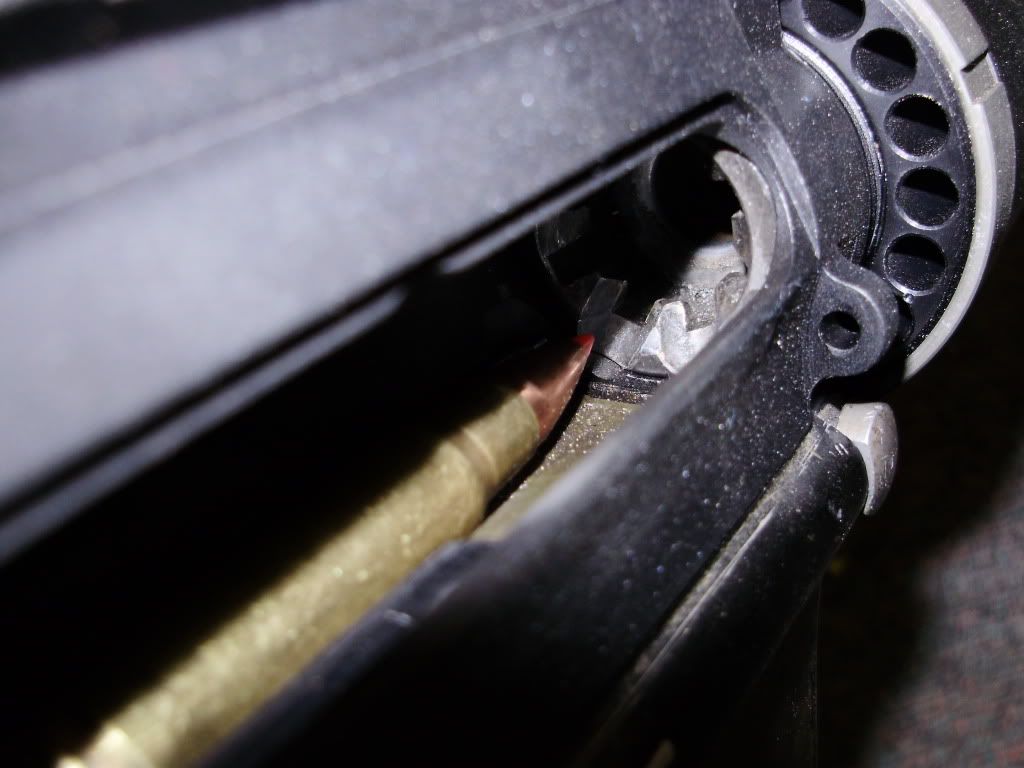
AR Performance photo |
|
Quoted:
1. Looks like reloads that were not crimped ? 2. Agree that the ramps could be cleaner. 3. Part of this could be mag related. A good or tuned mag will present the cartridge at a better height and angle. 4. Bullet set back can cause extremme over pressure. Get it solved before doing anymore shooting. I agree. Poor match on the ramps between the BE and upper. It's a easy diy fix or send it back to Rainier, they are good to work with. See how it feeds M193 NATO builds. |
|
Quoted:
Quoted:
Quoted:
Normal,the scratches on the rounds are from You hand cycling and the round coming back out of the feed ramps. NORMAL. Keith Yup...This If only someone had posted that halfway up the page 
The long light scratches are coming from the lugs when the live round is being extracted, but the short deep gouges are as the bullet is being driven forward up across the feed ramps (look at the gouge direction). The feed ramps need to be polished and de-bured for starters, then the barrel extension and the upper receiver extended ramps need to be bended as well. Hence, if someone is going to copy Colts M-4 extended ramps, you would think that at least they would get the specs right. 
|
|
Quoted:
Quoted:
Quoted:
Quoted:
Normal,the scratches on the rounds are from You hand cycling and the round coming back out of the feed ramps. NORMAL. Keith Yup...This If only someone had posted that halfway up the page
The long light scratches are coming from the lugs when the live round is being extracted, but the short deep gouges are as the bullet is being driven forward up across the feed ramps (look at the gouge direction). The feed ramps need to be polished and de-bured for starters, then the barrel extension and the upper receiver extended ramps need to be bended as well. Hence, if someone is going to copy Colts M-4 extended ramps, you would think that at least they would get the specs right.
Dano You are correct ,I DO SEE THE DEEP SHORT GOUGES,in the direction of going into battery not on ejection. GOOD EYE 
|
|
Quoted:
Normal,the scratches on the rounds are from You hand cycling and the round coming back out of the feed ramps. NORMAL. Keith Those deep scratches and the bullets pushed in to the case are not NORMAL. Look again. Bullets pushed in to the case can cause excess chamber pressure, not a good thing. |
|
Quoted:
Bullets pushed in to the case can cause excess chamber pressure, not a good thing. Yes, no, maybe, To many times I have come across compressed loads in data, and with so much extra powder listed of what the case could tangibly hold, it would take all day compressing and compacting the powder with a jack hammer in the case before you could get everything listed in the data into the case (much less the bullet afterwards as well). But either way, with a bullet set back, the jump to lands is going to be brutal for a clean engagement into the rifling on fired embed, and end up with just a wild flyer instead. |
|
Quoted:
OP, if you manually cycled those rounds out of the gun then those marks are to be expected. The bullets are being cammed against the lugs as they are pulled out of the chamber. It's normal. This. The scratches are completely normal. My Noveske SBR does the same thing on manually ejected rounds. And I'd like to think Noveske knows a thing or two about how to assemble a rifle. You have to remember, once a round is chambered, the design of the gun is to shoot the bullet out the muzzle end, not extract it intact back out of the chamber. It is a one way street, so to speak. Will the rifle extract and eject a full round? Yes. Will it still look all pretty? No. Even if the feed ramps are perfectly lapped and flush, the peak in between the two feed ramps is sharp, and the round doesn't ride upon the feed ramps on its way out of the chamber. When the round goes into the chamber it is either coming from the left or the right side of the magazine, and riding on it's respective feed ramp. When it is coming out of the chamber, it is going to come straight back down the center, probably riding the sharp peak in between the 2 feedramps. It comes out at a completely different angle, and it is going to scrape against something that it won't hit on its way in. By the way I have about 1100 or 1200 flawless rounds through mine. I'd say as long as it shoots well, just shoot it. I wouldn't worry about anything like that unless you were having clambering/ ejection issues. ******Edit for the fact that I didn't see the rounds that were pushed into the casings that far. I would inspect your ammo to at least eyeball the OAL to rule out that it didn't go in the chamber like that. |
|
I didn't want to contribute any more to this stupid debate... except I see a legitimate safety concern here, and most of the posters are saying everything is normal.
Bullets do not get pushed in by manually extracting them. If you press a bullet into the case until it falls in, it will get stuck behind the case neck, meaning that it forms a tight seal around the stuck bullet as the gas pressure builds enough to burst through the chamber wall. Yes, if you have the case loaded to full capacity with certain powders, the pressure will also be excessive if the bullet further compacts the powder. But that is not the primary hazard here. It could be the ammo, or more likely it is the problem documented in the OP's picture (the feed ramps are not correct). Whatever the cause, this is a major safety issue that needs to be addressed before you shoot it again. Also if the bullet is pushed too far into the case, there is a jump to the lands, causing accuracy problems in the short term, and gas sealing problems leading to throat erosion later on. Don't expect very good barrel life if the gun doesn't blow up first. There are deep scratches on the bullet. These are not a safety issue, but it will lead to accuracy problems, and might damage the jacket enough to cause penetration problems when used for hunting. Deep scratches cannot be caused by extraction because the weight of the round is insufficient to cut that far into the metal. Try dragging a knife against a sheet of aluminum. The weight of the knife alone only creates a small scratch. Now press a little harder and see how deep it cuts. Aluminum is softer than copper, the knife is sharper than the locking lugs and heavier then a 5.56 round. When in the chamber, the round is precisely centered. Depending on the extractor tension as it pulls the round out of the chamber, the round may not even fall away from the centered position until it is bumped by the ejector. Unless you stop in the middle, it might not even touch the lugs on the way out. The only force large enough to cause scratches like that are caused during feeding. When the position in not precise, and it is knocked into alignment by whatever is in the way. |
|
Quoted:
Quoted:
Bullets pushed in to the case can cause excess chamber pressure, not a good thing. Yes, no, maybe, To many times I have come across compressed loads in data, and with so much extra powder listed of what the case could tangibly hold, it would take all day compressing and compacting the powder with a jack hammer in the case before you could get everything listed in the data into the case (much less the bullet afterwards as well). But either way, with a bullet set back, the jump to lands is going to be brutal for a clean engagement into the rifling on fired embed, and end up with just a wild flyer instead. Agree. The high pressure thing for "set back" bullets comes from the pistol world. Seating depth on rifle rounds are not usually pressure sensitive and there are very few powders that compressed loads are warned against. I don't know how you can describe that as " NORMAL". I hunt with my AR and have to load and unload it on a regular basis and have NEVER had any damage to my NON-CRIMPED ammo of any kind and I have used at least 10 different bullets from 50gr to 69gr. |
|
Quoted:
PFC, "The ejector in an AR applies constant pressure." On that point I stand corrected. But I would still argue it is not enough pressure to cut into the copper jacket. Absolutely correct. That rifle has a FEEDING problem. Only feeding has enough force to cause what is happening to that ammo. |
|
Quoted:
PFC, "The ejector in an AR applies constant pressure." On that point I stand corrected. But I would still argue it is not enough pressure to cut into the copper jacket. Actually that was intended to be a comment on the technical operation of the ejector, not anything else. |
|
Motor1, normal for the bullets to get scrapped off the right hand side barrel lugs on manual extraction of a live round. The ejector is caming the live case to the ejection side, and as soon as the bullets section leaves the chamber, they are pushed to contract the right hand lug instead.
As for the gouging and bullet set back at loading, again not normal (bad infact), and the feed ramps on the barrel extension needs re-worked, then the upper receiver extended ramps work to match the now correct barrel feed ramps. |
AR Sponsor