


AR Sponsor

[ARCHIVED THREAD] - Gas system question (Page 1 of 2)
Posted: 11/20/2016 6:33:24 PM EDT
| Does the length of the barrel matter in regards to what gas system your AR utilizes? I'm looking at 16 inch uppers from BCM and they offer midlength and carbine for 16 inches. Even though the price on the midlength is a little more expensive, is it a better benefit to use it? |
|
Quoted:
Does the length of the barrel matter in regards to what gas system your AR utilizes? Yes. In general you will have a much more satisfactory AR15 experience with a rifle configuration that uses a gas system length that is well matched to the barrel length. Midlength is a much better option for a 16" barrel. |
|
Quoted:
http://www.bravocompanyusa.com/BCM-BFH-16-Mid-Length-Upper-Receiver-Group-p/bcm-urg-mid-16%20bfh.htm Any thoughts? Quoted:
http://www.bravocompanyusa.com/BCM-BFH-16-Mid-Length-Upper-Receiver-Group-p/bcm-urg-mid-16%20bfh.htm Any thoughts? BCM is a known entity as far as reasonable quality products, but overpriced IMO. Add a BCG, handguard and rear sight to that and you're practically at the price of a comparable complete rifle. Personally I'm not a fan of the government profile barrel and tend to avoid them. Quoted:
http://www.bravocompanyusa.com/BCM-Standard-16-M4-SOCOM-Upper-Receiver-p/bcm-urg-m4-16socom.htm If i was going for a carbine upper it would be this but it has a mid weight profile. Don't know if it's good enough for a carbine It's not a midweight, those are solidly in the "HBAR" heavy barrel weight class. Personally I would never (again) buy a carbine gas 16" (in 5.56/223). |
|
Here is a quick graphic of how the gas system works.
https://everydaymarksman.files.wordpress.com/2015/03/387bf-ar15-gasimpingement.gif The longer length between the gas port and the muzzle results in more gas going through the gas tube, moving the bolt carrier group, and increasing felt recoil (all else being equal). So the mid length has a shorter length between the gas port and muzzle, and therefore less recoil. This is oversimplified, because if the gas port is too large, that will negate the midlength advantage. BCM has excellent gas port sizes. Many people are moving away from government profiles, because the thicker barrel profile at the muzzle increases weight at the end with no real benefit for most people. Contrast that with BCMs ELW profile and the ELW will handle much easier due to a noticeable weight reduct at the end of the barrel. Having said all that, different strokes for different folks. If you're aware of advantages/disadvantages and prefer something, people still buy all sorts of different profiles. |
|
Quoted:
Here is a quick graphic of how the gas system works. https://everydaymarksman.files.wordpress.com/2015/03/387bf-ar15-gasimpingement.gif The longer length between the gas port and the muzzle results in more gas going through the gas tube, moving the bolt carrier group, and increasing felt recoil (all else being equal). So the mid length has a shorter length between the gas port and muzzle, and therefore less recoil. This is oversimplified, because if the gas port is too large, that will negate the midlength advantage. BCM has excellent gas port sizes. Many people are moving away from government profiles, because the thicker barrel profile at the muzzle increases weight at the end with no real benefit for most people. Contrast that with BCMs ELW profile and the ELW will handle much easier due to a noticeable weight reduct at the end of the barrel. Having said all that, different strokes for different folks. If you're aware of advantages/disadvantages and prefer something, people still buy all sorts of different profiles. Do you have any personal preferences on different barrel profiles? Im currently AD in the military and I'm used to gov profiles on the m4 carbine. It's the only rifle I've ever fired repeatedly. I just didn't know people were straying away from gov barrels. I'm guessing people are going for lightweight profiles? |
|
Quoted:
why wouldn't you go for a carbine gas Quoted:
why wouldn't you go for a carbine gas Because it just is wrong for a 16" barrel. Correct gas system length just makes a tremendous difference in shooting feel, and improves reliability and parts longevity. The simplicity of the parts of the AR15 gas system belies some of the complexities of how it all works. If you know anything about engines you know that timing is critical, stuff has to happen at the right time for everything to work smoothly. Timing is also important in the AR15, there are numerous pressures, forces and movements going on and having things timed correctly makes a difference, and the only real way to time the operating system of an AR15 is to adjust the gas system length to be appropriate to the overall barrel length chosen. and why aren't you a fan of a gov profile barrel? Because it's the dumbest way to make a barrel. If you know anything about how barrels work, you just look at it and say "that's wrong". I mean, it goes bang and the bullet goes out the end, I just prefer for things to be better so I pick better options. I would rather have a barrel that doesn't have the excess weight hanging off the front, or else put that weight to good use and improve the performance and handling. |
|
Quoted:
And correct me if I'm wrong but socom barrel profiles are alot better than a Gov since it's thicker under the handguards and it's better to shoot with. Depends on your definition of "better". Socom profile is heavy, since the SOCOM guys often use their rifles like light support weapons, so they need a heavy barrel to soak up heat from a bunch of rounds. Heavier rifle also moves less in recoil. (Everyone Army-wide is now being saddled with the SOCOM profile in the political aftermath of the Afghanistan firefight several years ago where the outpost was nearly overrun. IMO the lesson should have been to have enough support weapons, and train people to use them, but I guess it's easier to put a heavy barrel on all the rifles so you "did something" and sweep the rest under the rug.) The downside is, it's heavy. More tiring to carry, slower to handle. If you're young and spry, have fun swinging a heavy rifle around. Someday you'll probably understand why not everyone is into that. |
|
Quoted:
Depends on your definition of "better". Socom profile is heavy, since the SOCOM guys often use their rifles like light support weapons, so they need a heavy barrel to soak up heat from a bunch of rounds. Heavier rifle also moves less in recoil. (Everyone Army-wide is now being saddled with the SOCOM profile in the political aftermath of the Afghanistan firefight several years ago where the outpost was nearly overrun. IMO the lesson should have been to have enough support weapons, and train people to use them, but I guess it's easier to put a heavy barrel on all the rifles so you "did something" and sweep the rest under the rug.) The downside is, it's heavy. More tiring to carry, slower to handle. If you're young and spry, have fun swinging a heavy rifle around. Someday you'll probably understand why not everyone is into that. Quoted:
Quoted:
And correct me if I'm wrong but socom barrel profiles are alot better than a Gov since it's thicker under the handguards and it's better to shoot with. Depends on your definition of "better". Socom profile is heavy, since the SOCOM guys often use their rifles like light support weapons, so they need a heavy barrel to soak up heat from a bunch of rounds. Heavier rifle also moves less in recoil. (Everyone Army-wide is now being saddled with the SOCOM profile in the political aftermath of the Afghanistan firefight several years ago where the outpost was nearly overrun. IMO the lesson should have been to have enough support weapons, and train people to use them, but I guess it's easier to put a heavy barrel on all the rifles so you "did something" and sweep the rest under the rug.) The downside is, it's heavy. More tiring to carry, slower to handle. If you're young and spry, have fun swinging a heavy rifle around. Someday you'll probably understand why not everyone is into that. Yeah I understand it's just i like my barrel to be durable and accurate. Government profile hasn't been an issue to me since I've only fired the m4 carbine. Lightweight does sound better but with my experience with the gov is that it took a lot of abuse. I'm not saying I intentionally bang it on concrete but we constantly train with it everyday. |
|
Quoted:
Yeah I understand it's just i like my barrel to be durable and accurate. Government profile hasn't been an issue to me since I've only fired the m4 carbine. Lightweight does sound better but with my experience with the gov is that it took a lot of abuse. I'm not saying I intentionally bang it on concrete but we constantly train with it everyday. Quoted:
Quoted:
Quoted:
And correct me if I'm wrong but socom barrel profiles are alot better than a Gov since it's thicker under the handguards and it's better to shoot with. Depends on your definition of "better". Socom profile is heavy, since the SOCOM guys often use their rifles like light support weapons, so they need a heavy barrel to soak up heat from a bunch of rounds. Heavier rifle also moves less in recoil. (Everyone Army-wide is now being saddled with the SOCOM profile in the political aftermath of the Afghanistan firefight several years ago where the outpost was nearly overrun. IMO the lesson should have been to have enough support weapons, and train people to use them, but I guess it's easier to put a heavy barrel on all the rifles so you "did something" and sweep the rest under the rug.) The downside is, it's heavy. More tiring to carry, slower to handle. If you're young and spry, have fun swinging a heavy rifle around. Someday you'll probably understand why not everyone is into that. Yeah I understand it's just i like my barrel to be durable and accurate. Government profile hasn't been an issue to me since I've only fired the m4 carbine. Lightweight does sound better but with my experience with the gov is that it took a lot of abuse. I'm not saying I intentionally bang it on concrete but we constantly train with it everyday. Government profiles are the same as lightweight where it matters, just with extra weight hanging off the front that really does nothing for performance. You can get a barrel that is the same weight as a government profile, but that puts the weight where it actually improves durability and accuracy. |
|
Quoted:
There are so many options nowadays in the AR15 world it's pretty overwhelming to newcomers. Quoted:
Quoted:
Man these decisions are too much There are so many options nowadays in the AR15 world it's pretty overwhelming to newcomers. It is really. so many pros and cons for each barrel. I'm just going to stick with what I know. Gov is heavier but I haven't really had any problems firing it other than crappy GOV issued M4s. But that's just me because I never handled a lightweight profile. |
|
Quoted:
What experience did you have with it? Quoted:
Quoted:
Personally I would never (again) buy a carbine gas 16" (in 5.56/223). This! What experience did you have with it? Lots Still have my Windham carbine. Great rifle. That said I would only think about another 16" with mid gas system Or 18 and 20 with rifle gas Or a 14.5 with carbine gas They tend to shoot softer and are a bit easier on parts. |
|
The location of the gas port on a mid length does a few things for you.
When the bullet passes the gas port, the pressure of the gas is lower ( don't sweat it, the gas port is bigger so you get a larger volume of gas) This farther forward port location begins the bolt unlocking sequence a little later than the carbine. At the time the unlocking begins, the residual chamber pressure is lower. This puts less stress on the bolt body and bolt locking lugs during the unlock and extraction portion of the AR15 firing cycle. Since the case at this time also has less outward pressure and therefore less grip on the chamber walls, extraction of the spent case a little easier. The higher volume of lower pressure gas mentioned earlier ? this has an effect analogous to a long firm push to the bolt carrier group instead of short quick shove. What this means is your bolt is moving a little bit slower which in turn gives your magazine spring a little more time to raise the next round up to the magazine feed lips for in improvement in feeding reliability. It also makes it a little more tolerant of less than perfect magazine springs. These differences between carbine length and mid length gas systems are small. But they are meaningful in that they aid in reliability and lessen wear and tear on parts and smoothen out the operating cycle. Some guys can't feel the difference but most can. Some guys like it some guys don't. Some guys don't care either way about how a thing feels as long it works. Nobody is suggesting that a carbine length gas system is going to blow up your face. Just that there are options to fit your preferences whatever they may be. |
|
Quoted:
The location of the gas port on a mid length does a few things for you. When the bullet passes the gas port, the pressure of the gas is lower ( don't sweat it, the gas port is bigger so you get a larger volume of gas) This farther forward port location begins the bolt unlocking sequence a little later than the carbine. At the time the unlocking begins, the residual chamber pressure is lower. This puts less stress on the bolt body and bolt locking lugs during the unlock and extraction portion of the AR15 firing cycle. Since the case at this time also has less outward pressure and therefore less grip on the chamber walls, extraction of the spent case a little easier. The higher volume of lower pressure gas mentioned earlier ? this has an effect analogous to a long firm push to the bolt carrier group instead of short quick shove. What this means is your bolt is moving a little bit slower which in turn gives your magazine spring a little more time to raise the next round up to the magazine feed lips for in improvement in feeding reliability. It also makes it a little more tolerant of less than perfect magazine springs. These differences between carbine length and mid length gas systems are small. But they are meaningful in that they aid in reliability and lessen wear and tear on parts and smoothen out the operating cycle. Some guys can't feel the difference but most can. Some guys like it some guys don't. Some guys don't care either way about how a thing feels as long it works. Nobody is suggesting that a carbine length gas system is going to blow up your face. Just that there are options to fit your preferences whatever they may be. Thanks for the info. I will stick with options that I'm familiar with. I've never fired from a mid length AR, I'll look into it since I want to try something different. We only arm up with m4 carbines on duty so that's the only weapon system I'm familiar with. Never had problems with it although it's a military rifle not a civilian. |
|
Quoted:
The location of the gas port on a mid length does a few things for you. When the bullet passes the gas port, the pressure of the gas is lower ( don't sweat it, the gas port is bigger so you get a larger volume of gas) This farther forward port location begins the bolt unlocking sequence a little later than the carbine. At the time the unlocking begins, the residual chamber pressure is lower. This puts less stress on the bolt body and bolt locking lugs during the unlock and extraction portion of the AR15 firing cycle. Since the case at this time also has less outward pressure and therefore less grip on the chamber walls, extraction of the spent case a little easier. The higher volume of lower pressure gas mentioned earlier ? this has an effect analogous to a long firm push to the bolt carrier group instead of short quick shove. What this means is your bolt is moving a little bit slower which in turn gives your magazine spring a little more time to raise the next round up to the magazine feed lips for in improvement in feeding reliability. It also makes it a little more tolerant of less than perfect magazine springs. These differences between carbine length and mid length gas systems are small. But they are meaningful in that they aid in reliability and lessen wear and tear on parts and smoothen out the operating cycle. Some guys can't feel the difference but most can. Some guys like it some guys don't. Some guys don't care either way about how a thing feels as long it works. Nobody is suggesting that a carbine length gas system is going to blow up your face. Just that there are options to fit your preferences whatever they may be. The thing you're missing is when things get dirty. The carbine gas length is going to help greatly. As far as what I do is I go with a carbine and a adjustable gas option. Or just get a heavier buffer. A H or H2 buffer is usually good enough for a Carbine length gas system. |
|
Quoted:
Incorrect. Mistimed gas systems do not make for a more reliable configuration. Correct timing provides the largest operating envelope. Quoted:
Quoted:
The thing you're missing is when things get dirty. The carbine gas length is going to help greatly. Incorrect. Mistimed gas systems do not make for a more reliable configuration. Correct timing provides the largest operating envelope. What I don't understand is that alot of people diss the carbine but yet a Colt le6920 or a Smith and Wesson mp sport two is recommended for any first time AR owners. It also surprises me that companies will build their ARs in a 16 inch barrel configuration. I'm guessing it's because customers won't have to worry about the hassle of owning an SBR. |
|
Quoted:
The carbine length gas sytem was devised for 10.5 -11.5 inch barrels and the pressure curves that go with them. Yes, "devised", not "designed". Like many of the early Colt AR variants, things were fabricated, then they messed around until they got it to work, little "serious" engineering. The carbine length gas system was not 'designed', it is merely a by product of "making something". The original shorty barrel length was picked simply because they needed to get the overall length under 30 inches, similar to other folding stock carbines, such as the Stoner 63 carbine with a 16" barrel, which was about 26-27 folded. Because the AR design had the receiver extension, making a simple folding stock was not possible, the barrel had to be shortened to make the target overall length. The carbine length gas system what you get when you have a 10.5" barrel (the longest barrel possible for a 28 inch collapsed length), with a threaded muzzle and the fight sight base. When the 10.5 didn't work that well the pushed the length out an inch, which helped, but not enough. That's why the moderator was introduced. |
|
I would guess that most AR's sold in the last 15 years are carbine gas with M4/Govmnt profile, and they all seem to work. The M4/Govmnt profile is silly. The Soccom or a heavy barrel has benefits, as does the mid length gas system. Carrying a rifle all day is not in my job description, so the extra weight to me is desirable.
If you buy a quality upper with whatever profile and whatever gas system it should work just fine, and be adequately accurate. . |
|
Quoted:
When the 10.5 didn't work that well the pushed the length out an inch, which helped, but not enough. That's why the moderator was introduced. My understanding was that the moderator made little to no difference in gas system performance. The stated reason for the moderator was an attempt to make the sound signature similar to the sound signature of the full size rifle, ostensibly to obscure the presence of specialized users (SF, LRRP, etc) vs regular forces. 11.5 carbine gas setups generally run like a top with no fuss. Pretty close to the sweet spot for the carbine gas system in 223/5.56. The 14.5" is simply the product of using a carbine gas system and then extending the barrel to the right length to mount a regular M16 bayonet. |
|
Quoted:
What are the actual lengths of the "mid" and "carbine" gas systems, and measured from where when you have the barrel blank in hand? Are you finish machining the barrels yourself? I have a couple prints and found a couple more online which are all (mostly) in agreement for midlength... 9.370" from breech face to handguard ring shoulder. Then .300 from shoulder to gas port centerline. I found both 7.360 and 7.370 for carbine, I would be more tempted to believe 7.370. |
|
I have shot various ARs in various configurations.
Gas port diameter is more important than gas system length. A Colt 6920 with a 16" barrel and a carbine length gas system shoots smother than an AR with 16" middy and an oversized gas port. Changing the length of the gas system does not increase or decrease recoil energy. It might change how it feels- softer or sharper A 16" Colt 6920 barrel weighs 2 lbs, 3 oz. A Colt 14.5" SOCOM barrel weighs 2 lbs 5 oz. The weight of the SOCOM barrel is closer to the balance point of the AR and to me, handles better |
|
Quoted:
I have shot various ARs in various configurations. Gas port diameter is more important than gas system length. A Colt 6920 with a 16" barrel and a carbine length gas system shoots smother than an AR with 16" middy and an oversized gas port. Changing the length of the gas system does not increase or decrease recoil energy. It might change how it feels- softer or sharper A 16" Colt 6920 barrel weighs 2 lbs, 3 oz. A Colt 14.5" SOCOM barrel weighs 2 lbs 5 oz. The weight of the SOCOM barrel is closer to the balance point of the AR and to me, handles better That's what im wondering. Can't decide between a midlength BCM or a BCM 16 inch socom |
|
ill go against the grain here a bit.
I have built several Ar's now with a variety of barrel lengths and gas systems. I cannot tell the difference between a 16" middy and a Carbine Gassed rifle... My most reliable rifler actually is a 16" Carbine Gassed Stag with thousands of rounds through it. I couldn't really tell the difference until i got to 18" and went with a rifle gas system, it felt much softer. You can also correct over gassed symptoms with a heavy buffer. Carbine gassed barrels are also cheaper :)...so buy what you like, and shoot it. |
|
Quoted:
That's what im wondering. Can't decide between a midlength BCM or a BCM 16 inch socom A 16" SOCOM barrel would be even heavier still. In your shoes, I'd buy a Faxon 16" GUNNAR barrel with matched bolt. It has a well thought out profile and by all reports, it's accurate. It's a good value and the company stands behind its product |
|
Quoted:
I have shot various ARs in various configurations. Gas port diameter is more important than gas system length. A Colt 6920 with a 16" barrel and a carbine length gas system shoots smother than an AR with 16" middy and an oversized gas port. Changing the length of the gas system does not increase or decrease recoil energy. It might change how it feels- softer or sharper A 16" Colt 6920 barrel weighs 2 lbs, 3 oz. A Colt 14.5" SOCOM barrel weighs 2 lbs 5 oz. The weight of the SOCOM barrel is closer to the balance point of the AR and to me, handles better Agree |
|
The mid length system is closer to the rifle length in its operating pressures/ dynamics/stress levels than the carbine length system is.
Compared to the carbine length the mid length gives lower port pressure and later unlocking with less load on the locking lugs and less torsional stress on the bolt body at the time of unlocking, lower residual chamber pressure at the time of unlocking and extraction for less case grip on the chamber wall for easier extraction, lower BCG reciprocation speeds increase the time window for magazine spring and follower to present rounds rounds for feeding. Some things to consider. 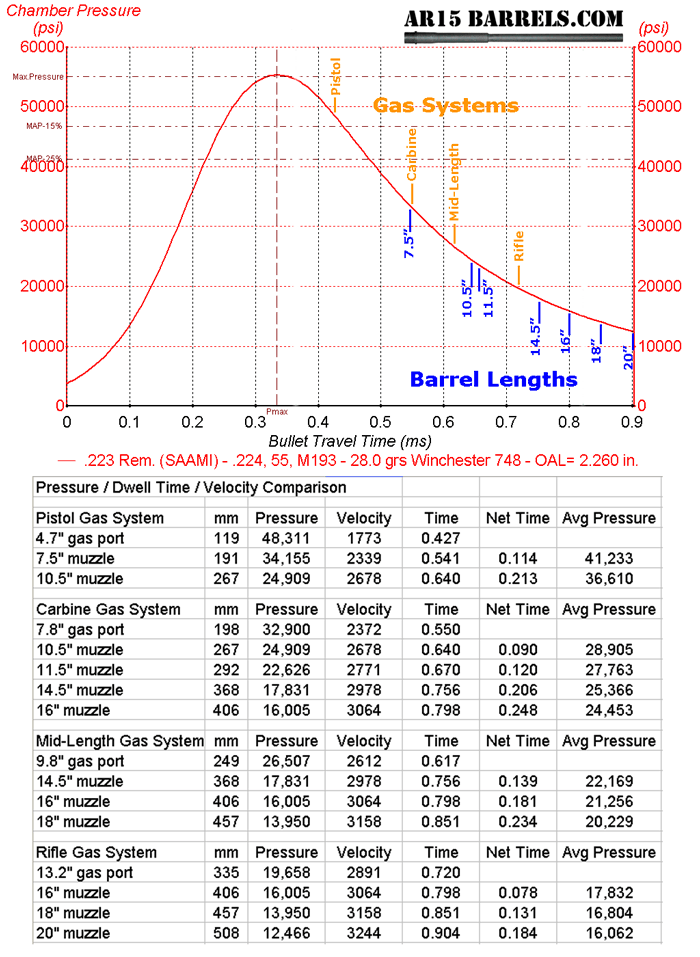
|
|
The "gas system" is simply how far down the barrel the gas port is located. Get a midlength gas system for a 16" barrel if you want it to operate ideally. Get carbine length if you are going with a 14.5" barrel.
https://www.shootingillustrated.com/articles/2014/9/24/ar-gas-system-lengths-explained/ Govt profile is useless unless you plan to mount a grenade launcher to your barrel. If you think you might be ripping through 4+ magazines in rapid fire consistently, then you should look at heavier barrels (govt, socom, hbar, etc). If you plan to shoot semi auto, controlled shots, with a few rapid fire strings here and there, then get a lightweight/pencil barrel. |
|
There is theory, fact, and real world practical application. In theory and fact, the midlength gas port is technically proper. In practice, the difference is one more of perception than reality. There are other factors that affect reliability. Gas port location is but one.
Colt uses a small gas port with its carbine gas system 16" barrel, about .062". Some have found that a larger gas port produces more reliable operation with a wider range of ammunition. Thus many manufacturers have opened up the port to about .080". By doing so they stopped getting the all too frequent gripes about their rifles not shooting the cheap low powered ammo so many people shoot now. Fewer and fewer people are regularly shooting full power 5.56 NATO ammo, for which the smaller gas port makes sense. My CMMG 16" nitride carbine barrel has carbine gas port and a .080" gas port. It will shoot anything and everything I feed it, from full power M855 5.56 NATO to the lowest power .223 plinking ammo. The bolt movement may be a bit "sharper" with the hot stuff, but it cycles beautifully across the full spectrum of ammo. I recently bought a match grade AR barrel from custom barrel maker Lilja. It is a duplicate of the barrel they made for the original Navy SEAL recon rifles. Yes, it has a carbine gas port location and also has a .080" gas port. Yes, these 16" barrels have the "wrong" port location and may be considered to have the "wrong" port diameter. Some may say they are "overgassed." But, they run. They run with anything. All the time. Without fail. If you want to slow the bolt down a bit, simply put in a heavier H-2 buffer. I did do that with the Lilja barreled precision build. I may get a middie someday. But, I really see a lot of fuss and not much objective evidence that the middie actually increases service life or reduces part failure. It probably does have less recoil or muzzle rise, but that may be at the expense of cycling issues with low power ammo. Personally, one man's opinion only, I'd look at all the other specs of the barrel first and if the barrel I wanted happened to be a 16" I'd choose the one with the best combo of specs I was interested in and pay little or no attention to whether the port was at the carbine location or at the midlength location. |
|
Quoted:
There is theory, fact, and real world practical application. In theory and fact, the midlength gas port is technically proper. In practice, the difference is one more of perception than reality. There are other factors that affect reliability. Gas port location is but one. Colt uses a small gas port with its carbine gas system 16" barrel, about .062". Some have found that a larger gas port produces more reliable operation with a wider range of ammunition. Thus many manufacturers have opened up the port to about .080". By doing so they stopped getting the all too frequent gripes about their rifles not shooting the cheap low powered ammo so many people shoot now. Fewer and fewer people are regularly shooting full power 5.56 NATO ammo, for which the smaller gas port makes sense. Quoted:
There is theory, fact, and real world practical application. In theory and fact, the midlength gas port is technically proper. In practice, the difference is one more of perception than reality. There are other factors that affect reliability. Gas port location is but one. Colt uses a small gas port with its carbine gas system 16" barrel, about .062". Some have found that a larger gas port produces more reliable operation with a wider range of ammunition. Thus many manufacturers have opened up the port to about .080". By doing so they stopped getting the all too frequent gripes about their rifles not shooting the cheap low powered ammo so many people shoot now. Fewer and fewer people are regularly shooting full power 5.56 NATO ammo, for which the smaller gas port makes sense. The whole point of using correct gas system lengths is that you have a larger operating envelope, so that there is not a need to do this. My CMMG 16" nitride carbine barrel has carbine gas port and a .080" gas port. It will shoot anything and everything I feed it, from full power M855 5.56 NATO to the lowest power .223 plinking ammo. The bolt movement may be a bit "sharper" with the hot stuff, but it cycles beautifully across the full spectrum of ammo. I recently bought a match grade AR barrel from custom barrel maker Lilja. It is a duplicate of the barrel they made for the original Navy SEAL recon rifles. Yes, it has a carbine gas port location and also has a .080" gas port. Yes, these 16" barrels have the "wrong" port location and may be considered to have the "wrong" port diameter. Some may say they are "overgassed." But, they run. They run with anything. All the time. Without fail. If you want to slow the bolt down a bit, simply put in a heavier H-2 buffer. I did do that with the Lilja barreled precision build. I may get a middie someday. But, I really see a lot of fuss and not much objective evidence that the middie actually increases service life or reduces part failure. It probably does have less recoil or muzzle rise, but that may be at the expense of cycling issues with low power ammo. I wish people would stop repeating bad information. Midlength gas systems in suitable barrel lengths with correct gas port sizes do not have a problem with low power ammo. To the contrary, they are less sensitive to ammo variation. You do not need to run special buffers, or special extractors, or special springs, or any of the other "upgrade" products. BCM did everyone a real disservice by selling a whole bunch of 14.5" midlength gas barrels with undersize gas ports which would only run XM193/XM855 or similar ammo. Thus began the internet mythology that the midlength gas system is defective and can't handle lower power ammo, simply because of the blind faith that was/is entrusted to that brand name. A 14.5 mid with a proper gas port size will run any reasonable ammo perfectly, and a 16" mid certainly has no issues. The commonplace carbine gas 16" barrel is actually a very good marketing strategy for firearms manufacturers. It's engendered a huge market in "upgrade" accessory parts. Personally, one man's opinion only, I'd look at all the other specs of the barrel first and if the barrel I wanted happened to be a 16" I'd choose the one with the best combo of specs I was interested in and pay little or no attention to whether the port was at the carbine location or at the midlength location. Gas system setup is one of the most important factors in the whole firearm function cycle. |
|
Quoted:
The whole point of using correct gas system lengths is that you have a larger operating envelope, so that there is not a need to do this. I wish people would stop repeating bad information. Midlength gas systems in suitable barrel lengths with correct gas port sizes do not have a problem with low power ammo. To the contrary, they are less sensitive to ammo variation. You do not need to run special buffers, or special extractors, or special springs, or any of the other "upgrade" products. BCM did everyone a real disservice by selling a whole bunch of 14.5" midlength gas barrels with undersize gas ports which would only run XM193/XM855 or similar ammo. Thus began the internet mythology that the midlength gas system is defective and can't handle lower power ammo, simply because of the blind faith that was/is entrusted to that brand name. A 14.5 mid with a proper gas port size will run any reasonable ammo perfectly, and a 16" mid certainly has no issues. The commonplace carbine gas 16" barrel is actually a very good marketing strategy for firearms manufacturers. It's engendered a huge market in "upgrade" accessory parts. Gas system setup is one of the most important factors in the whole firearm function cycle. Yup, if you do the math, the optimum place for the gas port is about 6.500" to 7.125" from the muzzle with the AR-type gas tube, bolt carrier. These are a few plots of the pressure inside the carrier cylinder for an M16A1. The total area under the curve is proportional to the total energy delivered to the system. 
If you shorten the distance from the gas port to the muzzle (RLGS and an 18" bbl) the peak pressure goes up (see below), but the horizontal distance remains the same. The peak pressure goes up because you have to increase the port size to get the same required volume of gas into the system in a shorter time. The horizontal distance stays the same because that is governed by how fast the gas can leave the system from the back (carrier) end of the system which is unchanged. If the peak gets taller, and the horizontal distance remains the same, the area (energy) increases. Yes, you can tame this extra energy with a heavier buffer, however, with lower port pressures (weaker ammo), the pressure in the carrier drops dramatically. Note the peak pressure in the normal case: 2000 to 2200 psi, the port pressure is over 6 to 7 times that. There is a lot of pressure drop between the port and the carrier, most of it at the port, so you get considerably less volume of gas with weaker ammo. 
If you lengthen the distance from the port to the muzzle, the peak remains the same (RLGS and a 22" bbl), and the horizontal distance remains the same, the the shape of the peak changes from a sharp point to a much more broad hump (see below). This is because the barrel is pressurized longer and pumps more gas into the system. In most cases this is worse that above, because broadening the top of the peak is a much more efficient way to increase the area under the curve. Again, yes, you can tame this with a heavier buffer, but with lower port pressures the peak pressure drops, and when the pressure in the carrier drops the carrier velocity drops. You can also tame this system with a smaller port and just lower the peak pressure. But, there is another part of the equation. The two faint vertical line denote the start of unlocking and the completion of unlocking. During this time, you need sufficient bolt carrier momentum (ie velocity) to effect extraction of the spent case. By broadening and lowering the peak you have moved when the energy is delivered, if the energy is delivered to late in the cycle, you have poor extraction. 
Can it be balanced out, certainly, hundreds of thousands of CLGS run today with 16" barrels. Is it optimum? No. Just read through the "my AR does work right..." threads, the operating range is much narrower. Oh, and mid-length, 16" bbls work over the largest range with standard weight buffers and 0.078" to .086", ports. |
|
Quoted:
The whole point of using correct gas system lengths is that you have a larger operating envelope, so that there is not a need to do this. I wish people would stop repeating bad information. Midlength gas systems in suitable barrel lengths with correct gas port sizes do not have a problem with low power ammo. To the contrary, they are less sensitive to ammo variation. You do not need to run special buffers, or special extractors, or special springs, or any of the other "upgrade" products. BCM did everyone a real disservice by selling a whole bunch of 14.5" midlength gas barrels with undersize gas ports which would only run XM193/XM855 or similar ammo. Thus began the internet mythology that the midlength gas system is defective and can't handle lower power ammo, simply because of the blind faith that was/is entrusted to that brand name. A 14.5 mid with a proper gas port size will run any reasonable ammo perfectly, and a 16" mid certainly has no issues. The commonplace carbine gas 16" barrel is actually a very good marketing strategy for firearms manufacturers. It's engendered a huge market in "upgrade" accessory parts. Gas system setup is one of the most important factors in the whole firearm function cycle. Quoted:
Quoted:
There is theory, fact, and real world practical application. In theory and fact, the midlength gas port is technically proper. In practice, the difference is one more of perception than reality. There are other factors that affect reliability. Gas port location is but one. Colt uses a small gas port with its carbine gas system 16" barrel, about .062". Some have found that a larger gas port produces more reliable operation with a wider range of ammunition. Thus many manufacturers have opened up the port to about .080". By doing so they stopped getting the all too frequent gripes about their rifles not shooting the cheap low powered ammo so many people shoot now. Fewer and fewer people are regularly shooting full power 5.56 NATO ammo, for which the smaller gas port makes sense. The whole point of using correct gas system lengths is that you have a larger operating envelope, so that there is not a need to do this. My CMMG 16" nitride carbine barrel has carbine gas port and a .080" gas port. It will shoot anything and everything I feed it, from full power M855 5.56 NATO to the lowest power .223 plinking ammo. The bolt movement may be a bit "sharper" with the hot stuff, but it cycles beautifully across the full spectrum of ammo. I recently bought a match grade AR barrel from custom barrel maker Lilja. It is a duplicate of the barrel they made for the original Navy SEAL recon rifles. Yes, it has a carbine gas port location and also has a .080" gas port. Yes, these 16" barrels have the "wrong" port location and may be considered to have the "wrong" port diameter. Some may say they are "overgassed." But, they run. They run with anything. All the time. Without fail. If you want to slow the bolt down a bit, simply put in a heavier H-2 buffer. I did do that with the Lilja barreled precision build. I may get a middie someday. But, I really see a lot of fuss and not much objective evidence that the middie actually increases service life or reduces part failure. It probably does have less recoil or muzzle rise, but that may be at the expense of cycling issues with low power ammo. I wish people would stop repeating bad information. Midlength gas systems in suitable barrel lengths with correct gas port sizes do not have a problem with low power ammo. To the contrary, they are less sensitive to ammo variation. You do not need to run special buffers, or special extractors, or special springs, or any of the other "upgrade" products. BCM did everyone a real disservice by selling a whole bunch of 14.5" midlength gas barrels with undersize gas ports which would only run XM193/XM855 or similar ammo. Thus began the internet mythology that the midlength gas system is defective and can't handle lower power ammo, simply because of the blind faith that was/is entrusted to that brand name. A 14.5 mid with a proper gas port size will run any reasonable ammo perfectly, and a 16" mid certainly has no issues. The commonplace carbine gas 16" barrel is actually a very good marketing strategy for firearms manufacturers. It's engendered a huge market in "upgrade" accessory parts. Personally, one man's opinion only, I'd look at all the other specs of the barrel first and if the barrel I wanted happened to be a 16" I'd choose the one with the best combo of specs I was interested in and pay little or no attention to whether the port was at the carbine location or at the midlength location. Gas system setup is one of the most important factors in the whole firearm function cycle. I don't know how else to say it: 16" carbine port barrels with .080" ports became an industry standard for years for one reason my experience confirms -- they reliably shoot everything. Everything. Without fail. Always. I'm not opposed to midlength gas system 16" barrels. I just think that in actual practice, the difference in performance in port location is slight at best. |
|
16 inch barrel with carbine length gas system became standard for that barrel length because until about 1994 it was the only choice other then a 20 inch barrel rifle length system.
Eta The carbine length gas system was originally devised for the 10.5 and 11.5 inch barreled CAR-15 / XM177 Increasing the barrel length to16 inches and deleting the NFA naughty capability made for street legal version. |
|
Quoted:
16 inch barrel with carbine length gas system became standard for that barrel length because until about 1994 it was the only choice other then a 20 inch barrel rifle length system. And something else to consider, is that the traditional AR15 build was dependent on handguards of the correct length. Making gas tubes of any length is trivial... making molds for a different handguard would have been expensive. And people really didn't understand the intricacies of how it worked. Before the adoption of the M4 as standard issue, the shorter AR15 configurations were really more a novelty. |
|
This has been a fascinating and insightful discussion and has raised a few questions of my own. A few people noted that the carbine length is ideal for 11.5". I also remember reading that port size can make a big difference in felt recoil in an SBR, both with and without a suppressor.
If I'm looking to optimize performance on an SBR build, what gas port size should I look for? If I'm looking at complete uppers, I assume that's something found in the specs and not something I can adjust? And is there any company to gravitate towards or move away from as a result of gas port/system performance for an SBR? Finally, I've read about adjustable gas systems. Is this worth the extra effort? How common is it? Thanks |
[ARCHIVED THREAD] - Gas system question (Page 1 of 2)
AR Sponsor