


AR Sponsor

Posted: 12/30/2006 4:05:26 PM EDT
|
OK... I understand the idea here (MPT). But this sounds like an episode of Penn & Teller's BS Ideas?? |


|
Sorry, I guess that was a little vauge. I'll spell it out OK... I understand the idea here (MPT). MEANING--- I understand the testing of the metal for flaws, Impurities, hair line fractures ECT. But this sounds like an episode of Penn & Teller's BS. MEANING Is paying the extra $20 for MP testing worth it OR is it a BS was of making money? !!! Ideas?? MEANING What do the AR15 members think? |
|
Click & Learn "Magnetic Particle Inspection". It works just as advertised!! As far as it being worth an extra $20? Is your face/Head/hand/any body part (POSSIBLY your life) that is next to the action of a gun when it KABOOMS worth $20 to you? Here are a couple of KB photos from an old posting.         |

MPI is simply a method of NDI (non-destructive inspection) used to detect cracks/defects in metal parts... It's used in the aviation world to inspect high-stress, 'critical' metal aircraft parts... It's used to test AR parts (by some companies) for potential failure-causing defects... The point of weather it is a must-have feature is debatable - to some on this board (who 'must have' every military feature designed to enhance field-survivability, the answer is 'yes'... To the rest of us who know our rifle's only duty will be the destruction of paper targets, milk jugs, broken appliances, and maybe the occasional game or pest animal, notsomuch... P.S. As for the KB argument - KBs generally are caused by ammo failures (case-head separation, etc)... |
|
MP testing of new parts , only serves to pick up flaws that were in the material before machining . In fact there are better methods of testing finished parts in an industrial setting . Where MP testing really shines is after a part has been in use for a while and metal fatigue becomes an issue . Unfortunately it's usually cost and time prohibitive for most to do unless they have access to the equipment . Especially on parts like an AR bolt or carrier . Often it's cheaper just to replace it if the round count is high enough . |
+1, it is highly unlikely that flaws will be found in new bolts as-machined. It would be far more beneficial to go back and have our bolts MP'd after XXXXX rounds have been fired. The photos above would likely have happened whether the parts were MP'd or not!!! |
Colt first fires a PROOF LOAD throught the barrel/Bolt subjecting them to It all boils down to do you want the bests mfg. parts in your gun or not? I still do not like how Bushmaster commited Fraud for years by claiming they MP tested bolts & barrels (Even stamping barrels MP), Then admitting they only BATCH TEST Some parts? Edited to more correctly explain the proof load test info. |
+1 to both of these concepts. MP testing does NOT make the parts better, it just makes them BETTER TESTED parts. Posting pictures of a KB'd rifle in an MP testing thread is bad form because many people here don't READ the posts and will ASSUME that MP testing somehow effects KB's and that's certainly not the case. |
Not MANY TIMES MORE PRESSURE than normal, but certainly MORE pressure than normal. Here is the spec sheet that calls out 70,000 PSI as the proof load pressure level. 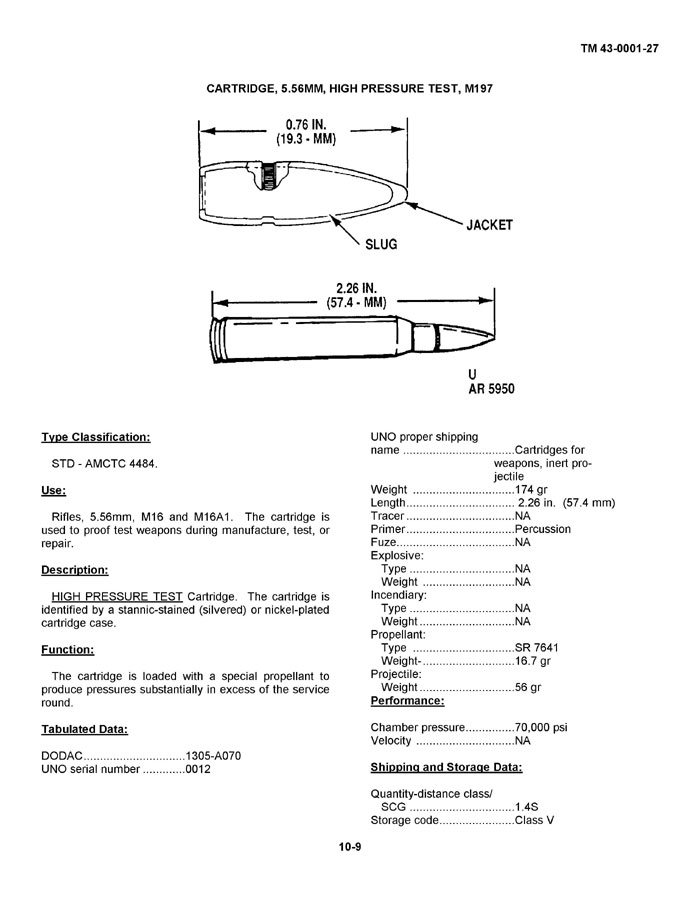
|
Thank you. |
|
I too have data on the M197 high pressure test load. Mine is exacly like yours except for the powder charge. Mine shows 20 grains of HPC-3 double based flake propellant. The pressure is 70,000 PSI + or - 3500 PSI. I suspect one of us has newer data. The original powder may have become unavailable & a substitute used. The army used too make its own powder at Radford arsenal, but in the era of Macnamara & Rumsfields world of turning the military into a business this plant has since been turned over too one of the comercial powder manufacturers, I think Hodgen. So now they have to use what they can get. M9 HPC-3 & SR7641 HPC= Hodgen Powder Company? or High Pressure Cartridge? SR = Small Rifle? |
I think it is indeed relevant. If Colt or FN cull 3 too 4% of the bolts due to defects & other manufacturers using the same bolts don't, then it does indeed increase the odds of getting a bad bolt from another manufacturer. Not shipping those % of bolts with a new weapon decreases the odds of a failure. M9 |
Are you saying that HPT and MPI'd bolts are exempt from KB's? I'm thinking that the kinds of pressures it takes to obliterate an action are well into the 100Kpsi range and that makes MP testing irrelevant in the case of KB's. |
No of course not. Its not always a high pressure rd that lets go. Sometimes its a bad case. Sometimes its a bad bolt. Did the case rupture cause the bolt failure? Did the bolt failure cause the case rupture? You can't always tell. M9 |
I don't have a date at all on mine. It does list M855 also. So its at least that new. Your data may be newer than mine. Some of the data listed goes back too 30-06. Probrably the newest loads listed are the M882 9mm & the M939 9mm AT4 subcaliber tracer for the AT4. Mine is a compiliation of several ordinance documents including Small arms ammunition, vol 2 Office of the chief of ordinance, Small arms ammunition pamplet 23-1 & others. M9 |
Case ruptures don't split bolts, carriers and receivers like banana splits. |
Now ain't that just the QC question of the week. Many manufacturers will MP test without firing an HPT load through the barrel/bolt. The whole MP inspection sorta relies on there being an HPT round first... Without the HPT round, you learn very little from MPI. |
Fixed what I know. Not sure what HPC stands for. IMR xxxx means Improved Military Rifle, and SR xxxx means Sporting Rifle. Dave. |
So what you're saying is that you don't know how CMMG conducts the MPT? I guess I could always call them and ask... |
|
MPI testing tells you that there were no "MPI detectable" flaws in the bolt at the time it was tested. Nothing else is stated or implied. Any further conjecture about whether it will last longer or be safer is not a logical progression. All it tells you is that it is not flawed in the ways that can be found by MPI detection at the time it was tested. It could fail at the very next round fired. Or it could last 50k rounds. No way to tell. The bolts coming before or after it on the production line may very well be every bit as long-lived and reliable as the one that was MPI tested. Because they are not tested, is no indication that they will be a lesser-performing item. If you tested it, it may very well pass just as well as the other ones you tested. The reason why the gov't specifies it is to weed-out bolts that are visibly flawed. Not because they will have any other special qualities or characteristics. MPI is a good test to determine that the bolt is not visibly flawed after a pressure test. MPI is not a good test to determine the life or safety level of a bolt, beyond the fact that it survived an initial pressure test with no cracks. It's great to rely on a test for what it is designed to tell you from the test. To extrapolate some kind of expectation of special characteristics, beyond what the test is designed to tell you, brings you into the realm of unsubstantiated speculation. |
I disagree. Before the pressure ruptures these components, it has to escape from the case/barrel where it is supposed to be sealed & contained. Something lost containment before this banna split occured. This can happen because of excess pressure caused by an excess charge of the wrong powder or a bore obstruction, a faulty case, or a blown bolt. M9 |
Fair enough. But not every case that has a separation results in the catastrophic destruction mentioned above. |
True. If the bolt holds, it is usually limted to a FUBAR extractor & magazine. Which is why it is essential that the bolt holds. So we should use the best bolts manufactering & testing can devolp. All the pooh-poohing of proofing, shot-peening & magnafluxing is by manufacturers that don't take the time to do it. I consider it essential. If the manufacturer doesn't do it, it can be done post manufacture. Proof testing has been an essential part of weapon manufactering since the 18th century, probrably even earlier. Now 3 centuries later we don't need it? Yea right. The weapons are still steel & the charge is still powder & lead. I don't see that anything has changed except AR manufactuers are churning out as fast as they can since the repeal of the AWB & they are making hay while the sun is shining & don't want to slow production. M9 |
THIS is exactly where I was going. Many more cases fail and eat extractors and magazines than complete bolt/carrier/receiver KB's My point is that a case failure is quite a different event than a catastrophic failure induced by excessive pressure or bore blockage. Case failures ruin your day. Catastrophic KB's can ruin your face and arms too. There is a BIG difference. Case failures don't cause bananna splits, but excessive pressures do. |
A big +1. Think of all the turbine blades & engine blocks/Heads that would fail if the Mfg.s did not MP test parts befor use. Another question for the experts. Does Remington/Ruger/Winchester/Styer/FN & all the other bolt gun Mfg.s MP test their barrels & bolts, I am pretty sure the European Mfg.s have to Proof their guns, What about the USA Mfgs? |
I don't have any recent bolt gun production to look at, but have several older weapons at hand presently. #1 Interarms MKX Mauser 270. Barrel & receiver profusley marked with at least 6 Proof marks including NP= nitro proofed. #2 Remington 700 300 Mag. Barrel is proof marked. # 3 Pre 64 Model 70 Winchester 300 H&H. Barrel is marked WP= Winchester proofed. I think the biggest difference in Europe & the US is in Europe for the most part firearms manufacturers are required to have weapons proofed by an independent proof house & in the US they are not. If any proofing is done it is by the manufacturer alone. M9 |
I guess we are arguing about wording now. Are you saying the case didn't fail in the above banna split? My point is these incidents also involve case failure. Unless the bolt failed first, this incident had to start with a failed case. Once you let the Genie out of the bottle results are hard to predict. M9 |
Ok, here's how I see it. You have two different levels of pressure. Let's call all pressures up to about proof load levels "working pressures" and let's call pressures of 100Kpsi and higher "catastrophic failure" pressures. Between these two levels is a gray area that we try to avoid for safety reasons because we don't truly know exactly where the line between "working pressures" and "catastrophic failure" lies and it's obviously different on each part in a production run. Cases can fail at "working pressures" These kinds of failures don't cause bananna splits. Obviously a load that reaches "catastrophic failure" levels IS going to take out the case during the event, but that's not a case failure, that's a pressure caused failure. Again, case failures don't CAUSE bananna splits, but they indeed happen along the way. |
The incident started before the failed case. I think we need some training in root cause analysis around here. 
|
+1 |
My training is in weapons. I don't think I want to study roots. The destruction of this weapon is caused by gas being in the wrong place in this weapon & most likley under too much pressure. Its probrably caused by an overcharge of too quick a powder. But in any event the destruction started with either the rupture of the case or the failure of the bolt. Whichever 1 happened first is difficult to detrimine. The bolt could have failed first & then the case ruptured or the case could have ruptured & then the bolt failed. Take yor pick. The one certain thing is this, an AR does not have a good method of venting gas. A 1898 Mauser has a better design for handling case ruptures. M9 |
Can only speak for Steyr and the other European producers: here it is required that every gun is submitted to proof firing with three proof rds. at the "Beschußamt". Then the gun gets a stamping which says that it has been proof fired. |
Outstanding. If we were to go by M9's form of troubleshooting, we would surmise that the gun KB'd due to a failed case (and not the overpressure that caused the failed case), and therefore we shall triple the thickness of the brass to fix that problem. In reality, we should not overcharge our rounds in the first place, or fire a round after a squib has stuck one in the bore. |
Nope, going by only the pics presented above my determination is no way of knowing what happened. It could have been caused by a bore brush left in the barrel & lots of other things. Anyone that looks at those pics & gives you a concrete reason for why it happened is full of it. They can make an educated guess, but the bottom line is insufficent data. M9 |
AR Sponsor