


AR Sponsor

[ARCHIVED THREAD] - Recoil reducing rubber buffer tips (Page 1 of 7)
Posted: 9/25/2019 4:20:31 AM EDT
|
There's a couple of new products out now that replace the regular rubber buffer tip with an enhanced rubber tip for greater recoil/vibration reduction. Basically the type of rubber and shape they use is intended to provide better shock absorption then the standard, 50 year old urethane AR buffer tip. Jones EAB: https://www.thefirearmblog.com/blog/2019/09/19/jones-arms-energy-absorbing-bumper-eab/ http://store.jonesarms.com/jones-arms-eab/jones-arms-eab-2847/energy-absorbing-bumpereab-2290936 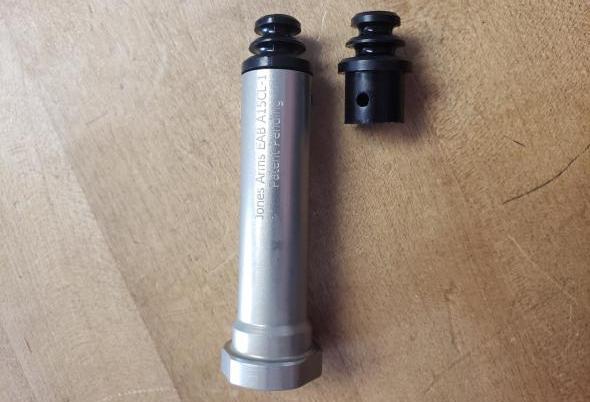
And another similar concept by LARB: https://armamentusa.com/product/larb-recoil-buffer-tail-cap/ 
PWS used to have a similar system, but in reverse - a shock absorbing rubber plug at the bottom of the buffer tube. This would ensure that there was a rubber-to-rubber impact at the end of the bolts stroke, as opposed to the current rubber-to-metal impact of a standard AR. 
Conceptually they all make sense; ~40% of the AR's recoil is due to the impact of the bolt/buffer slamming into the rear of the buffer tube, so lessening the impact through improved rubber will cut down on the shock and vibration of this impact. Has anyone tried any of these? |
|
Quoted:
Meh.. don’t really feel the need on a 223.. I’d install a good brake instead of messing with buffers. https://www.youtube.com/watch?v=R1zQuWpsYZY Its also the reason why adjustable gas reduces recoil, or why guns like the APC9/APC223 employ an integral hydraulic buffer - reducing bolt impact. Conversely, thats why 9mm AR's are known for their harsh recoil; even though 9mm is much weaker then 5.56, the bolt impact force of a heavy direct blowback slamming into the receiver produces a jarring impact. It's even applicable in .22lr; while my 10/22 never 'kicked hard,' there was a very noticeable reduction in vibration / increase in smoothness when I replaced the steel buffer pin with a urethane buffer. 
Given that every single other part of the AR15 has improved in the last 50 years, it seems reasonable to believe that the current, 50 year old buffer tip design can also be improved upon. For example, different rubber materials have different effects on shock response: 
Likewise, changing the shape of the rubber can effect how it compresses under impact. https://moldeddimensions.com/urethanes-in-compression.php |
|
Could be why these were so popular....
Except the we're reported breaking,,leaking hydraulic fluid https://www.enidine-defense.com/Products/Recoil-Buffers-and-Recoil-Reduction-Products/ |
|
The problem is now you are introducing a material that will break down the more you use it and eventually could bind up the gun in an extreme example. For something that doubtfully has any effect on recoil absorption. You would be much better off adjusting the amount of gas used to force the bolt back. And if you REALLY want to come up with something that will work, introduce a multiple spring buffer spring setup. |
The AR180 did introduce multiple springs on guide rods in the receiver, allowing a folding stock. One could say that Stoner improved the M16 with that just the same as Browning moved on from the 1911 to the Hi Power.
Look at the 'improvements' for the AR, with the view that what Stoner and team did with existing tech in the late 1950s isn't the last word on the design. Incremental improvements are the bulk of development for a firearm once accepted for issue, and what have we seen for the M16? Different flash hiders, fencing on the lower, the forward assist, charging handle changes, a higher capacity magazine, barrel profile changes, including, then eliminating the M203 cut, rifle then carbine gas, dry lube, three shot trigger group, the A1, A2, A3, A4 and M4, SDM, removing the carry handle, adding rail, adding free floats, different grips ... but no, it's worthless to change the bumper composition? Army changes the amount of tungsten weights, even invented the short carbine buffer. The entire firearm has had dramatic changes in the last 45 years, I'd be hard pressed to say what hasn't. A roll pin or detent, maybe? Every major functional accessory and feature isn't the same from the A nothing to now. No reason not to change it if a incrementally better result is achieved, which is about as much as could be said for a lot of the other stuff marketed for it. Like, lowers with skull magazine wells. Ooooo, major game changer there . . . |
|
Quoted:
Seems a spring could be designed that ramps up pressure in the end, preventing any impact of the buffer to the receiver extension. Quoted:
Seems a spring could be designed that ramps up pressure in the end, preventing any impact of the buffer to the receiver extension. 
Quoted:
And if you REALLY want to come up with something that will work, introduce a multiple spring buffer spring setup. |
|
Quoted:
The problem is now you are introducing a material that will break down the more you use it and eventually could bind up the gun in an extreme example. For something that doubtfully has any effect on recoil absorption. You would be much better off adjusting the amount of gas used to force the bolt back. And if you REALLY want to come up with something that will work, introduce a multiple spring buffer spring setup. Especially now with modern material science and computer simulation programs like Finite Element Analysis, it should be pretty straightforward to model and predict how a material and shape will effect impact. Frankly, this would be a great little AR product for Magpul to get into - become the new standard for AR buffer tips, similar to how their magazine followers have become the standard even in aluminum mags. Even with adjustable gas, the buffer is still impacting the buffer tube; even with reduced impact force, it is still transmitting recoil and vibration into the system. The ideal system would be an AR with: -Muzzle device (either Warcomp or proper break) -Adjustable / tuned gas -Enhanced rubber buffer tip -PWS style rubber buffer tube base |
|
Quoted:
I thought I'd give the Jones EAB a try, something different , and you don't know until you try it thing. $14 per bumper seemed reasonable. But, the shipping cost killed my interest. $8 bucks to ship one.. $4 more bucks for each additional one. ( YMMV ) If other vendors carry this and I can bundle it with another order I may try it on a 16” carbine system 7.62x39 upper. KCode98 also mentioned a dual spring setup. I’m surprised no one’s done a progressive rate spring, something with tighter coils at the end of travel. I know they’re harder to manufacture but would be compatible with mil spec buffers and tubes with nothing to break down or limit travel. |
| I don't feel 40% of recoil is from the buffer bottoming out but a softer bumper may soften the impact regardless. I could see a possibility of the softer bumper bouncing more if the impact was hard causing the bolt to outrun the catch? I don't know if it would happen but worth considering. |
| The biggest problem I see with these is no fan boy base for introduction. If LaRue, Geissele, or Magpul had introduced them then people would be going ga-ga over them at twice the price, less shipping of course. But a relatively nobody introduces them then they are going to be pooh-poohed by many. |
|
Quoted:
I'm assuming the PWS system required a shorter buffer. Rather have a tip on a standard buffer than having to use a proprietary one. Along those lines, an idea that I had was using the A5 buffer tube, which is 0.75" longer then a regular carbine buffer. Then putting a 0.75"x1" section of Sorbothane or other shock absorbing rubber into the base of the A5, and then using a regular carbine buffer/spring combo. That would result in a rubber-to-rubber impact. 
|
|
Quoted:
I have the LARB tip on my 9mm buffer its a-lot softer than a standard tip.I figure any little bit that helps to lower the force of a 9mm blowback is worth it. Did you notice any difference when using it vs the regular buffer tip? |
|
Quoted: Along those lines, an idea that I had was using the A5 buffer tube, which is 0.75" longer then a regular carbine buffer. Then putting a 0.75"x1" section of Sorbothane or other shock absorbing rubber into the base of the A5, and then using a regular carbine buffer/spring combo. That would result in a rubber-to-rubber impact. http://c3junkie.com/wp-content/uploads/2018/05/carbine-pa10-vltor_a5.png I believe that can happen if the bcg overtravels. |
|
Quoted:
The biggest problem I see with these is no fan boy base for introduction. If LaRue, Geissele, or Magpul had introduced them then people would be going ga-ga over them at twice the price, less shipping of course. But a relatively nobody introduces them then 5hey are going to be pooh-poohed by many. |
|
Quoted:
While I think this is a cool idea, isn't the bolt carrier key striking the lower receiver a possibility if the rubber compresses too much? I believe that can happen if the bcg overtravels. Quoted:
Quoted: Along those lines, an idea that I had was using the A5 buffer tube, which is 0.75" longer then a regular carbine buffer. Then putting a 0.75"x1" section of Sorbothane or other shock absorbing rubber into the base of the A5, and then using a regular carbine buffer/spring combo. That would result in a rubber-to-rubber impact. http://c3junkie.com/wp-content/uploads/2018/05/carbine-pa10-vltor_a5.png I believe that can happen if the bcg overtravels. A couple options that occur to me: -Using a less compressible rubber in the buffer tube; say a 90 durometer rubber buffer base, and then something like a 50 durrometer buffer tip. That wouldn't be that prone to compression, but would still provide a softer impact surface then the buffer striking aluminum. -Using a longer rubber section. The A5 has an extra 3/4" of travel, so it might make sense to use a 1" rubber section that allows 1/4" of compression, but no further. Perhaps by using a 2 layer rubber base; 0.75" of 90 durrometer rubber and 0.25" of 30 durrometer squishy rubber. -Using a shortened gas key. This would be a simplified version of the Surefire OBC carrier, which uses a shortened gas key to allow an extra 0.4" of travel. This would be the most expensive option, but likely the most effective. A 1 piece carrier design such as used by LWRCi, with the OBC gas key shortening, would provide an ideal safety margin and allow using a much softer rubber base in the buffer tube. |
|
Quoted:
The biggest problem I see with these is no fan boy base for introduction. If LaRue, Geissele, or Magpul had introduced them then people would be going ga-ga over them at twice the price, less shipping of course. But a relatively nobody introduces them then they are going to be pooh-poohed by many. Or for Geissele to release, as a complement to their Super42 buffer spring. |
|
Quoted:
you feel they are superior to the hydraulic units on the market? They are priced similarly. Quoted:
Quoted:
Those LARB bumpers are legit. His whole buffer is even better. |
|
Quoted:
I haven’t used a hydraulic buffer, so I can’t speak to that. |
|
Quoted:
I had an ednine hydraulic in a rifle tube 18 inch spr. I was always underwhelmed by it, but the more proficient I became with the AR system i learned the barrel was overgassed. Considering a blitzkrieg hydraulic setup in an A5 tube, but this has my attention now as well. Quoted:
Quoted:
I haven’t used a hydraulic buffer, so I can’t speak to that. The other .260 and my Grendel have the bumpers in them and those are pretty amazing as well. |
|
Quoted:
The buffer really impressed me. I have it in one of my .260s and it’s solved issues it was having overcycling. The other .260 and my Grendel have the bumpers in them and those are pretty amazing as well. |
|
Quoted:
The buffer really impressed me. I have it in one of my .260s and it’s solved issues it was having overcycling. The other .260 and my Grendel have the bumpers in them and those are pretty amazing as well. Quoted:
Quoted:
Quoted:
I haven’t used a hydraulic buffer, so I can’t speak to that. The other .260 and my Grendel have the bumpers in them and those are pretty amazing as well. |
|
Quoted:
Yes, they give about 75% of the performance of the full buffer. They spread out the recoil impulse over a longer time, making it feel smoother. Quoted:
Quoted: Are you noticing an improvement in recoil with just the bumpers/rubber tips alone? I'm curious how the new Jones buffer tip (the first one pictured in the OP) compares to the LARB tip. Its just come out and may have further improved performance, as its designed to work standalone. |
|
Quoted: Awesome, so at least someone has purchased one. And thats good to hear its a softer rubber. Did you notice any difference when using it vs the regular buffer tip? |
|
Quoted:
Seems a spring could be designed that ramps up pressure in the end, preventing any impact of the buffer to the receiver extension. http://automotivethinker.com/suspension/linear-vs-progressive-rate-springs/ Ive said it before..there is little to no innovation that comes from the firearms industry (just repackaged/rebranded from other industries). Just like the "new" wonder coatings NiB, TiN, nitride, ceramic based coatings (cerakote), and many metal alloy formulations are old news in the automotive and tooling industries..yes progressive/variable rate springs are old news and have been in use for many years outside of firearms. The difference? When a firearms manufacturer finally figures it out, they will rebrand and market it as though its a propietary process/design breakthrough and charge hundreds if not thousands of times more than comparable processes/products marketed towards other industries. |
|
Quoted:
^ this is the most logical way to solve this "problem". A progressive (aka variable rate) spring can be engineered to gradually increase rate and keep the buffer from ever impacting the aft end of the tube, while also preventing the bcg from impacting the receiver. Doing it this way would also eliminate the need for a rubber part which without doubt will degrade, crack and fail most likely at the worst time. Rubber "Buffers" are a bandaid for poor engineering and have no place in a firearm as they can and do fail due to age degredation alone. Rubber has a shelf life like perishable food. http://automotivethinker.com/suspension/linear-vs-progressive-rate-springs/ Ive said it before..there is little to no innovation that comes from the firearms industry (just repackaged/rebranded from other industries). Just like the "new" wonder coatings NiB, TiN, nitride, ceramic based coatings (cerakote), and many metal alloy formulations are old news in the automotive and tooling industries..yes progressive/variable rate springs are old news and have been in use for many years outside of firearms. The difference? When a firearms manufacturer finally figures it out, they will rebrand and market it as though its a propietary process/design breakthrough and charge hundreds if not thousands of times more than comparable processes/products marketed towards other industries. Quoted:
Quoted:
Seems a spring could be designed that ramps up pressure in the end, preventing any impact of the buffer to the receiver extension. http://automotivethinker.com/suspension/linear-vs-progressive-rate-springs/ Ive said it before..there is little to no innovation that comes from the firearms industry (just repackaged/rebranded from other industries). Just like the "new" wonder coatings NiB, TiN, nitride, ceramic based coatings (cerakote), and many metal alloy formulations are old news in the automotive and tooling industries..yes progressive/variable rate springs are old news and have been in use for many years outside of firearms. The difference? When a firearms manufacturer finally figures it out, they will rebrand and market it as though its a propietary process/design breakthrough and charge hundreds if not thousands of times more than comparable processes/products marketed towards other industries. The problem is thats not really practical with the AR for a number of reasons: -There's almost no margin for error; due to the relative shortness of the stroke, if the bolt travels just ~0.25" short, there would be a failure to eject, and if it travels ~0.25" too far, the gas key will strike the upper receiver. -The error margin engineering is compounded by the different gas systems of different AR's. Lets say you design a progressive spring that works perfectly with a 14.5" midlength; it likely would be overgased and impact the receiver in a 16" midlength or 14.5" carbine gas. While a progressive made for a 14.5" carbine would likely fail to eject on a 14.5" midlength... Even Jim Sullivan, designer of the AR15 and Ultimax, was unable to create a true Ultimax zero-impact system with for the AR. The best he was able to do was to reduce the bolt impact and FA ROF with the Surefire OBC. Ideally what we need is new rifle design that uses like 80% of the parts of an AR, but incorporates a new upper receiver/buffer/bcg to allow a Ultimax extra bolt travel for a zero impact system. This would no only be fantastic in FA, but would ensure that the rifle is never 'overgassed,' improving semi auto recoil and also suppressor compatibility. |
|
I have been shooting for over 50 years, many different types of guns and rifles
The ar15 platform in 5.56 does not need any help in the recoil department. recoil is almost non existent compared to other calibers that are very similar in what might be considered high powered rifle. Your biggest gain to stay on target and mitigate muzzle movement would be to put the right muzzle device on your barrel. This will also lessen the felt recoil, which is minimal to say the least. And if you are a real snowflake recoil snob, stay away from lightweight builds. But then again you might have a problem with... It's to heavy. Weight kills the felt recoil as it absorbs it. All my rifles shoot what ever I put through them, no lightweight BCG, AGB or fancy gas keys. If I was in a firefight and had to rob ammo from another source, I know my rifles will shoot it. You want to feel some real recoil, go out and shoot a 458 SOCOM AR15. |
|
Quoted:
I have been shooting for over 50 years, many different types of guns and rifles The ar15 platform in 5.56 does not need any help in the recoil department. recoil is almost non existent compared to other calibers that are very similar in what might be considered high powered rifle. Your biggest gain to stay on target and mitigate muzzle movement would be to put the right muzzle device on your barrel. This will also lessen the felt recoil, which is minimal to say the least. And if you are a real snowflake recoil snob, stay away from lightweight builds. But then again you might have a problem with... It's to heavy. Weight kills the felt recoil as it absorbs it. All my rifles shoot what ever I put through them, no lightweight BCG, AGB or fancy gas keys. If I was in a firefight and had to rob ammo from another source, I know my rifles will shoot it. You want to feel some real recoil, go out and shoot a 458 SOCOM AR15. |
|
Quoted:
Meh.. don’t really feel the need on a 223.. I’d install a good brake instead of messing with buffers. |
|
Quoted:
The idea is to keeping the rifle steady during the cycle which helps keep it on target. I have good brakes, they help. I could go with more expensive adjustable gas blocks, lightweight BCGs etc but if the above items are cheap and they work I will give them a try. Quoted:
Quoted:
Meh.. don’t really feel the need on a 223.. I’d install a good brake instead of messing with buffers. |
|
Quoted:
^ this is the most logical way to solve this "problem". A progressive (aka variable rate) spring can be engineered to gradually increase rate and keep the buffer from ever impacting the aft end of the tube, while also preventing the bcg from impacting the receiver. Doing it this way would also eliminate the need for a rubber part which without doubt will degrade, crack and fail most likely at the worst time. Rubber "Buffers" are a bandaid for poor engineering and have no place in a firearm as they can and do fail due to age degredation alone. Rubber has a shelf life like perishable food. http://automotivethinker.com/suspension/linear-vs-progressive-rate-springs/ Ive said it before..there is little to no innovation that comes from the firearms industry (just repackaged/rebranded from other industries). Just like the "new" wonder coatings NiB, TiN, nitride, ceramic based coatings (cerakote), and many metal alloy formulations are old news in the automotive and tooling industries..yes progressive/variable rate springs are old news and have been in use for many years outside of firearms. The difference? When a firearms manufacturer finally figures it out, they will rebrand and market it as though its a propietary process/design breakthrough and charge hundreds if not thousands of times more than comparable processes/products marketed towards other industries. Quoted:
Quoted:
Seems a spring could be designed that ramps up pressure in the end, preventing any impact of the buffer to the receiver extension. http://automotivethinker.com/suspension/linear-vs-progressive-rate-springs/ Ive said it before..there is little to no innovation that comes from the firearms industry (just repackaged/rebranded from other industries). Just like the "new" wonder coatings NiB, TiN, nitride, ceramic based coatings (cerakote), and many metal alloy formulations are old news in the automotive and tooling industries..yes progressive/variable rate springs are old news and have been in use for many years outside of firearms. The difference? When a firearms manufacturer finally figures it out, they will rebrand and market it as though its a propietary process/design breakthrough and charge hundreds if not thousands of times more than comparable processes/products marketed towards other industries. First, multi rate springs work by the coils compressing to a solid stack, that is horrible for springs and would never be used in a situation where every cycle needed to utilize it. This type of spring is only used in situations where most of the cycles do not reach second stage, and the second stage is only there for extreme impacts. Secondly, the distance between enough travel to cycle properly(including giving the magazine enough time to respond) and the carrier bottoming out is very small. For a spring to do anything in that distance it would have to have a rididculiusly high rate, which would then transfer the force nearly as much as just allowing for the impact. |
|
Quoted: Clearly we aren't all as badass as you. Forgive us for trying to make the AR shoot flatter and softer than it does. Shooting softer limits your ammo choice. It;s not like the AR15 is a recoil bruiser. |
|
Quoted: 2 reasons this cant work. First, multi rate springs work by the coils compressing to a solid stack, that is horrible for springs and would never be used in a situation where every cycle needed to utilize it. This type of spring is only used in situations where most of the cycles do not reach second stage, and the second stage is only there for extreme impacts. Secondly, the distance between enough travel to cycle properly(including giving the magazine enough time to respond) and the carrier bottoming out is very small. For a spring to do anything in that distance it would have to have a rididculiusly high rate, which would then transfer the force nearly as much as just allowing for the impact. |
[ARCHIVED THREAD] - Recoil reducing rubber buffer tips (Page 1 of 7)
AR Sponsor