


AR Sponsor


Posted: 12/19/2014 10:13:08 AM EDT
| New to forum, tried a friends suppressor on my windham ar and noticed that the empties land at about 2:30 and normally at 4:00. I assume its over gassed, how is that problem corrected? |
|
A heavier buffer will help slow the action and reduce felt recoil and gas blow back. It is important to verify that the weapon will still function properly when not suppressed. The ejection pattern doesn't matter as long as the weapon functions reliably. The AR gas vent, which replaces the useless forward assist, helps with blow back, as does the PRI Gasbuster and BCM Gunfighter charging handles. On the cheap you can drill a hole thru a standard charging handle to vent gas out of the channel. link to vent hole |
|
The suppressor increases the bore back pressure after the bullet has passed the gas port (just think of the barrel being longer after the gas port), which increases the amount of gas to the gas system to unlock the bolt, which in turn opens the action a tad bit earlier than needed.
Just increasing the mass of the buffer slows the action back down to open at the correct time with a suppressed rig. |
|
I've had good luck with Colt H2 buffers from Brownells I now use JP Silent System in all my new rifles, it drastically reduces felt recoil with a suppressor, but is expensive. |
|
Quoted:
New to forum, tried a friends suppressor on my windham ar and noticed that the empties land at about 2:30 and normally at 4:00. I assume its over gassed, how is that problem corrected? Welcome to our humble side of the net 
As mentioned, a heavier buffer or bolt carrier will help with felt recoil. An adjustable gas block will also help but might be overkill. If you intend to invest in your own suppressor (WORTH EVERY FUCKING PENNY) you may want to get a gas buster charging handle along with a heavier carrier and buffer. Again, as others have mentioned, you should always make certain that your rifle will cycle fine in your final configuration un-suppressed. |
|
Quoted:
My suppressor is on the way just waiting on the doj to do their thing on a forum 4 and a form 1. One will be for a .223 and the other for a blackout. Thanks for the replies, it's great to have people with knowledge of these guns that will help out . Welcome. It refreshing to have new members that ask intelligent questions. |
|
Quoted:
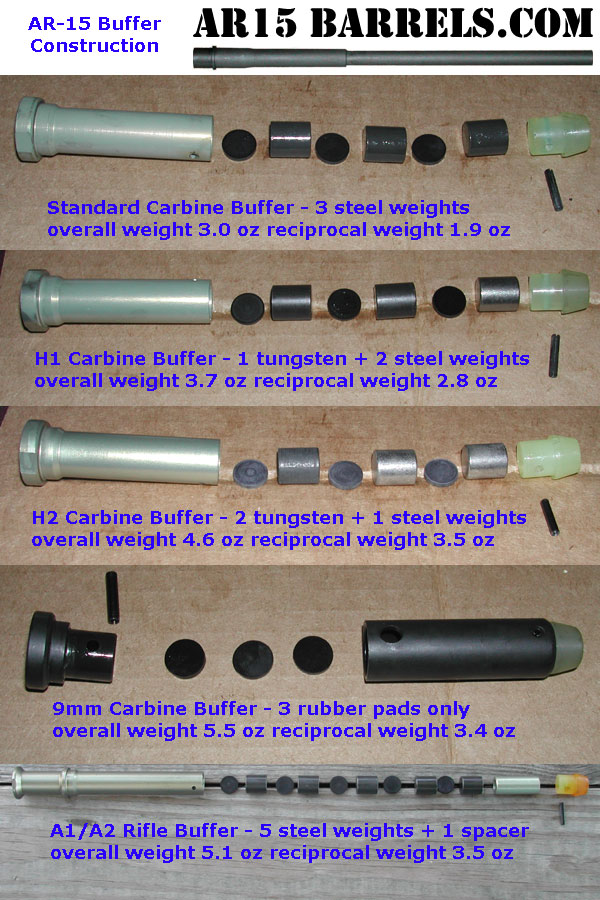
How do you know which buffer over the stock one? 16" barrel Barrel does not mean shit, as well as any other thing on the upper receiver when you are talking Buffers!!! We need to know the length of the receiver extension on the lower receiver, hence is it a telestocking stock, or a fix full length stock instead (depth of the tube inner void). This will tell use if your rig used a carbine buffer or standard length buffer because of the tube inner void depth, then from there, need to know the weight of the buffer that you have in play as well. If you have a fixed stock (A1 or A2), then you do not use a carbine buffer in the rifle since the B/C will not be limited correctly at the back of stroke, ending with you cracking the lower receiver (back of the key is going to strike the lower receiver at the tube threaded section to crack it there). In the case that you have a telescoping stock on the lower receiver, then you have a carbine length buffer in play. The carbine buffer is 2.9oz, and would suggest that you buy a Colt H-3 buffer. The reason for just buying the heaviest H buffer, is the way that buffers are built. In side both buffers, there are three internal metal discs. In the case of the standard buffer, the discs are just standard steel. In the case of the H3, all the discs are tungsten steel discs, which are much heaver than standard steel. So between the two buffers, and some disc's swapping, you can cover all the different weights of the carbine buffers. The H3 may work well, or if needed, you can swap out a disc between the two, turning the standard into a H1, and the H-3 into a H-2. |
|
You could use a Tubb carrier weight and use your standard buffer. It doesn't really matter if the extra weight is in the carrier or the buffer its all the same.
It comes with 3 pieces the tube with a flange on it that slides into the back of the carrier. Then 2 inserts one steel and one tungsten you can only use 1 at a time. From the produce info The CWS™ itself, with no additional weight inserts, weighs 1.54 ounces. The CWS™ with the stainless insert weighs 2.79 ounces (1.25 insert weight) CWS™ with the carbide insert weighs 4.05 ounces (2.51 insert weight). tubb carrier weight 4 oz is more than the difference between a standard and H3 buffer. The CWS runs about $60 which is probably less than the cost of 2 buffers The CWS was made to handle the heavy bullet loads and slower powders (more gas) in high power shooting, or the match 24" barrels with rifle length gas systems (even more gas) |
|
Quoted:
It is an adjustable stock with stock buffer. Carbine buffer, and as stated, pick up a H3 buffer, and between the standard buffer you already have and the new H3, can swap the internal weights between the two to come up with the needed buffer mass to cycle/unlock the bolt at the correct timing. |
|
Ordered a T3 buffer from spikes along with a gunfighter charging handle, installed the two and ran 15 rounds through it without the suppressor and it ran fine. I put the suppressor on and ran the rest of the mag. Everything ran fine, the gas blowback was drastically reduced and the recoil is almost non existent. Im not sure how I can make it any better. Thanks for the input and recommendations, anything I'm overlooking?
|
|
Quoted:
Ordered a T3 buffer from spikes along with a gunfighter charging handle, installed the two and ran 15 rounds through it without the suppressor and it ran fine. I put the suppressor on and ran the rest of the mag. Everything ran fine, the gas blowback was drastically reduced and the recoil is almost non existent. Im not sure how I can make it any better. Thanks for the input and recommendations, anything I'm overlooking? If you mean ran fine, as in the bolt is locking back on the catch after the last round out suppressed and unsuppressed after you have gotten a few hundred rounds through the rig to start to foul it up, then you are golden. If not, then reserve the T3 for when the suppressor is installed, and the standard buffer for it is not. |
AR Sponsor