


AR Sponsor


Posted: 11/23/2013 6:17:55 AM EDT
|
Would it work if I mounted a T1 in front of an elcan on an offset mount?
Thanks |
|
The Elcan has a pretty decent ~1x. The MRDS tend to be smaller/lighter than the T1 and you can mount them directly to the Elcan.
I don't have much experience with a piggybacked MRDS, but it sounds like they would be useful in a very rapid surprise engagement at very close range or while wearing a helmet where getting a good sight picture is more difficult. There's no reason why you couldn't run an offset T1/MRDS with the a Elcan. I just think such a setup would be better on a fixed-magnification optic or those with greater zoom. Maybe someone with more expertise will chime in on this. |
|
Quoted:
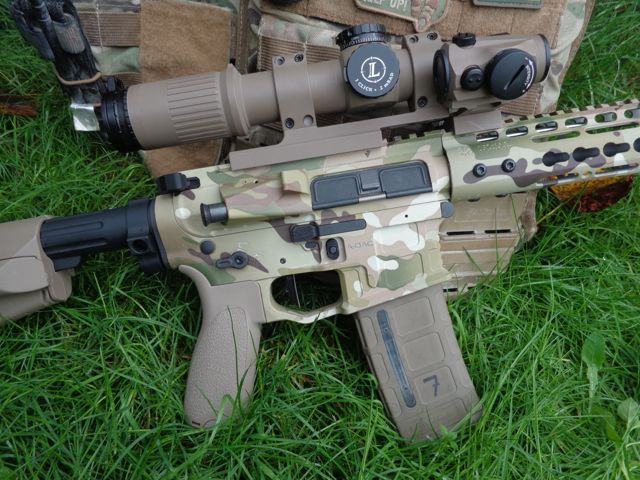
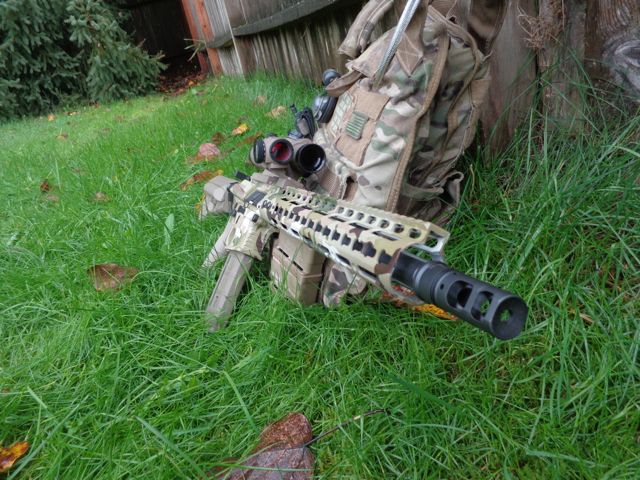
The Elcan has a pretty decent ~1x. The MRDS tend to be smaller/lighter than the T1 and you can mount them directly to the Elcan. I don't have much experience with a piggybacked MRDS, but it sounds like they would be useful in a very rapid surprise engagement at very close range or while wearing a helmet where getting a good sight picture is more difficult. There's no reason why you couldn't run an offset T1/MRDS with the a Elcan. I just think such a setup would be better on a fixed-magnification optic or those with greater zoom. Maybe someone with more expertise will chime in on this. I won't say I have more expertise, but I set my sighting system based on the shortcomings I've experienced using an Eotech 553 w/ 3x magnifier while in Afghanistan. The bottom line, in my opinion, is that a rifle should be set up to meet the needs of the individual shooter. What do you want your rifle to do, and how will you set it up to achieve this? My current rifle is a Leupold Mark 6 1-6x with a Micro T1 on a Larue LT724 offset mount. I'll list the shortcomings I've experienced with my Eotech/magnifier set up, and the solutions I've come up with to overcome the shortcomings. 1. Shortcoming: The 3x magnifier was not enough magnification for observing and PID. The glass clarity and FOV was poor. Solution: Run a 1-x variable scope. The Mark 6, and countless other low power variables offer superior glass quality, better FOV, and better magnification. 2. Shortcoming: Constantly fighting with dirty, dusty, muddy, sweaty optics. Always having to keep a cloth on hand to clean my optics. Solution: Run a low power variable with scope covers. While making movement, offset T1 is ready to go, main optic has covers on to keep it clean. If engaged, RDS is available. When set up in a blocking position, there will be time to flip covers off to scan my sector of fire. 3. Shortcoming: While using magnification and scanning at distance, I loose the ability to rapidly engage close threats (inside of 50 meters) without first flipping magnifier to the side. Solution: Run an offset red dot to transition from far targets to close targets quickly. Some will say, why not go with something along the lines of a 2.5-10x instead of a 1-6x? I have considered this. However, when running a dual optic system weight does become an issue. The 1-6x was going to be quite a bit lighter. Also, I didn't have a need for a 10x or 9x scope. Also, with a 1x low end, I have the ability to use the main optic when going in to a known CQB type situation. The dual optic system also provides redundancy. I'm comfortable running a Mark 6 and an Aimpoint Micro T1 without back up iron sights. Here's why I chose the Leupold Mark 6 and Aimpoint Micro T1. The Mark 6 was the lightest of the 1-6x variables weighing in at a listed weight of 17 oz. The illumination is day light visible. Reviews showed them to be a very robust, durable and reliable optic. Glass quality is on par with other high end optics. I've also considered the MRDS in lieu of the T1. In the end, I was willing to sacrifice a few onces for durability. I knew I wasn't going to utilize BUIS, so I wanted my RDS to be a proven reliable sight. Granted, I don't have any first hand experience with a MRDS, but I knew I could trust the T1 in a combat environment. The biggest drawback to running this optical sighting solution is weight. I haven't actually weighed my optics and mounts, but according to the manufactures the Mark 6 is 17 oz and the T1 is 3.0 oz. That's 20 oz without mounts. I'd guess the Larue LT104 and LT724 mount is in the neighborhood of 5 oz. That puts the total weight around 25 oz. While this is a fairly reasonable weight, it's not as light as a single optic set up with BUIS. However, the shortcomings I listed had some real life consequences to them, and I'm willing to carry around a few extra oz for what this set up provides. The bottom line is, each individual user has to come up with his own needs and set his rifle up to meet those needs. I'm still testing this set up, and training with it, but so far I really like it. If/when I deploy again, depending on the area I go to and the mission given, this may be what I bring with me. Transitions from 300 meter steel to 15 meter paper is scary fast and seamless. My hit potential is greatly improved. 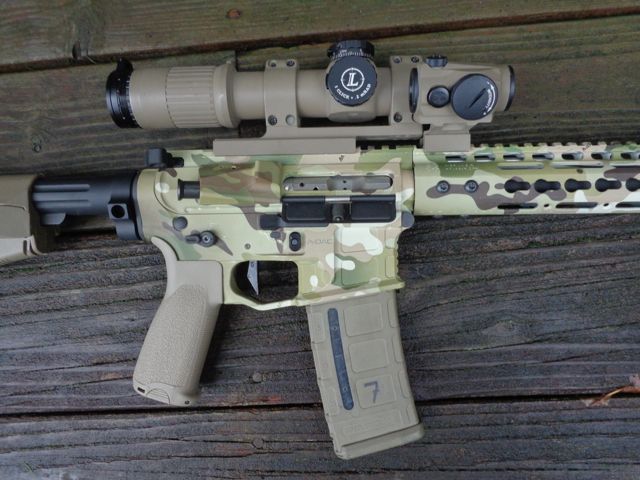
|
|
Quoted:
I won't say I have more expertise, but I set my sighting system based on the shortcomings I've experienced using an Eotech 553 w/ 3x magnifier while in Afghanistan. The bottom line, in my opinion, is that a rifle should be set up to meet the needs of the individual shooter. What do you want your rifle to do, and how will you set it up to achieve this? My current rifle is a Leupold Mark 6 1-6x with a Micro T1 on a Larue LT724 offset mount. I'll list the shortcomings I've experienced with my Eotech/magnifier set up, and the solutions I've come up with to overcome the shortcomings. 1. Shortcoming: The 3x magnifier was not enough magnification for observing and PID. The glass clarity and FOV was poor. Solution: Run a 1-x variable scope. The Mark 6, and countless other low power variables offer superior glass quality, better FOV, and better magnification. 2. Shortcoming: Constantly fighting with dirty, dusty, muddy, sweaty optics. Always having to keep a cloth on hand to clean my optics. Solution: Run a low power variable with scope covers. While making movement, offset T1 is ready to go, main optic has covers on to keep it clean. If engaged, RDS is available. When set up in a blocking position, there will be time to flip covers off to scan my sector of fire. 3. Shortcoming: While using magnification and scanning at distance, I loose the ability to rapidly engage close threats (inside of 50 meters) without first flipping magnifier to the side. Solution: Run an offset red dot to transition from far targets to close targets quickly. Some will say, why not go with something along the lines of a 2.5-10x instead of a 1-6x? I have considered this. However, when running a dual optic system weight does become an issue. The 1-6x was going to be quite a bit lighter. Also, I didn't have a need for a 10x or 9x scope. Also, with a 1x low end, I have the ability to use the main optic when going in to a known CQB type situation. The dual optic system also provides redundancy. I'm comfortable running a Mark 6 and an Aimpoint Micro T1 without back up iron sights. Here's why I chose the Leupold Mark 6 and Aimpoint Micro T1. The Mark 6 was the lightest of the 1-6x variables weighing in at a listed weight of 17 oz. The illumination is day light visible. Reviews showed them to be a very robust, durable and reliable optic. Glass quality is on par with other high end optics. I've also considered the MRDS in lieu of the T1. In the end, I was willing to sacrifice a few onces for durability. I knew I wasn't going to utilize BUIS, so I wanted my RDS to be a proven reliable sight. Granted, I don't have any first hand experience with a MRDS, but I knew I could trust the T1 in a combat environment. The biggest drawback to running this optical sighting solution is weight. I haven't actually weighed my optics and mounts, but according to the manufactures the Mark 6 is 17 oz and the T1 is 3.0 oz. That's 20 oz without mounts. I'd guess the Larue LT104 and LT724 mount is in the neighborhood of 5 oz. That puts the total weight around 25 oz. While this is a fairly reasonable weight, it's not as light as a single optic set up with BUIS. However, the shortcomings I listed had some real life consequences to them, and I'm willing to carry around a few extra oz for what this set up provides. The bottom line is, each individual user has to come up with his own needs and set his rifle up to meet those needs. I'm still testing this set up, and training with it, but so far I really like it. If/when I deploy again, depending on the area I go to and the mission given, this may be what I bring with me. Transitions from 300 meter steel to 15 meter paper is scary fast and seamless. My hit potential is greatly improved. http://i666.photobucket.com/albums/vv23/ezterra/AR%20Build/DSC02384.jpg http://i666.photobucket.com/albums/vv23/ezterra/AR%20Build/DSC02373.jpg http://i666.photobucket.com/albums/vv23/ezterra/AR%20Build/DSC02374.jpg Quoted:
Quoted:
The Elcan has a pretty decent ~1x. The MRDS tend to be smaller/lighter than the T1 and you can mount them directly to the Elcan. I don't have much experience with a piggybacked MRDS, but it sounds like they would be useful in a very rapid surprise engagement at very close range or while wearing a helmet where getting a good sight picture is more difficult. There's no reason why you couldn't run an offset T1/MRDS with the a Elcan. I just think such a setup would be better on a fixed-magnification optic or those with greater zoom. Maybe someone with more expertise will chime in on this. I won't say I have more expertise, but I set my sighting system based on the shortcomings I've experienced using an Eotech 553 w/ 3x magnifier while in Afghanistan. The bottom line, in my opinion, is that a rifle should be set up to meet the needs of the individual shooter. What do you want your rifle to do, and how will you set it up to achieve this? My current rifle is a Leupold Mark 6 1-6x with a Micro T1 on a Larue LT724 offset mount. I'll list the shortcomings I've experienced with my Eotech/magnifier set up, and the solutions I've come up with to overcome the shortcomings. 1. Shortcoming: The 3x magnifier was not enough magnification for observing and PID. The glass clarity and FOV was poor. Solution: Run a 1-x variable scope. The Mark 6, and countless other low power variables offer superior glass quality, better FOV, and better magnification. 2. Shortcoming: Constantly fighting with dirty, dusty, muddy, sweaty optics. Always having to keep a cloth on hand to clean my optics. Solution: Run a low power variable with scope covers. While making movement, offset T1 is ready to go, main optic has covers on to keep it clean. If engaged, RDS is available. When set up in a blocking position, there will be time to flip covers off to scan my sector of fire. 3. Shortcoming: While using magnification and scanning at distance, I loose the ability to rapidly engage close threats (inside of 50 meters) without first flipping magnifier to the side. Solution: Run an offset red dot to transition from far targets to close targets quickly. Some will say, why not go with something along the lines of a 2.5-10x instead of a 1-6x? I have considered this. However, when running a dual optic system weight does become an issue. The 1-6x was going to be quite a bit lighter. Also, I didn't have a need for a 10x or 9x scope. Also, with a 1x low end, I have the ability to use the main optic when going in to a known CQB type situation. The dual optic system also provides redundancy. I'm comfortable running a Mark 6 and an Aimpoint Micro T1 without back up iron sights. Here's why I chose the Leupold Mark 6 and Aimpoint Micro T1. The Mark 6 was the lightest of the 1-6x variables weighing in at a listed weight of 17 oz. The illumination is day light visible. Reviews showed them to be a very robust, durable and reliable optic. Glass quality is on par with other high end optics. I've also considered the MRDS in lieu of the T1. In the end, I was willing to sacrifice a few onces for durability. I knew I wasn't going to utilize BUIS, so I wanted my RDS to be a proven reliable sight. Granted, I don't have any first hand experience with a MRDS, but I knew I could trust the T1 in a combat environment. The biggest drawback to running this optical sighting solution is weight. I haven't actually weighed my optics and mounts, but according to the manufactures the Mark 6 is 17 oz and the T1 is 3.0 oz. That's 20 oz without mounts. I'd guess the Larue LT104 and LT724 mount is in the neighborhood of 5 oz. That puts the total weight around 25 oz. While this is a fairly reasonable weight, it's not as light as a single optic set up with BUIS. However, the shortcomings I listed had some real life consequences to them, and I'm willing to carry around a few extra oz for what this set up provides. The bottom line is, each individual user has to come up with his own needs and set his rifle up to meet those needs. I'm still testing this set up, and training with it, but so far I really like it. If/when I deploy again, depending on the area I go to and the mission given, this may be what I bring with me. Transitions from 300 meter steel to 15 meter paper is scary fast and seamless. My hit potential is greatly improved. http://i666.photobucket.com/albums/vv23/ezterra/AR%20Build/DSC02384.jpg http://i666.photobucket.com/albums/vv23/ezterra/AR%20Build/DSC02373.jpg http://i666.photobucket.com/albums/vv23/ezterra/AR%20Build/DSC02374.jpg based on this, how does the elcan size up? no it isn't 6x nor is it as fast in time as far as distance and RDS, but I think the elcan is for me (don't have one yet) |
| I don't run a T-1, but an Insight MRDS in 7 MoA. Within 50 yards, the MRDS is excellent, fast and lightweight. The off cheek weld from being mounted high is different, but in CQB type setup, it's not too bad. The Elcan isn't terrible at 1x either mind you, the open design of the MRDS just makes it faster. The Elcan is great to distance, my eyesight is poor, so only have 4x magnification to me is the only drawback. It's compact, and not too terrible on weight (~1lb), and extremely durable. Optic quality is very clear and the Elcan had excellent glass. It always amazes me every time I use mine on how clear the image is. |
|
Quoted:
I don't run a T-1, but an Insight MRDS in 7 MoA. Within 50 yards, the MRDS is excellent, fast and lightweight. The off cheek weld from being mounted high is different, but in CQB type setup, it's not too bad. The Elcan isn't terrible at 1x either mind you, the open design of the MRDS just makes it faster. The Elcan is great to distance, my eyesight is poor, so only have 4x magnification to me is the only drawback. It's compact, and not too terrible on weight (~1lb), and extremely durable. Optic quality is very clear and the Elcan had excellent glass. It always amazes me every time I use mine on how clear the image is. anyone else know about the MRDS? dot sizes, battery life, ect |
|
Quoted:
based on this, how does the elcan size up? no it isn't 6x nor is it as fast in time as far as distance and RDS, but I think the elcan is for me (don't have one yet) Quoted:
Quoted:
Quoted:
The Elcan has a pretty decent ~1x. The MRDS tend to be smaller/lighter than the T1 and you can mount them directly to the Elcan. I don't have much experience with a piggybacked MRDS, but it sounds like they would be useful in a very rapid surprise engagement at very close range or while wearing a helmet where getting a good sight picture is more difficult. There's no reason why you couldn't run an offset T1/MRDS with the a Elcan. I just think such a setup would be better on a fixed-magnification optic or those with greater zoom. Maybe someone with more expertise will chime in on this. I won't say I have more expertise, but I set my sighting system based on the shortcomings I've experienced using an Eotech 553 w/ 3x magnifier while in Afghanistan. The bottom line, in my opinion, is that a rifle should be set up to meet the needs of the individual shooter. What do you want your rifle to do, and how will you set it up to achieve this? My current rifle is a Leupold Mark 6 1-6x with a Micro T1 on a Larue LT724 offset mount. I'll list the shortcomings I've experienced with my Eotech/magnifier set up, and the solutions I've come up with to overcome the shortcomings. 1. Shortcoming: The 3x magnifier was not enough magnification for observing and PID. The glass clarity and FOV was poor. Solution: Run a 1-x variable scope. The Mark 6, and countless other low power variables offer superior glass quality, better FOV, and better magnification. 2. Shortcoming: Constantly fighting with dirty, dusty, muddy, sweaty optics. Always having to keep a cloth on hand to clean my optics. Solution: Run a low power variable with scope covers. While making movement, offset T1 is ready to go, main optic has covers on to keep it clean. If engaged, RDS is available. When set up in a blocking position, there will be time to flip covers off to scan my sector of fire. 3. Shortcoming: While using magnification and scanning at distance, I loose the ability to rapidly engage close threats (inside of 50 meters) without first flipping magnifier to the side. Solution: Run an offset red dot to transition from far targets to close targets quickly. Some will say, why not go with something along the lines of a 2.5-10x instead of a 1-6x? I have considered this. However, when running a dual optic system weight does become an issue. The 1-6x was going to be quite a bit lighter. Also, I didn't have a need for a 10x or 9x scope. Also, with a 1x low end, I have the ability to use the main optic when going in to a known CQB type situation. The dual optic system also provides redundancy. I'm comfortable running a Mark 6 and an Aimpoint Micro T1 without back up iron sights. Here's why I chose the Leupold Mark 6 and Aimpoint Micro T1. The Mark 6 was the lightest of the 1-6x variables weighing in at a listed weight of 17 oz. The illumination is day light visible. Reviews showed them to be a very robust, durable and reliable optic. Glass quality is on par with other high end optics. I've also considered the MRDS in lieu of the T1. In the end, I was willing to sacrifice a few onces for durability. I knew I wasn't going to utilize BUIS, so I wanted my RDS to be a proven reliable sight. Granted, I don't have any first hand experience with a MRDS, but I knew I could trust the T1 in a combat environment. The biggest drawback to running this optical sighting solution is weight. I haven't actually weighed my optics and mounts, but according to the manufactures the Mark 6 is 17 oz and the T1 is 3.0 oz. That's 20 oz without mounts. I'd guess the Larue LT104 and LT724 mount is in the neighborhood of 5 oz. That puts the total weight around 25 oz. While this is a fairly reasonable weight, it's not as light as a single optic set up with BUIS. However, the shortcomings I listed had some real life consequences to them, and I'm willing to carry around a few extra oz for what this set up provides. The bottom line is, each individual user has to come up with his own needs and set his rifle up to meet those needs. I'm still testing this set up, and training with it, but so far I really like it. If/when I deploy again, depending on the area I go to and the mission given, this may be what I bring with me. Transitions from 300 meter steel to 15 meter paper is scary fast and seamless. My hit potential is greatly improved. http://i666.photobucket.com/albums/vv23/ezterra/AR%20Build/DSC02384.jpg http://i666.photobucket.com/albums/vv23/ezterra/AR%20Build/DSC02373.jpg http://i666.photobucket.com/albums/vv23/ezterra/AR%20Build/DSC02374.jpg based on this, how does the elcan size up? no it isn't 6x nor is it as fast in time as far as distance and RDS, but I think the elcan is for me (don't have one yet) It's been a few years since I've messed with the Elcan. From what I remember it was a great optic. What's nice about it is being able to switch between 1x and 4x. With a variable power scope majority of the time you'll be on one extreme or the other. However, I find it nice to use 4x for target inside of 300 meters because it offers the best magnification while maintaining a good FOV. Although I don't have much first hand experience with the Elcan, I don't think you'll be disappointed with it. The point of my lengthy post is that you need to figure out what you want to do with your rifle and set it up to achieve those goals. I've gotten some flack for putting a T1 on a rifle that has a 1-6x scope, but for me it overcomes the shortcomings I've experienced and has so far proven to provide the capabilities I was looking for. It makes perfect sense to me. |
|
Quoted:
It's been a few years since I've messed with the Elcan. From what I remember it was a great optic. What's nice about it is being able to switch between 1x and 4x. With a variable power scope majority of the time you'll be on one extreme or the other. However, I find it nice to use 4x for target inside of 300 meters because it offers the best magnification while maintaining a good FOV. Although I don't have much first hand experience with the Elcan, I don't think you'll be disappointed with it. The point of my lengthy post is that you need to figure out what you want to do with your rifle and set it up to achieve those goals. I've gotten some flack for putting a T1 on a rifle that has a 1-6x scope, but for me it overcomes the shortcomings I've experienced and has so far proven to provide the capabilities I was looking for. It makes perfect sense to me. Quoted:
Quoted:
Quoted:
Quoted:
The Elcan has a pretty decent ~1x. The MRDS tend to be smaller/lighter than the T1 and you can mount them directly to the Elcan. I don't have much experience with a piggybacked MRDS, but it sounds like they would be useful in a very rapid surprise engagement at very close range or while wearing a helmet where getting a good sight picture is more difficult. There's no reason why you couldn't run an offset T1/MRDS with the a Elcan. I just think such a setup would be better on a fixed-magnification optic or those with greater zoom. Maybe someone with more expertise will chime in on this. I won't say I have more expertise, but I set my sighting system based on the shortcomings I've experienced using an Eotech 553 w/ 3x magnifier while in Afghanistan. The bottom line, in my opinion, is that a rifle should be set up to meet the needs of the individual shooter. What do you want your rifle to do, and how will you set it up to achieve this? My current rifle is a Leupold Mark 6 1-6x with a Micro T1 on a Larue LT724 offset mount. I'll list the shortcomings I've experienced with my Eotech/magnifier set up, and the solutions I've come up with to overcome the shortcomings. 1. Shortcoming: The 3x magnifier was not enough magnification for observing and PID. The glass clarity and FOV was poor. Solution: Run a 1-x variable scope. The Mark 6, and countless other low power variables offer superior glass quality, better FOV, and better magnification. 2. Shortcoming: Constantly fighting with dirty, dusty, muddy, sweaty optics. Always having to keep a cloth on hand to clean my optics. Solution: Run a low power variable with scope covers. While making movement, offset T1 is ready to go, main optic has covers on to keep it clean. If engaged, RDS is available. When set up in a blocking position, there will be time to flip covers off to scan my sector of fire. 3. Shortcoming: While using magnification and scanning at distance, I loose the ability to rapidly engage close threats (inside of 50 meters) without first flipping magnifier to the side. Solution: Run an offset red dot to transition from far targets to close targets quickly. Some will say, why not go with something along the lines of a 2.5-10x instead of a 1-6x? I have considered this. However, when running a dual optic system weight does become an issue. The 1-6x was going to be quite a bit lighter. Also, I didn't have a need for a 10x or 9x scope. Also, with a 1x low end, I have the ability to use the main optic when going in to a known CQB type situation. The dual optic system also provides redundancy. I'm comfortable running a Mark 6 and an Aimpoint Micro T1 without back up iron sights. Here's why I chose the Leupold Mark 6 and Aimpoint Micro T1. The Mark 6 was the lightest of the 1-6x variables weighing in at a listed weight of 17 oz. The illumination is day light visible. Reviews showed them to be a very robust, durable and reliable optic. Glass quality is on par with other high end optics. I've also considered the MRDS in lieu of the T1. In the end, I was willing to sacrifice a few onces for durability. I knew I wasn't going to utilize BUIS, so I wanted my RDS to be a proven reliable sight. Granted, I don't have any first hand experience with a MRDS, but I knew I could trust the T1 in a combat environment. The biggest drawback to running this optical sighting solution is weight. I haven't actually weighed my optics and mounts, but according to the manufactures the Mark 6 is 17 oz and the T1 is 3.0 oz. That's 20 oz without mounts. I'd guess the Larue LT104 and LT724 mount is in the neighborhood of 5 oz. That puts the total weight around 25 oz. While this is a fairly reasonable weight, it's not as light as a single optic set up with BUIS. However, the shortcomings I listed had some real life consequences to them, and I'm willing to carry around a few extra oz for what this set up provides. The bottom line is, each individual user has to come up with his own needs and set his rifle up to meet those needs. I'm still testing this set up, and training with it, but so far I really like it. If/when I deploy again, depending on the area I go to and the mission given, this may be what I bring with me. Transitions from 300 meter steel to 15 meter paper is scary fast and seamless. My hit potential is greatly improved. http://i666.photobucket.com/albums/vv23/ezterra/AR%20Build/DSC02384.jpg http://i666.photobucket.com/albums/vv23/ezterra/AR%20Build/DSC02373.jpg http://i666.photobucket.com/albums/vv23/ezterra/AR%20Build/DSC02374.jpg based on this, how does the elcan size up? no it isn't 6x nor is it as fast in time as far as distance and RDS, but I think the elcan is for me (don't have one yet) It's been a few years since I've messed with the Elcan. From what I remember it was a great optic. What's nice about it is being able to switch between 1x and 4x. With a variable power scope majority of the time you'll be on one extreme or the other. However, I find it nice to use 4x for target inside of 300 meters because it offers the best magnification while maintaining a good FOV. Although I don't have much first hand experience with the Elcan, I don't think you'll be disappointed with it. The point of my lengthy post is that you need to figure out what you want to do with your rifle and set it up to achieve those goals. I've gotten some flack for putting a T1 on a rifle that has a 1-6x scope, but for me it overcomes the shortcomings I've experienced and has so far proven to provide the capabilities I was looking for. It makes perfect sense to me. As an ELCAN user with a DocOptic piggybacked, I will say that while we have different setups, for the most part, I agree with your assessment, conclusions, and solutions. The biggest differences is that I don't keep my ELCAN's lenses covered during movement, and my RDS is piggybacked, rather than offset. I've caught similar "flak" over using an RDS in conjunction with a variable. Also, my ELCAN lacks a 6x capability. The biggest reasons for the differences for me are: I'd love for the ELCAN to be capable of 6x. However, in order to get an ELCAN that gave me 6x, I'd either have to go with the 1.5x6, which is both slightly larger (therefore heavier), and it eliminates the 4x, which I find the "most" useful magnification setting for general purpose use. A big part of the attraction of the ELCAN for me was its relatively size and profile compared to a tube-style scope and the resultant penalties in FOV and (IMHO) manipulation - I find the "throw lever" much easier and faster to use than having to turn an adjustment ring, even with a "cat-tail." Also, the ELCAN lacks the exposed turrets, and IMHO, instead using a more "combat oriented" and familiar ACOG-style BDC reticule, with the additional advantage of center dot and full crosshairs battery-powered, manual adjustable illumination. While many complain about the "chin weld" of piggybacked RDS, IMHO, once you combine all the various "everyday wear" items that you might have, ACH, Peltors, armor carrier, pouches, ect. ect. - having a more "heads up" option for surprise engagements can be beneficial and can allow you to have more situational awareness and experience less "tunnel vision." This also applies to the "open" DocOptic design compared to the T1, but that's a different matter entirely, "open" RDS have their shortcomings, too. "No free lunch." At the same time, a piggybacked RDS is an ambidextrous option, versus an offset RDS, which is "handed." Finally, I do believe that the RDS/3x magnifier can have some very real benefits compared to the variable option, but it will depend very heavily on your particular mission set and objectives. The best answer, in true ARFCOM fashion is, of course, to "have both" available - that being said, like ezterra, if I were unsure of the exact circumstances I was going into and had to pick only one optics setup, it would be a variable power option with a supplementary MRD. In my case, an ELCAN with a piggybacked DocOptic. ~Augee |
|
Quoted:
anyone else know about the MRDS? dot sizes, battery life, ect Quoted:
Quoted:
I don't run a T-1, but an Insight MRDS in 7 MoA. Within 50 yards, the MRDS is excellent, fast and lightweight. The off cheek weld from being mounted high is different, but in CQB type setup, it's not too bad. The Elcan isn't terrible at 1x either mind you, the open design of the MRDS just makes it faster. The Elcan is great to distance, my eyesight is poor, so only have 4x magnification to me is the only drawback. It's compact, and not too terrible on weight (~1lb), and extremely durable. Optic quality is very clear and the Elcan had excellent glass. It always amazes me every time I use mine on how clear the image is. anyone else know about the MRDS? dot sizes, battery life, ect Insight makes two main models in Black and Tan, 3.5 and 7.0 MoA dots. Battery life on "auto" is said to be about a year. I have a black 7 MoA on my 870 that I turn off after use, and the battery is still good after a year and a few months. Insight's customer service is excellent too. My original Black 7 MoA on the 870's battery contacts fell out. The sight was an earlier model (on/off button was flat vs raised) and they replaced the optic is a brand new one no questions asked. I personally think the newer versions are built better, especially the battery contacts, as well as a raised on/off button. All and all, great optic if you can have one for the right price. I have two, both 7.0 MoA, one Black and one Tan/FDE. The black was pure luck at ~$200 off ebay, and the tan was directly from Insight at $325 military price. I would recommend their aluminum hoods though, for extra protection. Augee's Docter's photos were an inspiration for the extra protection. |
|
Quoted:
As an ELCAN user with a DocOptic piggybacked, I will say that while we have different setups, for the most part, I agree with your assessment, conclusions, and solutions. The biggest differences is that I don't keep my ELCAN's lenses covered during movement, and my RDS is piggybacked, rather than offset. I've caught similar "flak" over using an RDS in conjunction with a variable. Also, my ELCAN lacks a 6x capability. The biggest reasons for the differences for me are: I'd love for the ELCAN to be capable of 6x. However, in order to get an ELCAN that gave me 6x, I'd either have to go with the 1.5x6, which is both slightly larger (therefore heavier), and it eliminates the 4x, which I find the "most" useful magnification setting for general purpose use. A big part of the attraction of the ELCAN for me was its relatively size and profile compared to a tube-style scope and the resultant penalties in FOV and (IMHO) manipulation - I find the "throw lever" much easier and faster to use than having to turn an adjustment ring, even with a "cat-tail." Also, the ELCAN lacks the exposed turrets, and IMHO, instead using a more "combat oriented" and familiar ACOG-style BDC reticule, with the additional advantage of center dot and full crosshairs battery-powered, manual adjustable illumination. ~Augee Like me, you and others might be as interested in the upcoming Elcan TR Tri FOV scope. 1x, 3x, & 9x magnifications. The size & weight are similar to a standard 1-6x scope.  
http://www.thefirearmblog.com/blog/2013/11/05/innovative-tactional-elcan-specter-tr-tri-fov-scope/ |
|
Quoted:
Like me, you and others might be as interested in the upcoming Elcan TR Tri FOV scope. 1x, 3x, & 9x magnifications. The size & weight are similar to a standard 1-6x scope. http://www.thefirearmblog.com/blog/wp-content/uploads/2013/11/elcan2-660x438.jpg http://www.thefirearmblog.com/blog/wp-content/uploads/2013/11/elcan-660x438.jpg http://www.thefirearmblog.com/blog/2013/11/05/innovative-tactional-elcan-specter-tr-tri-fov-scope/ I've seen that, and it's somewhat interesting to me, but at the same time, part of the attraction for me of the SpecterDR is its relatively compact size compared to other optics with comparable capabilities. I know a lot of people complain about the perceived weight of the DR, but once the mount is added to the weight of other traditional tube-style optics, the ELCAN either comes out about even or on top. Length, the ELCAN almost always wins. With the "Tri-FOV" scope, the advantage of compactness versus capabilities is largely lost, as is the simplicity of the 1x or 4x option. ~Augee |
AR Sponsor