


AR Sponsor


Posted: 2/27/2013 7:45:23 PM EDT
|
Has anybody used a polymer lower? how did it wok out
? |


 I'm not sure why I even try anymore, but I do
  I think the trying serves as a reminder that it never works, for me, at least.
| Due to the huge amount of polymer that companies like NFA has put out this has been asked a lot. I have one. It's better than nothing but just barely. It doesn't seem to cycle as reliably as my others and I've tried it on several uppers. I wouldn't ever purchase another. |
| The lowers that Cavalry Arms made were designed as polymer lowers rather than just substituting plastic for aluminum so they are a little thicker and stronger at the stress points like the pivot pin holes. I have two of them and they seem to hold up pretty well to casual shooting; not sure I'd put my 450 Bushmaster upper on them but so far no problem. They do make a light rifle. |
|
Quoted:
Has anybody used a polymer lower? how did it wok out ? Here's your answer http://www.ar15.com/forums/t_3_12/605043_AR15_Lowers_.html |
| I know one person that used two brands of polymer lowers to make an AR pistol in 7.62x39. Both cracked. Polymer is as stronger or stronger than aluminum, BY WEIGHT, not dimension. Just like balsa wood is stronger than oak... by weight. It still takes a lot more balsa wood to equal the strength of a 2x4 of even pine. The polymer is the same. You can't make it the same thickness as aluminum and expect it to hold up. The older Cav Arms polymer lowers were beefed up in critical areas, and the one piece design might also have been stronger. |
|
There is a local gun dealer that bought 10 complete NFA lowers, out of the ten, 4 had the buffer tube cross threaded up or down and side to side, bad enough the buffer and buffer spring would get stuck. He would install complete uppers on them, mostly 5.56 but some 7.62, 300blk. The bad thing about it, around here at least, is the people buying them don't know much about the AR platform, they are going to treat them as a truck gun and I'm afraid that the lowers will break. |



|
Regardless of those pics, one of which is a poly upper...I have a New Frontier Poly lower, its solid as hell.
Also, the guys that hate on the poly lowers, are the same snobs that hate/hated Glock. Once a snob always a snob. Dont take my word for it: Reviews @ Joe Bob |
|
I have an M&P 45 and I still hate poly ar-15 lowers, it offers nothing over a aluminum receiver except for decreased strength.
Quoted:
Regardless of those pics, one of which is a poly upper...I have a New Frontier Poly lower, its solid as hell. Also, the guys that hate on the poly lowers, are the same snobs that hate/hated Glock. Once a snob always a snob. Dont take my word for it: Reviews @ Joe Bob |
|
And its a tad lighter.
Listen, I'm not saying polymer is better, because I just don't know. I personally would prefer a forged lower myself. If all that is available to you is a polymer lower, I would suggest you research the company behind it, because the only folks I would trust to make a "proper" poly lower is New Frontier. Its all about what works for you. |
|
Quoted:
Poly is fine if you have no expectations of ever getting into a situation where you might strain your rifle, say a pogo maneuver or a simple fall form a short height at a odd angle. If its a range rifle its probably fine. Eh, I know this video is a bit biased, but they do throw the lower around quite a bit. NFA Poly Lower Test |
|
Military standard movement to prone firing position as we trained is to be able to drop to your knees first, then go prone, aggressively and quickly, with full body weight placed on the rifle while having one hand on the top of the narrow part of the buttstock and the other on the forearm, with butt of the rifle striking the ground to bear the force of the impact, so the knees don't have to.
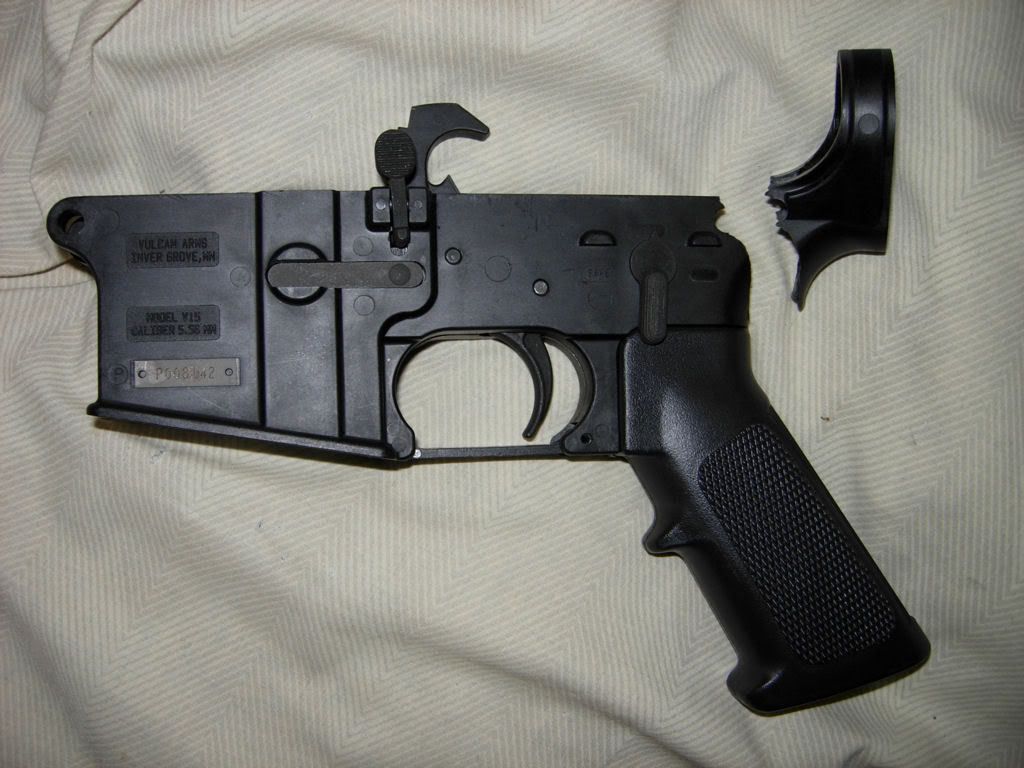
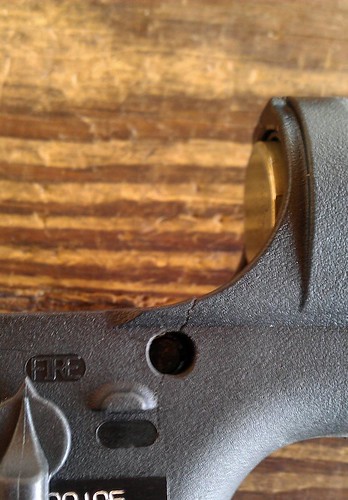
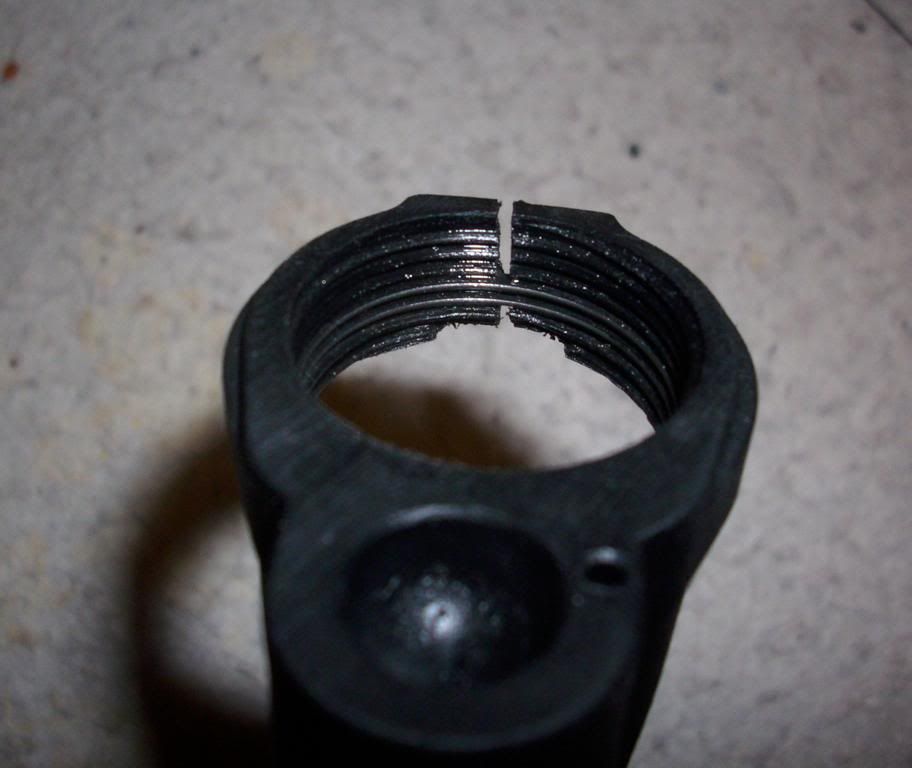
This is one maneuver that will place the maximum stress on the stock, receiver extension (known to some as buffer tube) and the rear of the receiver where the receiver extension screws into. This area where torque can be applied to the receiver is why polymer receivers fracture at that spot so frequently, polymer formed into the same shape as a forged aluminum receiver simply cannot hang with the torque. Cav Arms got around this by making a robust steel reinforced one piece buttstock design receiver (and they still had issues from time to time - though far fewer). Throwing the rifle around in the dirt does very little to test actual strength. Running over a rifle while on a flat surface or using the rifle as a step one time doesn't replicate the type of repetitive forces over time that can cause the type of fault causing stress and force that is at issue here either. Polymer simply is not the same as forged aluminum in the same thicknesses and designs. Simply copying the shape of a forged aluminum receiver with unreinforced polymer isn't going to give the the same strength, any engineer will tell you that. The same is true of cast vs forged aluminum, though cast aluminum will still be stronger than unreinforced polymer in the same dimensions of the standard AR15 or M16 lower receiver. There will be other points of failure with polymer. Here are some images of a New Frontier lower that failed that were posted on arfcom. Could be caused by dry firing hammer strike without an upper in place. But though not recommended, I have seen this done many times with forged aluminum uppers without damage. This illustrates in a graphic way the difference of strength in materials. 
Notice how they have made this lower of polymer virtually the same dimensions as a forged aluminum lower. This is a mistake. The polymer should be much thicker and denser in key areas such as the one that is damaged in the images. The problem with making it thicker is that it is not as aesthetic, and this has a negative effect on marketing of the product. 
If you want a range rifle that will be shot from the bench, or other light duties, you might be fine. To me it is not worth the expense of the rest of the components to own a rifle design that is executed in such a way so as to be too weak to used as originally intended. It's like having a kit car Ferrari body on a Volkswagen Beetle chassis. It might look good, but it will never have the same strength or performance. But that's just me. I say buy once cry once. Your results may vary. |
|
I disagree. Your example is for Military use, so it doesn't really hold water here (unless of course, the OP is building a gun for that purpose).
Also, that is the first and only pic of a New Frontier lower that I have ever seen broken. That being said, the picture doesn't tell the complete story. Bet my bottom dollar that some jackhole fired his lower without a complete upper on it. That can mess up shit on a forged lower too. In any case, Forged > Poly for now. I'm just saying proper poly lowers are fantastic for 99% of folks using them. |
|
Quoted:
I disagree. Your example is for Military use, so it doesn't really hold water here (unless of course, the OP is building a gun for that purpose). Also, that is the first and only pic of a New Frontier lower that I have ever seen broken. That being said, the picture doesn't tell the complete story. Bet my bottom dollar that some jackhole fired his lower without a complete upper on it. That can mess up shit on a forged lower too. In any case, Forged > Poly for now. I'm just saying proper poly lowers are fantastic for 99% of folks using them. Hey, if it works for you, more power to you. I just put that stuff there so people are aware of the differences before purchasing. Informed decision and all that. |
|
Quoted:
Military standard movement to prone firing position as we trained is to be able to drop to your knees first, then go prone, aggressively and quickly, with full body weight placed on the rifle while having one hand on the top of the narrow part of the buttstock and the other on the forearm, with butt of the rifle striking the ground to bear the force of the impact, so the knees don't have to. This is one maneuver that will place the maximum stress on the stock, receiver extension (known to some as buffer tube) and the rear of the receiver where the receiver extension screws into. This area where torque can be applied to the receiver is why polymer receivers fracture at that spot so frequently, polymer formed into the same shape as a forged aluminum receiver simply cannot hang with the torque. Cav Arms got around this by making a robust steel reinforced one piece buttstock design receiver (and they still had issues from time to time - though far fewer). Throwing the rifle around in the dirt does very little to test actual strength. Running over a rifle while on a flat surface or using the rifle as a step one time doesn't replicate the type of repetitive forces over time that can cause the type of fault causing stress and force that is at issue here either. Polymer simply is not the same as forged aluminum in the same thicknesses and designs. Simply copying the shape of a forged aluminum receiver with unreinforced polymer isn't going to give the the same strength, any engineer will tell you that. The same is true of cast vs forged aluminum, though cast aluminum will still be stronger than unreinforced polymer in the same dimensions of the standard AR15 or M16 lower receiver. There will be other points of failure with polymer. Here are some images of a New Frontier lower that failed that were posted on arfcom. Could be caused by dry firing hammer strike without an upper in place. But though not recommended, I have seen this done many times with forged aluminum uppers without damage. This illustrates in a graphic way the difference of strength in materials. http://i49.tinypic.com/jkcf9x.jpg Notice how they have made this lower of polymer virtually the same dimensions as a forged aluminum lower. This is a mistake. The polymer should be much thicker and denser in key areas such as the one that is damaged in the images. The problem with making it thicker is that it is not as aesthetic, and this has a negative effect on marketing of the product. http://i48.tinypic.com/okrbz9.jpg If you want a range rifle that will be shot from the bench, or other light duties, you might be fine. To me it is not worth the expense of the rest of the components to own a rifle design that is executed in such a way so as to be too weak to used as originally intended. It's like having a kit car Ferrari body on a Volkswagen Beetle chassis. It might look good, but it will never have the same strength or performance. But that's just me. I say buy once cry once. Your results may vary. Just to clarify, the Cav arms units had no metal in them other than the serial number tag and the nuts in the buttstock. I have 3 GWACS Armory CAV-15 MKIIs and the welds on them honestly look better than the ones we made at Cav Arms. The pic of the popped Mag well weld in this thread is from a Cav Arms CAV-15; this sometimes happenned due to moisture of residue in the parts when welded. I would note it happenned fairly early in the life cycle of the parts and Cav later implemented QA processes to catch this before they shipped. Unfortunately when Cav Arms was given a month to dispose of a years worth of inventory in February of 2010 some things shipped that shouldn't have. The good news is GWACS is offering service and replacement on old Cav Arms receivers. In any case unlike the catostrophic failures of the other lowers pictured, there were several ways end users could fix a split mag well themselves. |
|
that's what I thought would happen Quoted:
Quoted:
Has anybody used a polymer lower? how did it wok out ? http://i191.photobucket.com/albums/z172/sumkrnboy/DSCN0007.jpg http://img29.imageshack.us/img29/8723/45745390.jpg http://i188.photobucket.com/albums/z271/reloader1959/failedcarbonfiber.jpg http://farm6.static.flickr.com/5319/5818799409_a910e1a2c0.jpg http://i1123.photobucket.com/albums/l541/rattlesnake505/pclfailure2.jpg http://img213.imageshack.us/img213/2957/cavarmslower3.jpg |
|
Quoted:
Quoted:
Military standard movement to prone firing position as we trained is to be able to drop to your knees first, then go prone, aggressively and quickly, with full body weight placed on the rifle while having one hand on the top of the narrow part of the buttstock and the other on the forearm, with butt of the rifle striking the ground to bear the force of the impact, so the knees don't have to. This is one maneuver that will place the maximum stress on the stock, receiver extension (known to some as buffer tube) and the rear of the receiver where the receiver extension screws into. This area where torque can be applied to the receiver is why polymer receivers fracture at that spot so frequently, polymer formed into the same shape as a forged aluminum receiver simply cannot hang with the torque. Cav Arms got around this by making a robust steel reinforced one piece buttstock design receiver (and they still had issues from time to time - though far fewer). Throwing the rifle around in the dirt does very little to test actual strength. Running over a rifle while on a flat surface or using the rifle as a step one time doesn't replicate the type of repetitive forces over time that can cause the type of fault causing stress and force that is at issue here either. Polymer simply is not the same as forged aluminum in the same thicknesses and designs. Simply copying the shape of a forged aluminum receiver with unreinforced polymer isn't going to give the the same strength, any engineer will tell you that. The same is true of cast vs forged aluminum, though cast aluminum will still be stronger than unreinforced polymer in the same dimensions of the standard AR15 or M16 lower receiver. There will be other points of failure with polymer. Here are some images of a New Frontier lower that failed that were posted on arfcom. Could be caused by dry firing hammer strike without an upper in place. But though not recommended, I have seen this done many times with forged aluminum uppers without damage. This illustrates in a graphic way the difference of strength in materials. http://i49.tinypic.com/jkcf9x.jpg Notice how they have made this lower of polymer virtually the same dimensions as a forged aluminum lower. This is a mistake. The polymer should be much thicker and denser in key areas such as the one that is damaged in the images. The problem with making it thicker is that it is not as aesthetic, and this has a negative effect on marketing of the product. http://i48.tinypic.com/okrbz9.jpg If you want a range rifle that will be shot from the bench, or other light duties, you might be fine. To me it is not worth the expense of the rest of the components to own a rifle design that is executed in such a way so as to be too weak to used as originally intended. It's like having a kit car Ferrari body on a Volkswagen Beetle chassis. It might look good, but it will never have the same strength or performance. But that's just me. I say buy once cry once. Your results may vary. Just to clarify, the Cav arms units had no metal in them other than the serial number tag and the nuts in the buttstock. I have 3 GWACS Armory CAV-15 MKIIs and the welds on them honestly look better than the ones we made at Cav Arms. The pic of the popped Mag well weld in this thread is from a Cav Arms CAV-15; this sometimes happenned due to moisture of residue in the parts when welded. I would note it happenned fairly early in the life cycle of the parts and Cav later implemented QA processes to catch this before they shipped. Unfortunately when Cav Arms was given a month to dispose of a years worth of inventory in February of 2010 some things shipped that shouldn't have. The good news is GWACS is offering service and replacement on old Cav Arms receivers. In any case unlike the catostrophic failures of the other lowers pictured, there were several ways end users could fix a split mag well themselves. I stand corrected on that - thanks for your input. |
|
Quoted:
The good news is GWACS is offering service and replacement on old Cav Arms receivers. That's good to know, thanks. Just checked out their offerings - I did not realize the Cav Arms style lowers were still available. Those look pretty good. http://www.gwacsarmory.com/store.html#!/~/category/id=3143314&offset=0&sort=normal ETA just ordered one in OD. Figured might as well give them a try while they are in stock. Thanks again for the info. |
|
Quoted:
Quoted:
The good news is GWACS is offering service and replacement on old Cav Arms receivers. That's good to know, thanks. Just checked out their offerings - I did not realize the Cav Arms style lowers were still available. Those look pretty good. http://www.gwacsarmory.com/store.html#!/~/category/id=3143314&offset=0&sort=normal ETA just ordered one in OD. Figured might as well give them a try while they are in stock. Thanks again for the info. No prob. Be sure to check out my CAV-15 MKII Lower Parts Kit Install Video here |
|
Quoted:
Quoted:
Quoted:
The good news is GWACS is offering service and replacement on old Cav Arms receivers. That's good to know, thanks. Just checked out their offerings - I did not realize the Cav Arms style lowers were still available. Those look pretty good. http://www.gwacsarmory.com/store.html#!/~/category/id=3143314&offset=0&sort=normal ETA just ordered one in OD. Figured might as well give them a try while they are in stock. Thanks again for the info. No prob. Be sure to check out my CAV-15 MKII Lower Parts Kit Install Video here I ordered one of the pre-populated ones. For $100 more, figured it was worth it. I saw how installtion of lower parts is a bit different. I saw that the .45 ACP adapter block is available that allows use of M3 grease gun mags. Do you know what uppers this will accept for .45 ACP? I'd love to do a .45 carbine but no nothing about the uppers required. |
|
Quoted:
Quoted:
Quoted:
Quoted:
The good news is GWACS is offering service and replacement on old Cav Arms receivers. That's good to know, thanks. Just checked out their offerings - I did not realize the Cav Arms style lowers were still available. Those look pretty good. http://www.gwacsarmory.com/store.html#!/~/category/id=3143314&offset=0&sort=normal ETA just ordered one in OD. Figured might as well give them a try while they are in stock. Thanks again for the info. No prob. Be sure to check out my CAV-15 MKII Lower Parts Kit Install Video here I ordered one of the pre-populated ones. For $100 more, figured it was worth it. I saw how installtion of lower parts is a bit different. I saw that the .45 ACP adapter block is available that allows use of M3 grease gun mags. Do you know what uppers this will accept for .45 ACP? I'd love to do a .45 carbine but no nothing about the uppers required. Olympics are the only ones I am aware of. Make sure you use the Hahn Precision heavy buffer too, its necessary to avoid damaging the lower. 
|
AR Sponsor