


Armory Sponsor

Posted: 4/12/2014 1:26:31 PM EDT
|
well...took me almost a year to complete the test :-) but here are the results.
Overall, I can say the annealing each time gave me more consistent groups and tighter, the worst was never annealing, they just kept getting larger and larger until they were like off the shelf cheap ammo. With annealing every time 23 reloads random anneal 20 reloads no anneal 16 reloads (couldn't locate my original thread so posting this)  " /> " />
|
Silence is Golden, Duct Tape is Silver


|
good questions
1. Random anneal, the blue backgrounds indicate when I annealed on the random anneal, anywhere from 3-4 fires usually. 2. Annealing method during 'random anneal' was with tempilaq and the drill socket method, by the time I reached 'anneal every time' I purchased the Giraud annealer. 3. shot from a Semi-Auto AR15 (spikes tactical build) 15 inch 1 in 7 twist barrel. 4. Full Length resizing. The only points I'd like to make that I'm sure keep my brass alive longer are: a. my rifle shoulder setback reads 1.459 after firing, I push the shoulders back to 1.456 b. I trim to 1.756 |
Silence is Golden, Duct Tape is Silver

|
Again, many thanks for your excellent post.
I will certainly look at my AR 223 brass differently from now on, and certainly expect that annealing will become more of my processing too, thanks to your work. If this was polished up a little, I would bet it would be published by accurate shooter or many other sites. It really is a unique piece of work. |
|
Terrific data!
Can you present the group size progression data? That data is of much greater interest to me. In my world, I'd say the effect of annealing on case life is fairly small. As it is, you improved case life by only 11% by annealing every time. One piece of good news is you are getting an average of 13 firings for the un-annealed cases. Annealing increases that by one firing. Curiously, you lost substantially more cases (~10) early in the test from the annealed population. More curiousness - if you were to use the failure of the first few cases as an indicator that it is time to scrap the batch of brass (I do this), the two annealed batches would be retired first. Did you track the failure mode over time? When cases were lost, was it case neck cracks, case head separations, or whatever? What was the annealing process and how was time and temperature controlled? Was the process efficacious? Were the cases all identical to start? |
|
What conclusions do you draw from your data?
The accuracy conclusion is stated but the data to support it are not presented. I know the others and I are asking a lot of questions. Do not take this as criticism. Rather, it is great interest in your information. "One good test is worth a thousand expert opinions." -- Wernher von Braun |
|
So let me try to answer some questions. I'll try to catch them all.
My original intent was to prove to myself if 'range pickup/unknown firings' is really an issue or not. Brass selection My test bases were always, 100% lake city brass, various years, some found were as old as 90's, most were 2000-2013, I may have found a few from the 80's but didn't really think to log anything, thus the pure randomness. I will pick up any brass I find on the ground, some of these I'm sure some would have said toss. If it wasn't cracked then I didn't care how bad the bend is, if I can straighten it with the punch to round the neck and if I can shove a oval shaped body into the sizing die, well....firing it will make it like new. I made sure that ZERO once fired made it into my beginning counts of 150 cases. Having picked up numerous tens of thousands of brass I can pretty much tell what is once fired vs not. I wanted it to be 'truly unknown firings'. So I found them with silver primers, figuring a reloader left them so I would imagine they are of the mindset x firings and they just leave them. (thinking no less than 4??). Brass Cleaning Initial Probably at least 2/3 of what I found were those you really have to look for, you know those days when you go to the range and DARN....nobody left brass. If you walk slow and look you'll find some that are half buried and so dark and dank. I found lots that were full of dirt and grass roots. All brass initially went into the wet tumbler. Ongoing Cleaning pretty much just did the vib cleaning in walnut for 5-10 min, before sizing then 15-20 min after sizing to remove the lube. Since the initial cleaning made them perfectly look new (some looked copper) and I have a brass catcher, there was no need to go clean freak every single time in the wet method (though I do this when I store stuff :-) ) Firing Looking back, partway into the no anneal test is when I said 'dang....I should have taken pictures of targets cause my groups are opening way the heck up!" So being halfway through I decided to just finish vs. starting all over with test 1 (random anneal) and getting back to the 1/2 way mark in the no anneal test. Granted, some of the grouping could be my skills increasing, I can't discount that. But I did get disgruntled with the unannealed grouping and pulled out fresh ammo, shooting way better with the fresh ammo. repeating this on more than one occasion to at least confirm to myself that apparently the 8th firing I hear most toss it at is probably because groupings start going into the crapper. Then when I hit the annealing all the time, I was expecting my groups to start going south but they appeared to stay consistent. Zero data that I can show you guys to support the claim. Now also consider, I'm not one that can put cloverleaf on the paper with three rounds, 200 yards I'm maybe an 8 inch circle. Annealing Method Giraud annealer, tempilaq in the neck and the other temp down the side to ensure it didn't pass the top 1/3 of the case. (I'm not in my shop but it whatever the Giraud machine described to use). Timing was the moment that the entire green tempilaq in the neck melted, that was the moment the case dropped from the flame. I used (and continue to use) a set of 13 cases to configure before I start annealing. I've gotten to where now it takes me only 2. One to set, the other to confirm. on occasion a third. Failures - I tracked failures. I had a few loose primer pockets in the first batch, never got them in the last annealing case, but...that may be my definition of loose, if it went in lightly with barely resistance I tapped in on it's side at a angle, if the primer dropped out or dislodged at all, it was called a PP failure and counted as a failure. If it didn't dislodge....good to go. Had ZERO fall out in my chamber while firing. My failures were all case neck splits. Never a single case head separation, though I did look for the line in the case, never saw any. What I did notice by annealing every time, if the bottom of the neck can begin to split, just watch for burn marks on your brass and investigate them. I did not notice this with either the random or no anneal cases. Strange oddity The anneal every time, perhaps it was me getting new to the Giraud annealer? perhaps it was luck of the draw with the range pickup? I can't explain it...I would bet that if I took another case and did it again I would get no less than 3-4 addition firings than this test case. Very strange so many failed up front. But again this is pure randomness and can be expected. This test was about range pickup, So who knows how many times it had been fired. It would be interesting if it was 150 once fired. I would expect it to get more firings. My conclusion from all this...... I can be ocd and anneal every time, or...I can anneal every other time or third time, etc....I just know that I will anneal vs. not. Accuracy, while no data to support it...i'll anneal knowing that for me it seemed to keep the groupings better. The only true way to prove the accuracy would be to lock it down tight to where it was 100% same spot all the time and just run through the same test over and over to see. I started with 150 brand spanking new |
Silence is Golden, Duct Tape is Silver
You have a Giraud annealer, eh? I knew you were going to say that. I'm not jealous. No, really, I'm not. 
It's funny the failures were case neck splits when the cases were being neck annealed.If you were using standard dies and an expander ball, this could be the cause, despite the annealing. Every non-bushing die I've seen grossly under-sizes the neck, then relies on the ball to bring it back to the proper size. The technique of minimal shoulder set back (-0.003") really yields good case life. I think your data is interesting, if for no other reason than that. Thanks, again. |

Nickname: Doc. Came with wild hair and a DeLorean
Joined:
Apr 2010
Posts:
5715
EE: 100% (45)
 OH, USA
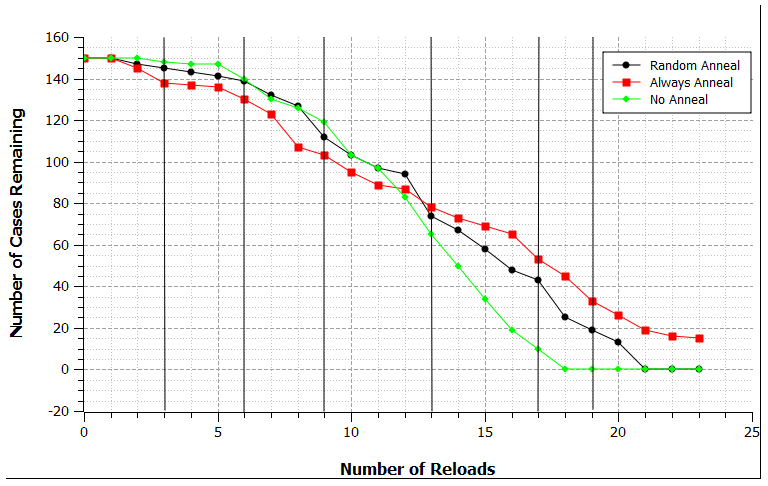
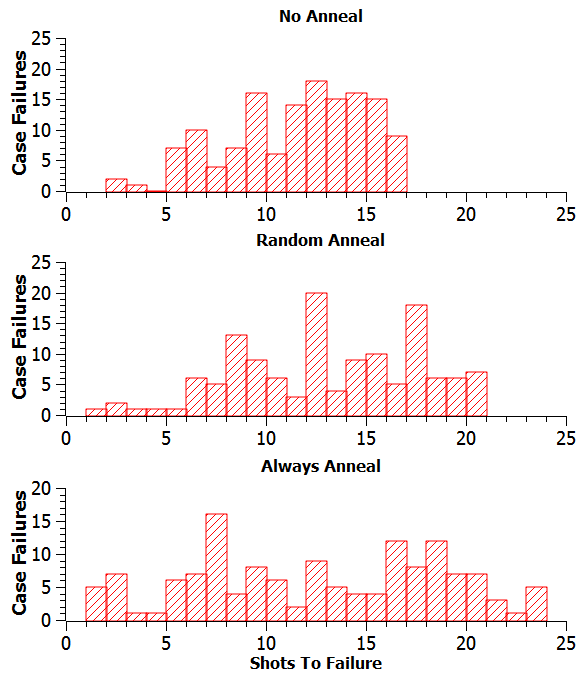
I would be interested to see the test repeated with a single annealing cycle run on the whole batch at 10 reloads or so. Seems that we see a significant and repeatable slope change in the failure rate at that point. This is assuming that I'm reading your data correctly, of course. |
"We're all new here, kid. The old ones are either dead or in the hospital. What the hell did you expect, a two week pass to Paris? Get in line and do what you're told, or you'll be dead before sunup."
|
LOL, I have those exact same plots on my machine.
Another interesting plot is number of failed cases versus number of firings for each of the three populations. The rate for the no anneal set seems could be changing at about 5 firings (green line). What is amazing is these are range picks. |
Nickname: Doc. Came with wild hair and a DeLorean
Joined:
Apr 2010
Posts:
5717
EE: 100% (45)
OH, USA
|
Originally Posted By RocketmanOU:
http://i927.photobucket.com/albums/ad111/RocketmanOU/AnnealExperimentCasesRemaining_zps33799346.png http://i927.photobucket.com/albums/ad111/RocketmanOU/AnnealExperimentHistogram_zps72cccfe5.png I would be interested to see the test repeated with a single annealing cycle run on the whole batch at 10 reloads or so. Seems that we see a significant and repeatable slope change in the failure rate at that point. This is assuming that I'm reading your data correctly, of course. I love your charts email me and I'll send you my excel you should then be able to figure out my various tabs and data maybe showing something in a different view. So are you saying take 10 rounds anneL once only and fire until they all fail? I should over the next few weeks be able to find more non once fired cases. Lots of reloader at my range, hell it's rare to find someone that isn't a reloader. All you see is .22. .17 hornet and steel on the ground |
Silence is Golden, Duct Tape is Silver
Nickname: Doc. Came with wild hair and a DeLorean
Joined:
Apr 2010
Posts:
5718
EE: 100% (45)
OH, USA
| Do you happen to know how much you were setting the shoulder back on the brass, and how much you were trimming, on average? |
"We're all new here, kid. The old ones are either dead or in the hospital. What the hell did you expect, a two week pass to Paris? Get in line and do what you're told, or you'll be dead before sunup."
|
Originally Posted By RocketmanOU:
Do you happen to know how much you were setting the shoulder back on the brass, and how much you were trimming, on average? msg above... a. my rifle shoulder setback reads 1.459 after firing, I push the shoulders back to 1.456 b. I trim to 1.756 |
Silence is Golden, Duct Tape is Silver
Nickname: Doc. Came with wild hair and a DeLorean
Joined:
Apr 2010
Posts:
5719
EE: 100% (45)
OH, USA
|
Originally Posted By Scorpius:
I love your charts email me and I'll send you my excel you should then be able to figure out my various tabs and data maybe showing something in a different view. So are you saying take 10 rounds anneL once only and fire until they all fail? I should over the next few weeks be able to find more non once fired cases. Lots of reloader at my range, hell it's rare to find someone that isn't a reloader. All you see is .22. .17 hornet and steel on the ground Originally Posted By Scorpius:
Originally Posted By RocketmanOU:
http://i927.photobucket.com/albums/ad111/RocketmanOU/AnnealExperimentCasesRemaining_zps33799346.png http://i927.photobucket.com/albums/ad111/RocketmanOU/AnnealExperimentHistogram_zps72cccfe5.png I would be interested to see the test repeated with a single annealing cycle run on the whole batch at 10 reloads or so. Seems that we see a significant and repeatable slope change in the failure rate at that point. This is assuming that I'm reading your data correctly, of course. I love your charts email me and I'll send you my excel you should then be able to figure out my various tabs and data maybe showing something in a different view. So are you saying take 10 rounds anneL once only and fire until they all fail? I should over the next few weeks be able to find more non once fired cases. Lots of reloader at my range, hell it's rare to find someone that isn't a reloader. All you see is .22. .17 hornet and steel on the ground Email sent I'm saying do another batch of 150, but instead of never annealing or random annealing, don't anneal any until the 10th reload. Based on your data, it seems like while annealing is giving you a benefit in terms of consistent neck tension, it's not doing that much to improve case life. This suggests to me that the dominant factor in case failure as seen here is the eventual stretching and thinning of the brass in the neck. Another piece of data that might be interesting (albeit difficult to measure and track) would be case wall thickness at the neck. You'd need a micrometer with a ball head though, and you'd have to track each case one by one, which would take a good bit of effort. Tell you what, I could easily do a test to look at brass stretching/dimensional change over time, and see if I can draw some conclusions in that regard. I'll add it to the list of stuff I want to explore during my 'time off' this summer. I'll be sure to post up results there and link them here, assuming this thread still exists. 
|
"We're all new here, kid. The old ones are either dead or in the hospital. What the hell did you expect, a two week pass to Paris? Get in line and do what you're told, or you'll be dead before sunup."

|
The whole "don't use range brass" is more of a safety thing, you are avoiding an unknown. Obviously nothing magical happens to brass when it lands on range property. The point is a novice may pick up some guys 10x fired brass that is ready to come apart.
Most of the brass I see/pick up at the range is new, so yeah I can treat it as basically new brass. Posted Via AR15.Com Mobile |
|
Originally Posted By popnfresh:
The whole "don't use range brass" is more of a safety thing, you are avoiding an unknown. Obviously nothing magical happens to brass when it lands on range property. The point is a novice may pick up some guys 10x fired brass that is ready to come apart. Most of the brass I see/pick up at the range is new, so yeah I can treat it as basically new brass. Posted Via AR15.Com Mobile Good point, while I did pick up some narly looking brass I did inspect it for cracks or issues that concerned me. If the sizing die could fix it and if firing it could reform it as well, then I used it. I think brass is way more durable than it's given credit for. I should do a "can you use it thread" next :-) |
Silence is Golden, Duct Tape is Silver

|
Dryflash or Aero E can we get a toggle on this? This kind of information is something to keep around!
|
<font size=2>Anyone can kill a dumb enemy, killing the smart ones requires Artistry!</font id=s2>
quemadmodum gladius neminem occidit, occidentis telum est
Lucius Seneca 4 BC-65 AD
quemadmodum gladius neminem occidit, occidentis telum est
Lucius Seneca 4 BC-65 AD

Global Warming Hoax Skeptic before it was cool
Joined:
Jun 2007
Posts:
29912
EE: 100% (1)
WA, USA
|
Originally Posted By Nightwolf357: Dryflash or Aero E can we get a toggle on this? This kind of information is something to keep around! |
Selling agent for Algores carbon credit scam.
Shooting and Reloading, one hobby feeds the other.
Shooting and Reloading, one hobby feeds the other.


Nice work! Thanks for posting this. It will help me make some points with some of my shooting buddies.
|
"Rome's glory by way of the Greeks came,
America's by cutting the English cord,
But Texas was sired by Fighters,
And a nation was born of the Sword"
Anonymous 1836
America's by cutting the English cord,
But Texas was sired by Fighters,
And a nation was born of the Sword"
Anonymous 1836
Armory Sponsor