


Armory Sponsor


Posted: 10/21/2012 1:31:28 PM EDT
| How finicky is an ar chamber? I'm resizing my brass so it is even with the upper step on the Wilson headspace guage. Will this cause issues with chambering? |
|
Quoted:
How finicky is an ar chamber? I'm resizing my brass so it is even with the upper step on the Wilson headspace guage. Will this cause issues with chambering? 1. Where does a unfired case rest in the Wilson gauge? 2. Where does a fired case rest in the Wilson gauge? 3. Two to three thousandths shorter than a fired case should be satisfactory. 4. I use a Hornady cartridge case gauge to be more precise. 
|
|
Quoted:
How finicky is an ar chamber? I'm resizing my brass so it is even with the upper step on the Wilson headspace guage. Will this cause issues with chambering? Sizing has nothing to do with finicky; the cases have to be sized correctly to function. Wait a day or so for the next thread requesting help because cases are either sticking the chamber of an AR, or failing to eject correctly. The chamber of an AR type rifle is manufactured with the same care and tolerancing of any other firearm. It's defective if it's not. |
|
Quoted: How finicky is an ar chamber? It's not. Just have to correctly size cases. I'm resizing my brass so it is even with the upper step on the Wilson headspace guage. Will this cause issues with chambering? End of case should be below the end of the case gauge but above the cut. What you describe is incorrect. As in not sized enough. Lower sizing die a small amount until it is. 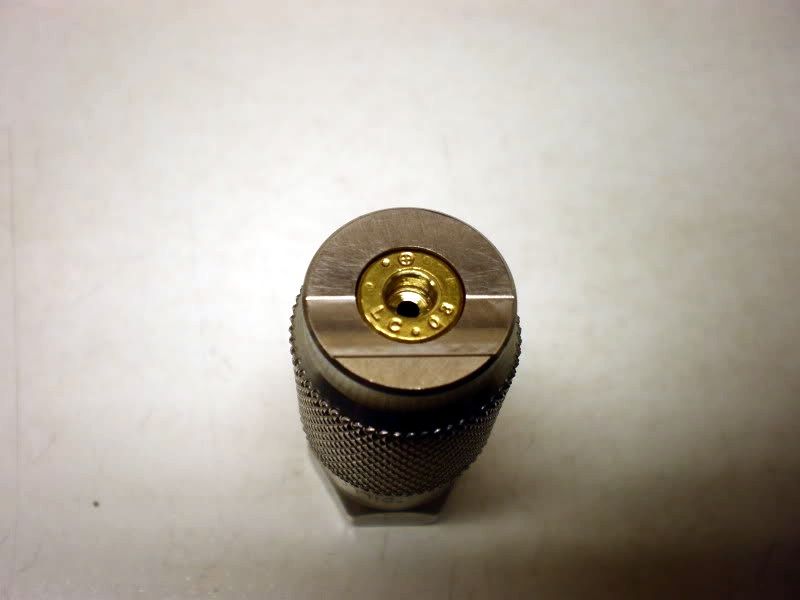 Like this. Dillon gauge shown, a Wilson gauge works the same way.
|
|
Quoted: http://i250.photobucket.com/albums/gg272/dryflash3/Case%20Gauge/PB290317.jpg Like this. Dillon gauge shown, a Wilson gauge works the same way. A good rule of thumb, especially when loading for multple rifles, is to see how a factory round sits in those gages (hopefully between the high and low steps) then size your brass so it lies the same way |
| Thanks for the help guys. I like the idea of being able to measure headspace to the .001 of an inch with the Hornady tool. However, when I check a fired case with the Wilson case gage, it is above the max step, and I don't believe that sizing the case just .002-.003 below the fired case would put it in the acceptable range on the Wilson gage. |
|
Quoted:
Thanks for the help guys. I like the idea of being able to measure headspace to the .001 of an inch with the Hornady tool. However, when I check a fired case with the Wilson case gage, it is above the max step, and I don't believe that sizing the case just .002-.003 below the fired case would put it in the acceptable range on the Wilson gage. The dimension obtained by setting up your sizer according to a fixed gage is one that the gage maker decided is the right dimension. The Wilson and Lyman gages I have used cause the sizer to produce 0.008 inches of cartridge headspace, which is just about the maximum desirable and not necessary for good function. I prefer to have more control over the sizing of my brass than provided by a fixed drop in gage. |
|
Quoted:
How finicky is an ar chamber? I'm resizing my brass so it is even with the upper step on the Wilson headspace guage. Will this cause issues with chambering? BTW, there are a few techniques by which you could gage your chamber for reference purposes. If you have the actual chamber dimensions, you would be able to adjust your reloading process accordingly. |
|
I can't get into the "measuring" end of the discussion.
I will tell you that dies and chambers are different. They are not identical from one brand to another (dies) or one rifle to another (chamber). All my ARs "ate" my reloads with no issues (Lee and Pacific .223 Rem. dies) for several years. These rifles are a mix of used gun show bought complete rifles, new kits I added a lower receiver to and new rifles where the parts were ordered from various makers. About 3 years ago I built a carbine that consistently failed to feed about half the reloads I tried to "feed" it. I found out a new set of RCBS X dies would give me resized/reloaded shels this rifle would feed consistently. I bought headspace gauges and checked every rifle I built. This rifle passes but was noticeable tighter with the go ga. that my other AR15's. Recently I've started seeing some pressure signs with that rifle (flat primers, primers blown out of cases) with the same reloads that shoot fine in my other AR15's. I recently got out several and did some bolt interchanging between rifles while checking head space and founce a bolt in another rifle that was a little bit looser in that "tight" carbine and I'm going to try that. Bottom line is your reloads have to reliably load, chamber, fire, extract, eject from your rifle's chamber. You've got to figure out what is causing the problem and correct it either with the resizing/reloading process/equipment or in the rifle. I'm not willing to write off that carbine. It has all the parts I wanted on it (most expensive AR 15 I've built so far) and it is a sweet shooting rifle (group size). So I'm still working with it. Good luck with yours. |
Armory Sponsor