


Armory Sponsor

Posted: 7/15/2014 5:09:10 AM EDT
|
May be a stupid question, but is it possible to anneal 223/5.56mm brass with a propane torch? I have ben researching this and it doesn't seem to be all that complicated. Does the brass need to be quenched after heating, or can it cool on its own?
Vince |
|
Quoted: May be a stupid question, but is it possible to anneal 223/5.56mm brass with a propane torch? I have ben researching this and it doesn't seem to be all that complicated. Does the brass need to be quenched after heating, or can it cool on its own? Vince |
|
Yes it is. Hornady makes a nice basic kit, comes with some shellholders to mount in a drill to spin the cases and some tempilaq for the body of the case. I recommend 750° tempilaq for the inside of the case neck as well. Color is a poor indicator of temperature. You need temoilaq.
I drop mine in water, but they go straight from there to the wet tumbler. If you're using a decent propane torch, you should be able to heat them fast enough that the body won't be affected. This is one of the reasons for the shellholders - it keeps the torch off of the body of the case. Brass is essentially unaffected by cooling rate (quenching hot steel would harden it, for example) - I do it somewhat to limit the heat affected zone to the neck only, but mostly so I don't burn myself when I'm done with a batch. Results from some microhardness testing I did about a month ago on a new case: 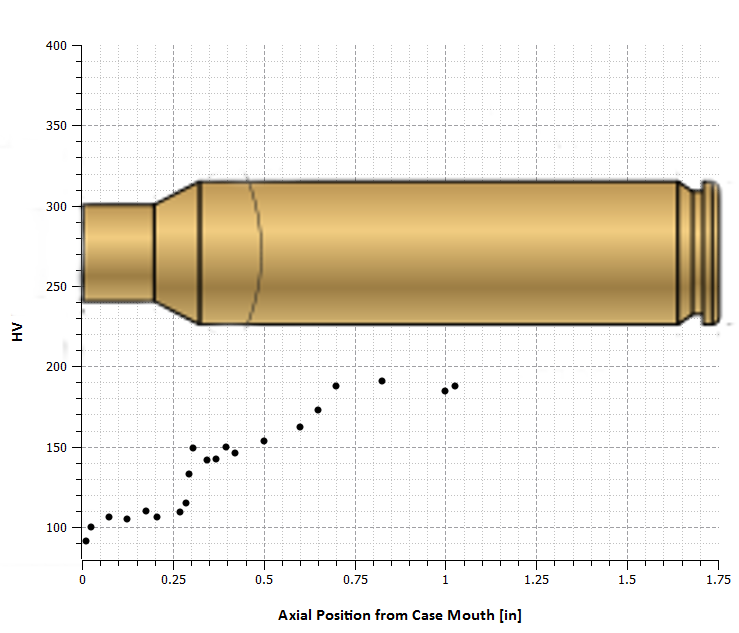
Notice that the reduced-hardness section of the case stops just below the shoulder. This is what you want to maintain, if you can. |
|
I have read several articles on the subject and there is some disagreement on the quenching. Some say it is not needed and some do. One method I found intriguing was to place the brass in a pan of water with the water just below the neck. Heat up the neck and then knock the brass over into the water. Another method was to place the brass in a dill so it will rotate as it is heated then drop into water. Also there is some disagreement on the color of the brass when it is hot enough.
Vince |
|
Quoted:
I have read several articles on the subject and there is some disagreement on the quenching. Some say it is not needed and some do. One method I found intriguing was to place the brass in a pan of water with the water just below the neck. Heat up the neck and then knock the brass over into the water. Another method was to place the brass in a dill so it will rotate as it is heated then drop into water. Also there is some disagreement on the color of the brass when it is hot enough. Vince I use the pan method. An old timer bench shooter taught me that. He was that guy that won all the matches, so I tend to think he knew what he was doing. I did a ton of .300AAC with no issues. Next time I will use a propane torch in each hand to speed things up and to heat more evenly. No tempilac. I anneal in the garage with the lights turned out. 
I also tried a carburized flame in a small 000 tip oxy acetylene welding tip. That was much too hot and melted the case mouths. When I turned on the lights, there was soot all over my cars in the garage. 
|
|
Check this out. I went with it after doing all the reading and listening to all of the "opinions"...most of which were ill informed. Simple, inexpensive, fast, and works very well.
http://www.cartridgeanneal.com/ Link made hot. AeroE |
|
Quoted:
I have read several articles on the subject and there is some disagreement on the quenching. Some say it is not needed and some do. One method I found intriguing was to place the brass in a pan of water with the water just below the neck. Heat up the neck and then knock the brass over into the water. Another method was to place the brass in a dill so it will rotate as it is heated then drop into water. Also there is some disagreement on the color of the brass when it is hot enough. Vince The water is not necessary. Judging brass temperature by color is inaccurate at best. You need to use a temperature-sensitive indicator such as Tempilaq or a thermocouple. Non-contact infrared thermometers are also inaccurate, as the emissivity of brass is very low, whereas most infrared thermometers are set to detect an emissivity of 0.95. ETA: The reason some guys put them in a pan of water is because they have no idea what temperature they're heating them to (since they're judging by color), and therefore no idea what temperature they're heating the body of the case to. Anything above about 450° on the body of the case, and you will weaken the brass in that area, which is a no-no. Tempilaq is cheap, and if you use it, you won't have to guess. |
|
Quoted: The water is not necessary. Judging brass temperature by color is inaccurate at best. You need to use a temperature-sensitive indicator such as Tempilaq or a thermocouple. Non-contact infrared thermometers are also inaccurate, as the emissivity of brass is very low, whereas most infrared thermometers are set to detect an emissivity of 0.95. ETA: The reason some guys put them in a pan of water is because they have no idea what temperature they're heating them to (since they're judging by color), and therefore no idea what temperature they're heating the body of the case to. Anything above about 450° on the body of the case, and you will weaken the brass in that area, which is a no-no. Tempilaq is cheap, and if you use it, you won't have to guess. Quoted: Quoted: I have read several articles on the subject and there is some disagreement on the quenching. Some say it is not needed and some do. One method I found intriguing was to place the brass in a pan of water with the water just below the neck. Heat up the neck and then knock the brass over into the water. Another method was to place the brass in a dill so it will rotate as it is heated then drop into water. Also there is some disagreement on the color of the brass when it is hot enough. Vince The water is not necessary. Judging brass temperature by color is inaccurate at best. You need to use a temperature-sensitive indicator such as Tempilaq or a thermocouple. Non-contact infrared thermometers are also inaccurate, as the emissivity of brass is very low, whereas most infrared thermometers are set to detect an emissivity of 0.95. ETA: The reason some guys put them in a pan of water is because they have no idea what temperature they're heating them to (since they're judging by color), and therefore no idea what temperature they're heating the body of the case to. Anything above about 450° on the body of the case, and you will weaken the brass in that area, which is a no-no. Tempilaq is cheap, and if you use it, you won't have to guess. One thing that's needed to the above is a method to rotate the case as it's heated. For 223/300 blk I use an battery powered screwdriver with adaptor to hold a 3/8 deep socket to rotate the case. 30-30 and 308, same tools as above except a 1/2 socket is used. This is the slow economy method, but you can get professional results. There are dedicated machines that anneal at a much faster rate for more cost. http://www.midwayusa.com/product/988733/tempilaq-temperature-indicator-750-degree-2-oz Yes you really need to get the Tempilaq if you want to keep from overheating your cases. I'll add some pics tonight, if this hasn't been covered by another poster. |
Great info at link > http://bisonballistics.com/articles/the-science-of-cartridge-brass-annealing The Science of Cartridge Brass Annealing. To much heat will deplete the zinc, making the case to soft.  Cartridge Brass- Cartridge Brass-
Material is 70 copper/30 zinc with trace amounts of lead & iron , called C26000. Material starts to yield at 15,000 PSI when soft (annealed), and 63,000 PSI when hard. Material yields, but continues to get stronger up to 47,000 PSI when soft, and 76,000 PSI when work hardened. |
| Quenching is not necessary. I use the Tempilaq method and have the flame length and time in the flame down. Once set just count it out and you can feel the bullets go in buttery smooth. Occasionally there are pieces that didn't quite make it and I cull the ones that have the a hard bullet seat in the case. |
|
Quoted:
You don't need water, you can use Tempilaq (750 degree) and a torch to anneal. What I use. One thing that's needed to the above is a method to rotate the case as it's heated. For 223/300 blk I use an battery powered screwdriver with adaptor to hold a 3/8 deep socket to rotate the case. 30-30 and 308, same tools as above except a 1/2 socket is used. This is the slow economy method, but you can get professional results. There are dedicated machines that anneal at a much faster rate for more cost. http://www.midwayusa.com/product/988733/tempilaq-temperature-indicator-750-degree-2-oz Yes you really need to get the Tempilaq if you want to keep from overheating your cases. I'll add some pics tonight, if this hasn't been covered by another poster. Quoted:
Quoted:
Quoted:
I have read several articles on the subject and there is some disagreement on the quenching. Some say it is not needed and some do. One method I found intriguing was to place the brass in a pan of water with the water just below the neck. Heat up the neck and then knock the brass over into the water. Another method was to place the brass in a dill so it will rotate as it is heated then drop into water. Also there is some disagreement on the color of the brass when it is hot enough. Vince The water is not necessary. Judging brass temperature by color is inaccurate at best. You need to use a temperature-sensitive indicator such as Tempilaq or a thermocouple. Non-contact infrared thermometers are also inaccurate, as the emissivity of brass is very low, whereas most infrared thermometers are set to detect an emissivity of 0.95. ETA: The reason some guys put them in a pan of water is because they have no idea what temperature they're heating them to (since they're judging by color), and therefore no idea what temperature they're heating the body of the case to. Anything above about 450° on the body of the case, and you will weaken the brass in that area, which is a no-no. Tempilaq is cheap, and if you use it, you won't have to guess. One thing that's needed to the above is a method to rotate the case as it's heated. For 223/300 blk I use an battery powered screwdriver with adaptor to hold a 3/8 deep socket to rotate the case. 30-30 and 308, same tools as above except a 1/2 socket is used. This is the slow economy method, but you can get professional results. There are dedicated machines that anneal at a much faster rate for more cost. http://www.midwayusa.com/product/988733/tempilaq-temperature-indicator-750-degree-2-oz Yes you really need to get the Tempilaq if you want to keep from overheating your cases. I'll add some pics tonight, if this hasn't been covered by another poster. That is exactly how I do it with great results. |
Pics as promised. Everything I use to anneal. Torch is set in drawer and is about 8 inches above the bench top.  Look inside case mouth and notice the green spot of (750) Tempilaq. Case is rotated with torch flame on the neck of the case. Watch the Templiq as it comes around, as soon as the spot of Templiq is gone (about 2-3 seconds) case is dropped into metal pan to cool.  This is the results. RP factory round on the left, the rest are my annealed rounds. That's my economy technique of annealing. Good luck |
|
Quoted: Check this out. I went with it after doing all the reading and listening to all of the "opinions"...most of which were ill informed. Simple, inexpensive, fast, and works very well. http://www.cartridgeanneal.com/ Can you buy Tempilaq at any local stores or is it something you have to order?
|
|
Quoted:
Pics as promised. Everything I use to anneal. That's my economy technique of annealing. Good luck Thank you very much, I appreciate it. Quick question, does the Tempilaq leave any residue behind? I will not be annealing 223/5.56 brass, I just have too much of it. I will be annealing 30.06 brass for M1 Garand though. Vince |
|
Quoted: Thank you very much, I appreciate it. Quick question, does the Tempilaq leave any residue behind? I will not be annealing 223/5.56 brass, I just have too much of it. I will be annealing 30.06 brass for M1 Garand though. Vince Quoted: Quoted: Pics as promised. Everything I use to anneal. That's my economy technique of annealing. Good luck Thank you very much, I appreciate it. Quick question, does the Tempilaq leave any residue behind? I will not be annealing 223/5.56 brass, I just have too much of it. I will be annealing 30.06 brass for M1 Garand though. Vince It leaves a black "smear"/stain on the inside of the neck. Which hasn't caused a problem for me.
|
|
When the Templaq cools it will form a glob on the inside of the case neck. Right? It seems like it will change the inside diameter.
I've been putting it on the outside of the neck, then it gets scraped off when I neck size on my trimmer. Since very thin brass (copper / tin) is a good conductor of heat, here is minimal difference between the temperature on the outside of the neck and the inside of the neck. |
|
Quoted:
When the Templaq cools it will form a glob on the inside of the case neck. Right? It seems like it will change the inside diameter. I've been putting it on the outside of the neck, then it gets scraped off when I neck size on my trimmer. Since very thin brass (copper / tin) is a good conductor of heat, here is minimal difference between the temperature on the outside of the neck and the inside of the neck. You put it on the inside of the neck so it's snesing the brass temperature instead of the flame temperature. The residue doesn't matter to me, as I tumble after annealing, and then resize. For brass that I'm annealing, my process goes as follows: Dry tumble 30 mins to get major dirt/crap off brass Decap on progressive Inspect brass, Tempilaq necks, Anneal Wet tumble, dry in forced air food dehydrator Lube, then resize on progressive Trim, chamfer and debur on lathe (WFT and standard debur/chamfer tools) Dry tumble 30 mins to remove lube Run through progressive to prime, charge, seat and crimp |
|
+1 on Tempilaq 750 liquid temp indicator inside of case neck, 400 on body on a few to prove safety, air cool/no quench for me.
Can use this to either set an auto machine or on each case if doing by hand. Tempilaq makes it easy and takes out the guess work. For what it's worth, the 750 tempilaq inside the case will change before the case turns red, at least this has been my experience. Draw your own conclusions. If considering a machine, I like/use the bench source. |
| personally i find no need to anneal any brass, i once did, then give it up as with the tip over method there was uneven heating which will cause splitting sooner. i have some 5.56mm NATO brass with over 20 reloads, if/when they show signs of splitting or any abnormally, i pitch them into the scrap bin, only after i crush them. |

|
I have a hundred 6X47 Lapua cases that have been fired an unknown number of times that I think I will anneal before running them through the next load cycle. The guy that owned the rifle didn't know a hell of a lot about the gun or his loads. There are about 15 or 20 loaded cartridges to break down, some of those are loaded with Data Powder.
The man that makes the first annealer linked had them for sale at a benchrest match here last summer. He has reduced his price, probably because his equipment is too easy to duplicate. |

Armory Sponsor