


Armory Sponsor

Posted: 1/11/2011 5:02:37 AM EDT
|
Hello,
I'm a service rifle shooter and compete with a Wylde cambered AR-15 and also load for an early 70s surplus upper with a 1:12 twist barrel. I have always sized my brass using RCBS full length dies set according to the manufacturer's instructions, having the shell holder contact the bottom of the die with a slight "cam over". My reloads have always fuctioned fine. Lately I've been reading more online regarding the use of a case headspace gauge to see if your brass is sized too long or short. This has me confused since it would seem there is no adjustment for this per RCBS's instructions. Is there some problem with the method I have been using? Any input is appreciated. Thanks, Ken |
|
A fixed drop in gage sets the headspace to whatever the gage maker decided is a good dimension. I've measured 0.008 inches for cases that were sized using Wilson and Lyman gages.
In order to set minimal headspace, an adjustable gage on a caliper is needed. The Hornady/Stoney Point tool is very popular, and now Sinclair sells a version that functions the same way. The point of that exercise is two fold, to improve brass life (not sure if a service rifle shooter will realize that), and to improve fit in the chamber in hopes of better accuracy. 0.0015 to 0.003 inches is a good range, I shoot for 0.002 inches or just slightly less; that works fine in an AR type rifle, but a bolt action match rifle might need a tad more for smooth chambering. I would opt for 0.0015 to 0.002 inches until I found out it was a problem. I don't care for drop in gages simply because I want control over the case dimension after sizing. |
|
As far as adjustment with the RCBS full length sizing die, there are two ways. To tighten head space one would back out the die body in the press frame by 1/16 turn or less increments until the proper length is acquired. To loosen head space (from your cam over position) one would have to grind down a few thousands off of the shell holder face, then screw down the die body in the press frame until the "cam over" is reached again.
As Aero-E suggests, to track the changes (length from gage diameter on shoulder to the head surface) one would probably need to use the Stoney Point (now Hornady) gage system or the RCBS Precision Mike equipped for your particular caliber. Since you are looking for only a few thousandths, make sure the case head rim or surface is free from distortions or burrs. Some autoloader mechanisms can really mess that up. |
|
I adjust my dies a little bit more rudimentary. I take a fired case from my rifle, set the die about a turn and a half off of the shell holder. After lubing the case I will smoke the neck / shoulder area with a lighter to color the case black. Run the press up and see how much it is sizing. I will adjust the die down until it hits the shoulder, then check to see how it chambers in the gun. If it chambers, then I'm good to go. Pretty much full sizing while bumping the shoulder back a tad.
You can do the same with bump gauges. The goal is to not to work the brass more than needed |
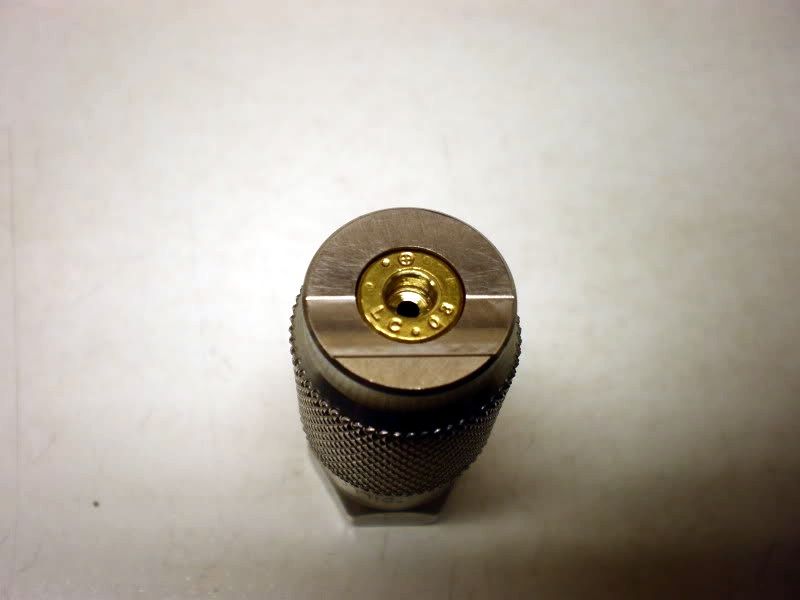
| You could very well be sizing your brass too much. In that case you would be falling below the low shelf on the case gauge. If your not to far below it the ammo will still fire in your rifle. Reason being it gets picked up by the extractor anyway and is being held to the bolt face by it. Is this a good thing most likely NOT. For the life of me I can't understand how anyone can reload for a rifle with out having some type of case gauge's |
| The Dillon gage would probably be fine for most applications. However, the OP mentioned that he had two rifles: a wylde chamber recent and an older '70s model 1:12 upper (if I am reading that correctly), and is wanting to refine case head space if possible. The older 70's model 1:12 twist rifle could have worn lugs and a longer head space than the wylde chamber recent rig. Using a micrometer based rig for measuring, like a stoney point (now Hornady) or an RCBS precision case mike, could allow the OP to track small changes caused by die adjustment and subsequent fire forming. |
| If he's loading for 2 different rifles, he still has to find the medium for them. Which would be the high shelf on the gauge at the most. Anything over that and the rifle would be out of spec and in need of repair. Also since he's shooting Match's with them he needs reliabity. I don't shoot high power but I do shoot rifle match's. I would give up some accuracy to have 100% function in my ammo. YMMV |
|
There is more to adjusting F/L re-sizing dies than just reading and following the instructions usually found in the box. Buy the case headspace gauge. Then try this............... 6) I use a single station press (RCBS Rock Chucker). You could use a progressive Dillon IF you wanted to. It's a personal choice. But, with whatever press you choose, consider shell plate/shell holder and/or press "flex.” I use a regular FL size/de-capper die, NOT the small base dies. To begin, lube your cases. Then, FL size and de-cap, 1 or 2 cases for a test. Gauge the re-sized case(s), to confirm that the "correct re-size" has been achieved. I use a Forster Products case gauge (the Wilson or Dillon case gauges are also popular choices). Holding the gauge vertically (large hole up), insert a case into the case gauge (DO NOT place it on the table top). The headstamped end of the case, needs to be at or between the high and low cuts on the gauge, to pass. This checks for the “correct re-size.“ While the other end, is used to check if the case will need to be trimmed (a job for later on). IF, it’s not the “correct re-size,” your die setting will need adjustment. Lower the ram and simply screw the die in or out a little. Don’t forget about the lock nut. Then, re-size another couple of test cases and check your work again. Repeat the test and adjustments, as needed. When you're satisfied that your test cases are properly re-sized, do the entire lot (remember to test some cases throughout the run). Note that this in MY step #6. Aloha, Mark |
I use the Hornady System as mentioned, I use the OAL Gage to determine the max OAL (with a Service Rifle you are limited to mag length) I then use a bullet comparator to determine how far off the lands I am, again with a Service Rifle this is not something you can take full advantage of and I also use a Headspace gage to let me know how far I am bumping the shoulder back ... the funny thing is when I first started reloading all I wanted to do was crank out ammo and now I find myself taking more and more time in prepping cases and weighing bullets with all the tools and gadgets you guys have talked me into buying but I will say the all of this has paid off even if the Mrs. does not aggree and if it did'nt help it all looks cool sitting next to my reloading bench 
|
Armory Sponsor