


Armory Sponsor


Posted: 8/14/2010 2:05:26 PM EDT
|
How does everyone check bullet setback?
How much before you set the crimp die tighter? I personally make a dummy round and chamber it 5 to 10 times and recheck the O.A.L. I was setting my dies for my new press and seem to be getting more setback than I like. But if I set the crimp die tighter it crushes the case. |
|
You didn't mention the caliber. Different techniques are used.
223 you don't need to crimp if your neck tension is good. Use the "push against the bench test". Put a caliper on your sizing button. Example 223. Bullets are .224 diameter, sizing button should be .002 less or .222. This will give good neck tension. If your button is too large, chuck it in a drill and sand down with 400 grit wet or dry sandpaper. Check the diameter often, you can't put it back. If you are set on crimping 223, get a Lee FCD. (factory crimp die) They don't smash cases. Pistol calibers are different. With a straight wall semi auto round, I use a taper crimp die and just take the bell out of the case. Revolver rounds get a firm roll crimp. I always seat bullets and crimp in separate dies. It is much easier to do it correctly this way. Not necessary, just easier. Good luck, and welcome to Arfcom. |
|
Yes, what caliber are you loading? Generally with semi-autos (rifle and pistol), crimp is not there to "tighten" the case and prevent setback. Crimp is just there to remove the "bell" from expansion. Your case tension, which was established when you resized the cases, is what holds the rounds tightly in place. Even with revolver....the roll crimp is there to prevent the bullet from coming "out" of the case, under hard recoil. |
|
Are you using a 3 die set? Seating bullets and crimping with the same die?
It can be done, but it's much easier to get a proper crimp with a 4 die set. Seat bullets with your present #3 die, adjust the die for no crimp. Buy a crimp die. Either a taper crimp die, I use a Hornady, or a Lee FCD. factory crimp die. 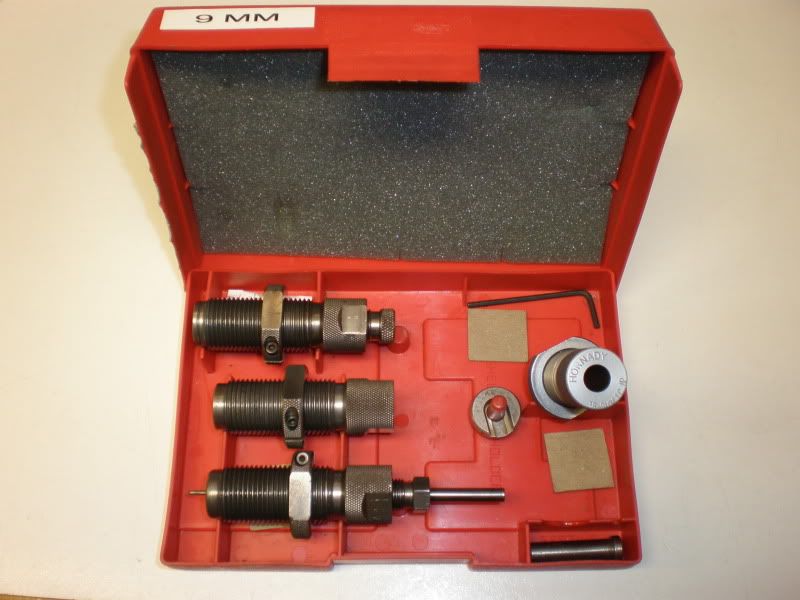
Taper crimp die is the one standing up. Didn't come with the dies, I had to order it. 
Lee FCD on top in my 45 ACP die set. Either one works, your choice. 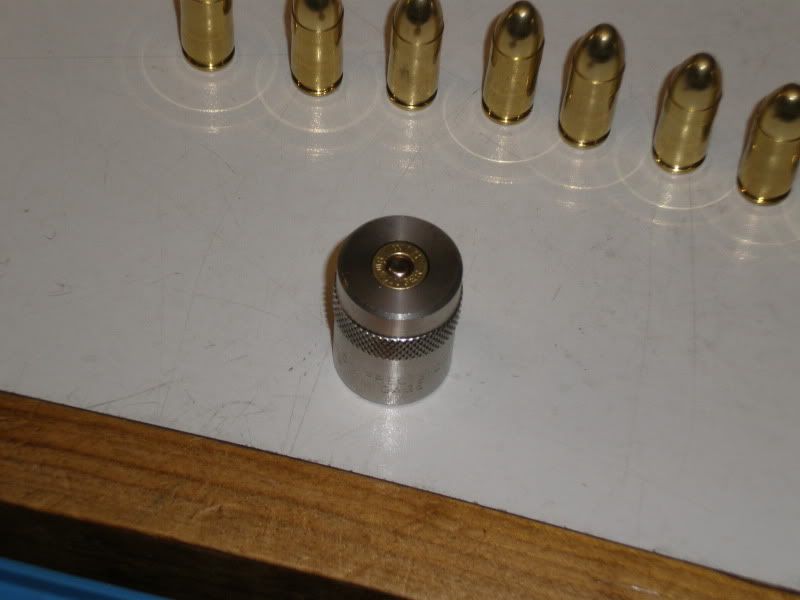
I will suggest you get a case gauge, and run all your rounds through it. Saves many problems at the range. |
|
You can allways do a final check by cycling the ammo through your firearm and measuring the OAL afterwards. Do this at a safe location in case you have an accidental discharge. This is the real test, does the bullet move after being fed from the magazine?
Most dies are very good about establishing plenty of neck tension. If your's doesn't, send it back or buy one of Lee's "U" dies. They are .001" smaller than standard. Evolution Gun Works (EGW) usually has them in stock. |
|
Red lights and loud sirens are flashing and sounding to your post so I just thought I'd drop in and see what the commotion was all about. Now I see. You follow the directions for installing your dies to the letter. No deviations. Then you find SAAMI spec for 9mm and set your crimp diameter between .377 and .381. .381 being maximum SAAMI spec and .377 being what white box Winchester diameter is. YOU CHAMBER ONLY ONE TIME WHEN TESTING SET BACK........ There is no need to check 7 or 8 times and if that's your standard.... factory ammunition will fail a test to that standard. There's absolutely no need for a round to survive that many chamberings. What about carry ammunition you ask ? My daily carry is Colt Government Model 1911. When checking for round chambered I simply pull the slide back with my index finger wrapped around slide and thumb behind grip safety. Pulling my thumb and index finger together.
Next, we can play the old school, new school reloader game all day long as well the color cool-aid game or we can have real dialogue about manufacturing reliable pistol ammunition. You need a factory crimp die. period. end of dialogue. Learn SAAMI spec for each caliber. You'll find that white box Winchester feeds reliably in all makes of semi-auto pistols. If you reload to those specs you'll do fine. |
| A "WARNING" sign that you may not have enough case tension on the bullet is "when you are expanding with the expander die and you can feel almost no resistance from the expander going into the case then you may not have enough grip on the bullet". Thin case walls of some brands or lots, undersized bullets, or possible case neck cracks, oversized expander, can cause too little grip on the bullet resulting in bullet setback. The crimp whether roll or taper will not solve a loose bullet condition. For thin wall cases that you may run into, Lee's U-Die Undersized sizing die which squeezes the case around a thousandth more than standard plus sizes farther down the case wall can solve a problem. Again, if you don't feel your expander "expanding" then you may have a problem with bullet setback. Some of Hornady's Die Sets do NOT have a taper crimp feature. A separate crimp die should be purchased for taper crimping and they can be bought separately. If unsure contact Hornady. |
Armory Sponsor