


Armory Sponsor


Posted: 4/1/2011 7:29:30 AM EDT
|
I got a wild hair up my ass to improve my reloads consistency. This website article is what motivated me to work on flash hole improvements:
http://www.snipershide.com/forum/ubbthreads.php?ubb=showflat&Number=96660#Post96660 The local reloading shop tried to get the Lyman tool for inside work and the RCBS for outside, as the article recommends. See my submission to RCBS below to understand my boggle. RCBS Flash Hole deburrer to do Inside Flash Holes I asked my local gun shop to order me one of these tools. He said they come in .22 and .30 sizes. Are both necessary for .223 Rem and .308 Win? Why is that? Are teh flash holes different sizes or something? _ He also ordered me a tool from Lyman to deburr the inside of the flash holes. Theirs comes in only one size. This does not make sense to me. I am NOT trying to work the primer pockets. This is just for the flash holes. Does anyone know if flash holes come in more than 1 size between 223 rem and 7.62 Nato/.243 Win? It would make sense that they do, but Lyman only sells a single tool, while RCBS specifies 2 by caliber. Something ain't right, and I don't want to get started if I am going to not do this right. Thanks! |
|
What I use. Works for .30 and .223. You just adjust the little guide cone thingy to get the correct depth. Knocks the burrs off right quick! Get the one with the handle.
Sinclair Generation II Flash Hole Tool |
|
Quoted:
What I use. Works for .30 and .223. You just adjust the little guide cone thingy to get the correct depth. Knocks the burrs off right quick! Get the one with the handle. Sinclair Generation II Flash Hole Tool That's what I use. I'll be doing a bunch of 45-70 tonight. |
|
Quoted:
What I use. Works for .30 and .223. You just adjust the little guide cone thingy to get the correct depth. Knocks the burrs off right quick! Get the one with the handle. Sinclair Generation II Flash Hole Tool Sir, I too use the Sinclair tool for the inside of the flash hole, but I also use the RCBS tool for the same purpose from the outside at the bottom of the primer pocket. The sleeve on the tool shaft is supposed to be caliber specific and when I bought my tool there were a number of other sizes available besides .22 and .30cal. The sleeve is only needed as a guide on the tool shaft when you're deburring the flash hole on the inside of the case. HTH, 7zero1. ETA: I just checked the RCBS web site and see that they list a pilot for .270 caliber in addition to the tools that come with a .22 and .30 cal. pilot. You can buy the tool without a pilot and purchase any of the three pilots seperately but those are the only three sizes I found on their web site. I suppose if it were important to you, one could turn down the .270 pilot to .243 but frankly if I were going to use my RCBS tool for the .243 I would just use the .22 pilot. The Sinclair tool works for any cartridge case and the conical pilot adjusts anywhere on the cutter shaft to suit the case length. HTH, 7zero1. |
|
Quoted:
Thanks guys. I should have mentioned that I will be doing this chucked in a drill press. I don't want/need a handle on the tool. Has anyone here seen increased velocity/accuracy consistency from this step? There are two processes. One is to deburr the inside of the flash hole and the other is to uniform the opening of the flash hole. I use a Lyman for deburring and it works fine. For uniforming the flash hole diameters, the Sinclair tools seem to be the way to go. I think that they open the SR and LR holes to .001" over SAAMI, for a uniform diameter. Chris |
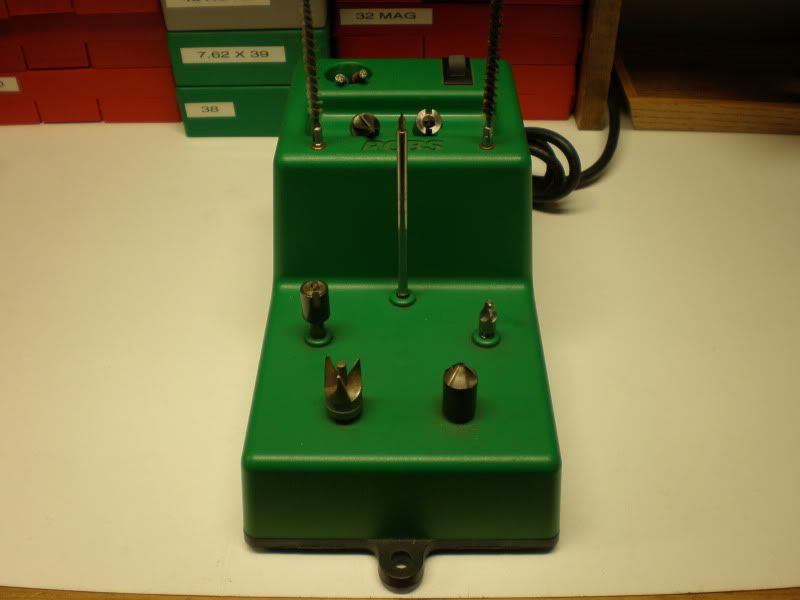
|
Quoted:
Thanks guys. I should have mentioned that I will be doing this chucked in a drill press. I don't want/need a handle on the tool. Has anyone here seen increased velocity/accuracy consistency from this step? There are many "contributing factors" but note what is said here............. : Which of the variables within a reloader's control have the greatest : impact on rifle accuracy? Primer uniformity is probably at the top of the list. This is about 60% of accuracy. But it matters more as the range gets longer. Non-uniform primers mean a greater velocity spread which means the vertical stringing at the target will be greater. Case length doesn't matter much. As long as the mouth is square with the case axis, case length can vary 10 to 15 thousandths of an inch and accuracy will still be excellent. Necks should be reasonably uniform in wall thickness, like no more than a .0005-in. variance. This helps keep the necks straight when the cases are resized. And they should not be sized too much. If they are, the bullet seating pressure will be too high; too much tension will cause a higher spread in velocity due to the normal variable incountered as each bullet needs a different amount of force to push it out of the cases. If neck tension is minimum, the spread of the force to push the bullet out gets lower resulting in a lower velocity spread. Case weight variance plays a somewhat important part. Heavier cases have less volume, hence slightly higher pressures and velocities for the same set of components. A 1% spread in case weight is typically good enough for best accuracy. Any more than that doesn't seem to make any difference. Primer pockets and flash holes should be uniform. Pocket depth needs to be consistant so each primer has the same pre-load; more uniform ignition. Flash holes need to be the same diameter so the same flame properties are transferred to the powder. But these two things only make about a 1/16th MOA difference in group size. Case body wall thickness helps too. They shouldn't have a spread of more than about .003-in. for 30 caliber cartridges; .002-in. for 22 and 24 caliber ones. But again, this only has a small effect, like about 1/8th MOA or a tad less. Powder charge weight variance can also cause more velocity spread. But just as important is powder type and charge weight. It's been my experience that for a given powder, there's two charge weights that tend to produce the best accuracy; one at about maximum, and one several grains less. A chronograph is needed to check the velocity spread to determine this. Charges with no more than a tenth grain variance is plenty good enough. Primers typically cause a greater difference in velocity spread than a tenth of a grain of powder. Bullet seating depth also has an effect on accuracy. Best accuracy is usually going to happen when the bullet contacts the lands. A lot of folks are reluctant to do this as they claim max pressures will be higher. Well, they're right, but cutting the powder charge a few tenths of a grain will reduce that pressure. Bullet concentricity is important, too. In a .308 Win. for example, if the bullet runout is more than about .003-in., the groups will start to open up a bit. If it's more than about .007-in., they probably straighten out as they enter the leade; I've not seen any more accuracy reduction with such rounds. The more a bullet has to jump to the lands, the straighter it needs to be. But bullets that are seated out far enough to be pushed back into the case a few thousandths as the bolt is closed can have a bit more runout and be accurate as compared to bullets that jump a ways to the lands. A square case mouth probably does more for letting the bullets seat straight than most other things. It's easy to get good cases, bullets, powder and tools to assemble them. But the hardest thing is getting good, uniform primers. Primers vary quite a bit across several lots; some much more than others. For ranges of 200 yards or less, there's not much difference between primers, like about 1/4 MOA in the groups they can produce for the most part. When longer ranges are used, primer uniformity becomes more important. A recent batch of match-grade ammo (about 300,000 rounds) was loaded from the same lots of cases, bullets and powder. Neck tension was quite uniform. Primer pockets were not uniformed nor were flash holes drilled to the same size. Bullet runout peaked at about .004-in. But several lots of primers were used. Some loaded lots of this ammo would shoot 2.8-in., 20-shot groups at 600 yards. Other lots would shoot 20-in. 20-shot groups at the same range. The difference was in the primer lots; some were very uniform, others were not. BB Spend your time on whatever YOU like. Aloha, Mark |
| Let me just worn you about the RCBS tool. Now I love RCBS tools in general, but I got no love for their flash hole deburing tool because it is a cutter inserted into a sleeve that can come loose as mine did after no more than a thousand cuts. I got my money back and bought a Lyman that has the cutter and the shaft made from one solid piece of stock, which has served me now for many thousands of cuttings. |
|
The only difference in the 22 & 30 cal flash hole tools is the size of the pilot that comes with them, any of the tools that have a hole pilot like the Redding(my favorite), Sinclair, or Lyman all uniform the flash hole size as well as deburr the flash hole so two tools are not needed for these two task.
The RCBS tool I have is the worst since it doesn't have the hole pilot which makes aligning the tool much more work, the Lyman is a good tool but depth of cut is based on case length so all your cases need to be trimmed exactly the same before deburring the FH. The Redding, Sinclair, & K&M tool all have cutters that have the depth of cut preset so regardless of case length every FH will be deburred to a uniform depth and the hole will be uniformed in size as well, the Redding tool opens the hole about .001" to give uniform results on every case. Also the Redding SS pilots will work with most FH tools except the Lyman which has a larger shaft. 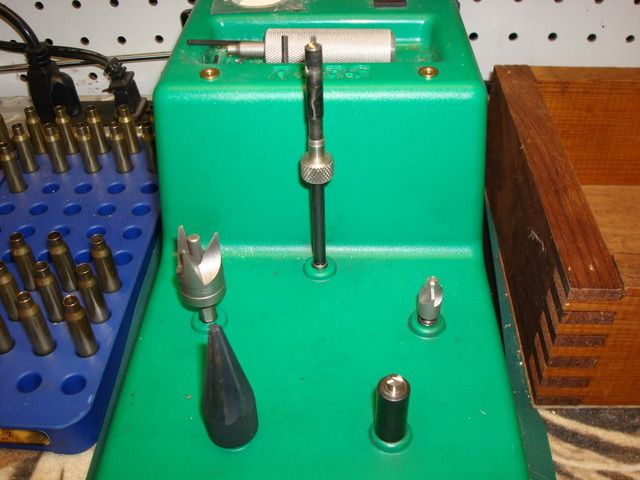
|
|
Quoted: Thanks guys. I should have mentioned that I will be doing this chucked in a drill press. I don't want/need a handle on the tool. Has anyone here seen increased velocity/accuracy consistency from this step? It might depend on the brand you use, but even at best, it's almost nil. I've got a buddy who's very good with statistics and designing tests. Using his F-class 223 bolt gun, we saw that there was no statically meaningful data to support that any case prep involving a cutter (beyond required trimming) made a difference. I think it was Win brass. |
|
Quoted:
What I use. Works for .30 and .223. You just adjust the little guide cone thingy to get the correct depth. Knocks the burrs off right quick! Get the one with the handle. Sinclair Generation II Flash Hole Tool That's what I use too, works great. |
|
Quoted:
Quoted:
Thanks guys. I should have mentioned that I will be doing this chucked in a drill press. I don't want/need a handle on the tool. Has anyone here seen increased velocity/accuracy consistency from this step? It might depend on the brand you use, but even at best, it's almost nil. I've got a buddy who's very good with statistics and designing tests. Using his F-class 223 bolt gun, we saw that there was no statically meaningful data to support that any case prep involving a cutter (beyond required trimming) made a difference. I think it was Win brass. I think the best answer to this question can be found in, The Ultimate In Rifle Accuracy by Glenn newick. The author is a bench rest competitive shooter. The info in his book is more geared to competitive shooting but there is a lot that can be appied to loading accurate ammo for your hunting rifles as well. |
Armory Sponsor