


Armory Sponsor

Posted: 12/30/2016 12:10:08 AM EDT
| So I have been reloading 9mm for a while and recently got a nice REM 700 in 308 and needless to say match grade ammo isn't that cheap anywhere so I am looking into adding what is needed to start reloading for it. I know that I will need a case trimmer, dies and a case gauge to make the jump up. What do you guys recommended for these parts keeping in mind that I am looking for precision out of this rifle? Also, what are some recommended powders that I should be picking up to try out? I have been mainly running 175gr SMK's with some 168gr SMK's as well. Thank you everyone for the help. |
|
Quoted:
So I have been reloading 9mm for a while and recently got a nice REM 700 in 308 and needless to say match grade ammo isn't that cheap anywhere so I am looking into adding what is needed to start reloading for it. I know that I will need a case trimmer, dies and a case gauge to make the jump up. What do you guys recommended for these parts keeping in mind that I am looking for precision out of this rifle? Also, what are some recommended powders that I should be picking up to try out? I have been mainly running 175gr SMK's with some 168gr SMK's as well. Thank you everyone for the help. L.E. Wilson case trimmer is the most accurate. Good case gauge as well. Dies, there are several, Forster, RCBS gold medal are good. I have had good luck with 4064, Varget. |
|
Quoted:
So I have been reloading 9mm for a while and recently got a nice REM 700 in 308 and needless to say match grade ammo isn't that cheap anywhere so I am looking into adding what is needed to start reloading for it. I know that I will need a case trimmer, dies and a case gauge to make the jump up. What do you guys recommended for these parts keeping in mind that I am looking for precision out of this rifle? Also, what are some recommended powders that I should be picking up to try out? I have been mainly running 175gr SMK's with some 168gr SMK's as well. Thank you everyone for the help. LE Wilson trimmer on the low end for precision. WFT for speed. I use a Giraud now tho. I recommend Redding dies. Type S Bushing FL die, and competition seating die are all you need. Type S bushing die lets you FL size, neck size with precision, and lets you bump the shoulder back a tiny bit while holding the case firmly during neck sizing to keep it concentric. Small tin of Imperial sizing wax (trust me) You will need a chamfer/debur tool for the brass after trimming. LE Wilson case gauge. Sinclair primer pocket uniformer and primer flash hole debur. Sierra 175SMK, Varget, CCI BR primers. I recommend a single stage press. I use a Rock Chucker with Inlinefabrication case kicking system added. |
| I like Varget as my main powder - though its not the easiest to work with. I use Redding National Match dies, and they are worth every penny in my view. I'm picky about my brass. My precision loads all get Lapua brass. I've also had good luck with Hornady brass, and will buy it when I can find it once fired. Most of my equipment is Hornady, but there's a lot of really nice equipment out there right now. Also, track your loads until you find what works best in each rifle. Also, get a chronograph to help track your results. Have fun with it. |
|
Quoted:
LE Wilson trimmer on the low end for precision. WFT for speed. I use a Giraud now tho. I recommend Redding dies. Type S Bushing FL die, and competition seating die are all you need. Type S bushing die lets you FL size, neck size with precision, and lets you bump the shoulder back a tiny bit while holding the case firmly during neck sizing to keep it concentric. Small tin of Imperial sizing wax (trust me) You will need a chamfer/debur tool for the brass after trimming. LE Wilson case gauge. Sinclair primer pocket uniformer and primer flash hole debur. Sierra 175SMK, Varget, CCI BR primers. I recommend a single stage press. I use a Rock Chucker with Inlinefabrication case kicking system added. Now this is my first rifle cartridges that I am loading. When you go to push the shoulder back, can this be done with a neck sizing die or is that what the FL die is for? Also, how would I find out what size I need for the bushings for those dies? |
|
A lot of people who reload for accuracy in a bolt action rifle neck size vs. full length resizing.
Consider match primers. If you go with a 180 grain bullet, consider IMR4350 powder. The most accurate 180 grain loads I ever ran through my .308 and 30.06 rifles were loaded with IMR4350 powder, Federal match primers and Sierra 180 grain match hollow point boat tails. I don't remember the powder charge, it was from an old Lyman reloading manual, it was a compressed load but was not a maximum charge/pressure load. |
|
I would avoid the Lyman EZ trim, as it precludes you from adjusting trim length, without permanently modifying the trimmer.
Also, a reloading block is very nice to have. Don't forget to wipe a plastic powder funnel with a dryer sheet. If you want to anneal, AZsky's hot salt bath is easy and cheap. |
|
Quoted:
Now this is my first rifle cartridges that I am loading. When you go to push the shoulder back, can this be done with a neck sizing die or is that what the FL die is for? Also, how would I find out what size I need for the bushings for those dies? Traditionally for bottleneck rifle cases, there are three common sizing dies: Full Length (FL) Neck Sizing (NK) Body Die The FL bushing die sizes the entire body, shoulder, and neck. The NK sizer sizes ONLY the neck The body side sizes ONLY the body including the shoulder. The traditional method to sizing for rifle was to resize the FIRST time with a full length sizer, then subsequently, only resize the neck, until the brass would grow long enough that it started sticking in the rifle's chamber, or the bolt handle would get heavy on loading or unloading the weapon. I used this method for years. The problem with neck sizing only, is one of concentricity. It is possible that when neck sizing, that the sized neck is not perfectly concentric with the body. Modern wisdom, is to use a FL sizer with bushings, and back that off so you are not resizing the case back to minimum SAAMI standards each time, but just bumping it back a slight amount so your brass is work hardened to a minimum, which is keeping your brass exactly the same size every time for each firing. At the same time, the neck gets sized while FIRMLY holding the case centered in the die, so the neck is perfectly concentric. The reason to use the bushing dies is that they are slicker than a standard FL die (less stress on the case), and they allow for exact neck tension to be set based on the brand of brass you are using. They allow for greater flexibility and control over a standard FL die. A standard FL sizing die without bushings will size the neck to the absolutely minimum specs, which is really overworking the neck and depending on your brass choice, creating way too much neck tension. To pick what bushing size you need - it depends on what brass you plan to use, and what your desired neck tension is. For .308, I use a titanium nitride Redding bushing, and I find I mostly use .335 but I am also using Lapua Brass. This will change depending on the thickness of the brass lot you settle on, from .331 to .336 generally. But you will need to determine that for sure but loading a bullet into your brass, and measuring that, subtract .002, and that is your size. This may sound confusing at first since you are new, but once you read over it a few times, it will make more sense. Additionally, some items to think about. Loading block: I really like the MTM universal Reloading tray 50 round block. You can get these at Midway or many other places. Powder funnel. You don't need a drop tube for .308 so any good funnel will work. MTM has a set for multiple calibers. Hand primer. If you are priming in a progressive press this isnt needed. But if using a single stage I really like the RCBS hand primer. I tried the LEE based on recommendations from here, and I found it to feel junky. The RCBS uses the same shell holders that the press uses for the Rock Chucker. |
|
Quoted:
Look at headspace tools and OAL tools sold by Hornady Learn about how much to resize and 'jump' I use Reloder15 but the others mentioned in this thread work, too Forget a case gauge. Take a step up and get a much better tool Hornady headspace tool. Does all bottleneck cases. 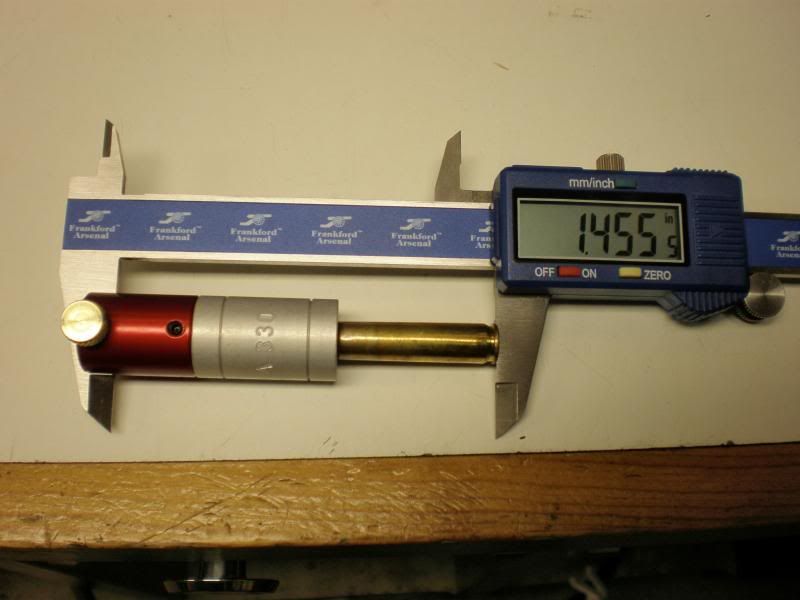
Attach to your caliper and set your sizing die with precision. |
|
alot of good info above.
I havent used a redding S die before but I recently started using the lee collet dies(neck sizing) for my bolt guns and kick myself for not trying it sooner. i'm getting .35-.5moa from my douglas barreled .308 You may want to try the new nosler 175gr RDF. i'm in the process of working up a load but so far it's looking pretty good and has a decent bc boost over the SMK's. there cheaper too. Try br2's or 210m's and see which give you lower es/sd (remember for long range es/sd provails over tiny groups at 100yds sometimes you get both  ) )
I've had good results in the past with varget but as of late I have grown to love IMR 8208 xbr. yes it leaves some velocity on the table (not much for me as I have a 18.5" barrel) but it flat out shoots and work great in my .223 with 77's also so stocking 1 powder has been nice (still have varget just don't use it currently) nice not having to worry about powder bridging on .223 cases. if you plan on shooting alot get the giraud try way or theres a new company out there with a comparable product the name is slipping my mind currently. they offer "dies" for different cartridges vs giraud only has the whole unit per cartridge family and not many to chose from. |
|
Quoted:
Forget a case gauge. Take a step up and get a much better tool Hornady headspace tool. Does all bottleneck cases. Attach to your caliper and set your sizing die with precision. Do not waste your money and time buying a drop in gage. This gage gives you measurements in .001" increments and works for virtually 90% of all calibers on the market. You won't have to buy a separate gage for each caliber if you buy the Hornady Lock-N-Load tool. It's one and done. |
|
Quoted:
Do not waste your money and time buying a drop in gage. This gage gives you measurements in .001" increments and works for virtually 90% of all calibers on the market. You won't have to buy a separate gage for each caliber if you buy the Hornady Lock-N-Load tool. It's one and done. Quoted:
Quoted:
Forget a case gauge. Take a step up and get a much better tool Hornady headspace tool. Does all bottleneck cases. Attach to your caliper and set your sizing die with precision. Do not waste your money and time buying a drop in gage. This gage gives you measurements in .001" increments and works for virtually 90% of all calibers on the market. You won't have to buy a separate gage for each caliber if you buy the Hornady Lock-N-Load tool. It's one and done. One point of order - the Hornady headspace gauge does NOT replace the need for a case gauge across the board. The cause gauge measures case neck length, headspace from the shoulder, AND measures the body dimension. This is very useful when loading for semi-auto's to find brass defects in the case body and case head that otherwise would go undetected. If you are just loading for a bolt action rifle, this is much less of a concern, especially so when reusing brass fired from your rifle's chamber, and always keeping that load/brass for that rifle. In that case, the Hornady Headspace Kit is a nice addition for knowing exactly how much shoulder you want to bump back from your fire formed case after its initial firing in your rifle's chamber. |
|
First things first. Every person who loads .308 needs to know right out-of-the gate is that .308 and 7.62x51mm brass varies considerably. New commercial Winchester brass has the highest internal capacity and weighs as little as 155 grains empty and unprimed. Once fired Lake City 7.62x51mm or new IMI brass weighs as much as 180 grains empty and unprimed.
This difference is huge and requires a 2.0 full grain reduction in powder charges when switching from Winchester to bulk military surplus brass to obtain the same maximum chamber pressures upon firing! Don't screw this up, pay attention to the brass head stamp and keep them separated when loading. I have used RCBS, Redding and Forster .308 dies. I won't buy or recommend Lee simply because they look and feel cheap. Forster and Redding match grade bullet seating dies are the best and worth every penny. I tend to favor Forster because they will custom hone their die necks for a nominal fee (I think $12.00 plus shipping) so you can make the dies fit your brass. Measure your loaded ammo's neck diameter and subtract .0035" to .004" to get the custom hone dimension. This measurement will change if you change brass. Winchester brass will read much smaller than military brass in this regard. Most people consider Lapua brass as being the best available. I like Winchester commercial brass because with a little work it's every bit as good, just cheaper. Federal is too soft, but can be reloaded once or twice. I use Lake City and IMI for my semi-autos. It's built tough and can take the cycling better, plus it's much cheaper as a rule. IMI brass can be purchased new for .31 to .33 cents a case when purchased in bulk. .308 is a dream to reload. It's naturally capable of good accuracy and allows the use of most medium burn rate powders. Best powders in my experience are as follows: Varget IMR-4064 RE-15 VihtaVuori N150 IMR-4895 VihtaVuori N140 H4895 IMR-3031 WW-748 |
|
Quoted:
One point of order - the Hornady headspace gauge does NOT replace the need for a case gauge across the board. The cause gauge measures case neck length, headspace from the shoulder, AND measures the body dimension. This is very useful when loading for semi-auto's to find brass defects in the case body and case head that otherwise would go undetected. If you are just loading for a bolt action rifle, this is much less of a concern, especially so when reusing brass fired from your rifle's chamber, and always keeping that load/brass for that rifle. In that case, the Hornady Headspace Kit is a nice addition for knowing exactly how much shoulder you want to bump back from your fire formed case after its initial firing in your rifle's chamber. I have never had a resized case not fit in any of my seven .308 semi-autos or 4 bolt actions, but I have read where other have had this problem. I use SAAMI minimum (go gage) -.001" as my resize goal and it has always worked for me. I have and use the very best gages on the market (Mo DeFina's) for .223, 308 and .30-06. They are .001" micrometers as well as a chamber style with trim marks for the case mouth. Similar to RCBS's micrometer, only better. 90% of reloaders are not willing to buy $65.00 gages for every caliber they load. The Hornady tool will give them the most important measurement, shoulder set-back, and everything else should fall into place once that is established. The Hornady tool's cost is the driving factor behind my recommendation. It allows the reloader to measure fired brass and resized brass and adjust the sizing die to reach their personal goal. Drop in gages are inferior in every way in that regard. If anyone is setting their shoulders back to SAAMI minimum (for use in a semi-auto) or -.002" from fired measurement for use in a specific bolt action and their ammo won't chamber, it's my opinion there is something wrong with their dies. They may have a shell holder that is imposing a tolerance stacking issue when used in combination with their dies. Using the same brand shell holders as your dies will usually fix this. Removing metal from the top of the shell holder will work as well. Lake City brass fired from 7.62mm chambers is notoriously hard to resize and springs back more than the commercial varieties. It's the end result of 7.62x51mm chambers being several thousandths of an inch longer and radially larger than commercial .308 chambers. Acceptable headspace on a NATO 7.62 chamber is longer than the field gage on a commercial .308. It's even worse if the ammo was fired from a machinegun. These dimensions combined with the fact that 7.62mm brass is at least .002" thicker all around than commercial brass and you end up with resizing difficulties. I have never has anywhere near the resistance resizing Lake City brass when fired new from commercial rifles that I do when I resize brass purchased as once fired military surplus brass. Their chambers are huge compared to civilian varieties. Virtually all of the chambering problems people experience is associated with surplus G.I. brass, not ammo that was fired from civilian owned rifles. If you are buying once fired Lake City brass, you will need every type of gage. I trim every case, every time. No exceptions. I don't even look at my gages to see if they need to be trimmed. It's actually easier, faster and better for me to just run every resized case through my Giruad or Gracey. |
|
"I have never had a resized case not fit in any of my seven .308 semi-autos or 4 bolt actions"
I have. Especially LC .308 fired from a machinegun. "90% of reloaders are not willing to buy $65.00 gages for every caliber they load." That is a subjective statement and not my experience. PS.... case gauges dont cost $65. I buy LE Wilson case gauges and they are 24 bucks. When you invest in a caliber to reload, $24 one time up front cost is nothing. Be realistic. "The Hornady tool will give them the most important measurement, shoulder set-back, and everything else should fall into place once that is established." Key word is "should". Reality is, it doesn't always work that way. I reload thousands of rounds of .223 and .308 a year and my case gauge does catch defects in the case or the case head. I case gauge EVERY round that is going in a semi-auto. It is a good practice. "The Hornady tool's cost is the driving factor behind my recommendation. It allows the reloader to measure fired brass and resized brass and adjust the sizing die to reach their personal goal." And I agreed, it is a nice add-on when making the most precise load and working the brass to the least amount is a goal. "Drop in gages are inferior in every way in that regard." No - drop in gauges are useful because they provide other purposes beyond just headspace measurement. "I trim every case, every time. No exceptions. I don't even look at my gages to see if they need to be trimmed. It's actually easier, faster and better for me to just run every resized case through my Giruad or Gracey." I do as well, once I got a giraud. But before I did - I only trimmed every 4 firings, and there was zero detectable difference in accuracy. I used a case gauge to spot any anomalies. It was very handy. It is also VERY handy for new reloaders who are not experiences in lube amounts (dented shoulders), crushing shoulders ever so slightly when crimping and seating in the same operation (not saying I recommend that, as I use LFCD now), etc. It just makes good sense. Once you get a decade of experience behind you and familiarity with all your processes, I agree.... they become less important to you. But I'd still recommend them as a general practice - $24 and it is a good tool to save you grief. |
Armory Sponsor