


Armory Sponsor


Posted: 11/3/2008 9:21:30 PM EDT
|
Guys i need your help. I have read the FAQ's and have employed the paper clip inspection but I am looking for a quicker way to sort out potentially bad cases.
I recall reading that you could measure either the base of the cartridge or the inside of the extractor rim to find expansion in the base of the cartridge, after resizing. Did I dream this one night or does someone have some measurements they use to separate out potential case head separations? |

|
You don't really need to worry about this unless you have over-sized cases a few times or have a rifle with excessive headspace problems.
Measuring the case head expansion won't tell you anything. Excessive headspace is the problem. Cartridges must fit freely to chamber, this means there is an undersize tolerance. For headspace, that means 0.002-0.004". If the cartridge headspace is much larger, say 0.006", the force of the firing pin drives the case far into the chamber. Since firing pin extends 0.032" or so, it isn't a problem. When pressure expands the case, it does so first on the diameter as hoop stress is twice that of axial (tending to make the case longer). So the case grabs the chamber right at the shoulder as the diameter to thickness is the least there and it is usually in an annealed state. But remember, the case head is forward of the bolt face by 0,006". When pressure rises to about 28,000 PSI, the case is firmly grabbing the case walls and the pressure is now high enough to stretch the case axially. It does so right at the junction of the web and body and there is some material thinning there. When reloaded, the die cannot restore this loss. And the case is longer so you trim. There is one good clue, EXCESSIVE TRIMMING. Here, if you can see the trimming progress, as in how much trimming swarf is removed off each case, you can find any problems. |
Peak oil happened shortly after Drake sunk his first well in Titusville PA...in 1858.
Hubbert was a Luddite geologist...or he had no concept of Moore's Law and how it applies to exploration and production.
Hubbert was a Luddite geologist...or he had no concept of Moore's Law and how it applies to exploration and production.
|
My head space was checked today and I always check every case after resizing in a Lyman case dimension gauge. But I am getting little splits at the base of the brass even in light loads. It looks like the bulge in a pistol case in an unsupported chamber that blew out just a little bit. It is blowing back smoke into the rifle when it happens and occasionally loosens or detaches the base plate on the mag.
I'll start tossing cases that require excessive trimming. Thanks Keith, Bob |


|
In the past when buying once fired military case I seemed to always find a few to several cases that show signs of incipient case separation. I use the bent sharpened feeler tool to feel for the stretch mark or cracks inside the case. I don't have problems with my brass fired in my guns, just once fired brass I bought. Don't know if it's the result of incomplete bolt lock-up on a few cases or a few cases fired in guns not properly headspaced. Anyway I do recommend checking EVERY once fired case from an unknown source. I also use an Opti-Visor when checking cases and the extra magnification will help you spot case stretching from the outside of the case. Pressure is not the cause of case stretching and measuring pressure signs on the case won't show you stretched cases.
RCBS makes a tool called the CaseMaster that should help to speed up the checking of the inside of the case for the tell-tale stretched ring on the inside of the case.http://shop.rcbs.com/WebConnect/MainServlet?storeId=webconnect&catalogId=webconnect&langId=en_US&action=ProductDisplay&screenlabel=index&productId=3180&route=C11J142 |
|
Yes, M249 brass is famous for this. Still, the best sign is a case that is much longer than the rest of the cases. If you trim with the older style tools, you will see all the extra swarf coming off the case. But if you trim in something like the Dillon or any of the tools indexing off the shoulder, it may not be obivious.
Cases are also harder to size and will be a bit longer in headspace, making you think a small base die is needed. But that case should be thrown out. |
Peak oil happened shortly after Drake sunk his first well in Titusville PA...in 1858.
Hubbert was a Luddite geologist...or he had no concept of Moore's Law and how it applies to exploration and production.
Hubbert was a Luddite geologist...or he had no concept of Moore's Law and how it applies to exploration and production.
|
Have you tried punching out the primer and shining a flashlight up through the flash hole while you looked into the case mouth at the inside walls?
This usually works for 223, but doesn't on most other cals because the AR separates the cases not quite half way up and other cals separate at the web. HTH 'Borg |


|
You could try it this way...............
To start..........it's very important to keep all your brass together by lot#. And to treat them alike. So........buy some brass from 1 lot#. Prep your brass from the entire lot. Reload and shoot it. reload and shoot it, reload and shoot it....etc....... You know when you're suppose to trim.....so, trim them as a lot. Keep all the brass as a lot (example: you don't want some being fired 2x and some being fired 4x). And, don't fire the lot in multiple firearms (unless all of the lot is expended in a particular firearm)......chambers vary. If/when you get a case separation or until you see the tell tail signs of a sparation..........toss the whole lot. I realize that some may say you're throwing away good brass that way........but, I'm trying to be conservative here. Maybe, you'll wait until you have ____% failure before you toss the lot. Bottom line.......do it how you like. Aloha, Mark PS..........seeing problems w/ brass........ http://stevespages.com/diagnosingproblems.html |
"Guns don't kill people......the Government does."
Dale Dribble
Dale Dribble


|
Originally Posted By Ky_Bob:
My head space was checked today and I always check every case after resizing in a Lyman case dimension gauge. But I am getting little splits at the base of the brass even in light loads. It looks like the bulge in a pistol case in an unsupported chamber that blew out just a little bit. It is blowing back smoke into the rifle when it happens and occasionally loosens or detaches the base plate on the mag. I'll start tossing cases that require excessive trimming. Thanks Keith, Bob Not to detract from what Keith_J said, but I have never seen that phenomena you described. And, if I did, I would stop shooting until the problem was cleared up. You are pressurizing the magazine? Holy case head, batman! Not sure if you really mean that. Also fissures at the base? Do you mean base as in web and rim and primer pocket? That is tantamount to a case head structural failure which can make for a very bad day. Not sure if you really mean that. The photo Easy_E posted above is a "case head separation". Not so bad, because the gases are pretty much contained at max. chamber pressure. I think Keith is correct in what he advised, and that extra trimmng to length after firing means brass is having to come from somewhere and it can only be the body of the case thinning and stretching. |
" America is at that awkward stage in life. It's too late to work within the system, but too early to shoot the bastards."
|
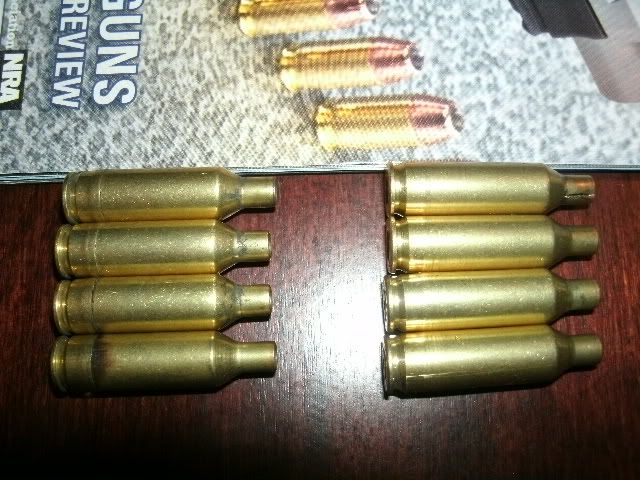
Is this what you're talking about?
http://s240.photobucket.com/albums/ff128/We-rborg/?action=view¤t=2247crop_13502.jpgcase failure Look close at the base of the web |


|
Originally Posted By Easy_E:
You will see the line around the outside . After five reloads my fireball brass has had it. http://i570.photobucket.com/albums/ss148/Easy_E_photos/761cf84b.jpg Thanks in advance because I ran across some brass that had exactly what's been described here. |
Beware Panopticon.
®¿®
http://marylandshooter.com/ar15/junkOne.asp (funny pics)
Thinking of an MI Rail? DON'T
http://marylandshooter.com/ar15/mi/mirailissue.asp
®¿®
http://marylandshooter.com/ar15/junkOne.asp (funny pics)
Thinking of an MI Rail? DON'T
http://marylandshooter.com/ar15/mi/mirailissue.asp


|
Originally Posted By CCW:
Originally Posted By Ky_Bob:
My head space was checked today and I always check every case after resizing in a Lyman case dimension gauge. But I am getting little splits at the base of the brass even in light loads. It looks like the bulge in a pistol case in an unsupported chamber that blew out just a little bit. It is blowing back smoke into the rifle when it happens and occasionally loosens or detaches the base plate on the mag. I'll start tossing cases that require excessive trimming. Thanks Keith, Bob Not to detract from what Keith_J said, but I have never seen that phenomena you described. And, if I did, I would stop shooting until the problem was cleared up. You are pressurizing the magazine? Holy case head, batman! Not sure if you really mean that. Also fissures at the base? Do you mean base as in web and rim and primer pocket? That is tantamount to a case head structural failure which can make for a very bad day. Not sure if you really mean that. The photo Easy_E posted above is a "case head separation". Not so bad, because the gases are pretty much contained at max. chamber pressure. I think Keith is correct in what he advised, and that extra trimmng to length after firing means brass is having to come from somewhere and it can only be the body of the case thinning and stretching. CCW: Yes, I really, really mean that I get little splits about an 1/8" from the rim and gas escapes. Keep in mind that this post was started in 2008 and I have solved the problem bu now. But I think that this post should remain as a reference since there is so much good information in it. |
NOBAMA, you keep the change.
|
Originally Posted By BeerBender:
Just put a broken shell extractor in your gear and be done with it. I rotate brass out before it gets close to separating... but every once in a while I'll get a separation on a piece of brass that's just once or twice fired. I already have. Nothing ends a day at the range like a case stuck in the chamber. |
NOBAMA, you keep the change.
|
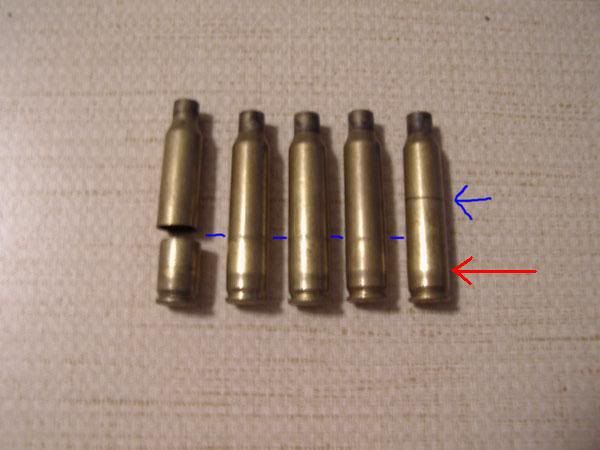
The separations in SkyPup's photos and the 4 on the left in your photo are case head separations and are not so bad. The two pieces of the case remained sealed against the chamber during peak pressure and closed bolt head helps hold the rear piece in place during pressure build up and decay. Worst thing is fishing out the forward portion of the case from the chamber.
Fissures behind the red arrow (the unsupported part of the case during firing) are dangerous, to the health of the rifle and you. There are photos around the web that show the destruction of the AR-15 when there is structural failure in the case head and high pressure plasma jets out the unsupported section of the case (that portion behind the red arrow). Blowing out the magazine baseplate, follower, and spring, are the least of the consequences. As someone mentioned earlier when a few in a batch of cases that have been fired X number of times begin to show the signs of advanced fatigue, those should be scrapped out. Additional resizing and firing can lead to serious consequences, as you have demonstrated. .308, & 5.56 / .223 cases are so common, there is no cost incentive involved there to take the risk. In some of the more rare calibers, maybe so. Keeping case head space to a minimum and annealing the necks from time to time can prolong case life. |
" America is at that awkward stage in life. It's too late to work within the system, but too early to shoot the bastards."

|
Ok. Question for the experts.
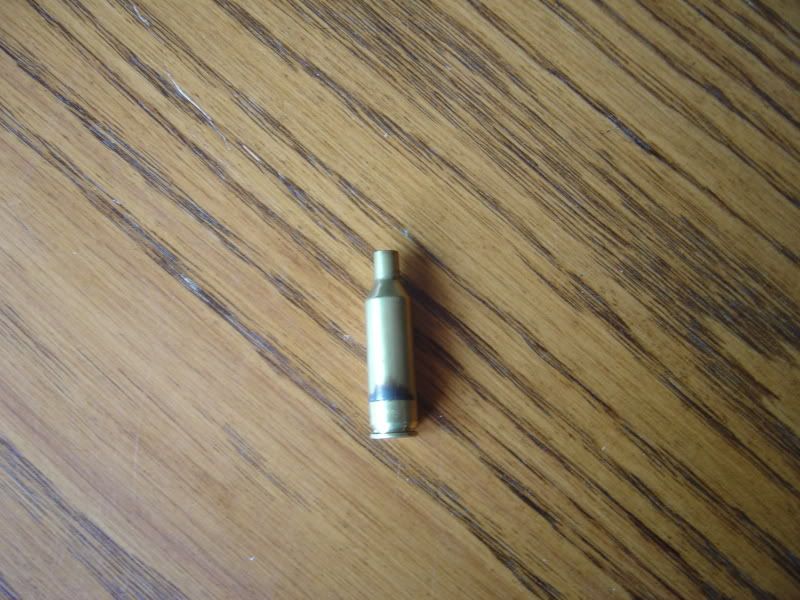
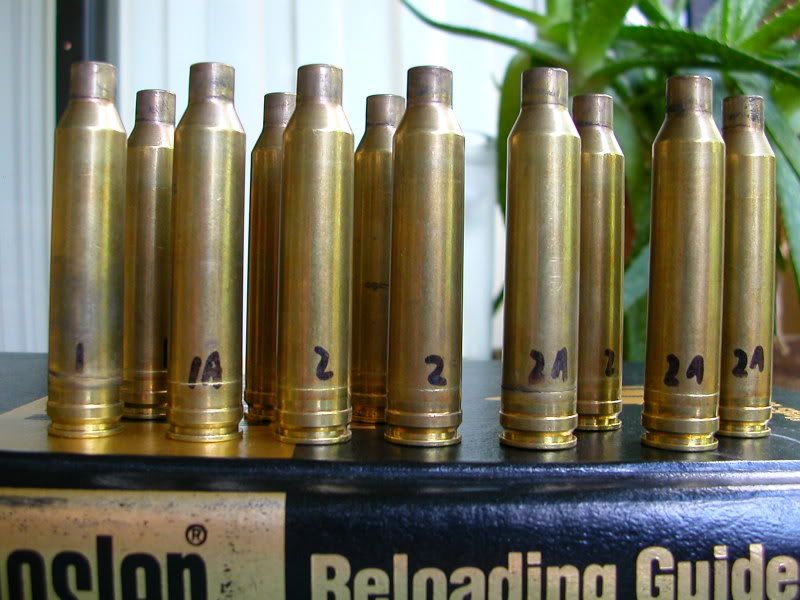
How do you tell the difference between the "bright ring" of incipient case head separation and what I've been told is the line created by the resizing die at the bottom of its cycle/stroke. I've seen a number of pictures in this thread that look more like the resizing die issue than the signs of wall thinning. Is the paper clip method then the only way to be sure? I've used the paper clip and have yet to detect anything more that a little roughness toward the bottom of the shell, near where the resizing die mark is. I've reloaded these rounds 4 times now and the mark is still there. Here's a photo of once fired and first time resized Winchester 30-06. I posted this photo a year or two ago and was told this is normal by more than one poster. 
|
Decimals are pointless

|
Originally Posted By ppknut:
Ok. Question for the experts. How do you tell the difference between the "bright ring" of incipient case head separation and what I've been told is the line created by the resizing die at the bottom of its cycle/stroke. I've seen a number of pictures in this thread that look more like the resizing die issue than the signs of wall thinning. Here's a photo of once fired and first time resized Winchester 30-06. I posted this photo a year or two ago and was told this is normal by more than one poster. Each caliber will tend to get a head separation in a different spot based on the interior case geometry. I.e. 556 will usually separate 1/4 or so up as was shown earlier in the thread. 30-06 happens further down like in this picture (taken from this thread). If you look carefully, you can see the line where the resizing die stopped as well. 

If you tumble clean your brass it is very easy to tell the difference between the sizing die ring and signs of case head separation since the tumbling media will mostly/completely polish out the previous sizing ring. Just look at the case before sizing and then compare it to how the case looks afterwards. You will see every case will have the sizing ring in the same place and it will pretty obvious. You can also draw a vertical line with a sharpie from the case mouth to the case head on one piece of brass before resizing it. Where that black line remains will line up exactly with the ring that is in the picture that you posted. |
|
Dusten:
Thanks for your reply post. That does help. Next time I detect "a lttle roughness" with the paper clip I believe I'll cut it open and inspect closely for actual wall thinning. It helps to see the photo that shows both thinning and the sizing ring. -ppknut |
Decimals are pointless

I had a blow out this weekend in my bolt gun. Lakecity 9x fired. I cut some cases open.

It is about .030" on each side of the split, the split is about .010-.014, about the same as the neck wall thickness 
Here are a few from all the same lot, the middle is the split one. 
I chose all of these by looking into the cases with a light and observing the shadow at the stretch point, these were the worst of the lot. 
|
|
Originally Posted By Ky_Bob:
I have also been discarding cases that have any sign of a bright ring at the base after resizing. I noticed that most of those cases also needed excessive trimming. You're going to toss quite a few perfectly fine cases that way. 223/5.56 cases - in my experience, if I'm an idiot someone please call me out on this - separate about 10-15mm up from the bottom, not down where you expect most rifle cases to go, or where you see the bright rings from resizing. Use the paperclip. It's fast and pretty much idiot proof; if you tumble again after sizing/decapping, you can also use the other end of the paperclip to poke tumbling grit out of the flash holes as you inspect, chamber, and deburr. If you have any doubts a flashlight will show you what's up. I use an RCBS X-die, so I virtually never see incipient separations in my own fired brass. I see one every couple hundred of once-fired military brass after resizing them, most likely from SAW brass. I am VERY glad I got those dies; I'm working on the 7th-9th reloading on some sets of brass. |
|
Originally Posted By popnfresh:
I had a blow out this weekend in my bolt gun. Lakecity 9x fired. I cut some cases open. http://i3.photobucket.com/albums/y59/glock2027/CIMG1846_zps847051bb.jpg It is about .030" on each side of the split, the split is about .010-.014, about the same as the neck wall thickness http://i3.photobucket.com/albums/y59/glock2027/CIMG1844_zpsef3ded36.jpg Here are a few from all the same lot, the middle is the split one. http://i3.photobucket.com/albums/y59/glock2027/CIMG1850_zps360d0e0d.jpg I chose all of these by looking into the cases with a light and observing the shadow at the stretch point, these were the worst of the lot. http://i3.photobucket.com/albums/y59/glock2027/CIMG1855_zpscf0d9af0.jpg Great photo's. Thanks. PS: The RCBS Case Master open setup inspection rig has a feature that makes the infamous groove search a little more objective than the paper-clip. The photo is a copy of a magazine print. Sorry about the quality. The case is sectioned and painted to emphasize the inspection probe feature. 
|
“Then said he unto them, But now, he that hath a purse, let him take it, and likewise his scrip: and he that hath no sword, let him sell his garment, and buy one."-Luke 22:36

|
Originally Posted By popnfresh:
I had a blow out this weekend in my bolt gun. Lakecity 9x fired. I cut some cases open. http://i3.photobucket.com/albums/y59/glock2027/CIMG1846_zps847051bb.jpg It is about .030" on each side of the split, the split is about .010-.014, about the same as the neck wall thickness http://i3.photobucket.com/albums/y59/glock2027/CIMG1844_zpsef3ded36.jpg Here are a few from all the same lot, the middle is the split one. http://i3.photobucket.com/albums/y59/glock2027/CIMG1850_zps360d0e0d.jpg I chose all of these by looking into the cases with a light and observing the shadow at the stretch point, these were the worst of the lot. http://i3.photobucket.com/albums/y59/glock2027/CIMG1855_zpscf0d9af0.jpg Which cartridge? Those look like the typical 7.62X51 case. This case wall thinning business is the reason I avoided rifles for belted magnums for a long time. The forward end of the belt is a classic stress concentration and the cases are prone to separate at the belt. I failed however, I think I own 5 now, including one for a wildcat cartridge  . .
|
It is not easy to explain Liberty to those that are not familiar with Liberty. Kevin Jamison, on explaining firearm regulation to a Massachusetts lawyer. Jeff City, Mo 18 Apr 13.

Global Warming Hoax Skeptic before it was cool
Joined:
Jun 2007
Posts:
53846
EE: 100% (1)
 WA, USA

|
Originally Posted By Keith_J:
You don't really need to worry about this unless you have over-sized cases a few times or have a rifle with excessive headspace problems. Measuring the case head expansion won't tell you anything. Excessive headspace is the problem. Cartridges must fit freely to chamber, this means there is an undersize tolerance. For headspace, that means 0.002-0.004". If the cartridge headspace is much larger, say 0.006", the force of the firing pin drives the case far into the chamber. Since firing pin extends 0.032" or so, it isn't a problem. When pressure expands the case, it does so first on the diameter as hoop stress is twice that of axial (tending to make the case longer). So the case grabs the chamber right at the shoulder as the diameter to thickness is the least there and it is usually in an annealed state. But remember, the case head is forward of the bolt face by 0,006". When pressure rises to about 28,000 PSI, the case is firmly grabbing the case walls and the pressure is now high enough to stretch the case axially. It does so right at the junction of the web and body and there is some material thinning there. When reloaded, the die cannot restore this loss. And the case is longer so you trim. There is one good clue, EXCESSIVE TRIMMING. Here, if you can see the trimming progress, as in how much trimming swarf is removed off each case, you can find any problems. OP, I use 2 things for checking for case head separation..A modified booger hook tool and a $40 bore scope..makes it simple and quick... Attached File Attached File |

|
One of the side effects or benefits of wet tumbling brass, especially the stuff with a questionable history, is to be able to "see" inside the case without the soot in the view.
One of the cheap borescopes can be used to verify if the hook finds something. Once there is even a single one found this way, the whole batch needs to be checked very hard. Brass for common calibers just isn't worth the risk. If you determine the brass is questionable, dump it and move on. |
|
My 223 brass in photo. PHOTOBUCKET links no longer work, unless you pay their ransom. I am locked out from my photos. www.photobucket.com/joe1944usa |
Armory Sponsor