


Armory Sponsor


Posted: 12/1/2015 1:05:00 PM EDT
|
I am curious how you keep your load data organized? Most of mine was digitally stored in a separated spread sheet for each load but, I nearly lost all of it in a hard drive failure. Luckily most of it was paper backed up from stuff I either printed or still had paper notes for but, my paper notes are real disorganized and jumbled.
Looking for new ideas how to store digital and paper load data (books, binders, spreadsheets) and what your system looks like... I am also curious how many shots you generally fire when building and testing new load and consider it to be a reasonable test batch. Personally, I like to shoot 10-20rds or as high as the mag can shoot in one string without having to reload.... |
|
I use lined 4x6 index cards in an old fashioned box. I have tabbed dividers to separate calibers, and in some cases loads for a particular gun.
When I'm loading, the card for the load being loaded is removed from the box and clipped to the shelf behind the press with a spring loaded clip. This way I can walk away, and return later and know exactly what I was working on. ETA: Looks similar to this except the tabs have calibers on them instead of letters. 
|
|
I use the blank loading data pages in the Sierra manuals with extra copied pages. I've lost too much stuff digitally. (Please don't give me advice on this, I don't care) I shoot 5 rounds groups when working up. Find loads I want to try again and shoot 10 round groups to confirm. |
|
Can't disagree with the possibility of lost loading data when going digital. But I'm also bad about being able to organize the paperwork.
One way to prevent data loss would be to keep a spreadsheet in your email, and just work off of it. Re-send it to yourself every time you make a change. I doubt many people back up on an external drive like we should lol. Plus, if you ever happened to be somewhere and needed it for some strange reason, you'd have it. I do the same thing you mention...a spreadsheet. Each spreadsheet is a specific caliber (one reason I've gone with fewer calibers, I can focus more easily and the data is less spread out). Each tab is a different bullet for that caliber. Depending on what type of loads you are putting together, standardizing on a single powder/primer/casing where possible means that your spreadsheet tabs can all look the same internally, the only variables being powder charge, velocity, and bullet used. I then build a simple chart within the tab that has the charge weight in grains across an upper row, with the velocity of each string running top to bottom below the respective charge weight. Just for consistencies sake, on the top row I still identify the primer, case, and powder used. |
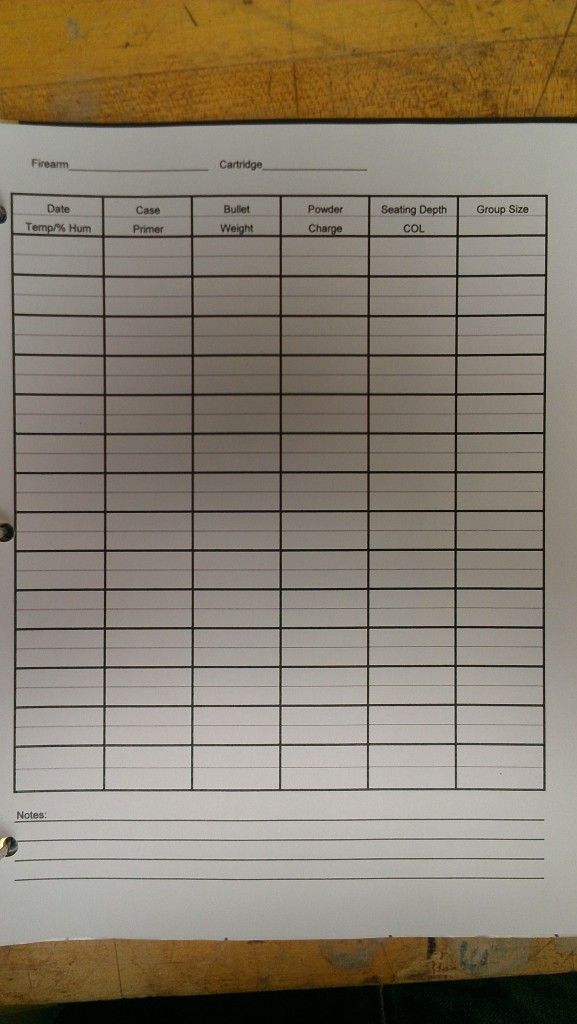
Three ring binder:

With tabbed partitions for each caliber. With these "forms" I printed up in word: 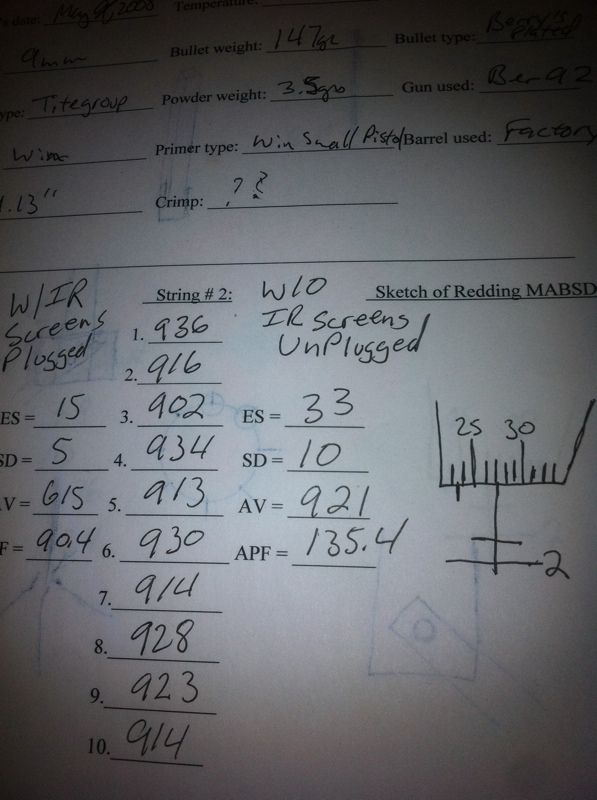
And sometimes I will save my targets behind those load sheet forms: 
And sometimes I will use an Avery label I also made up on the plastic ammo box or I will put it on the target: 
|
|
I have a different suggestion - forget paper and concentrate on a way to back up your important data.
Not just load data, but other stuff too. Load data can easily be copied to (eg) a $8 USB drive like this one. Note I just picked the first one under $10. |
| I use numbers on my iPhone / iPad. I can use and update on my phone, the iPad, or the computer. Any changes update across all the devices. I use a differnt sheet for each caliber I load. Each powder is highlighted a differnt color. I tried a binder for a while and it just didnt work for me. |
| I have a three ring binder where I keep firearm and load data sorted under caliber. I made my own sheets using Excel so I could have the information I wanted. The data sheet gets started and saved on the computer but is printed out and kept in my reloading room in the binder for quick access. Plan was to update the digital copy but that never seems to happen. Targets and chrony data sheets are also in the binder with the load data. |
|
Quoted:
I use lined 4x6 index cards in an old fashioned box. I have tabbed dividers to separate calibers, and in some cases loads for a particular gun. When I'm loading, the card for the load being loaded is removed from the box and clipped to the shelf behind the press with a spring loaded clip. This way I can walk away, and return later and know exactly what I was working on. ETA: Looks similar to this except the tabs have calibers on them instead of letters. http://i21.geccdn.net/site/images/n-picgroup/75907.jpg Quoted:
I use lined 4x6 index cards in an old fashioned box. I have tabbed dividers to separate calibers, and in some cases loads for a particular gun. When I'm loading, the card for the load being loaded is removed from the box and clipped to the shelf behind the press with a spring loaded clip. This way I can walk away, and return later and know exactly what I was working on. ETA: Looks similar to this except the tabs have calibers on them instead of letters. http://i21.geccdn.net/site/images/n-picgroup/75907.jpg This is actually a pretty decent idea, although I think the note cards are a little smaller then what I think I am going to end up doing. Quoted:
With these "forms" I printed up in word: http://i603.photobucket.com/albums/tt112/gryphon1994/676B3649-F3E4-42A3-B069-1151BC56A62F-99-000000444E4BD78A_zps6f6c0c5b.jpg And sometimes I will save my targets behind those load sheet forms: http://i603.photobucket.com/albums/tt112/gryphon1994/A4DEF4D9-60E9-4C42-A259-2F72914D21EA-99-000000448C20F1F9_zpsb5c31e81.jpg Any picture of the form in it's entirety? I'm curious what data you like to record. |
|
Paper is bad. Lets get out of the stone ages. Guys have 1000's of dollars in gear, and they fail to modernize the most important part, record keeping.
Use Google Docs. Create a spreadsheet. Take pictures or scan your test targets. Store all of this data on Goggle Docs. I can sit at the range and input data and notes. You can access this data anywhere, from any device. Computer, phone, tablet, at the range, sitting at work, whatever, wherever. Your house could burn, your dog could eat it, whatever, at least you will still have all your data. My spreadsheet for each caliber includes: Bullet Primer Powder type Charge weight OAL Best group size at XXX distance Ladder charge weights Ladder results Notes |
|
Quoted: I use lined 4x6 index cards in an old fashioned box. I have tabbed dividers to separate calibers, and in some cases loads for a particular gun. When I'm loading, the card for the load being loaded is removed from the box and clipped to the shelf behind the press with a spring loaded clip. This way I can walk away, and return later and know exactly what I was working on. ETA: Looks similar to this except the tabs have calibers on them instead of letters. http://i21.geccdn.net/site/images/n-picgroup/75907.jpg This. |
|
Quoted:
I use lined 4x6 index cards in an old fashioned box. I have tabbed dividers to separate calibers, and in some cases loads for a particular gun. When I'm loading, the card for the load being loaded is removed from the box and clipped to the shelf behind the press with a spring loaded clip. This way I can walk away, and return later and know exactly what I was working on. ETA: Looks similar to this except the tabs have calibers on them instead of letters. http://i21.geccdn.net/site/images/n-picgroup/75907.jpg My file.box is so old the plastic lid hinge broke. In fact one of the boxes itself is fragile as an egg. Motor 
|

|
Quoted: My file.box is so old the plastic lid hinge broke. In fact one of the boxes itself is fragile as an egg. I know you are not supposed to do where to find in threads but..... Where can I get some card file boxes? Please !!! Motor Quoted: Quoted: I use lined 4x6 index cards in an old fashioned box. I have tabbed dividers to separate calibers, and in some cases loads for a particular gun. When I'm loading, the card for the load being loaded is removed from the box and clipped to the shelf behind the press with a spring loaded clip. This way I can walk away, and return later and know exactly what I was working on. ETA: Looks similar to this except the tabs have calibers on them instead of letters. http://i21.geccdn.net/site/images/n-picgroup/75907.jpg My file.box is so old the plastic lid hinge broke. In fact one of the boxes itself is fragile as an egg. I know you are not supposed to do where to find in threads but..... Where can I get some card file boxes? Please !!! Motor  Please stop. |
|
Spreadsheet. One tab per caliber plus a summary tab that details how many rounds per caliber per year. I'm up to over 40 calibers. Just added .357 Sig. I back it up to a thumb drive. I started on paper in 1992, but went electronic sometime in early 2000's. It was easy enough to transcribe my data to excel. I also attach labels to boxes and ammo cans containing my reloads. |
|
Quoted:
Paper is bad. Lets get out of the stone ages. Guys have 1000's of dollars in gear, and they fail to modernize the most important part, record keeping. Use Google Docs. Create a spreadsheet. Take pictures or scan your test targets. Store all of this data on Goggle Docs. I can sit at the range and input data and notes. You can access this data anywhere, from any device. Computer, phone, tablet, at the range, sitting at work, whatever, wherever. Your house could burn, your dog could eat it, whatever, at least you will still have all your data. And what if Skynet comes to fruition and there's no more internet/power? Everything is gone... 
I want to have both a spreadsheet and paper documents. |
|
Quoted:
Paper is bad. Lets get out of the stone ages. Guys have 1000's of dollars in gear, and they fail to modernize the most important part, record keeping. Use Google Docs. Create a spreadsheet. Take pictures or scan your test targets. Store all of this data on Goggle Docs. I can sit at the range and input data and notes. You can access this data anywhere, from any device. Computer, phone, tablet, at the range, sitting at work, whatever, wherever. Your house could burn, your dog could eat it, whatever, at least you will still have all your data. My spreadsheet for each caliber includes: Bullet Primer Powder type Charge weight OAL Best group size at XXX distance Ladder charge weights Ladder results Notes Pretty much how I do it too. I started adding pictures of targets recently. |
|
Quoted:
I use lined 4x6 index cards in an old fashioned box. I have tabbed dividers to separate calibers, and in some cases loads for a particular gun. When I'm loading, the card for the load being loaded is removed from the box and clipped to the shelf behind the press with a spring loaded clip. This way I can walk away, and return later and know exactly what I was working on. ETA: Looks similar to this except the tabs have calibers on them instead of letters. http://i21.geccdn.net/site/images/n-picgroup/75907.jpg This is what I do. |
|
Quoted:
And what if Skynet comes to fruition and there's no more internet/power? Everything is gone...
I want to have both a spreadsheet and paper documents. Quoted:
Quoted:
Paper is bad. Lets get out of the stone ages. Guys have 1000's of dollars in gear, and they fail to modernize the most important part, record keeping. Use Google Docs. Create a spreadsheet. Take pictures or scan your test targets. Store all of this data on Goggle Docs. I can sit at the range and input data and notes. You can access this data anywhere, from any device. Computer, phone, tablet, at the range, sitting at work, whatever, wherever. Your house could burn, your dog could eat it, whatever, at least you will still have all your data. And what if Skynet comes to fruition and there's no more internet/power? Everything is gone...
I want to have both a spreadsheet and paper documents. I lose power at least a couple times a year for extended periods It's nice going in the reloading room with my stone aged paper papyrus data 
|
|
When I purchased my competition electronics pro digital chrono, I spent a little extra coin and got the digital link blue tooth adapter which sends all my chrono data directly to my iPad or Phone using their free app. I can then email myself string data from the bench. In each shot string Ican input basic load data , and the device calculates and provides SD, averages, barometric pressure, temperature... Really lots of great data. No more note taking at the range, all digital data. Bonus, never have to approach the chrono to reset..no more calling the range cold. All work done from the iPad. Best coin I have spent in a long time.
I store that data in a file on an external hard drive, but then keep the emails filed for backup, as well as a printed copy in the man-cave just in case of a network/ power outage. Has worked very well and made my data and range time much more efficient. |
|
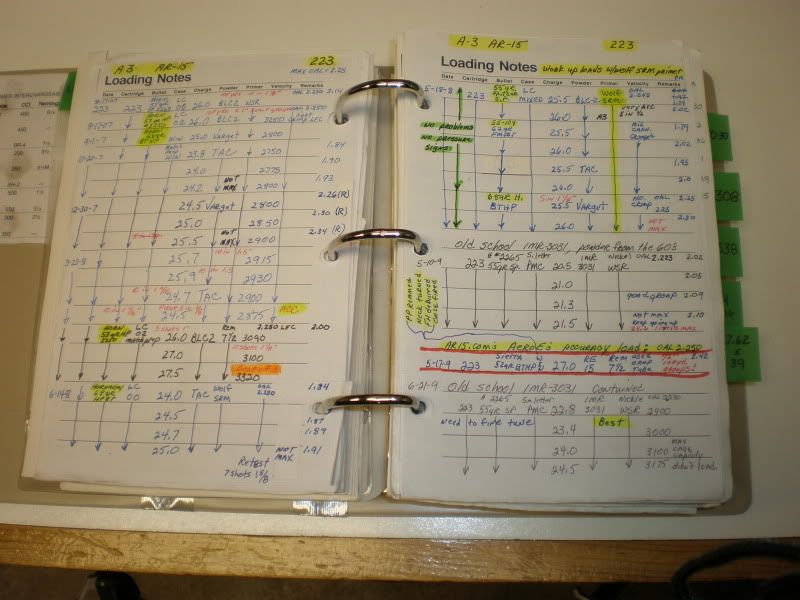
I log each load I make in a spiral notebook on my bench. After the load is chronographed, the load data and velocities are put in a spread sheet that calculates statistics and power factor and has a place for notes. A copy of the spread sheet is printed off once in awhile and placed in the spiral notebook for quick reference at the bench.
For pistol, I only load a couple of round at a time then chrono to find the velocity I want for power factor. As soon as I think I am at the target power factor, I load ten rounds and check velocities and stats. If the power factor looks good and no anomalies in velocities, I load 10-20 rounds and shoot at 25 yd paper to check accuracy. |
|
Quoted:
And what if Skynet comes to fruition and there's no more internet/power? Everything is gone...
I want to have both a spreadsheet and paper documents. I don't know about your computer, but I have one of the fancy ones that lets me print stuff. It even has colors! |

|
Quoted:
My file.box is so old the plastic lid hinge broke. In fact one of the boxes itself is fragile as an egg. Motor Quoted:
Quoted:
I use lined 4x6 index cards in an old fashioned box. I have tabbed dividers to separate calibers, and in some cases loads for a particular gun. When I'm loading, the card for the load being loaded is removed from the box and clipped to the shelf behind the press with a spring loaded clip. This way I can walk away, and return later and know exactly what I was working on. ETA: Looks similar to this except the tabs have calibers on them instead of letters. http://i21.geccdn.net/site/images/n-picgroup/75907.jpg My file.box is so old the plastic lid hinge broke. In fact one of the boxes itself is fragile as an egg. Motor Plastic? Mines so old it's metal. |
|
I use a couple of methods.
Excel spreadsheet* - the raw data from the sessions go in. Each cartridge gets its own workbook (223, 308, etc). Each bullet weight gets its own worksheet within the workbook (69, 75, 80 gr). I tabulate the data, calculate the statistics for the sample and make graphs of the results. Typical data would include Muzzle velocity versus weight of powder charge
Group size versus weight of powder charge Deviation in point of impact (up or down relative to point of aim) I measure thrown charge weights for each target charge weight, too, so that data goes in the workbook. I get the stats on that data. Statistics always include - mean, standard deviation, max, min, extreme spread, sample size. I also keep two loose leaf binders - one for pistol cartridges and one for rifle cartridges. These are divided into sections, one for each cartridge. I print hard copies of my data and my plots and keep them in the section. There SAAMI cartridge and chamber drawing for each cartridge. I tape my chrono print outs and the targets onto paper sheets and keep them. One thing I have found very useful to do - I take photographs of the case heads after firing the load development rounds. When I load them, I make a 3X5 card describing the load for each row in the cartridge box. When I fire them, the rounds go back into their assigned slots with the case heads up (showing). When done, I take a macro-photograph of the open box (shows all case heads) and the 3X5 card all in the same frame. With that, I have a permanent record of the condition of the primers for the loads. When done, I have chrono data, accuracy data, primers/case head condition (pressure?) data. There's more, but you get the idea. * My hard disk gets backed up regularly. |
|
Well, I'm such a simpleton. I basically write down the loads that work for me in a notebook but don't chronograph anything or take temperatures etc.
Basically if it works I keep it and I use it again and if I find out it doesn't work in a specific gone well then I note it. |
|
Quoted:
I lose power at least a couple times a year for extended periods It's nice going in the reloading room with my stone aged paper papyrus data Quoted:
Quoted:
Quoted:
Paper is bad. Lets get out of the stone ages. Guys have 1000's of dollars in gear, and they fail to modernize the most important part, record keeping. Use Google Docs. Create a spreadsheet. Take pictures or scan your test targets. Store all of this data on Goggle Docs. I can sit at the range and input data and notes. You can access this data anywhere, from any device. Computer, phone, tablet, at the range, sitting at work, whatever, wherever. Your house could burn, your dog could eat it, whatever, at least you will still have all your data. And what if Skynet comes to fruition and there's no more internet/power? Everything is gone...
I want to have both a spreadsheet and paper documents. I lose power at least a couple times a year for extended periods It's nice going in the reloading room with my stone aged paper papyrus data I have settings enabled on all my devices I access my data from to keep a current local copy so even if I lose connection to the internet I can still access everything. I keep paper copies as well for use on the reloading bench. This is what works best for me. YMMV |
|
Quoted:
For the people that are using google docs to store their data, do you mind sharing a link to the template? Do you guys track inventory and costs that way as well? I dont really have a template. Create a new sheet. Across the top I go in each column: powder charge - primer - oal - bullet - best group size - notes - test charge weights - test charge group size If I had a chrono, which I will soon, that would added as well. When I test loads, its a little messy, but because changing it is as easy as deleting the data that is not important. When I finalize a load I change the format slightly and only fill in: powder charge - primer - oal - bullet - group size - notes I thought about tracking costs and inventory, but that would give my wife something to use against me telling me I have too much money spent, blah blah blah.... :) |
|
Quoted:
You too?  Quoted:
I thought about tracking costs and inventory, but that would give my wife something to use against me telling me I have too much money spent, blah blah blah.... :) You too? You bet. Thats why I try to pay cash for my reloading supplies. 
|
|
When I develop a load recipe, I give each one its own serial number, and enter the data into a page in M.S. Word. It lists the all the pertinent data such as number of rounds loaded, details about brass preparation, charge weight, etc. plus and the reason for this particular recipe. I save it but don't print immediately.
I cut and paste the basic data about bullet type, B.C., date, MV and any other information I might need at the range and make a label which I print, cut, and attach to the top of my ammo box using clear tape. If I'm load testing I also tape a matrix inside the box lid listing the charge weight or seating depth or whatever for that particular row so I can keep track of where each round is located in the box in instances where they're not all the same, sort of like a Whitmans Sampler box of chocolate candy. When I'm done shooting, I scan my targets and save the data in an Excel Worksheet for each day at the range. Precision measurement is an important key to knowing what's going on. A carpenters tape won't do the job. I record Date, Group#, Ammunition Type (including recipe serial number), Distance, Hole Size, # of Shots, Offset W, Offset H, Offset Dist from aim point, Group W, Group H, Mean Radius, Group size, Group Notes (where I record charge weight or seating depth test data), MOA, MV, Std. Dev., Powder type, Bullet Weight. The bulk of this data is transferred directly from my measuring software, On Target, into Excel without any typing effort on my part. Then I add chronograph data and other details by hand. These work sheets are filed by date with the recipe serial number for future reference. I can sort by any column to see how MOA compares with charge weight or seating depth or whatever I'm testing that day. For instance, I can quickly graph MOA, Mean Radius, and Group Height vs the testing parameter (charge weight for example) to quickly find answers which are difficult or impossible to extract from a big sheet of scribbled notes in a spiral binder. Then I copy some of the data and past it back into the M.S. Word recipe sheet, make additional notes about the results, highlight a few important items, and then print the sheet to add to my stack of records which I keep in the reloading room for future reference. Of course, I can also pull up the recipe sheet on my computer any time I want. I can revisit the recipe if I want to duplicate it and the range results are right there for easy reference.. Finally, I copy the day's Excel worksheet and add all the information into a huge master sheet, one for each particular rifle. That way I can sort and filter each and every round which has gone down that particular barrel. How does the vertical dispersion of Hornady V-Max bullets compare with Sierra Match Kings of the same weight using the same powder? How does SD relate to MOA for all bullets? How about SD vs MOA just for Berger VLD 80gr bullets? I can get the answers in a few seconds, something you would have to hire a Monk to dig out of a notebook spanning thousands of rounds and many trips to the range. By using the previously established recipe sheet as a template, new data can be entered in a few seconds by changing the date, serial number, and a few line items, so the task is not nearly as time consuming as it might at first sound. Believe me, any time spent recording this data will be WAY less than the time invested in digging meaningful information out of a hand-written notebook sometime in the future. What good is data if you can't easily access it and, more importantly, filter and search various parameters? |


So here's what I've cooked up. I can add the chrono data and it will automatically calculate the ES, SD, Max, Min, Average and kinetic energy based on the average velocity. You can enter 5 shots or 30 shots and it will still function correctly. It uses the bullet weight cell to calculate kinetic energy. There's plenty of lines to add some more details and shift the sheet. (Thinking of adding case trim length, and OAL to ogive as well) Fits on a standard 8.5x11 sheet of paper and when the data is entered and then sheet printed, you can slide it in a clear sheet protector. If you cut the sheet in half, it will fit 1 data set perfectly inside of a 5.5x8.5 mini-3 ring binder and 5.5x8.5 clear sheet protector and the target can be slid inside the protector with it. This way both a digital version and a physical version can be maintained easly. What do you think? What data should be added? I can make the .xls available for anyone interested... |
Armory Sponsor