


Armory Sponsor

Posted: 10/3/2011 5:42:31 PM EDT
|
I have always been fascinated by the Lee Enfield. The "greatest bolt action service rifle" thread has rekindled my interest a bit. Even after reading the Wiki article, the Lee Enfield family of rifles is still somewhat difficult to understand. Tell me more, Arfcom... What is the best variant? What is the best variant in terms of value? How much should a good example cost? What are the strengths and limitations of the rifle? What are the strengths and limitations of .303? Where do you get .303 ammo? How much is it? Is there any other "must know" info?
|
| I've been reading everything that I can find on the internet about Lee Enfield rifles. I was able to get one over the weekend and there is still so much to learn. I found a No.4 Mk1 in fine condition and though I have yet to take it to the range it seems a very nice addition to my collection. I'll be checking this thread often to see what the experts have to say. |
|
Quoted:
I have always been fascinated by the Lee Enfield. The "greatest bolt action service rifle" thread has rekindled my interest a bit. Even after reading the Wiki article, the Lee Enfield family of rifles is still somewhat difficult to understand. Tell me more, Arfcom... What is the best variant? What is the best variant in terms of value? How much should a good example cost? What are the strengths and limitations of the rifle? What are the strengths and limitations of .303? Where do you get .303 ammo? How much is it? Is there any other "must know" info? The questions are really more vague than you think. The No. 1 Mk 3 has the best bolt throw, and very fast sights. It has an open leaf as opposed to a peep, which is a problem for my older eyes. The No4 Mk 1 has a better sight, worse take-down, and cost more to make than the No. 4 Mk. 2. The best value would be an unfired example of whichever you can find. Best investment has more to do with cost/worth than anything else. Strength? Fast. Damned fast. 10 rounds in a full mag. Fairly robust; action dealt with dirt better than anything other than a Mosin. Weakness? Weak lock-up; rear lockup wich allowed the bolt to flex. Hurt accuracy and strength a little. A blown-up SMLE would be more likely to hurt you than a blown Mauser. (For the purpose of the discussion a 1903 is a Mauser). It didn't handle the gasses very elegantly, and that rear-locking bolt let you get more shrapnel. The .303 round is more like the 30-40 Krag than anything else. It was also huge and heavy for the power, due to being older, designed with less efficient propellants. The Mk VII Bullet had a nasty rep for tumble/frag on impact; a good thing if you were shooting it. Rimmed cases made it tricky to use the chargers (strippers) properly. You had to orient the rims in a certain fashion for them to be reliable. They are fugly. The ammo is expensive now, and surplus is *gone*. Other need to know? They are fugly. Inelegant. Unwieldy. Handle with all the elan of a 2x4. The cock on close takes a bit to get used to, but then it's OK. I own 2 No. 1 Mk 3, an Ishapore in 7.62, and a No. 4 Mk 1. My favorite military bolt gun is the US Rifle of 1917. Then either the Mosin or Swedish Mauser. I have a 1903, many Mosins, many Mausers of various descriptions. A Berthier, Carcano, Arisaka, 2 MAS 36, and probably more that slip my mind right now. |
|
I have been colleting enfields since 1990 and I have to say my ultimate favorite is a 1950's Doninion Arsenal No.4 Mk.I* I have had the unissued No.4 Mk.II's but the Canadian outshines it. The deep blued finishwith the walnut stock just fits for a classic battle rifle.
Furthermore, the 6 groove barrel is accurate as hell. I have two of the 1950 Canadian's one is a mint safe queen and the other is a slightly used one that I shoot regularly. My other favorit is a dinged up Savage with an "L" flip sight dated 1944 that has South African "U" broadarowwhead markings and a nice 2 groove barrel. She shoot real nice as well. I will try to post pics soon. |
|
Okay, here we go.
The best variant of the Lee-Enfield is the original one, the MLE. Good luck. 

To be serious, the MLE has an elegant charm the later rifles lack. It is truly a Victorian rifle, in every sense of the word. In terms of value, the less common it is, the more it is going to be worth. This is obvious with easily recognizable trials rifles like the No. 1 Mk. VI, the SMLE Mk. V, the No. 6, etc - but there also exist many rare sub-variations of the common SMLE and No. 4. For example, the Savage and Long Branch No. 4 Mk. I (as opposed to No. 4 Mk. I*) rifles are much less common and command much higher prices than a normal No. 4. You should always look for non-import marked examples; especially with the SMLE (No. 1) series, as recently a large number of abysmal-condition rifles have been imported from S Asia (India/Pakistan). The non-import rifles, assuming Bubba didn't fuck them up, are generally in much nicer condition than the imports. A nice example of either the SMLE or No. 4 should run you no more than $300-350. The inherant strengths of the Enfield are the magazine capacity, speed of the bolt, and the rifle's extreme reliability. It's major weakness is the rear locking lugs, which tend to cause receiver stretch in the long run. Additionally, the Enfield is a combat rifle. It offers no amenities to the sport shooter; it cares not for hunters, save those that hunt men. As such, its strengths are often lost on modern users, who are more prone to use it as a sporting rifle. .303 is a rimmed round, and as such is an obsolete design. Fate conspired to keep it the standard British cartridge; it would have been retired long before otherwise. It is in the same power range as the .30-'06, the 8mm Mauser, and the 7.62x54R. However, it should be noted that service Mk. VII ball ammunition is a truly nasty anti-personnel round. Due to the front part of the bullet being made of wood pulp or cardboard, the bullet will fragment and yaw violently after impact, causing horrific wounds in flesh. It was rightly feared by those facing it. Amusingly, the British made sure to sterilize the paper or wood pulp before assembling the bullet. Wouldn't want the enemy to get an infection, that wouldn't be sporting at all, old chap! The main failing of the .303, however, had to do with the propellant used. Cordite, while being remarkably resistant to age and conditions, burns much hotter than nitrocellulose powder. As such, it causes serious erosion issues, greatly shortening the life of barrels it is used in. The bores of any Enfield rifle should be checked for Cordite erosion before you buy them, especially pre-WWI SMLEs. Currently, many commercial loads of .303 are available - I prefer the Prvi Partizan stuff myself. .303 is, however, a round that benefits greatly from reloading. Look to pay around $15/20 for commercial .303. When looking for an Enfield rifle, optimally you should look for a "matching" example. This means that all of the parts that bear the rifles's master (serial) number are marked with the same number. All of the variants of Enfield have different marking schemes, but the receiver and the bolt will always be numbered. On SMLE rifles, look for additional markings on the forestock, barrel, nosecap, and the underside of the rear sight. On the No. 4 Mk. I, the barrel is sometimes serialed. On No. 5 and No. 4 Mk. 2 rifles, look for serials on the forestock, barrel, and magazine as well. From a technical standpoint, it is best to choose rifles that have matching bolts; doing so greatly reduces the chances of getting a rifle with headspace issues. Hope that helps! |
|
Here's a rarity for you, a commercial #1 Mk 3! A quick summary is that BSA sold Lee Enfield rifles commercially for some period in the '20s. There were two flavors, Military and Sporting. The military style guns were designed for shooting competitions, and the sporters were as expected, for hunting. There was only 1 military style, but the sporting guns could be ordered in several grades of finish and engraving. The only maker to do this was BSA. The numbers produced were low. The military flavor is really no different than a military contract rifle except for a finer rear sight and much better wood. The photo is a bit grainy, but the mark is "B S A Co"  |
|
LSA also made commercial rifles for at least some time - both to sporting "Lee-Speed" patterns as well as approved service rifle patterns. They are much rarer than the BSA examples, but do appear occasionally. Little is known about them as no catalogue has been found; the BSA rifles are much more extensively researched as old BSA catalogues are fairly common.
BSA made commercial Lee-pattern rifles all the way back to the introduction of the Lee-Metford in 1888. |
|
Quoted: Quoted: I have always been fascinated by the Lee Enfield. The "greatest bolt action service rifle" thread has rekindled my interest a bit. Even after reading the Wiki article, the Lee Enfield family of rifles is still somewhat difficult to understand. Tell me more, Arfcom... What is the best variant? What is the best variant in terms of value? How much should a good example cost? What are the strengths and limitations of the rifle? What are the strengths and limitations of .303? Where do you get .303 ammo? How much is it? Is there any other "must know" info? The questions are really more vague than you think. The No. 1 Mk 3 has the best bolt throw, and very fast sights. It has an open leaf as opposed to a peep, which is a problem for my older eyes. The No4 Mk 1 has a better sight, worse take-down, and cost more to make than the No. 4 Mk. 2. The best value would be an unfired example of whichever you can find. Best investment has more to do with cost/worth than anything else. Strength? Fast. Damned fast. 10 rounds in a full mag. Fairly robust; action dealt with dirt better than anything other than a Mosin. Weakness? Weak lock-up; rear lockup wich allowed the bolt to flex. Hurt accuracy and strength a little. A blown-up SMLE would be more likely to hurt you than a blown Mauser. (For the purpose of the discussion a 1903 is a Mauser). It didn't handle the gasses very elegantly, and that rear-locking bolt let you get more shrapnel. The .303 round is more like the 30-40 Krag than anything else. It was also huge and heavy for the power, due to being older, designed with less efficient propellants. The Mk VII Bullet had a nasty rep for tumble/frag on impact; a good thing if you were shooting it. Rimmed cases made it tricky to use the chargers (strippers) properly. You had to orient the rims in a certain fashion for them to be reliable. They are fugly. The ammo is expensive now, and surplus is *gone*. Other need to know? They are fugly. Inelegant. Unwieldy. Handle with all the elan of a 2x4. The cock on close takes a bit to get used to, but then it's OK. I own 2 No. 1 Mk 3, an Ishapore in 7.62, and a No. 4 Mk 1. My favorite military bolt gun is the US Rifle of 1917. Then either the Mosin or Swedish Mauser. I have a 1903, many Mosins, many Mausers of various descriptions. A Berthier, Carcano, Arisaka, 2 MAS 36, and probably more that slip my mind right now. I'm no expect but that ^ seems pretty much spot on. I'd add the following opinion in regards to your questions: What is the best variant? I like them all, No4's seem to be more available and typically in better shape than the SMLE's just because of the age, No4 MKII's are harder to find because they made fewer of them but from what I understand they have "better" trigger assemblies in them. Note that there are many variants (mostly place of manufacture) in the No4 line as well and some are worth more than others. What is the best variant in terms of value? How much should a good example cost? Whichever one you can find in the best condition (bore/metal/wood). I got lucky and bought my No4 MKII in a pawn shop for $175 out the door a few years ago. "Beat to crap" seems to be going for $250 or so now, watch the gun boards, private sellers and gun/pawn stores for a good deal. What are the strengths and limitations of the rifle? he ^ covered that already What are the strengths and limitations of .303? rimmed cartridge can be a pita to load on chargers, load it wrong and you get FTF's. Where do you get .303 ammo? How much is it? It's powerful enough, surplus is pretty much gone, modern production ammo is not real expensive but its not cheap either (buy it locally or online by the 20/box). I have a good bit of surplus put back but it's "mixed british manufacture" and has 1944 headstamps on it , loaded with cordite but it shoots well enough.Is there any other "must know" info? Check headspace with a go/no-go gauge before purchase, check the bore/rifling. |
|
Quoted:
... A blown-up SMLE would be more likely to hurt you than a blown Mauser. (For the purpose of the discussion a 1903 is a Mauser). It didn't handle the gasses very elegantly, and that rear-locking bolt let you get more shrapnel. ... Other need to know? They are fugly. Inelegant. Unwieldy. Handle with all the elan of a 2x4. The cock on close takes a bit to get used to, but then it's OK. .. [/div] The part I highlighted in red is wrong. I've seen complete case head separations in No.4s a couple of times and in both cases, we didn't find out until opening the bolt. In contrast, even a partial case head separation in a Mosin will result in a blast of gas back in your face. Fugly is in the eye of the beholder and IMO, the SMLE and No.4 handle just fine. |
|
Not able to hot link it, but here is a link to a GD thread with massive photos of the No. 4 & other enfields plus a wealth of additional info about them:
http://www.ar15.com/forums/t_1_5/1236892_the_greatest_bolt_action_service_rifle.html&page=1 EDIT: "hotted" http://www.ar15.com/forums/t_1_5/1236892_the_greatest_bolt_action_service_rifle.html&page=1 |
|
Enfields are a fascinating and complex subject. The Birits used many many variations on the design. Early models were often rebuilt into later configurations. All of them stamped with the Brit's confusing nomenclature. Numbers, marks, "stars", along with a host of proof and inspection marks. The rifles were scattered to the four corners of the globe. Made in Great Britain, Canada, the US, Australia, India. Used by dozens of countries and still to be found in Indian arsenals. Lots of books written on them with the definitive volume yet to appear, in my view. This is one firearm subject where surfing the net will leave you a day late and a dollar short.
The technical aspects have already been touched upon. The action isn't as strong as a Mauser. The rimmed cartridge requires some care in loading. Surplus ammo is long gone; anything you find today is best avoided. Bolt speed is amazing; a little practice and a ten round mag can be emptied in ten to twenty seconds. Accuracy can be decent but like all mil surps tends to vary based on bore condition, ammo used, etc. |
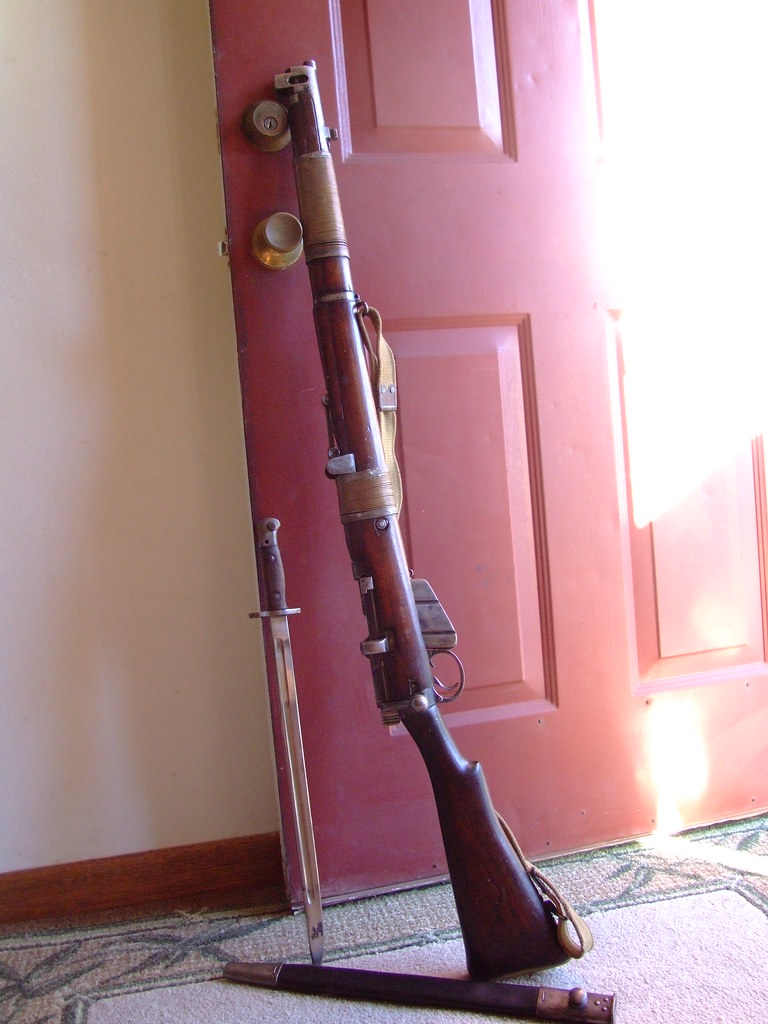
|
Most of the other posters have answered your question. The 303 is compared to the 30/40 Krag in power but in reality it has a worthwhile edge over the 30/40 krag. It is just below the 308 in power. And the 174 grain bullet is excellent. The original military rounds were good anti-personnel rounds.
|
Armory Sponsor