


Armory Sponsor


Posted: 10/29/2015 12:50:29 PM EDT
| Twice fired federal brass, hornady 55 grain fmj soft point over 26 grains of cfe223. Had a kaboom yesterday. I know too little neck tension can cause a problem, my question , can too much neck tension cause a kaboom. I check my charge twice and no way to double charge .223 case. I seat the bullet to the cannilure and crimp with a lee factory crimp die. Pulled a bullet from another round and it took quite a pounding to pull it. |
|
I really doubt it.
The pressure builds and the first thing to release is the bullet or the case neck expanding and then release the bullet. It's the thinnest metal in the case and pressure is probably fairly uniform in the "pressure vessel"/case interior. As long as the chamber's neck area is cut right there should be room for the case neck to expand and release the bullet as designed. Only custom match chambers are touchy and need brass fitted. (bench rest). Another way to cause failure of the bullet to release is to have your brass too long for the chamber. The mouth gets pinched into the throat and has no where to expand so you don't get the normal bullet release but the pipe bomb effect. Check your case lengths first. Can you elaborate on "kaboom". what blew? Case neck, case head separation, case head failure. (that was from less trouble to most trouble) magazine blown out? Reciever and bolt carrier split? there are different types of failures. Kaboom, generally indicates case head failure, out of battery firing with bolt, carrier, receiver, magazine and under wear damage. I'd also go back to your scale, how sure are you that it's telling the truth? You use check weights to verify? I use an electric scale and I cross check it with RCBS balance scales and I use check weights. Call me a skeptic but I don't give emphatic trust to electronic scales. |
|
All depends,
If you are crimping the bullet with too much tension with standard dies, then you can buckle the case shoulders, and this causes problem with loading since the case is not longer fully sized correctly, and even higher working pressures since you get less blow by at firing forming since the case has been wedged into the chamber at loading as well. Now if you are bullet crimper like the FLD die, then you can go buck wild with bullet tension, since the way that crimper works, it will not buckle the shoulders of the case instead. So to conclude, drop the loaded rounds in an ammo test gauge, and determine if the too much bullet crimping pressure is causing problems with the case shoulders to buckle them, hence the ammo will no longer fit correctly in the test gauge/the rifle chamber, and this is causing the over pressure of the rounds instead (not enough blow by at firing forming to the chamber on ignition). |
|
Quoted:
Over crimping with a LFCD can raise pressures, been on here before. Really depends on your "kaboom". Where did the case come apart, head, body, shoulder, neck areas?? Or primer blow/fall out?? I realize that you would get a higher pressure from a crimp but he reports a full grain less than max according to the Hodgdon data. I have a hard time thinking he'd get that much of a pressure bump. If he was up near max charges then yea I would more expect an unplanned pressure issue. Then again I could be wrong, I've heard of old milsurp rounds getting corrosion and bonding between jacket and case and causing ruptured cases. I am looking forward to some more details from the OP. ETA- OP, while there is no way to double charge a .223 case with that load, there is still a possibility to over charge. How are you charging your cases? Are you weighing each charge on a scale? (I wouldn't necessarily with that powder but I would monitor it periodically). On a progressive or any powder dispenser, you should cycle it until the powder hopper settles, otherwise your early charges will be light and your later charges heavier as the powder packs in with the shaking from the cycles. More of an issue with sticks and flakes than ball but still an issue to check. One could also have a measure than bridges some powder up inside the measure's body. This would give you a light charge then a heavy charge on the next use. Again this doesn't happen so much with ball powders but it could with static. I have only had this happen with the small case neck fitting installed on the RCBS measure and never on the larger one unless trying to throw ImR4064. |
|
Quoted:
I really doubt it. The pressure builds and the first thing to release is the bullet or the case neck expanding and then release the bullet. It's the thinnest metal in the case and pressure is probably fairly uniform in the "pressure vessel"/case interior. As long as the chamber's neck area is cut right there should be room for the case neck to expand and release the bullet as designed. Only custom match chambers are touchy and need brass fitted. (bench rest). Another way to cause failure of the bullet to release is to have your brass too long for the chamber. The mouth gets pinched into the throat and has no where to expand so you don't get the normal bullet release but the pipe bomb effect. Check your case lengths first. Can you elaborate on "kaboom". what blew? Case neck, case head separation, case head failure. (that was from less trouble to most trouble) magazine blown out? Reciever and bolt carrier split? there are different types of failures. Kaboom, generally indicates case head failure, out of battery firing with bolt, carrier, receiver, magazine and under wear damage. I'd also go back to your scale, how sure are you that it's telling the truth? You use check weights to verify? I use an electric scale and I cross check it with RCBS balance scales and I use check weights. Call me a skeptic but I don't give emphatic trust to electronic scales. Yes the head seperated but I don't think that was the cause. Magazine blew, split the carrier and upper and cracked the barrel ext. I'm trying to rule things out. It took quite an effort to pull the bullet. Yes I double check my charge. I use a RCBS charge master that I calibrate before every use and I back it up with my lyman digital scale.. Excelt for a sore thumb i came out uninjuried. |
|
Damn I was hoping it was not a full blown kaboom but it sure sounds like it was.
You might post some pics of the destroyed case bits. Give some of the expert eyes (not mine) better clues as to how it happened. It could have fired out of battery to get that much damage. I think a long case neck into the throat would also do the same damage. I am skeptical on blaming the crimp but I have been schooled before. Hell military cases have sealant like cement tar on the necks that must add to the pressure but not that much. Your charge is a full grain lighter than Hodgdon max. Granted Hodgdon can offer up some hot loads. Glad you're ok. ETA- Any pressure signs on your other cases? Any cases left from when you worked up your loads from min to where you were? Any pressure signs there? Did you work back up with the new heavier crimp? I doubt most guys would have, even though by the book you probably should. Not casting aspersions. I've stuffed 77 and 69 grain bullets back (no crimp) by chambering rounds just laying on top of the follower (slung up prone slow fire). When the nose hits the extension squarely they can stuff right in and lose powder in the area. Even if only stuffed in a bit, I put them away for a rebuild instead of shooting them and risking a pressure spike. Your rounds should have been free from that issue. On the opposite end, can the Lee FCD squeeze so hard that the bullet core gets extuded out of the neck expanding the jacket to bigger than .224 outside of the case neck? I don't own a FCD. Like I said, I am ready to be schooled on the FCD issue. |
|
To do that much damage you had to have a serious over pressure situation. Like the case length being too long which caused the case mouth to be shoved into the rifling not allowing the case mouth to let the bullet release.
Or some kind of barrel obstruction. A .223 or 5.56 is proof tested at about 130% of maximum normal working pressure. What you had was way over proof. This can not be caused by something as simple as a case separation. Glad you're ok. Did you notice anything strange leading up to it like maybe something didn't sound just right or was there a "stoppage" that you had to clear. Think it over real well. Also inspect the barrel real good. Look for any signs of a bulge along its length. Motor |
|
First off, thank you for posting. I am glad you appear to be OK (since you don’t mention any injury). Kaboom postings are some of the most useful safety information that can be posted.
If you don’t mind, a lot more detail on the Kaboom would be extremely helpful. Photographs of the failure, and photos of some of the loaded ammo not yet fired, would be quite helpful. Let’s start with the rifle. Can you tell us who made it, how many rounds, any recent parts replacements etc? Then the event. Was this the first round fired of the day? Was it just cleaned? How was the rifle behaving before? Did the prior round impact the target and report normally? Did you have to force the round in, or anything of that nature? Then the ammunition. That seems your top suspect, and perhaps so. Your load doesn’t sound particularly bad. Tell me a bit about your load procedures, and in particular, your powder handling. Is this equipment dedicated to rifle powders and equipment? Was this round manufactured on powder handling equipment that saw pistol powder prior to this batch? Is anything new, perhaps with a little shipping oil still on it? Were you experiencing any bridging or anything else to suggest irregular powder throwing. I would be surprised if you could stuff enough CFE223 in there to Kaboom, but pistol powder contamination can do it. Do you trim your cases? Being Federal, unlikely you have excessive case length issues. Crimping – what technique where you using to crimp? As others state, in some sort of extreme case I suppose you could be having problems. But if you were using a Lee Factory crimp, I doubt you collapsed your shoulder – they don’t work like roll crimp dies. And I’ve crimped the bejesus out of brass with a LFC, you MIGHT get some pressure increase, but enough to Kaboom a 26 gr load of CFE 223? No. Brass: Federal brass is not a favored here, because the heads do get soft very quickly, they can have irregular web thickness, and other issues. Here is one thread on FC brass. http://www.ar15.com/forums/t_6_42/449440_Federal__223_brass___still_junk___American_Eagle_50gr_ballistic_tipped_varmint.html&page=1 If you can find the link, Dryflash did an even better analysis, showing the variability of the web thickness. The rubble: When you say it had a case head break off – rarely does a case-head separation alone result in a Kaboom. Did it break in the middle, sort of down further (leaving something akin to a 9mm casing dimension), or right at the head itself? Photos’ would be helpful. Sorry for your rifle loss – I’m glad you are OK. You will be able to replace the rifle cheaply enough. Personally, I would scrap it out, and not try to salvage any of the primary parts – but’s just me. |
|
Lazyengineer
Rifle is a 5.56 dpms classic 16, only mod was to change the upper from a carry handle to a flat top. I have the knowledge and correct ar tool to have easily accomplish the swap. Ammo, federal twice fired cases, deprimed, sonic cleaning, fullly resized , trimmed, deburred, and chamfered. All checked in wilson gauge. Them tumbled for two hours. Cfe223 in one lb containers, 55 gr. Honady soft point , winchester primer. Power dispenser clean. RCBS CHARGE MASTER backup with a lyman dital scale both calibrated before each use. Crimping I use a lee factory crimp die set to mild crimp at the bullet cannilure. I was so upset I didn't take photos. The case separeted right at the head. I'm ok, sore thumb,black and blue. Scraped every major part. Keep hand guards, front sight, stock, and my wilson combat trigger |
|
Quoted:
Lazyengineer Rifle is a 5.56 dpms classic 16, only mod was to change the upper from a carry handle to a flat top. I have the knowledge and correct ar tool to have easily accomplish the swap. Ammo, federal twice fired cases, deprimed, sonic cleaning, fullly resized , trimmed, deburred, and chamfered. All checked in wilson gauge. Them tumbled for two hours. Cfe223 in one lb containers, 55 gr. Honady soft point , winchester primer. Power dispenser clean. RCBS CHARGE MASTER backup with a lyman dital scale both calibrated before each use. Crimping I use a lee factory crimp die set to mild crimp at the bullet cannilure. I was so upset I didn't take photos. The case separeted right at the head. I'm ok, sore thumb,black and blue. Scraped every major part. Keep hand guards, front sight, stock, and my wilson combat trigger Thank you. Here are my thoughts: -There have been at least 2 Kabooms I know of due to RCBS chargemaster contamination from pistol powder - as there are a many nooks and crannies for powders to hide in, with that design. So if that was used for pistol powder prior to this lot, that's a high suspect to me. (I no longer allow pistol powder to touch my chargemaster, which otherwise is a pretty good dispenser). In at least one of the cases, it sounds like the user forgot to clear the dispensing tube itself during the changeover. -When tumbling, depending on the media, it can bridge in the casing, and you might have a reduced capacity casing. I don't really think this Kaboom'd you. I'm pretty sure I've had at least some residual media stuck inside a casing before, and haven't had a problem. But one thing to pay attention to. -FC brass.... Yea, I'm not a fan of FC brass. Usually a broken shell isn't an issue, because even if it breaks semi-close to the back, there still will be enough of the case left to seal the chamber - and in truth, they usually don't break until after the firing is done, and the extraction begins. However, if it breaks right at the very head itself, then there is nothing left to swell into the chamber walls back there and keep you sealed. It's tough to diagnos like this, because a high pressure Kaboom may well also break the case head off there. One way to tell, is to examine the case head for pressure sign. Extractor smear? Is the primer flattened in the extreme? Are the letters of the head stamping flattened into obscurity? I once had a batch of handloads go so ultra-high pressure on me they did all that, including started obscuring the headstamp text. If you have that, then it was a pressure event. If you don't, then the casing failed. I have my own theory on what happened, but awaiting your feedback on what that case head looks like. edit to add: Ah, I see you did answer this. The case head looks fine. Then my guess is your brass failed, due to a defect or other quality issue. I wouldn't say this is common - but there's a reason some of us just toss Federal brass. |
|
The OP might want to break down some of his remaining FC twice fired rounds and using the bent paperclip method, attempt to see if the brass shows signs of thinning down by the base. While I was fortunate enough not to have a catastrophic case failure, when I started shooting .223, I had FC brass drop their primers after only 1 reloading. As they showed loose primer pockets, I pulled some down and check the inside. Low and behold, I found thinning of the case walls right above the base. I broke down the lot and scrapped the brass. Now I don't bother with FC brass at all, either scrapping it if it appears to have been reloaded or selling it in bulk if it has it's primer crimp intact. |
|
Even if the case failed it would not cause an over pressure event the would destroy the rifle. The job of the case is to house the components. It does not contain the pressure in such a way to prevent damage to the rifle not at least in a catastrophic failure sense.
Motor |
|
Quoted:
Even if the case failed it would not cause an over pressure event the would destroy the rifle. The job of the case is to house the components. It does not contain the pressure in such a way to prevent damage to the rifle not at least in a catastrophic failure sense. Motor I do not agree. A complete case head separation without any brass left to swell and seal, will send a considerable volume of the 50,000 psi gas back into the action, and cause kaboom damage. It will not shear lugs (I assume this did not happen), but the gas will blow past that and into the action. 50,000 psi is a considerable pressure release inside the receiver and magazine well. It is for this reason that the 1903 Springfield was modified, and the Hatcher Holes were drilled into the sides of the receiver - specifically to release pressure in the event of a case failure, which was blowing up guns. |
|
Quoted:
The pressure is already in the chamber. The brass case does little to contain it. Think about what you are saying. Now if the chamber is intact and barrel is not damaged I see your point. Motor That's not dumb to think at first glance, but actually, the brass keeps the gun from exploding. The action is not designed to be a gas-tight seal without it. Note the gaps between the lugs and the back of the chamber in the attached photo. The swelling action of the brass is fundamental to containing the pressure in an AR15, as it is the gasket material. It is supported by the steel chamber for strength to handle the pressure, but without the brass, the gas blows back out of the breach. So the gas seal is actually in the chamber, starting past the non-swelling head portion, and going pretty much to the end, with the swelling brass filling that gap. The head is solid on purpose, because that's the one area not supported by steel (unless it's a Glock .40, hence the infamous Glock Kaboom issues, with that lower pressure round than .223). 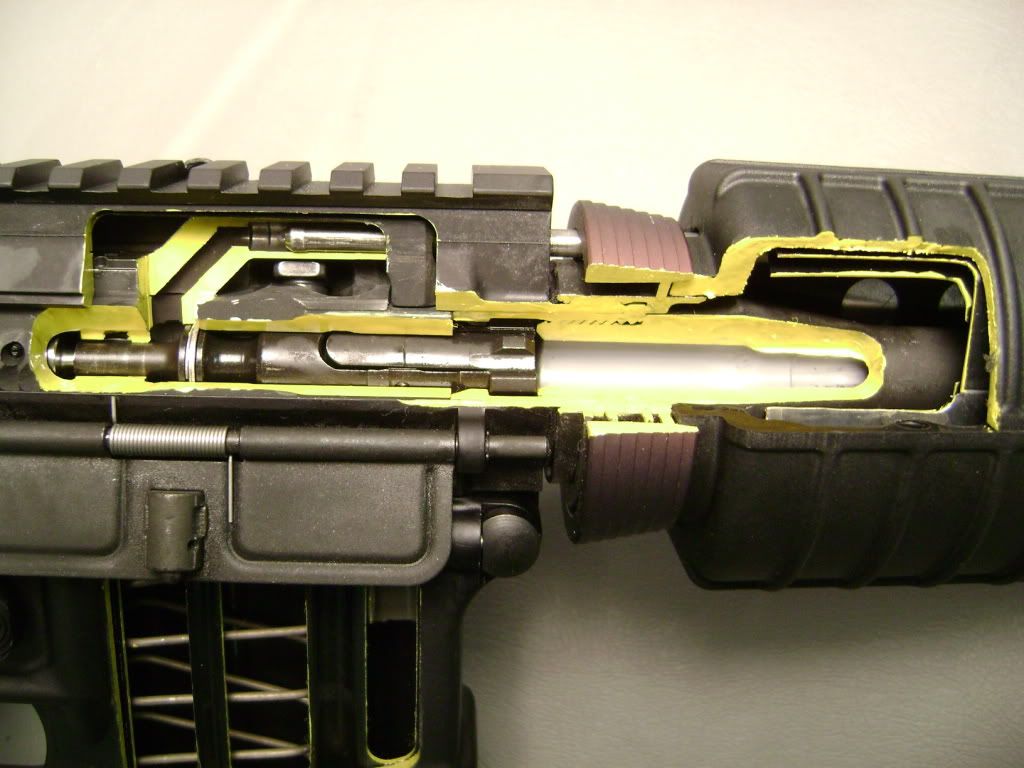
In most case head separations, the case breaks about half way up the body, leaving enough brass to still fill the back half of the chamber walls, and keep it sealed (if it broke under pressure). If the case head separates all the way there at the back, as OP describes, then there's nothing left to swell and be pressed against the chamber walls, and a whole lot of gas is coming back around those lugs and into the action - kaboom. Just like a Glock Kaboom. It's rare for that to happen with an AR, as the brass is purposely dimensioned to fail half way up, not at the very back. Usually - with reputable brass. What COSteve describes above is indeed a very scary set-up, and he's right to have dumped that brass, because in that case, COSteve was on the path for a Kaboom just like the OP had. Personally I load FC once, mark it as discard, and forget it. I'm beginning to question the wisdom of reloading FC Brass even once, after reading this thread, and particularly COSteve's observation. That one was chilling to read. |

|
My first guess would be your RCBS powder dispenser wasn't completely cleaned of pistol powder before you filled it with CFE223.
I never crimp bullets, full metal jacket or otherwise. .003" of neck tension is more than sufficient to hold any bullet firmly in the case mouth. Why are you crimping the crap out of your loads? Did you have a "dud" or failure to fire before your Kaboom? You may have loaded a bullet into a case devoid of powder. The bullet stuck in the barrel from the force of the primer detonation and created a bore obstruction resulting in a Kaboom. |
|
Quoted:
My first guess would be your RCBS powder dispenser wasn't completely cleaned of pistol powder before you filled it with CFE223. I never crimp bullets, full metal jacket or otherwise. .003" of neck tension is more than sufficient to hold any bullet firmly in the case mouth. Why are you crimping the crap out of your loads? Did you have a "dud" or failure to fire before your Kaboom? You may have loaded a bullet into a case devoid of powder. The bullet stuck in the barrel from the force of the primer detonation and created a bore obstruction resulting in a Kaboom. My charge master is cleaned after every session whether changing powder or not. I crimped because the bullet had a cannilure and only used a mild crimp. No dud or ftf. First five went fine. |
|
we've discussed bore obstructions from a previous undetected dud, brass neck jammed into the throat, powder mixed in, over charged powder.
about the only other thing I can think of is the brass material was out of spec ie too weak from the beginning. About as rare as hen's teeth but it has happened before. Oh and motor1 and lazyE, I was going to pipe in there too on your discussion, with the brass being the gasket of the system, not strong enough on it's own and the chamber and bolt will fail without it's seal. I liken it to the inner tube failing without the tire to support it. some of the early cartridge firearms were downright dangerous with a failure, many venting gasses right into the shooter's face and eye. It took them a few years to design systems to direct the gas else where. OP, you pulled the front half of the casing out of the chamber. did you check to see that there was remnants from just one cartridge, ie no case neck within a case neck? Shouldn't have happened with such low reload count ammo but that failure has happened before, a neck or neck and shoulder from a previous round that ruptured and the gun chambered in the next round and couldn't go all the way and some how fired out of battery. I'd also look carefully at the chamber just to make sure there isn't something in there yet. |
|
Quoted:
we've discussed bore obstructions from a previous undetected dud, brass neck jammed into the throat, powder mixed in, over charged powder. about the only other thing I can think of is the brass material was out of spec ie too weak from the beginning. About as rare as hen's teeth but it has happened before. Oh and motor1 and lazyE, I was going to pipe in there too on your discussion, with the brass being the gasket of the system, not strong enough on it's own and the chamber and bolt will fail without it's seal. I liken it to the inner tube failing without the tire to support it. some of the early cartridge firearms were downright dangerous with a failure, many venting gasses right into the shooter's face and eye. It took them a few years to design systems to direct the gas else where. OP, you pulled the front half of the casing out of the chamber. did you check to see that there was remnants from just one cartridge, ie no case neck within a case neck? Shouldn't have happened with such low reload count ammo but that failure has happened before, a neck or neck and shoulder from a previous round that ruptured and the gun chambered in the next round and couldn't go all the way and some how fired out of battery. I'd also look carefully at the chamber just to make sure there isn't something in there yet. Yes sir, that's pretty much it. While more photo evidence would be useful, with what we know now, I'm fairly confident it was a brass failure. |
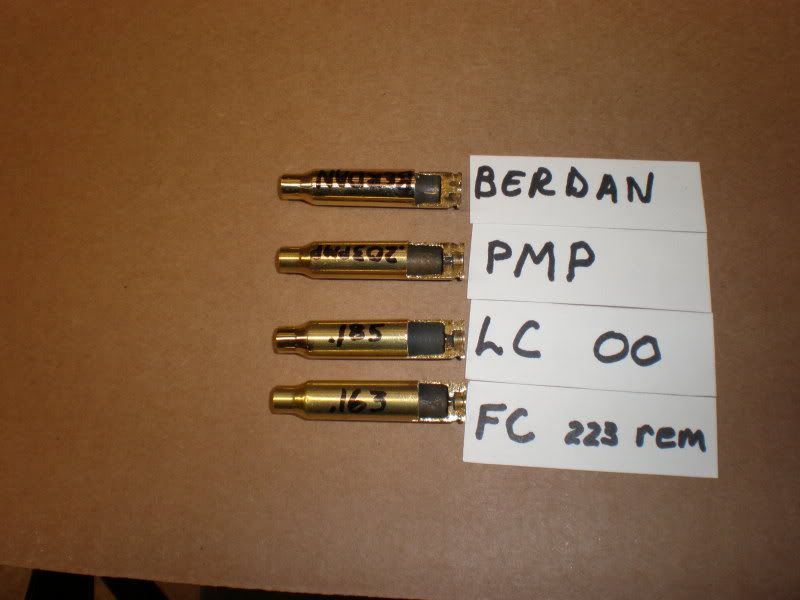
| I can't post pic and unfortunately in my hast and aggravation i shit canned all the damaged parts. Made me sick looking at them. What I can tell you is the upper blew apart, the carrier split the barrel extension cracked and the bolt wedged itself in the extension. Also blew the magazine out. |
Armory Sponsor