


Armory Sponsor


Posted: 1/2/2016 2:42:55 PM EDT
|
I'm finally biting the bullet and getting into reloading. Been reading forums and watching Youtube videos. Got a Lyman manual on the way.
My goal is to load cheap 147gr. 9mm ammo so I can shoot more. I'm starting with a Lee single stage to learn the ropes and then will purchase a 550 or 650. I'm a mechanical engineer so I understand how to use calipers etc. Which leads me to my questions: 1. Are powder coated bullets a bad choice for a beginner? If so, what would you recommend? I have aftermarket barrels in my Glocks so lead is OK. 2. I'd like to mainly load 147gr. bullets, is this a bad choice for a newb? If so, what weight to cut my teeth on? I have access to Accurate #5 and Hodgdon HS6 powders. Thanks |
|
Powder coated bullets are fine.
I shoot plated, FMJ, powder coated, and Hi-Tek coated bullets out of my stock Glocks with no issues at all. 147's are nice but I like 124 FP better and the cost is cheaper. Best bang for your buck is Titegroup as a little goes a long, long way. Enjoy. |
|
OP. Sounds like a good plan but like the last post I'm questioning the 147gr bullets. I've gotten good results from 115gr, 124gr and yes 147gr but typically heavier bullets mean more cost and more recoil. Neither of which are beneficial when it comes to inexpensive shooting.
Motor |
|
For 9mm plinking ammo, 115 or 124 is all that you need.
Check around for bullet prices to find which is the cheapest in bulk, since either plated or powder coated bullet will be fine for what you are using them for. As for at some point if you can find scrap lead, your going to get into casting instead of buying bullets. Hence cost me $.04 per round to load 45acp. As for powder for 45, something titegroup lets you hit speeds, and keep the price down on powder. Hence it takes 2 more'ish grs in HS-6 than titegroup to his close to the same speeds in say a 115gr bullet, and when you start adding that up on a lb of powder (7000grs), a lb of tight group will allow you to load more bullets per lb of powder isntead. The # 5 is close to the same amount of powder as titegroup, but your giving up some speed instead. http://www.accuratepowder.com/wp-content/uploads/2010/09/WP_LoadSpec_1-23-14.pdf Lastly, keep in mind that plated and powder coated bullets are treated as cast lead bullet in reloading data, unless you can find some other specific data for them isntead. So do not use jacketed bullet data for powder coated or lead bullets, since your working pressures will be too high instead!!!!! So plated bullets use cast data, and in the case of plated bullets, may luck out and find say rainier bullet data for them instead. |
|
You can shoot coated, plated, and jacketed bullets out of the factory Glock barrel. If you want to shoot lead, the aftermarket barrel will suite you better. There are guys shooting lead out of the factory barrels but they're religious about cleaning them, I wouldn't recommend doing so.
I've always bought 124 grainers for 9mm, some brands fly better than others. If you want to shoot 147s by all means do so but keep in mind they are going to be moving slower. Personally, when I started loading I bought the components specific to the load data. For example, if the data called for a 124 grain XTP, I bought a 124 grain XTP. I took me several hundred known loadings before I felt comfortable playing with seating depths and charges for unlisted components. Take load data posted from users with a grain of salt, just because it's safe in their gun doesn't mean it's safe in yours. Typical suggestions: Coated lead - Bayou bullets, SNS, Black and Blue, Blue Bullets. Plated - Xtreme, Berrys, Powerbond Jacketed - Precision Delta, Zero, Montana Gold |
|
There are many types of cast, plated, or otherwise coated bullets. You need to fallow the manufacturers recommended maximum load range.
I have no doubt that I can shoot 18bhn powder coated cast bullets in my 9mm with maximum jacketed data. This holds true for most common hand gun calibers. It all depends on alloy strength. Most plated bullets are made with soft alloy this is why they recommend "cast bullet data". Sorry if I muddied the water but if you are going to buy commercially made bullets research the manufacturers recommended loading range for them before you buy them. Motor |
|
Powder coat is fine.
147s are fantastic IMO. They have can make minor PF with a much softer recoil impulse if using a fast powder. They also use less powder, granted it is the least expensive component. I have no experience with the powders you listed. Titegroup and Bullseye are my go tos with 147s. Properly sized lead of the correct alloy is fine in most any barrel, including factory Glocks. Lighter bullets of the same brand, caliber, and type are always cheaper, if you're just plinking unsuppressed the slightly softer recoil of heavies is probably not worth the small premium. |
|
One thing to watch for with AA#5.
I could not get complete burning in my glock19 with 124gr lead bullets. I'd get unburned powder all over me. AA#5 may have to be at the top end of loads to get complete burns, I was trying to stay low velocity. Had to switch to titegroup and bullseye. |

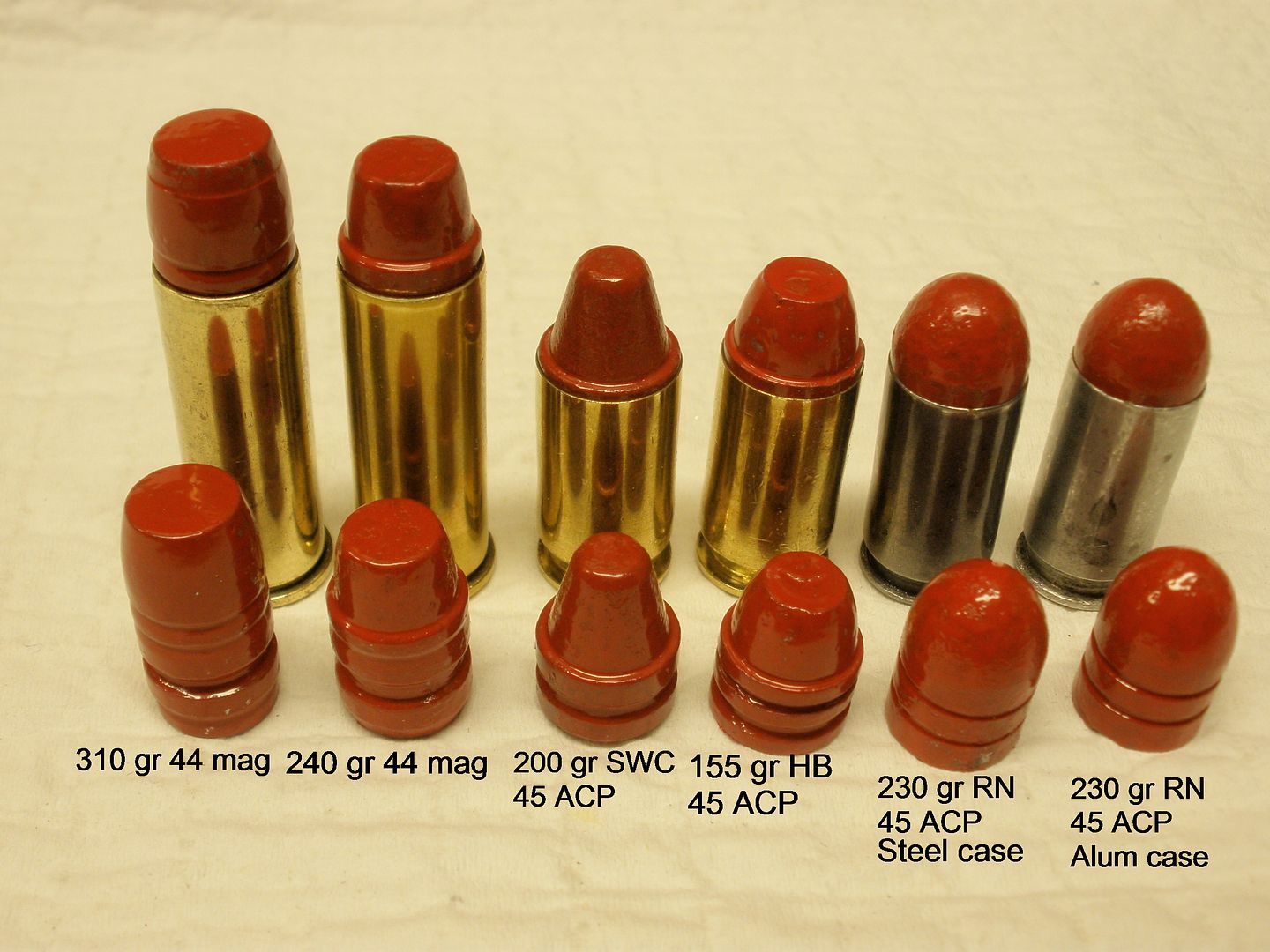
|
I shoot 147gr moly or Hi-Tech coated with a bullet profile to mimic the 147gr JHP factory loads. AA#7 is my go to powder with 6.4gr. This is for a CZ75 and BHP.
I use #5 for 40SW and 45ACP. Haven't tried it yet with the 147gr 9mm, but it should work fine. The 4th edition Hornady manual has 4.6gr as max load. Use moly, uncoated and Hi-Tech bullets in my Gen 1 Glock23 and clean it spic and span every time I shoot. No problems for the past 20+ yrs with the OEM barrel... |
|
Quoted:
I think there might be a fair number of IDPA shooters that might disagree with this assessment? Quoted:
Quoted:
and more recoil. Motor I think there might be a fair number of IDPA shooters that might disagree with this assessment? You very well could be correct. I'm just speaking of my own experience and the fact that launching a heavier object will "normally" create more recoil. But in the real world of auto loading with actions to work and such I can see where a lighter load with a heavier bullet could produce either less felt recoil or a milder form of recoil like a "push" vs a sharp snap. Motor |
|
Quoted:
Thanks for all the answers. Sounds like 124gr is a good balance of cost and shootability. I load a lot of 147's in coated bullets. They can be a problem if you load them too long. 124 and 115 gr bullets tend to be more reliable. However, for competition I like the softer shooting 147 gr bullets. |
|
Well I ordered 8# of Titegroup and 5000 S&B primers. Also 250 of the 125gr RN Blue Bullets to try them out. Hope my Glock 17 likes this combo.
My Lee Challenger kit should be delivered tomorrow. I'm about a hair away from ordering a 550 also. As if black rifle and NFA disease weren't bad enough, now I have reloadingitis and I haven't even loaded one round yet. 
|
|
Keep a close eye on Titegroup while charging the cases.... it has a narrow min-max range... in other words it builds pressure fast, with a inadvertent over charge, it gets spooky fast.
Also, don't be surprised if you need to flare the case mouth a little more, so you don't scrap the coating off. I do not recommend new reloaders seat the bullet and crimp in one step...it can be a little bit of a challenge to get it right. Take your time crimping, ( do a punk test in your barrel ) so you can get that part right. Welcome to the fastest way to not save money !!! Lol 
|
 I will also warn you about double charges. In this pic charge is 3 grs Bullseye in a 357 case. (my wadcutter load) 1= 3 grs 2=double charge, 6 grs 3=triple charge, 9 grs 4= quadruple charge, 12 grs So the lesson here is to look down into your charged cases and ensure you have no double charges. Which can happen in 9mm with TiteGroup. I use and like TiteGroup, just be aware of double charges. |
|
Quoted:
Well I got everything set up in my cold garage. Starting decapping and the damn carbide insert came out of the Lee die on the 20th round. I got the case unstuck from it and pressed the insert back into the die. Came out again about 5 rounds later. Yay! Just like any other manufacturer, Lee will replace the die without any questions. Personally the only dies I buy are RCBS and Dillon. |
|
Quoted:
Just like any other manufacturer, Lee will replace the die without any questions. Personally the only dies I buy are RCBS and Dillon. Quoted:
Quoted:
Well I got everything set up in my cold garage. Starting decapping and the damn carbide insert came out of the Lee die on the 20th round. I got the case unstuck from it and pressed the insert back into the die. Came out again about 5 rounds later. Yay! Just like any other manufacturer, Lee will replace the die without any questions. Personally the only dies I buy are RCBS and Dillon. I went ahead and belled the mouths and seated some bullets (no powder). Got it set up to a light crimp where it wasn't scoring the powder coat with an COL of 1.130 (125gr Blue Bullets) after some trial and error. They didn't pass the plunk test. Looks like the decapper/sizer is sizing them at .378". Don't know if it's related to the insert being loose or what. I'll try again when Lee replaces the decapping die. Been a good learning experience so far and as soon as I get a new bench build I'm pulling the trigger on a Dillon. I'm "saving" so much money! |
|
Quoted: I went ahead and belled the mouths and seated some bullets (no powder). Got it set up to a light crimp where it wasn't scoring the powder coat with an COL of 1.130 (125gr Blue Bullets) after some trial and error. They didn't pass the plunk test. Looks like the decapper/sizer is sizing them at .378". Don't know if it's related to the insert being loose or what. I'll try again when Lee replaces the decapping die. Been a good learning experience so far and as soon as I get a new bench build I'm pulling the trigger on a Dillon. I'm "saving" so much money! Quoted: Quoted: Quoted: Well I got everything set up in my cold garage. Starting decapping and the damn carbide insert came out of the Lee die on the 20th round. I got the case unstuck from it and pressed the insert back into the die. Came out again about 5 rounds later. Yay! Just like any other manufacturer, Lee will replace the die without any questions. Personally the only dies I buy are RCBS and Dillon. I went ahead and belled the mouths and seated some bullets (no powder). Got it set up to a light crimp where it wasn't scoring the powder coat with an COL of 1.130 (125gr Blue Bullets) after some trial and error. They didn't pass the plunk test. Looks like the decapper/sizer is sizing them at .378". Don't know if it's related to the insert being loose or what. I'll try again when Lee replaces the decapping die. Been a good learning experience so far and as soon as I get a new bench build I'm pulling the trigger on a Dillon. I'm "saving" so much money! And learning a lot.  Nothing wrong with Lee dies. With mine I modify the nut on the die to a locknut. This pic was taken to show the importance of checking the vent hole to make sure it isn't blocked. It's blocked in the pic. |
|
Quoted:
I went ahead and belled the mouths and seated some bullets (no powder). Got it set up to a light crimp where it wasn't scoring the powder coat with an COL of 1.130 (125gr Blue Bullets) after some trial and error. They didn't pass the plunk test. Looks like the decapper/sizer is sizing them at .378". Don't know if it's related to the insert being loose or what. I'll try again when Lee replaces the decapping die. Been a good learning experience so far and as soon as I get a new bench build I'm pulling the trigger on a Dillon. I'm "saving" so much money! Quoted:
Quoted:
Quoted:
Well I got everything set up in my cold garage. Starting decapping and the damn carbide insert came out of the Lee die on the 20th round. I got the case unstuck from it and pressed the insert back into the die. Came out again about 5 rounds later. Yay! Just like any other manufacturer, Lee will replace the die without any questions. Personally the only dies I buy are RCBS and Dillon. I went ahead and belled the mouths and seated some bullets (no powder). Got it set up to a light crimp where it wasn't scoring the powder coat with an COL of 1.130 (125gr Blue Bullets) after some trial and error. They didn't pass the plunk test. Looks like the decapper/sizer is sizing them at .378". Don't know if it's related to the insert being loose or what. I'll try again when Lee replaces the decapping die. Been a good learning experience so far and as soon as I get a new bench build I'm pulling the trigger on a Dillon. I'm "saving" so much money! I can't see where re-sizing at .378" is an issue, unless your die isn't fully re-sizing the entire case. My 9MM re-sizing die runs the case mouth down to .372", this will vary from manufacturer to manufacturer but it shouldn't matter all that much because you're going to bell / flare the mouth to .380"-.382" etc... After the bell you're going to crimp probably in the .375"-.378" range and call it a day. I measured the towards the rear of my case (not a typical measurement) and I'm getting roughly .388", make sure your cases are getting fully resized. How are they failing the plunk test? Too far in, too far out, or too tight? You might want to double check your OAL, the lead bullets might have a longer profile than jacketed or plated. |
|
Quoted:
I can't see where re-sizing at .378" is an issue, unless your die isn't fully re-sizing the entire case. My 9MM re-sizing die runs the case mouth down to .372", this will vary from manufacturer to manufacturer but it shouldn't matter all that much because you're going to bell / flare the mouth to .380"-.382" etc... After the bell you're going to crimp probably in the .375"-.378" range and call it a day. I measured the towards the rear of my case (not a typical measurement) and I'm getting roughly .388", make sure your cases are getting fully resized. How are they failing the plunk test? Too far in, too far out, or too tight? You might want to double check your OAL, the lead bullets might have a longer profile than jacketed or plated. Quoted:
Quoted:
Quoted:
Quoted:
Well I got everything set up in my cold garage. Starting decapping and the damn carbide insert came out of the Lee die on the 20th round. I got the case unstuck from it and pressed the insert back into the die. Came out again about 5 rounds later. Yay! Just like any other manufacturer, Lee will replace the die without any questions. Personally the only dies I buy are RCBS and Dillon. I went ahead and belled the mouths and seated some bullets (no powder). Got it set up to a light crimp where it wasn't scoring the powder coat with an COL of 1.130 (125gr Blue Bullets) after some trial and error. They didn't pass the plunk test. Looks like the decapper/sizer is sizing them at .378". Don't know if it's related to the insert being loose or what. I'll try again when Lee replaces the decapping die. Been a good learning experience so far and as soon as I get a new bench build I'm pulling the trigger on a Dillon. I'm "saving" so much money! I can't see where re-sizing at .378" is an issue, unless your die isn't fully re-sizing the entire case. My 9MM re-sizing die runs the case mouth down to .372", this will vary from manufacturer to manufacturer but it shouldn't matter all that much because you're going to bell / flare the mouth to .380"-.382" etc... After the bell you're going to crimp probably in the .375"-.378" range and call it a day. I measured the towards the rear of my case (not a typical measurement) and I'm getting roughly .388", make sure your cases are getting fully resized. How are they failing the plunk test? Too far in, too far out, or too tight? You might want to double check your OAL, the lead bullets might have a longer profile than jacketed or plated. They are too far out, not by much. While I was dialing in the COL I set some way too deep. These were also failing the plunk test in the same manner. |
|
Quoted:
I think there might be a fair number of IDPA shooters that might disagree with this assessment? Quoted:
Quoted:
and more recoil. Motor I think there might be a fair number of IDPA shooters that might disagree with this assessment? At least with the .40 cal I like the heavier bullets and lower slide speed. |
Armory Sponsor