


Armory Sponsor


Posted: 2/6/2016 5:33:38 PM EDT
|
I'm sure somewhere, somebody has discussed this but I've been unable to find it primarily due to the fact that I'm not sure what somebody would call it. I'm interested if anyone has come up with a list of incompatible powders, and if not that, if at least somebody could explain to me which types of powders do not play well with each other. I'm referring to when you have shot several rounds in a barrel with powder #1, and then proceed to shoot in the same barrel several rounds loaded with powder #2 and you do NOT have the opportunity or ability to clean the barrel/bolt between shooting. I've witnessed several powders that do not interact at all, some that interact a little, and some that seemingly had bad interactions as they threw several flyers in the following group until it settled down after 3-4 shots.
With .223, shooting 4064 after 4895 I saw minor problems. With 300BLK shooting 300MP after Remington Subsonics in 300BLK saw major problems again with 300BLK, I4227 and then A5744 saw enormous amount of flyers for nearly 5 rounds. Ones that haven't been a problem (for me at least): N140 following H335 I4064 following Varget |
|
Your POWDER should not be the issue. The charge or bullet could be. Your powder should be almost completely consumed in the firing, the only possible answers I see for your issue is that either their is unburnt powder left after a round is fired, or your load is causing an issue with the bullet's contact with the rifling, possibly excessive leading or jacket fouling?
|
|
Not a powder problem, unless you loads are not getting a full burn to start with.
Hence we need to take the problem all the way back to barrel harmonic's, being that differ loads/ different powders will have the bullet existing the muzzle in different points of the muzzles oblong movement instead. Hence the muzzle will be traveling in a oblong circle as the bullet is traveling down the barrel (not up and down, but the axes direction off to one side from top to bottom instead), 
And your trying to get the bullet to exit the muzzle when its at is stillest points in movement, being either the crest of trough, with any give load. 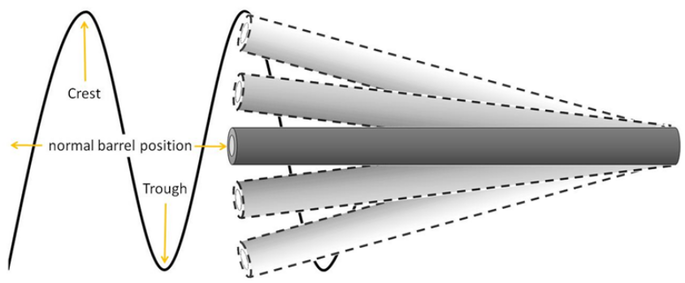
So when one load will have the bullet existing the muzzle at either the crest or through, then rifle will shot it tightest groups. But change the load, which changes the barrel harmonics as well, and this load may have the bullet exiting between the crest and trough points instead, and will increase the group sizing instead. Also to point out, as the barrel gets hotter, it increases the movement of the barrel harmonics, and this may be what you are seeing, being that as you heat the barrel up more with the next load, it's changing the barrel harmonics to now get the bullet with the new load to exist the muzzle at one of the crest or through now instead. So same gun, same load, and just different weather temps has this same gun shooting differently, all due to barrel harmonies/muzzle movement. Summer time and we can see the barrel harmonics on the grouping and where the bullets are leaving the muzzle in the oblong path of the muzzle, 
Winter time with the powder not pushing the bullet as fast, and we again, see the harmonics of the barrel oval movement and where the bullets are leaving the muzzle instead. 
Note, if you over lay the two target and draw in the muzzle oblong movement, we can see the the crest is about the 2:00 O'clock postion, and the trough is about the 8:00Oclock position for this barrel. So summer loads has the bullet leaving the muzzle around the trough of the muzzle movement, while the winter time has the bullet leaving the muzzle more between the trough to crest on the right hand side (with one shot that has higher SD, and ended up leaving the muzzle on the other side of the crest to trough instead. http://www.ar15.com/forums/t_6_42/457743_30___40__temp_difference_causes_this_much_variation___Update__pics_should_work_now_.html So again, 4064 to push a round to 3K, then 4895 to push the same bullet to 3K, since the burn rate of the powder is different, so will be the barrel harmonics of the muzzle between the too loads, and where the muzzle will be in it's moment in regards to crest and trough when the bullet exists the muzzle. P.S, To figure out the direction of the oblong muzzle movement in motion, it will always be counter clock wise of the barrel rifling. |
|
Dano, Thanks for your detailed overview. While I'm familar with what you are talking about, its always good to hear somebody else's explanation of barrel harmonics. And while I agree with most of what you state, I disagree with your assessment that it is causing my issues. First, let me say that I'm not having any "issues". I was just trying to gather information on what I thought was a well known and understood cause/effect relationship.
What I'm referring to about powder interaction is a documented phenomenon that many have seen, and some have written about. I don't want to argue the merits of whether or not it exists, that doesn't interest me at all because I don't care much whether you believe it is real or not, that's your perogative. I will only say that whether my situation is unique or not, I have no idea, but I just went into my shooting log table for the past 10 years and searched for how many instances I had where I switched powders during a shooting session, whether practice or not, in all of the calibers I shoot, without cleaning between the powder change, and it was over 3500 times. So I personally have a lot of experience with this, and the data I've run myself on my own shooting shows there is absolutely a repeatable effect certain powders have when being shot after other powders that cannot be explained by anything other than that. For instance, if you shoot a 20 round group, the first several shots will be erratic (and usually noticeable on the chrono as well), and they stabilize after the first 2-6, producing a very tight group (if the load is good). No explanation of barrel harmonics or heat would explain this if you are managing to shoot at a defined interval when the barrel temp is not coming into effect. Regardless, like i said, I'm not interested in arguing about this. I merely wanted to see if anyone else who knows about this had bothered to document conflicting powders because I'm about to go through the trouble of doing it, and wanted to not duplicate efforts, or hopefully be able to skip doing it if it has already been done. I've just not been able to find it anywhere, and for me the issue continues to pop up from time to time. And for you non-believers, you should talk to Sierra and debate with them the merits of this phenomenon, as it is mentioned in their reloading manuals, and it is also talked about in a little more detail on their exteriorballistics page. Its about 2/3 of the way down, paragraphs 4 & 5 in the section called Powder Selection. Unfortunately, they didn't bother to put any anchors in the page so I couldn't link to it directly, but its easy enough to find by searching the page for powder selection then reading the last 2 paragraphs of that section: http://www.exteriorballistics.com/reloadbasics/gasgunreload.cfm If anyone does come along that knows about this issue and wants to share notes about specific powders, or can educate me on why certain powder types are more likely to induce this effect than others, I'd be most appreciative. cheers. |
|
No worries, and considering that each type of powder will leave behind some sort of residue in the bore, it could simply be this problem, with the new powder rounds having to blow out the old residue and lay it own coating down for the needed new residue resistance instead.
I just have never had this problem when working between 4064 and 4895 with 30 cal rounds, but could see it if you where using a dirty powder to begin with, then went to the IMR and needed to blow out the dirty powder residue instead. Note, with 4064 and 4895 in 223, if your working pressures are not high enough to get a full burn quick enough, it will leave behind a lot of soot to begin with. Simply, God knows that if you have any traces of CLP in the bore, it takes a hand full of shots to blow out the Teflon from the bore before it settles in,and with some loads that are not high enough pressure to get a ideal burn quick enough, could be having the same problems as well. As for taking a few round to first shot season the barrel, if it's taking a few shots instead, then suspect that you have a problem with what you are using to first clean the bore leaving behind trace elements instead. Myself between shot string, use Sweets on match barrels, and all it take is one shot to clear and season the barrel, since sweets leave behind not protective residue. Note, Hoppes/CLP, could be into a hand full of shots, and still not cleared the bore of those residues yet. |
|
Zpat:
You are bringing up what some call powder compatibility. It is the residue from the first powder reacting with the second....... It doesn't effect most shooters as it is a LR thing............ John Feamster in "Black Magic" (pge 177-179) and Glen Zediker in "Handloading for Competition" (pge 389-391) both discuss it. Usually when a switch from ball to extruded but others. I have a internet list I copied from there but I'm not sure if I can find it............. |
|
Here you go...................
While my answer may not be exactly what you are talking about.. you did ask about cleaning the "Bore" ... so here goes... Some Match shooters say they have seen some problems when not cleaning the bores when switching between Ball and Stick powders or one brand v. another etc. , there is a list somewhere on my computer that shows what I'm writing about, any how I think thats how some of these gunny tidbits come about. Here is the list of powders and their compatibility.... (Quote)..."Anyway, here is the compatibility list I compiled a few years ago. It is in no way scientific and compiled nearly 100% by hearsay." Powder Compatibilities Short Range Long Range OK? 2015 H4350 No 4895 N540 Yes AA2520 N540 No AA2520 N135 No IMR4895 Re15 Yes IMR4895 Varget No IMR4895 IMR4064 Yes IMR4895 H4350 Yes IMR4895 N540 Yes H4895 Re15 Yes N135 N540 OK, No N135 N140 Yes N135 N150 Yes N140 N540 No N140 H4350 No N140 Varget No N540 N550 Yes N540 IMR4895 No Re15 N540 Yes, No Re15 N550 Yes Re15 N140 No Re15 Varget No TAC N135 Yes TAC N140 Yes TAC Re15 Yes TAC IMR4064 Yes TAC Varget No Varget N540 No, Sighters low, rest OK. Varget H4350 Yes Varget N140 Yes Varget IMR4064 Yes WC844 Varget No WC844 Re15 No WW748 Re15 No IMR4064 N150 Yes From this thread...http://www.usrifleteams.com/forums/index.php?showtopic=14581&hl=compatibilities&st=15 and all credit for this info is given to "becoole" I 've noticed it before, but usually wrote it off... as one load likes to group at 03:00 o'clock while the other liked 09:00 or 07:00 etc... |
|
Now if this is the source of your issues...............That is for you to decide.
For me to further opine, I'd like more info from you............. ie. Distance, rifle, what sort of problems did you see? etc.. PS........ Each of those authors (and I assume the list creators) were referring to their experiences with the 223 but I would think the same would/could apply to other calibres. |
Armory Sponsor