


Armory Sponsor


Posted: 6/29/2014 4:27:30 PM EDT
|
Over the past few days, I have been tinkering with my grandpa's Dillon 650. I've been learning how to reload .223 by researching and using trial and error. Yesterday, I set up the dies and loaded 40 rounds that fired without a hitch in my Sig 516.
Today I went to reload the rest of the 300 or so cases I have. I loaded approximately 50 before I started having problems. Suddenly, every single round was deforming at the shoulder in the crimp die. I measured some of the cases that hadn't been run through the press and found many of them were 1.760 inches, which is the max length in my reloading manual. So, I set up my trimmer and trimmed 20 cases to 1.750 inches. A few of them still came out of crimping deformed, so I trimmed the next 20 to 1.740 inches. They were also deformed in the crimper. I set up my resizing die by screwing it in until it touched the shell plate and making adjustments using a Wilson case gauge. I don't understand why this started happening. Before I attempted to load these 300 cases today, I successfully loaded about 75 cases in the past few days without any deformation. Is it possible the crimping die wasn't locked down properly? |
|
Quoted:
cDo not crimp with the seating die. Only seat your bullets then when it comes time to crimp, remove your seating die and use a Lee Factory Crimp Die. You get a nice crimp that looks like one you'd see on a factory round. This is a very well know problem. When you try to crimp with a seating die the die hits the top of the case hits the crimp ring before the bullet is fully seated. Since you're not at the cannular yet, the case is not able to "fold over into the groves" so there is no where for it to go. The result is that it crushes downward and bulges the shoulder. I've had this problem before as well as most people. Buy a lee Factory crimp die and quit crimping with your seating die. It will solve your problem. I will also note that crimping is not necessary at all, I would just use your seating die to seat and call it a day. Edit: if you are using a crimp die separately than your seating die then the problem is you're trying to crimp too much. Back out the die some and try again. Same problem as above. |
|
Likely cause: brass needs to be trimmed to spec so all are uniform. Second issue: crimping .223/556 is really not necessary. Many thousands of rounds thru AR's without ever a crimp, no problems with accuracy or neck tension. Also, starting with properly trimmed cases, you will find that brass fired in AR's takes 3-5 firings before they are out of spec. Primer pockets become loose before trimming is an issue, especially if you skip the crimp. A large number of posts in regard to crimping rifle cases indicates there are many who believe it's needed. I have never crimped rifle reloads.
With that said, I have been using the Lee crimp die on .300 B/O. I am not yet sure this makes any difference in accuracy, others experience may be different. I reload for economy and accuracy, without going full anal retentive. Crimping rifle cases requires uniformly trimmed cases, a step that one can perform after each firing if you want. Bolt gun fired brass is where more attention is needed on brass length as the cases grow more in that platform. We did more than one A/B test on the crimp issue in AR-15 guns and really didn't see any reason to do so. I think annealing after 2-3 firings made more difference in accuracy and brass life than worrying about a crimp. |
|
The OP did not state if he was crimping and seating in one step or not or if he was roll crimping. The problem does sound like a roll crimp being to low though.
OP: If you are seating and crimping with the same die, it is very likely your die has moved and you are now over crimping. Checking your case length was a "on track" move because roll crimping requires case lengths to be consistent. While I do agree with the 2 step seat and crimp especially on a progressive press it can be done in one step successfully but does take some skill to set it up properly. If you don't have a separate crimp die and don't want to send your ammo back through the press to crimp I suggest you either set up your seat die for no crimp and just shoot non crimped ammo or learn how to set it up to do both properly. Best option if you don't already have one is to have a separate crimp die. Maybe a little off the wall but did you happen to change bullet types. If you went from a bullet with a canalure (crimp groove) to one that don't you could also get what you are getting. |
|
I am not seating and crimping with the same die. I know the crimp die is a Lee, but I'm not sure which one or if it even matters.
I don't have a headspace gauge like the Hornady one you guys mentioned. I'm using Winchester 55 grain FMJ bullets. I'm pretty sure they all have the cannelure, but I will check tomorrow. |
|
Quoted:
My guess would be is that the cases are not sized properly, like the shoulder is not pushed back far enough so if you Have a headspace gage like say one from Hornady I would measure a fired case and bump the shoulder back at least .003-.005" This is probably a stupid question. If I can easily slide the resized cases into a case gauge without the tip of the mouth sticking out of the end of the gauge, can it still not be sized properly? |
|
OK The fact that your problem is occurring at the crimp station tells me you need to focus on that station. It sounds like your crimp die moved.
Personally I can't think of any reason for a case that was not sized properly would cause the type of problem you are having. The case shoulder should not be anywhere close to contact with anything in a crimp die. My bet is your case shoulder is being crushed because of an improperly set crimp die. It is crimping too much. Even if it is a Lee FCD which is a collet type crimp die it can cause the problem you are having if adjusted too low. Look into the top of the crimp die. If it has a bore that the bullet comes up through and has slots cut in it that run from the bore out to the inner die body it is a collet crimp die. This die closes those slots when the shell holder presses up against the bottom of the collet. This die should never be adjusted to where those slots fully close before the ram reaches the top of it's stroke. Most guys set it so there is still a little gap when the ram is topped out. |
|
Quoted: This is probably a stupid question. If I can easily slide the resized cases into a case gauge without the tip of the mouth sticking out of the end of the gauge, can it still not be sized properly? Quoted: Quoted: My guess would be is that the cases are not sized properly, like the shoulder is not pushed back far enough so if you Have a headspace gage like say one from Hornady I would measure a fired case and bump the shoulder back at least .003-.005" This is probably a stupid question. If I can easily slide the resized cases into a case gauge without the tip of the mouth sticking out of the end of the gauge, can it still not be sized properly? No, what that checks is OAL. (over all length) The other end of the gauge is for setting your sizing die. Dillon gauge shown, the Wilson works the same way. Study the pic, this is what you want. End of the case below end of the gauge, but above the cut.
|
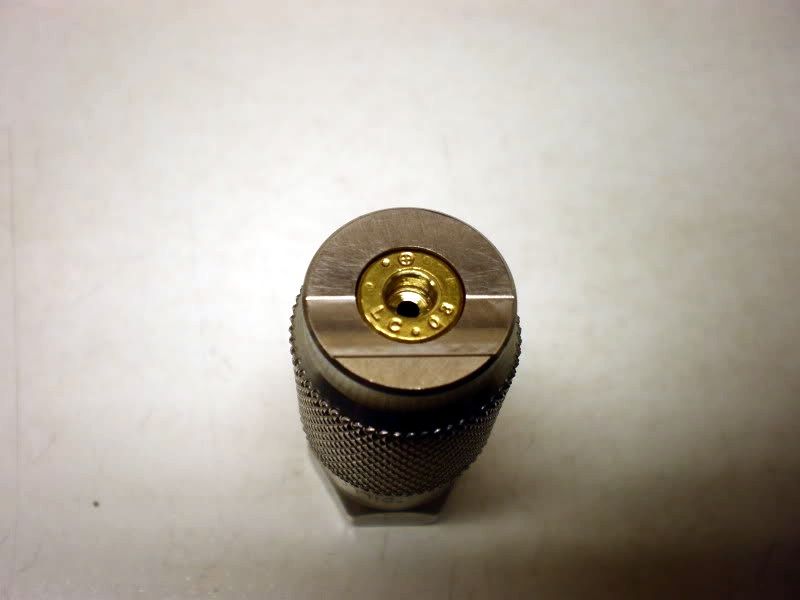
|
Quoted:
No, what that checks is OAL. (over all length) The other end of the gauge is for setting your sizing die. <a href="http://s250.photobucket.com/user/dryflash3/media/Case%20Gauge/PB290317.jpg.html" target="_blank">http://i250.photobucket.com/albums/gg272/dryflash3/Case%20Gauge/PB290317.jpg</a> Dillon gauge shown, the Wilson works the same way. Study the pic, this is what you want. End of the case below end of the gauge, but above the cut. Quoted:
Quoted:
Quoted:
My guess would be is that the cases are not sized properly, like the shoulder is not pushed back far enough so if you Have a headspace gage like say one from Hornady I would measure a fired case and bump the shoulder back at least .003-.005" This is probably a stupid question. If I can easily slide the resized cases into a case gauge without the tip of the mouth sticking out of the end of the gauge, can it still not be sized properly? No, what that checks is OAL. (over all length) The other end of the gauge is for setting your sizing die. <a href="http://s250.photobucket.com/user/dryflash3/media/Case%20Gauge/PB290317.jpg.html" target="_blank">http://i250.photobucket.com/albums/gg272/dryflash3/Case%20Gauge/PB290317.jpg</a> Dillon gauge shown, the Wilson works the same way. Study the pic, this is what you want. End of the case below end of the gauge, but above the cut. The gauge I have has the same configuration. I didn't realize the mouth end was for checking OAL, but I still adjusted my resizing die to allow the cases to fit in the gauge similar to your picture. I thought both ends of the gauge were a reflection of the resizing die. Am I understanding this correctly? The mouth end of the gauge checks OAL, and the other end checks the resizing/headspace? I'll post an example tomorrow. |
|
Did you read the tutorial in the Tutorials Resources at the top of the forum?
http://www.ar15.com/content/page.html?id=399 Quoted:
I am not seating and crimping with the same die. I know the crimp die is a Lee, but I'm not sure which one or if it even matters. I don't have a headspace gauge like the Hornady one you guys mentioned. I'm using Winchester 55 grain FMJ bullets. I'm pretty sure they all have the cannelure, but I will check tomorrow. Of course the crimp matters; there are two main types of crimp in use, and you need to know which type you are applying. Once you get the crimp sorted out, you're going to find out that the Winchester bullets have the cannelure located at pretty much random distances from the base of the bullet, so you COAL will be all over. Don't sweat it as long as the longest cartridges are 2.26 inches or shorter. You main problem is caused by the crimp ring in the sizer die. Turn it in until you feel it contact the case mouth, then turn it back out a quarter turn or so to get the crimp ring out of contact, then lock down the die and set the bullet seating depth. |
|
Quoted:
The gauge I have has the same configuration. I didn't realize the mouth end was for checking OAL, but I still adjusted my resizing die to allow the cases to fit in the gauge similar to your picture. I thought both ends of the gauge were a reflection of the resizing die. Am I understanding this correctly? The mouth end of the gauge checks OAL, and the other end checks the resizing/headspace? I'll post an example tomorrow. Quoted:
Quoted:
Quoted:
Quoted:
My guess would be is that the cases are not sized properly, like the shoulder is not pushed back far enough so if you Have a headspace gage like say one from Hornady I would measure a fired case and bump the shoulder back at least .003-.005" This is probably a stupid question. If I can easily slide the resized cases into a case gauge without the tip of the mouth sticking out of the end of the gauge, can it still not be sized properly? No, what that checks is OAL. (over all length) The other end of the gauge is for setting your sizing die. <a href="http://s250.photobucket.com/user/dryflash3/media/Case%20Gauge/PB290317.jpg.html" target="_blank">http://i250.photobucket.com/albums/gg272/dryflash3/Case%20Gauge/PB290317.jpg</a> Dillon gauge shown, the Wilson works the same way. Study the pic, this is what you want. End of the case below end of the gauge, but above the cut. The gauge I have has the same configuration. I didn't realize the mouth end was for checking OAL, but I still adjusted my resizing die to allow the cases to fit in the gauge similar to your picture. I thought both ends of the gauge were a reflection of the resizing die. Am I understanding this correctly? The mouth end of the gauge checks OAL, and the other end checks the resizing/headspace? I'll post an example tomorrow. A properly sized case will sit between the notches on the top of the gauge. A properly trimmed case will be flush with the other end of the gauge. |
|
I know the crimp die is a Lee , but I'm not sure which one or if it even matters.
Bullet Seating Die Crimp Style
There are two crimp shoulders in our bullet seating dies. The first shoulder applies a slight taper crimp and the second shoulder applies a full roll crimp. The closer the die is adjusted to the shell holder the heavier the crimp will be. Rifle Factory crimp die adjustment
The amount of crimp applied will be consistent if your press has mechanical stops built into the lever linkage, and you lower the lever to the stop every time. Start with the Factory Crimp die turned into the press until it stops against the shell holder with the ram raised all the way. Lower the ram, and turn the die in one full turn. Now try crimping a case, making sure that you raise the ram (lower the lever) all the way to the stop. You will feel slight resistance at the top of the stroke, as the crimp collet is forced up into the die body. If the crimp is not firm enough, turn the die in another 1/4 turn and try again. If you turn the die in to the point where the four slits in the collet are closed when the ram is raised all the way, you have reached the limit. |
|
Quoted:
Did you read the tutorial in the Tutorials Resources at the top of the forum? http://www.ar15.com/content/page.html?id=399 Of course the crimp matters; there are two main types of crimp in use, and you need to know which type you are applying. Once you get the crimp sorted out, you're going to find out that the Winchester bullets have the cannelure located at pretty much random distances from the base of the bullet, so you COAL will be all over. Don't sweat it as long as the longest cartridges are 2.26 inches or shorter. You main problem is caused by the crimp ring in the sizer die. Turn it in until you feel it contact the case mouth, then turn it back out a quarter turn or so to get the crimp ring out of contact, then lock down the die and set the bullet seating depth. Quoted:
Did you read the tutorial in the Tutorials Resources at the top of the forum? http://www.ar15.com/content/page.html?id=399 Quoted:
I am not seating and crimping with the same die. I know the crimp die is a Lee, but I'm not sure which one or if it even matters. I don't have a headspace gauge like the Hornady one you guys mentioned. I'm using Winchester 55 grain FMJ bullets. I'm pretty sure they all have the cannelure, but I will check tomorrow. Of course the crimp matters; there are two main types of crimp in use, and you need to know which type you are applying. Once you get the crimp sorted out, you're going to find out that the Winchester bullets have the cannelure located at pretty much random distances from the base of the bullet, so you COAL will be all over. Don't sweat it as long as the longest cartridges are 2.26 inches or shorter. You main problem is caused by the crimp ring in the sizer die. Turn it in until you feel it contact the case mouth, then turn it back out a quarter turn or so to get the crimp ring out of contact, then lock down the die and set the bullet seating depth. AeroE. Shouldn't this be bullet seater die? Not sizer? |
Armory Sponsor