


Armory Sponsor

Posted: 11/3/2011 1:56:50 AM EDT
|
Should I be scared of buying pulled bullets? Not any specific caliber just saw some on the internet and wondered how everyone's luck with pulled bullets has been?
Thanks. |
| I wont speak for all companies or individuals selling pulled bullets, but I will tell you my experience with one company. I have purchased close to 9k bullets both handgun and rifle from RMR bullets. The owner Jake posts on our EE board and his customer service is top notch. The bullets I have purchased range from practice only, to target and hunting bullets. When comparing targets between his bullets and factory sealed "new" bullets I can not tell the difference (this is shooting out to 600yds with 175SMK). RMR seems to take care of the customer and they make sure you are getting quality bullets. Any other company may or may not do the same (they are the only ones I have delt with). In many cases he sells bullets at nearly half of what it would cost getting them "new". Hope it helps. |
|
+1 for longdayjake. I have several thousand of his pulled .30 (147 and 175) plus his .223(62 gr). Good to go pulled bullets.
Some other pulled other than US bullets that I bought sucked ass with over a 6 grain weight varience making for very inconsistent groups ( even when sorted by weight ). |

I buy SS-109 (22 cal, 62 gr FMJBTSC) pulled bullets on a regular basis. 3k in this pic from Hitech. Wideners is also a good place to look. Also don't be afraid of the pull marks. They shoot fine. Just don't expect match grade accuracy with pulled bullets. But they make fine SHTF, plinking, and blasting ammo. |
|
Quoted:
+1 for longdayjake. I have several thousand of his pulled .30 (147 and 175) plus his .223(62 gr). Good to go pulled bullets. . Another +1 for Jake and RMR. I've purchased thousands of bullets from Jake. I especially liked the pulled 38/357 158 grn and the 30 cal 175 grn bullets. I can't tell any difference in performance. If you buy from a reputable source, such as RMR, it's a way of saving $$$ for more shooting! |
| Anybody else when buying the pulled bullets run into different wieght of bullets in the bulk packing? I ran into this from the last batch I bought. I purchased 155gn, and have seen them go anywhere from 130gn to 180gn. Its not a huge amout of bullets (30 out of 500), but just thought people should know to look out for it. I only found this from weighing every finnished round before adding them to the inventory. |
|
http://www.tjconevera.com/bullets.html
X-treme plated in 9mm 147gr round nose are excellent, cheap, and free shipping! |
|
Handgun.
Plated bullets used to fill the void between expensive Jacketed bullets and Inexpensive cast bullets. This is no longer the case. Plated bullets have soared in price and are now more expensive than many true copper jacketed bullets. With this increase in the price there really isn't any good reason to use them over Jacketed or Cast. Forget the plated and go jacketed or cast and save money without the unwanted hassles associated with plated. |
|
Quoted:
Actually, if you want jacket bullet performance out of lead bullet, use Lee Bullet Liquid Alox lube. It is messy to put on, but the treated bullet will pretty much behaves like a copper-jacketed bullet. I use this lube even though my lead bullets are not specifically designed for this lube. Lee has specific bullet mold designed bullets to use their lube.
Handgun. Plated bullets used to fill the void between expensive Jacketed bullets and Inexpensive cast bullets. This is no longer the case. Plated bullets have soared in price and are now more expensive than many true copper jacketed bullets. With this increase in the price there really isn't any good reason to use them over Jacketed or Cast. Forget the plated and go jacketed or cast and save money without the unwanted hassles associated with plated. |
| Most of the pulled bullets you buy are safe to shoot. Some are advertised as being resized. A lot of pulled bullet shooters including me, resize them myself even if they are advertised as resized. You can buy Lee's inexpensive bullet resizing dies and you will be assured they are all good to load. The Lee bullet sizing dies are actually for resizing lead bullets but work great for jacketed bullets. The larger bullets such as .50 BMG bullets need to be lubed before pushing them through the die. Your case lube will work for bullet sizing. You won't need the Liquid Alox lube that comes in the set. It's for lubing lead bullets to prevent barrel leading. Lee makes bullet sizing dies for most calibers.http://www.midwayusa.com/product/550436/lee-lube-and-size-kit-224-diameter |
|
I ordered a bunch of pulled 175 gr smk's from RMR. I didnt have much luck with the bullets. I only have a precision .308 so practice for me is dot drills and shooting small targets out to 450 yards.
Best group I could get out of the pulled bullets was about 1.5". New 175 smk's group around .4 MOA for me. It's hard doing 1/2" dot drills at 100 yards with 1.5 MOA ammo. I can never tell if my misses are me or my ammo. When I miss with my match reloads, I know it was me and not the ammo. Now, tbese bullets would be perfect if I had a semi auto .308 and just wanted blasting ammo. |
|
Quoted:
I ordered a bunch of pulled 175 gr smk's from RMR. I didnt have much luck with the bullets. I only have a precision .308 so practice for me is dot drills and shooting small targets out to 450 yards. Best group I could get out of the pulled bullets was about 1.5". New 175 smk's group around .4 MOA for me. It's hard doing 1/2" dot drills at 100 yards with 1.5 MOA ammo. I can never tell if my misses are me or my ammo. When I miss with my match reloads, I know it was me and not the ammo. Now, tbese bullets would be perfect if I had a semi auto .308 and just wanted blasting ammo. No you had great luck with the pulled, they shot just fine for what they were, You just bought the wrong tool for the job you wanted 
|
|
Quoted: Quoted: I ordered a bunch of pulled 175 gr smk's from RMR. I didnt have much luck with the bullets. I only have a precision .308 so practice for me is dot drills and shooting small targets out to 450 yards. Best group I could get out of the pulled bullets was about 1.5". New 175 smk's group around .4 MOA for me. It's hard doing 1/2" dot drills at 100 yards with 1.5 MOA ammo. I can never tell if my misses are me or my ammo. When I miss with my match reloads, I know it was me and not the ammo. Now, tbese bullets would be perfect if I had a semi auto .308 and just wanted blasting ammo. No you had great luck with the pulled, they shot just fine for what they were, You just bought the wrong tool for the job you wanted Yes, this is correct. If you measure the pulled rounds and compared them from those of a factory box, you will find a couple of enlightening things. First, the pull rounds have a crimp mark on them since they come from a military round and so they are very slightly distorted. Second, they have significantly wider weight variance. For example, I weight 40 of both batches, and the factory stuff varied between 175.080gr and 175.220gr. The pulled rounds varied between 174.740gr and 175.300gr, so that is 0.080% vs 0.320% respectively around their ideal weight of 175gr. Why? Because one comes from one single lot and the other comes from many lots as one would expect. Similar difference between the two batches exist for variance in terms of their OAL or length as measured from their ogive. I brought them for use as fouling rounds for which they are eminently suitable for, but as one should expect, they are not for precision shooting. |
|
Quoted:
Quoted:
I ordered a bunch of pulled 175 gr smk's from RMR. I didnt have much luck with the bullets. I only have a precision .308 so practice for me is dot drills and shooting small targets out to 450 yards. Best group I could get out of the pulled bullets was about 1.5". New 175 smk's group around .4 MOA for me. It's hard doing 1/2" dot drills at 100 yards with 1.5 MOA ammo. I can never tell if my misses are me or my ammo. When I miss with my match reloads, I know it was me and not the ammo. Now, tbese bullets would be perfect if I had a semi auto .308 and just wanted blasting ammo. No you had great luck with the pulled, they shot just fine for what they were, You just bought the wrong tool for the job you wanted Yup, I guess that's what I was trying to say. Although, before I ordered them, I had read reports from others saying they'd gotten .75-1 MOA groups from them. It may be possible if you picked the ones out with the least amount of pull mark damage and then separated by weight out of that population. To recap: 1.) Good for blasting ammo. 2.) Don't expect sub MOA accuracy. |
|
Quoted:
I had some m855 pulls that looked like they were ripped out with a pliers. The teeth marks were pretty deep. I used them as plinkers, and haven't tried any long range stuff yet. 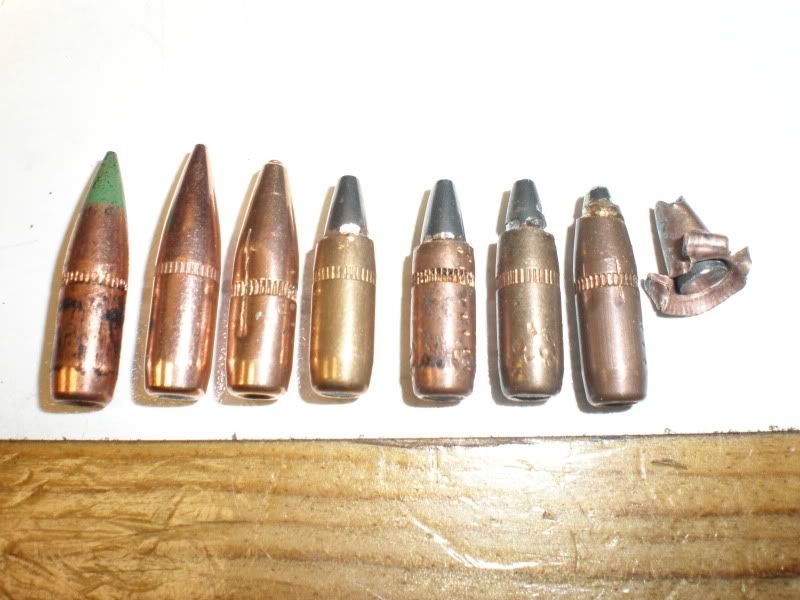
Like the third bullet from the left. These shoot fine for me, 1.5 to 2 moa 10 shot 100 yd groups. Great steel target bullet. |
|
The ones from RMR are much better than these, just slight blemishes from the military crimp and some minor scrapes from coming out the neck. The problem as it relates to weight, OAL are unavoidable regardless of how good the technique that was used to pull the bullets, it’s just the nature of the beast when you use mixed batch bullets. I would recommend them, just not for precision shooting. |
|
OK, so this brings up a question I have always wondered about. I understand that weight sorting the bullets will get more consistent MV and so better precision and chance for better grouping. However, the question is can the weight variance range be great enough that the node you found with a certain bullet weight during load development no longer applies for bullets which are significantly different in weight? I can see how this might happen theoretically since significant difference in bullet weight would change chamber pressure and so MV which is tied in to where a node might be assuming constant powder weight/case/primer variables. You know that is can happen because a load you perfected in for a 175gr SMK will not work for a 168gr SMK, but obviously the weight differences are extreme. The question is in real life, how wide a variance in bullet weight will cause you a problem? |
|
Do you mean the extreme spread weight range of the pull 175gr SMK is 2 grains? In my 40 bullet survey, I only found about 0.389gr for the pull bullets and 0.080gr for the new stuff so 2 grains seems a lot, but of course your data is probably from measure 2K of bullets? I myself was slightly surprise at the 0.389gr spread but rationalized it as perhaps some of the bullets might be quite old since it came from old military rounds and the older Sierra’s weight may not be quite as tight as those made today. Back to my question regarding how weight variation may affect whether a bullet is still on the accuracy node, I wonder if anyone has tested this? Since you have this significant spread of bullet weight, have you tested your load using bullets from the two extreme ends of the spectrum in terms of bullet weight to see if they have similar accuracy/precision? |
|
Quoted:
Do you mean the extreme spread weight range of the pull 175gr SMK is 2 grains? In my 40 bullet survey, I only found about 0.389gr for the pull bullets and 0.080gr for the new stuff so 2 grains seems a lot, but of course your data is probably from measure 2K of bullets? I myself was slightly surprise at the 0.389gr spread but rationalized it as perhaps some of the bullets might be quite old since it came from old military rounds and the older Sierra’s weight may not be quite as tight as those made today.
Back to my question regarding how weight variation may affect whether a bullet is still on the accuracy node, I wonder if anyone has tested this? Since you have this significant spread of bullet weight, have you tested your load using bullets from the two extreme ends of the spectrum in terms of bullet weight to see if they have similar accuracy/precision?
It hasn't been that bad with these bullets. Another batch of pulled bullets was that wide. I was making reference to that I have found that a 2 grain difference will throw a load off, even if they are all the same weight but 2 grains plus or minus the original data. With the pulled 175 SMK I have found a little bit of a spread like you but only a marginal difference with new Sierra SMKs. I hope that clears it up. |
|
Quoted: Quoted: Do you mean the extreme spread weight range of the pull 175gr SMK is 2 grains? In my 40 bullet survey, I only found about 0.389gr for the pull bullets and 0.080gr for the new stuff so 2 grains seems a lot, but of course your data is probably from measure 2K of bullets? I myself was slightly surprise at the 0.389gr spread but rationalized it as perhaps some of the bullets might be quite old since it came from old military rounds and the older Sierra’s weight may not be quite as tight as those made today. Back to my question regarding how weight variation may affect whether a bullet is still on the accuracy node, I wonder if anyone has tested this? Since you have this significant spread of bullet weight, have you tested your load using bullets from the two extreme ends of the spectrum in terms of bullet weight to see if they have similar accuracy/precision? It hasn't been that bad with these bullets. Another batch of pulled bullets was that wide. I was making reference to that I have found that a 2 grain difference will throw a load off, even if they are all the same weight but 2 grains plus or minus the original data. With the pulled 175 SMK I have found a little bit of a spread like you but only a marginal difference with new Sierra SMKs. I hope that clears it up. Thanks for your response. So to clarify, when you say "2 grain difference” you are talking about powder weight? |
|
No bullet weight. If I do up a load for say 175 and get the magical "close to one hole 5 shot group", if the bullets are either 173 or 177 gr (consistent weights), then they probably will not shoot that perfect group developed as a 175 gr load.
As for the powder, yes, a 2 grain varience or change will also affect the load. For tight "one shot" groups it is all about consistency. Every bullet, case weight and length, primer seating, powder weight and throw, bullet seating and crimo - down to sight picture and trigger squeeze must be as close to the same as possible. |
|
Right, pretty much everything you say agrees with my own view. However, I do have another reason for asking this question which is related but not specific to pull bullets. I myself weight sort bullets and brass like most folks here for the reason you mentioned i.e. consistency. So let’s just say I start with a nice bunch of this sorted stuff and work on a load development. To keep things consistent, I use all the bullets and brass which are close in weight. As a rule, I usually start from the lighter weight stuff and work upwards. So far so good. So let’s just say after a couple of sessions, I completed my load development with a nice sub-MOA load. So I start to shoot this in a number of matches and as one would expect, I start using up my bullets and brass. As time goes on, I move into the heavier stuff. The question here is would the increase in weight of the components affect the accuracy/precision of the originally developed load? Logically, this might but my guess is that "it depends” on the spread of weight of the components. The more extreme spread from using pull rounds are likely a problem, but what about the factory stuff which is tighter in weight? i.e. how much is too much? Another question is how best to avoid this problem if it exists? Should one for example do load development with the mid weight stuff so that the two extremes is always not so far away? |
Armory Sponsor