


Armory Sponsor

Posted: 1/17/2013 12:18:56 PM EDT
|
Dad and I reloaded 115 grn FMJ's and 125 grn truncated cone nose (TCN) into 9mm the other week and I had
some questions. We are using Win 231 and CCI small pistol primers, and everything loaded great. Got to the range today and the loading of 5.0 grains of 231 under the 115 FMJ's was snappy, but shot well, no problems with FTF or FTE's. We loaded the TCN's with 4.2 grains of 231 and it shot well (very accurate), but we were having problems with it chambering properly. All rounds were chambering (nothing was getting hung up on the ramp), but there seemed to be an issue with the cartridges chambering all the way. It was odd. I'm not sure what was going on, but Dad and I thought it might be that the bullet wasn't seated deep enough. These bullets have a blue lube in the lube band and most of the band was visable above the cartridge rim. This was my first go at lead bullets, so we didn't know what to expect. The COL was significantly shorter than our FMJ loads, but I'm thinking it may be something with the ogive geometry, and it possibly getting hung up on the lands of the barrel. Anyway, we only shot maybe 10 of the TCN's and jsut switched over to the FMJ's. I think we are going to run the cartridges back through the seater die and push the bullets down a little. Do you guys that shoot lead normally seat down to the point that the lube band is below the case rim? BTW, the pistol was an M&P9 full size. Thanks guys. -ZA |
|
Quoted: Dad and I reloaded 115 grn FMJ's and 125 grn truncated cone nose (TCN) into 9mm the other week and I had some questions. We are using Win 231 and CCI small pistol primers, and everything loaded great. Got to the range today and the loading of 5.0 grains of 231 under the 115 FMJ's was snappy, but shot well, no problems with FTF or FTE's. We loaded the TCN's with 4.2 grains of 231 and it shot well (very accurate), but we were having problems with it chambering properly. All rounds were chambering (nothing was getting hung up on the ramp), but there seemed to be an issue with the cartridges chambering all the way. It was odd. I'm not sure what was going on, but Dad and I thought it might be that the bullet wasn't seated deep enough. These bullets have a blue lube in the lube band and most of the band was visable above the cartridge rim. This was my first go at lead bullets, so we didn't know what to expect. The COL was significantly shorter than our FMJ loads, but I'm thinking it may be something with the ogive geometry, and it possibly getting hung up on the lands of the barrel. Anyway, we only shot maybe 10 of the TCN's and jsut switched over to the FMJ's. I think we are going to run the cartridges back through the seater die and push the bullets down a little. Do you guys that shoot lead normally seat down to the point that the lube band is below the case rim? BTW, the pistol was an M&P9 full size. Thanks guys. -ZA What was your COAL? Test fit your rounds in your barrel before cranking off a lot of them. |
|
That style of bullet has a longer length that is full diameter at the base. Set one next to a round nose and you'll see what I mean. If that full diameter portion contacts the rifling, the round won't chamber properly. This is more than likely your problem. You can experience the same issue with and hollowpoints that are shaped like the hornady XTP.
Yes, the lube groove should be completely inside the case. The exact depth that they need to be seated to will vary from one pistol to the next. I've tried a couple different methods of finding a good OAL. At first I kind of just went trial and error. I loaded a dummy, gradually seating it shorter and shorter until it dropped into my chamber (with the barrel removed from the gun), then set my die to seat about .008" shorter. Now I take an fired case that has not been resized (you may have to try a few cases to find one that isn't too snug or too loose), barely seat a bullet in it by hand, carefully slide this case into the chamber all the way, carefully remove the case, being sure not to upset the position of the bullet as you pull it out. Take a measurement of this round. Repeat this a few times. You should have the length that the cartridge will be to contact the rifling. I set my OAL about .010" shorter than this to allow some extra space for OAL variation. Note that you may need to adjust powder charge when shortening OAL significantly. |
|
hello;
suggest pulling barrel, drop a factory round into barrel, note how the rear fits in relation to the rear of the barrel. do the same with the lead bullet. seat lead bullet until it looks like a factory bullet when in the barrel. had this problem when loading a s&w auto and a ruger. if set to fit in a ruger the round would not fit into a s&w barrel. learned this the hard way, with the bullet seated make sure the case diameter at case mouth is .380". strongly suggest using a taper crimp die when loading cast bullets. don't be surprised if you are still have problems shooting cast bullets the expander die is the problem. shooting cast bullets ->http://castboolits.gunloads.com/forumdisplay.php?8-Cast-Boolits = tons of info on shooting cast bullets. one of the most accurate bullets we shoot is the lee, 358-125 rnfp bullet sized to .357". a very small part of a grease grove does show, but so what. does not look just right but the load shoots great. to me if the bullet feeds and accuracy is great it's not a b.f.d. have learnd bullet lube and barrel leading can be an issue shooting cast bullets in a 9mm. in my ruger & s&w anything over 925 fps leading starts. cast bullets and chore boy copper wool will become your friend. casting bullets with a lee six cavity mold, after you learn how to cast with this mold, you can produce a large number of bullet in a reasonable amount of time. good luck. rp |
|
Quoted:
Dad and I reloaded 115 grn FMJ's and 125 grn truncated cone nose (TCN) into 9mm the other week and I had some questions. We are using Win 231 and CCI small pistol primers, and everything loaded great. Got to the range today and the loading of 5.0 grains of 231 under the 115 FMJ's was snappy, but shot well, no problems with FTF or FTE's. We loaded the TCN's with 4.2 grains of 231 and it shot well (very accurate), but we were having problems with it chambering properly. All rounds were chambering (nothing was getting hung up on the ramp), but there seemed to be an issue with the cartridges chambering all the way. It was odd. I'm not sure what was going on, but Dad and I thought it might be that the bullet wasn't seated deep enough. These bullets have a blue lube in the lube band and most of the band was visable above the cartridge rim. WHOA!!! UH, yeah, your OAL is WAAAAAY too long. If your bullets look like this, I bet your OAL should be 1.1 or less. 
Seat your bullets deeper. How deep? Do this test... Take the barrel out of your pistol. Drop the loaded round in there and push it in with your thumb. Put some pressure on it. Now turn the barrel muzzle up. Does it fall out? If not, your OAL is too long. This test works well with lead bullets. When you drop the cartridge in it should land with a TING and not a THUD. Once you get it to where it falls out when you turn it over, make it a tad shorter and call it done. This was my first go at lead bullets, so we didn't know
what to expect. The COL was significantly shorter than our FMJ loads, but I'm thinking it may be something with the ogive geometry, and it possibly getting hung up on the lands of the barrel. Anyway, we only shot maybe 10 of the TCN's and jsut switched over to the FMJ's. I think we are going to run the cartridges back through the seater die and push the bullets down a little. Do you guys that shoot lead normally seat down to the point that the lube band is below the case rim? Absolutely. BTW, the pistol was an M&P9 full size.
Thanks guys. -ZA Are these rounds loaded with START book loads? The minimum? If so you should be able to safely shorten them. If not you may want to pull them. |
|
Quoted:
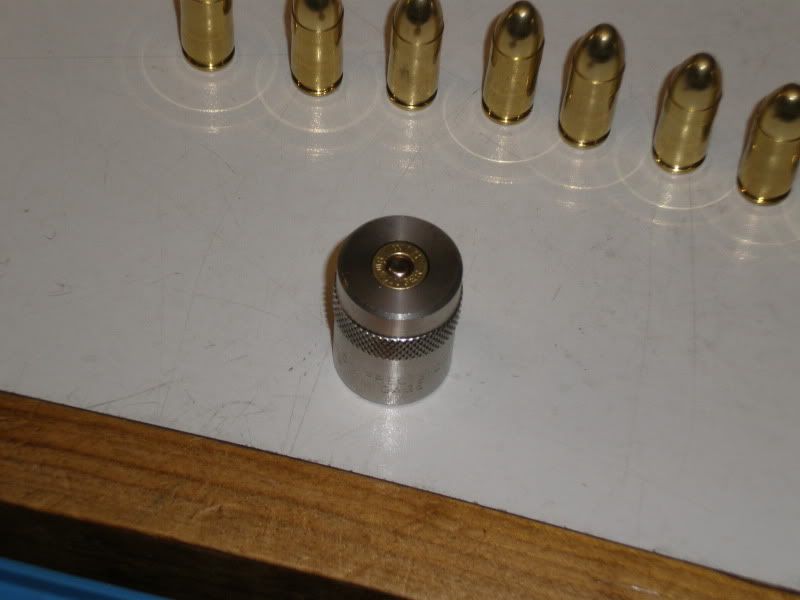
Check them in your barrel too. The gauge won't tell you if they are too long to chamber in your gun(s). Definitely. The listed OAL may not work in your pistol where chamber throats can vary slightly and cat bullets themselves can vary as alloy and casting temp can effect diameter. This round is set to the specified OAL. You can see a visible step above the case mouth, and while it's less than the case diameter, it still hangs in the chamber. Reliability at this OAL was horrible with at least one round per magazine failing to go into battery. You can see the round does not drop fully into the chamber and extends past the end of the barrel. If not corrected, the slide has to tap the round the rest of the way into the chamber, something it won't do with any degree of reliability. 

Seating the shoulder on the bullet flush with the case mouth allowed the case to sit nearly flush in the barrel and fall out under it's own weight. At that OAL it gave 100% reliability. The visual effects are subtle, but the pressing the round into the chamber and then seeing if it will fall out on it's own is very effective provided case length is within reasonable limits. 
|
|
Quoted:
http://i250.photobucket.com/albums/gg272/dryflash3/SDB/9mm%20loading/P7040222.jpg Make them look like this. Should be no lube grove showing past end of case. Lyman 49 pg 342 shows a 120 gr truncated cone bullet at 1.110 OAL. No idea if you bullet is the same as the Lyman #356402 shown. Why didn't you tell me to look in my Lyman 49 manual before I started loading these up? It was only 5 ft away from the press! Some friend you are... You also forgot to tell me to use my Dillon case gauges that were 3 ft from the press. 
I'm an idiot. 
ZA |
|
Quoted: Quoted: http://i250.photobucket.com/albums/gg272/dryflash3/SDB/9mm%20loading/P7040222.jpg Make them look like this. Should be no lube grove showing past end of case. Lyman 49 pg 342 shows a 120 gr truncated cone bullet at 1.110 OAL. No idea if you bullet is the same as the Lyman #356402 shown. Why didn't you tell me to look in my Lyman 49 manual before I started loading these up? It was only 5 ft away from the press! Some friend you are... You also forgot to tell me to use my Dillon case gauges that were 3 ft from the press. I'm an idiot. ZA Your not a new guy. So didn't think to say so. Our bad.
 |
|
you are loading cast bullets. I load cast bullets. forget some of the stuff you learned about reloading jacketed rounds as it does not necessarily apply to cast. When it comes to cast you must readjust your thinking about COL and start thinking about your DRIVING BANDS. The driving bands on cast rounds are normally a minimum of .001 larger than the bore, or should be. This is a must for lead bullets but also presents a new set of issues. The driving band must not engage the bore during the chambering process or your round may not chamber or at best have difficulty if you try to extract it. I try to seat my rounds in such a way as that the driving band is just shy of the bore during the chambering process. This reduces loading and extraction problems and slightly reduces pressure during ignition. Seems like this is the problem you are having. So reduce your COL a touch at the time until the round chambers. Ensure the deeper seated round has the needed capacity, then work your load up from there. I always make dummy rounds before starting a new load process. This sets my seating dies up and gives me safe cartridges to test with, it also gives me a better idea of my case capacity and what to expect. As always work your loads from the bottom up.
|
Armory Sponsor