


Armory Sponsor


Posted: 3/16/2012 1:41:51 PM EDT
|
I'm loading 200 grain SWCs in a 45 ACP.
The Lyman Pistol and Revolver handbook states 1.161" OAL for their 200g bullet, but my particular bullets have a longer "nose". (1.161" OAL would seat the bullets about .050-.060" BELOW the case mouth) I was wondering if it's "OK" to seat the bullet so that the shoulder is flush with the mouth of the case. (Actually flush to "+ .010") I have been loading those with about .030" of the shoulder sticking out, past the mouth of the case, but now they don't "pass" using a Midway 45 ACP Case gauge. The OAL is OK, but the cases stick out on the rim-side of the gauge. Thanks..... |
|
are these lead or jacketed/plated?
if they are lead make sure you are belling / flaring the cases enough and not shaving lead. if you look around the case mouth closely you can see it or pull one that doesn't gauge. Also check your crimp diameter. I assume they were full length sized to get out any possible bulge, generally not a problem in 45 though. |
|
OAL is firearm and bullet specific, Not manual specific. Your handloads first must feed, fit and fire. Load the the OAL that best fits your bullet and firearm and forget what the manual says. After all, if your ammo does not fit and fire, there really is no need to be concerned about pressure.
You did not mention what SWC your are using, but I load my Lead 200gr SWC to 1.250. for all four of my 1911's. Do this. 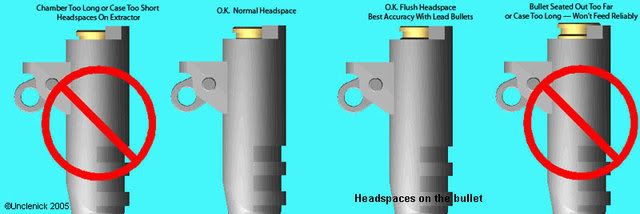
|
|
Quoted: OAL is firearm and bullet specific, Not manual specific. Your handloads first must feed, fit and fire. Load the the OAL that best fits your bullet and firearm and forget what the manual says. After all, if your ammo does not fit and fire, there really is no need to be concerned about pressure. You did not mention what SWC your are using, but I load my Lead 200gr SWC to 1.250. for all four of my 1911's. Do this. http://i2.photobucket.com/albums/y17/steve4102/45seatingpossibilitiesx.jpg Bingo Mine end up being 1.20-1.215 depending on the bullet |
|
Steve,
Don't take offense. OAL is specific to bullet first, firearm second. Bullet "shoulder", commonly referred to as ogive should never fall below case mouth. As a RULE bullets should be seated no less than 1/32nd of an inch distance from ogive to case mouth. A picture of bullet would be helpful as seated in brass. Another exception I'd like to point out. Picture of proper head space shows an ideal but not always true to go, no go gage spacing. Case head can fall below hood a little if chamber is reamed deep as many are. Or Short case length. Whatever scenario, bullet ogive contacting rifling is a no go. |

|
Sorry, came late to the party.
OK, I'll check with my 1911 and Glock chambers. Also, I'm using lead, not jacketed nor plated bullets. The brand is BULL-X (Went out of business years ago.) Also using Western-Nevada (now called Extreme Bullets) and also HARDCAST Bullets, of Pacoima Calif. They are all "variants" of the H&G # 68, I believe.... (Stocked-up on bullets in the early 1990's) |
|
They are all "variants" of the H&G # 68, I believe....
http://www.pennbullets.com/45/45-caliber.html Note this comment. When set to an O.A.L. (overall length of the loaded cartridge) of 1.25 inches and a taper crimp at .469 (measured right at the case mouth) this will prove to be optimal in 99% of the .45s out there for reliable feeding. |
|
Quoted:
They are all "variants" of the H&G # 68, I believe....
http://www.pennbullets.com/45/45-caliber.html Note this comment. When set to an O.A.L. (overall length of the loaded cartridge) of 1.25 inches and a taper crimp at .469 (measured right at the case mouth) this will prove to be optimal in 99% of the .45s out there for reliable feeding. They're at 1.250"-1.260" now. I'm sure this batch is from before I started running my 45 loads them thru a Lee Factory Crimp Die in station #4 on my Dillon 550-B. I found these at the bottom of my "45 Stash" the other day, and started checking to see whether they were "pre-FCD" or "post-FCD". Reason I'm asking advice here is b/c of the wealth of knowledge that can be gleened by the many handloaders that visit this site. Thanks a million for all of your positive input and great advice! |
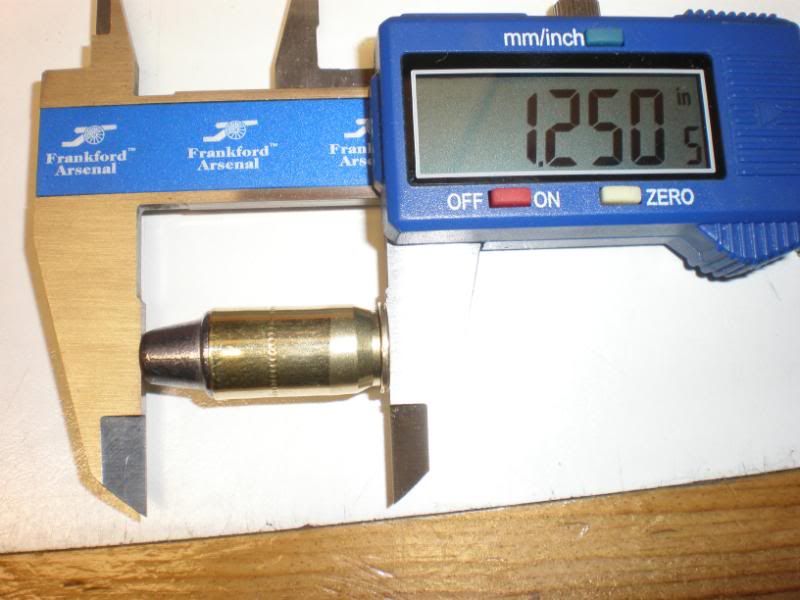
Cast bullets will change length from base to nose when using different alloys. For a swc bullet i set my COL using the shoulder of the bullet. This COL is very important when seating to just touch the lands.  More Photos More Photos
|
|
Quoted:
Steve, Don't take offense. OAL is specific to bullet first, firearm second. Bullet "shoulder", commonly referred to as ogive should never fall below case mouth. As a RULE bullets should be seated no less than 1/32nd of an inch distance from ogive to case mouth. A picture of bullet would be helpful as seated in brass. Another exception I'd like to point out. Picture of proper head space shows an ideal but not always true to go, no go gage spacing. Case head can fall below hood a little if chamber is reamed deep as many are. Or Short case length. Whatever scenario, bullet ogive contacting rifling is a no go. That really "spoke" to me about reloading, not just for this cartridge but for all of them. Every gun is different and as you change bullets you'll also see differences. Most of the time I've been really lucky with my reloads in .45 acp. First place I start is overall length (compared to factory hardball) and then insure they chamber in one of my 1911's. Only twice have I had issues. My series 70 refuses to reliably feed the 200 grain lead RNFP bullets (picked up from a guy who got out of cowboy action shooting) that all my other guns (series 80 Colt, SA 1911A1, PA P14 all feed just fine - yeah, I know feed not chamber issue but I found that if I load them a tad longer they feed fine in the Series 70. Those rounds still work fine in my Series 80. The 185 grain semiwadcutters seated "out" to feed in the Series 70 won't chamber in my Series 80 (both guns are Colts). They are your reloads for you guns. Fiddle with them till they work in your guns. The beauty of reloading (one of them anyway) is that you can change things to make your guns do things they won't do with factory ammo. Your gun can be made more reliable with certain bullet types, you should be able to get better accuracy and you may be able to get more velocity. Have fun, be safe. |
|
After taking a closer look, is seems that Station 2 ( on the Dillon 550 ) needs to be lowered about .005" to open the bell-mouth a tad.
Then on Station 3, the die needs to be raised a bit, then the seater plug needs to be lowered to get the OAL to 1.250". Then on Station 4, the Lee FCD needs to be set so that is bottoms out on the shellplate, and the crimp adjustment needs to be adjusted to fully iron-out the bell-mouth. I have a feeling that the bell was not large enough, allowing the seater to "shave" the bullet before it was fully seated. Then that lead is building-up right on the mouth of the shell, causing the cartridge to not enter the case gauge fully. Like I said, I loaded this batch MANY years ago, but the ones I loaded after these have been working 99% in both my Glock and my S/A M1911. Prob just .015" of lead coming between a "Pass" and "Fail" on the gauge. |
Armory Sponsor