


Armory Sponsor

Posted: 7/25/2013 9:05:18 PM EDT
|
When I was learning to reload (still am really) I had a hard time finding pics showing what a fired primer from a round that was too hot looked like. Over the 4th I was shooting with a guy who had some reloaded rounds that were too hot for his rifle and I figured I would share.
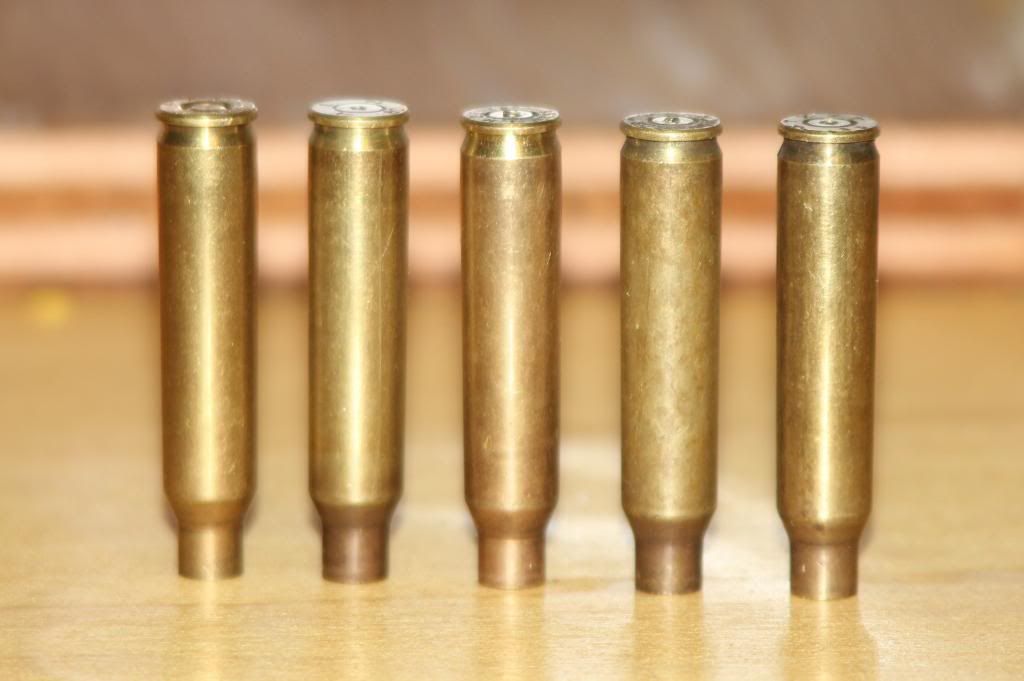
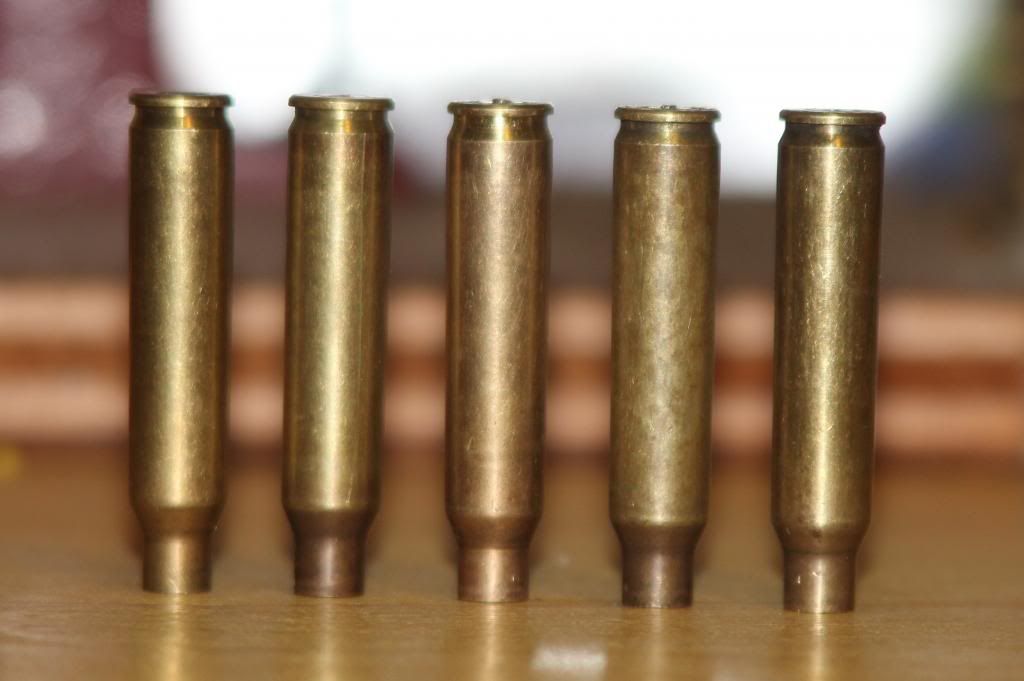
Not sure exactly what his mixture was but I know they were 55gr rounds done on a progressive running right at max OAL. He was shooting them out of a (registered of course) full auto AR15 with a 10" barrel and sometimes had his suppressor on. It was probably 85-90deg out and we were just blasting steel so things were getting warm. He started off suppressed and it had some feeding problems, the gun is normally very reliable. Then it busted a firing pin so we looked at his spent brass and sure enough found a pierced primer and other issues. New firing pin resulted in brass being stuck onto the firing pin and having to be pried from the bolt (yes he is stubborn). Finaly he pulled the suppressor and the primers were just flat. It was good enough that he fired several hundred more rounds with no problems. Left is one of my un-fired primed cases for reference 2nd from left is a flat primer from a charge that is just on the edge of having problems Middle is over pressure pushing the primer back around the firing pin and into the bolt 4th from left is a pierced primer 5th from left is a pierced primer that is so bad you can see light thru it The only thing I don't have a pic of is a fired round that has an acceptable looking primer... I de-primed everything I had before I thought of it. 
Feel free to discuss..... 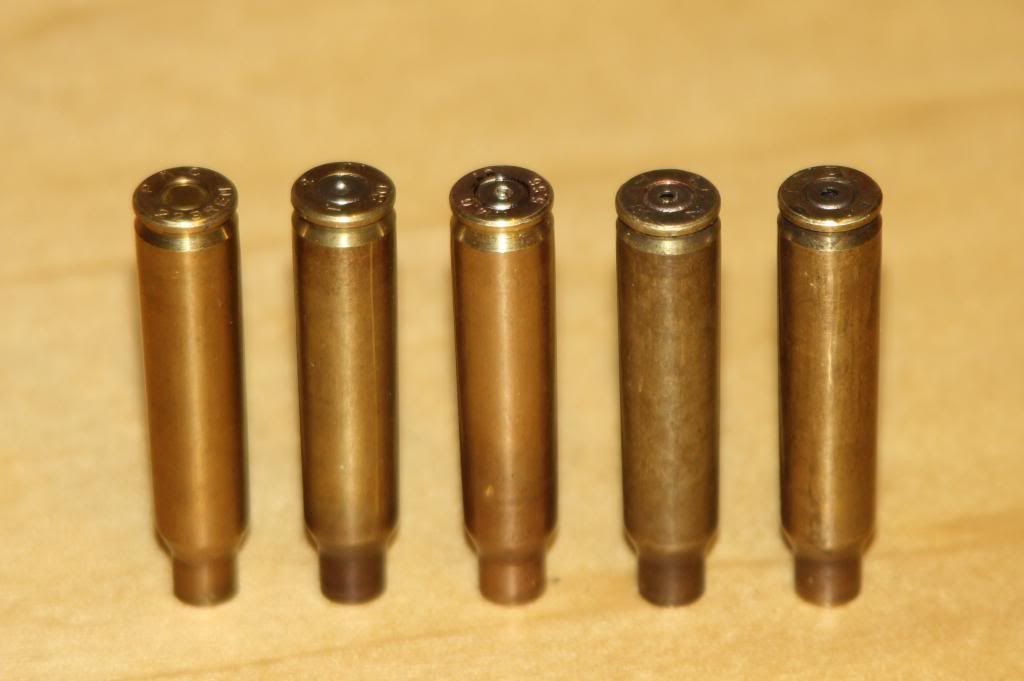
 " /> " />
 " /> " />
|
|
None of the fired rounds look like the primers are too flat from the first photo angle. From the second photo, the one might be pretty flat. To me flat is filling up the pocket with no round edge & little space left. Pressure does not alway manifest with flat primers, as possibly evident in this experience.
If I experienced problems with a load, I would not recommend to keep shooting, risking more problems with some of the ammo, or a steady diet of high pressure loads or blown primers in an expensive rifle. Thats just me. |
| The key here is, he was shooting suppressed. Supressed rounds should be loaded lighter because of the back pressure created by the can. I would start with the loads at 50% and work your way up or back based on case pressure and velocity (realistically, suppressed rounds should be subsonic). If you're going to be loading for a suppressed AR, you need to know exactly what you are doing. Havering a case pressure gauge and a chrono are a must. Modern metallic cartridge load data is VERY accurate and powder for consumer reloading is very precise as well, if you're getting results like these, you have misread something, you accidentally grabbed magnum primers, or your powder drop has an issue with consistency. If you see one round that has a damaged primer after being fired, you need to STOP! Go home, disassemble some of your loads and check your brass, powder charge, primers, and bullet weight. Continuing to shoot under these circumstances can damage a rifle, or worse, get someone hurt. |
|
Here is a good example for anyone having problems finding one.
From left to right with increasing pressure. 
This image was stolen from Larry Willis's website. Click |
|
As far as I'm concerned, the only acceptable application for a non-magnum small rifle primer is something like the .218 Bee or the 25-20.
Use those lousy thin primers for anything else, and you are going to get extrusions, piercings, and blankings. 5.56 loaded to normal pressures is going to give you fits with non-magnum primers. CCI 400's do this. 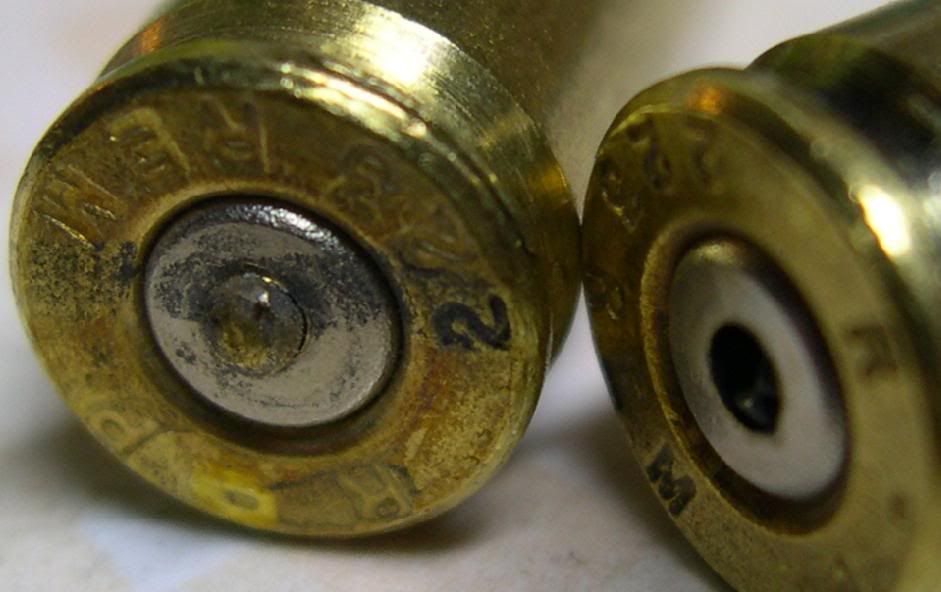
|
|
Quoted:
Here is a good example for anyone having problems finding one. From left to right with increasing pressure. https://dl.dropboxusercontent.com/u/1209837/Reloading/Examples/NewbieQuestions/pressureSigns.jpg This image was stolen from Larry Willis's website. Click Where those tested for actual pressure? Is so, what was the actual pressure from left to right? |
|
Quoted:
Where those tested for actual pressure? Is so, what was the actual pressure from left to right? Quoted:
Quoted:
Here is a good example for anyone having problems finding one. From left to right with increasing pressure. https://dl.dropboxusercontent.com/u/1209837/Reloading/Examples/NewbieQuestions/pressureSigns.jpg This image was stolen from Larry Willis's website. Click Where those tested for actual pressure? Is so, what was the actual pressure from left to right? All the information for this photo that I have is right here. |
|
Quoted:
Quoted:
Quoted:
Here is a good example for anyone having problems finding one. From left to right with increasing pressure. https://dl.dropboxusercontent.com/u/1209837/Reloading/Examples/NewbieQuestions/pressureSigns.jpg This image was stolen from Larry Willis's website. Click Where those tested for actual pressure? Is so, what was the actual pressure from left to right? All the information for this photo that I have is right here. OK, got it thanks. The photo above is of Rem. 221 Fireball. The fireball has a Max Average Pressure (MAP) of 45K psi. At what PSI do these primers decide to indicate that the 221 Fireball round is "over pressure"? The same primer and case can used in the 300 ACC which has an MAP of 55K, so, how does the primer know to flatten just over 45K in the 221 but wait till 55K plus in the Blackout? The 5.56 NATO uses the same primer as the 221 and the Blackout and has a MAP of 62K psi. Again, how does the primer know not to flatten in the 5.56 until the pressures are above 62K psi and still be smart enough to flatten in the Fireball at 45+K? |
|
Quoted:
The 5.56 NATO uses the same primer as the 221 and the Blackout and has a MAP of 62K psi. Again, how does the primer know not to flatten in the 5.56 until the pressures are above 62K psi and still be smart enough to flatten in the Fireball at 45+K? Assuming the same primer, other causes are:
|
|
Quoted:
Assuming the same primer, other causes are:
Quoted:
Quoted:
The 5.56 NATO uses the same primer as the 221 and the Blackout and has a MAP of 62K psi. Again, how does the primer know not to flatten in the 5.56 until the pressures are above 62K psi and still be smart enough to flatten in the Fireball at 45+K? Assuming the same primer, other causes are:
Above are possible causes of "flattened" primers, but are they indicators of "Over" pressure or are they just another non-pressure related reason that primers may flatten and still be within SAAMI specs? |
|
Flattened vs. rounded primers are an indicator of relative pressure.
You will often see references to flattened primers in discussion boards like this one, and sometimes new reloaders don't understand what that looks like. I use this picture to illustrate what "Flattened primers" looks like. |
|
Quoted:
Flattened vs. rounded primers are an indicator of relative pressure. You will often see references to flattened primers in discussion boards like this one, and sometimes new reloaders don't understand what that looks like. I use this picture to illustrate what "Flattened primers" looks like. OK, but at what PSI did the 221 Fireball primers flatten? The SRP in a 223 sized case will handle 62+ psi without any signs of high pressure. Are you saying that these 221 fireball loads were loaded hotter that 62K? Almost 20K above SAAMI max? |
|
Quoted:
Relative being the key word: What I am saying is: Quoted:
Relative being the key word: What I am saying is: Primers show increasing pressure from left to right. Primer on the right is quite "flattened" Are you sure these are signs of pressure? If you are sure, how do you know and at what PSI did they start to develop? |
Pressure Signs -  More Photos CCI 400 primers flow sooner then the Rem. 7 1/2 primer, for me. More Photos CCI 400 primers flow sooner then the Rem. 7 1/2 primer, for me.
|
|
Quoted:
Pressure Signs - http://i338.photobucket.com/albums/n420/joe1944usa/FirearmsReloading102/PressureSigns.jpg More Photos CCI 400 primers flow sooner then the Rem. 7 1/2 primer, for me. Great a list of possible over pressure signs, now we are getting somewhere. Now, at what PSI do the above "pressure" signs show up? A 270 win runs at 65K psi, a 7.62 x 39 runs at 45K both take the same LR primers. Are these pressure signs and primers smart enough to know to what SAAMI has listed as Max pressure or will these pressure signs occur at the same pressure(over 65K) regardless of what SAAMI says. |
|
Quoted:
Above are possible causes of "flattened" primers, but are they indicators of "Over" pressure or are they just another non-pressure related reason that primers may flatten and still be within SAAMI specs? Quoted:
Quoted:
Quoted:
The 5.56 NATO uses the same primer as the 221 and the Blackout and has a MAP of 62K psi. Again, how does the primer know not to flatten in the 5.56 until the pressures are above 62K psi and still be smart enough to flatten in the Fireball at 45+K? Assuming the same primer, other causes are:
Above are possible causes of "flattened" primers, but are they indicators of "Over" pressure or are they just another non-pressure related reason that primers may flatten and still be within SAAMI specs? well the one in red can be a false sign of high pressure if the case is sized too small for the rifle headspace. In a false positive instance the cartridge is small and is held forward to the chamber shoulder by the ejector leaving an air gap between the bolt face and headstamp. Upon firing the primer can pop back out of the case and is stopped by the bolt face, meanwhile pressure is building in the case and the neck seals and then the case stretches and the case head moves back toward the bolt face, reseating the primer cup. Often times the reseated primer as it has pressure now too, will show as flattened or is a bit mushroom headed. Deprime a mushroom head and the closed end will be wider than the sides. Now if you got a "blanked out primer" that fills the whole primer pocket with no rounded curves at the edge, some cup extrusion into the firing pin hole and some ejector marks on the brass then you most likely had high pressure. |
|
Quoted:
None of the fired rounds look like the primers are too flat from the first photo angle. From the second photo, the one might be pretty flat. To me flat is filling up the pocket with no round edge & little space left. Pressure does not alway manifest with flat primers, as possibly evident in this experience. If I experienced problems with a load, I would not recommend to keep shooting, risking more problems with some of the ammo, or a steady diet of high pressure loads or blown primers in an expensive rifle. Thats just me. It's hard to get good pics of metallic things but #2 from the left is smooth across the pocket to the point where you can just catch your nail on the parting line. It's interesting that the ones that were pierced relieved enough pressure to not flatten the primer. I agree 100% with not continuing to shoot the amo. But it's not my gun and not my amo. The guy is extremely experienced with ARs (and guns in general) he knows better... but that's just the way he is. The worst part is that he built an entire 50cal can of this load without testing it first 
|
|
Quoted:
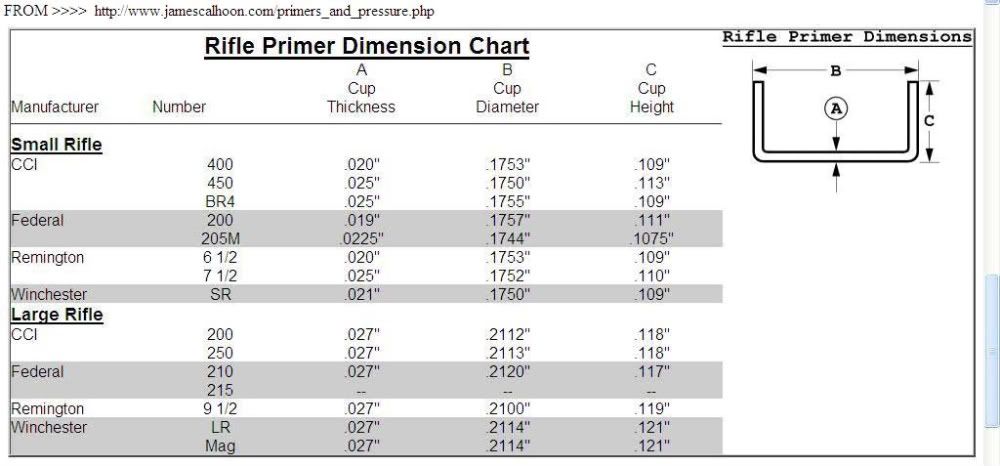
What kind of primers?... is the first question. I had serious primer issues in the AR15, even using "within-book" loads, until I switched to MAGNUM primers. "Standard" small rifle primers have markedly-thinner cups than the magnum type. Good question... I'll have to ask him next time I talk to him. |
|
Quoted:
Great a list of possible over pressure signs, now we are getting somewhere. Now, at what PSI do the above "pressure" signs show up? A 270 win runs at 65K psi, a 7.62 x 39 runs at 45K both take the same LR primers. Are these pressure signs and primers smart enough to know to what SAAMI has listed as Max pressure or will these pressure signs occur at the same pressure(over 65K) regardless of what SAAMI says. Quoted:
Quoted:
Pressure Signs - http://i338.photobucket.com/albums/n420/joe1944usa/FirearmsReloading102/PressureSigns.jpg More Photos CCI 400 primers flow sooner then the Rem. 7 1/2 primer, for me. Great a list of possible over pressure signs, now we are getting somewhere. Now, at what PSI do the above "pressure" signs show up? A 270 win runs at 65K psi, a 7.62 x 39 runs at 45K both take the same LR primers. Are these pressure signs and primers smart enough to know to what SAAMI has listed as Max pressure or will these pressure signs occur at the same pressure(over 65K) regardless of what SAAMI says. A study on Bolt Thrust may tell us something? The thickness of the web, if different, when comparing a 45acp to 44 mag using the same WLP might be interesting. Plus brass may work harden. modulus of elasticity- Cartridge Brass-
Material is 70 copper/30 zinc with trace amounts of lead & iron , called C26000. Material starts to yield at 15,000 PSI when soft (annealed), and 63,000 PSI when hard. Material yields, but continues to get stronger up to 47,000 PSI when soft, and 76,000 PSI when work hardened. Modulus of Elasticity is 16,000,000 PSI. This means to pull a 1.000 inch long strip to 1.001 inch long induces a 16,000 PSI stress. So if you pull a 1.000 inch strip to 1.005 inch long, you get about 76,000 PSI, which is the max obtainable. 
|
|
Quoted: [/span] [span style='color: blue;']Do i have the answer, NO. [/span] Quoted: [/span] modulus of elasticity- Cartridge Brass-
Material is 70 copper/30 zinc with trace amounts of lead & iron , called C26000. Material starts to yield at 15,000 PSI when soft (annealed), and 63,000 PSI when hard. Material yields, but continues to get stronger up to 47,000 PSI when soft, and 76,000 PSI when work hardened. Modulus of Elasticity is 16,000,000 PSI. This means to pull a 1.000 inch long strip to 1.001 inch long induces a 16,000 PSI stress. So if you pull a 1.000 inch strip to 1.005 inch long, you get about 76,000 PSI, which is the max obtainable. That is very misleading when used in this thread... i'll try to explain... Internal stresses of material (yield and ultimate stress) are not directly equal to pressures generated when you fire a round even though they both use the same units and one is the result of the other. They are only mathematically related due to the geometry of the object. As an example: Use the same material and make a 30gal air tank out of it (keeping the same thin wall) and try to put 15,000psi of pressure in it. It will blow long before 15,000psi... probably won't even make 500psi. Yield strength of mild steel is only around 36000psi, witch I would expect most air tanks to be made from, is more than double "cartridge brass" and I sure wouldn't try to put 500psi in it. Somewhere around here someone posted an FEA analysis of a 223 cartridge analysis. ROB |
|
Quoted:
That is very misleading when used in this thread... i'll try to explain... Internal stresses of material (yield and ultimate stress) are not directly equal to pressures generated when you fire a round even though they both use the same units and one is the result of the other. They are only mathematically related due to the geometry of the object. As an example: Use the same material and make a 30gal air tank out of it (keeping the same thin wall) and try to put 15,000psi of pressure in it. It will blow long before 15,000psi... probably won't even make 500psi. Yield strength of mild steel is only around 36000psi, witch I would expect most air tanks to be made from, is more than double "cartridge brass" and I sure wouldn't try to put 500psi in it. Somewhere around here someone posted an FEA analysis of a 223 cartridge analysis. ROB Quoted:
Quoted: [/span] modulus of elasticity- Cartridge Brass-
Material is 70 copper/30 zinc with trace amounts of lead & iron , called C26000. Material starts to yield at 15,000 PSI when soft (annealed), and 63,000 PSI when hard. Material yields, but continues to get stronger up to 47,000 PSI when soft, and 76,000 PSI when work hardened. Modulus of Elasticity is 16,000,000 PSI. This means to pull a 1.000 inch long strip to 1.001 inch long induces a 16,000 PSI stress. So if you pull a 1.000 inch strip to 1.005 inch long, you get about 76,000 PSI, which is the max obtainable. That is very misleading when used in this thread... i'll try to explain... Internal stresses of material (yield and ultimate stress) are not directly equal to pressures generated when you fire a round even though they both use the same units and one is the result of the other. They are only mathematically related due to the geometry of the object. As an example: Use the same material and make a 30gal air tank out of it (keeping the same thin wall) and try to put 15,000psi of pressure in it. It will blow long before 15,000psi... probably won't even make 500psi. Yield strength of mild steel is only around 36000psi, witch I would expect most air tanks to be made from, is more than double "cartridge brass" and I sure wouldn't try to put 500psi in it. Somewhere around here someone posted an FEA analysis of a 223 cartridge analysis. ROB Sorry, i dont get your point. I guess i dont understand it? Cartridge brass is contained in the firearms chamber. If a cartridge is fired without chamber support, it will rupture for sure. Some proof loads go as high as 93,000 PSI and are contained by the rifle action. The brass can not be used again, as it may loose its elasticity or goes thru Plastic deformation? 
|
|
Quoted:
[span style='color: blue;']Sorry, i dont get your point. I guess i dont understand it? Cartridge brass is contained in the firearms chamber. If a cartridge is fired without chamber support, it will rupture for sure. Some proof loads go as high as 93,000 PSI and are contained by the rifle action. The brass can not be used again, as it may loose its elasticity or goes thru Plastic deformation? [/span] Quoted:
Quoted:
Quoted: [/span] modulus of elasticity- Cartridge Brass-
Material is 70 copper/30 zinc with trace amounts of lead & iron , called C26000. Material starts to yield at 15,000 PSI when soft (annealed), and 63,000 PSI when hard. Material yields, but continues to get stronger up to 47,000 PSI when soft, and 76,000 PSI when work hardened. Modulus of Elasticity is 16,000,000 PSI. This means to pull a 1.000 inch long strip to 1.001 inch long induces a 16,000 PSI stress. So if you pull a 1.000 inch strip to 1.005 inch long, you get about 76,000 PSI, which is the max obtainable. That is very misleading when used in this thread... i'll try to explain... Internal stresses of material (yield and ultimate stress) are not directly equal to pressures generated when you fire a round even though they both use the same units and one is the result of the other. They are only mathematically related due to the geometry of the object. As an example: Use the same material and make a 30gal air tank out of it (keeping the same thin wall) and try to put 15,000psi of pressure in it. It will blow long before 15,000psi... probably won't even make 500psi. Yield strength of mild steel is only around 36000psi, witch I would expect most air tanks to be made from, is more than double "cartridge brass" and I sure wouldn't try to put 500psi in it. Somewhere around here someone posted an FEA analysis of a 223 cartridge analysis. ROB [span style='color: blue;']Sorry, i dont get your point. I guess i dont understand it? Cartridge brass is contained in the firearms chamber. If a cartridge is fired without chamber support, it will rupture for sure. Some proof loads go as high as 93,000 PSI and are contained by the rifle action. The brass can not be used again, as it may loose its elasticity or goes thru Plastic deformation? [/span] Internal stresses of material (yield and ultimate stress) are not directly equal to pressures generated when you fire a round even though they both use the same units and one is the result of the other. They are only mathematically related due to the geometry of the object That was my point. http://www.engineeringtoolbox.com/stress-thick-walled-tube-d_949.html The stress in axial direction at a point in the tube or cylinder wall can be expressed as: sa = (pi ri2 - po ro2 )/(ro2 - ri2) where sa = stress in axial direction (MPa, psi) pi = internal pressure in the tube or cylinder (MPa, psi) po = external pressure in the tube or cylinder (MPa, psi) ri = internal radius of tube or cylinder (mm, in) ro = external radius of tube or cylinder (mm, in) You can see from the stress equation above (one of the many equations you can use to evaluate an object to see if it will be pushed over the yield or ultimate stress) that the pressure inside the cartridge is not equal to the stress it will see... you have to take the geometry of the object into consideration. ROB |
Armory Sponsor