


Armory Sponsor


Posted: 4/14/2017 5:02:49 PM EDT
|
Let me see if I can type a good description of what I want to do...
I have about 200 rounds of sub-sonic, 220gr LRN ammo in .300 Blk that I bought. It was made by Grizzly Cartridge company. The ammunition will not chamber in any firearms that I've tried. A home-built .300 Blk in the AR style and no luck chambering a round in my Ruger American Ranch rifle. Actually it will chamber on the Ar-style platform but after firing you pretty much have to hammer the BCG open. The bolt on the Ruger will not rotate to the locked position. What I'd like to do is pull the ammo down and then resize the brass. I think but am not sure the cases may be formed incorrectly. I measured many dimensions with a digital caliper and did not come across any huge differences. I've bought a Lee press and a set of Lee dies. I think they will be sufficient for the task. I did try to contact the manufacturer twice but never got a peep in return. Advice please. Thanks in advance. |
  
The AR-style rifle was fresh from being built so it never had any ammo through it. We did get one to chamber and fire but extraction was not happening. Really had to force the BCG back to get the chamber cleared. The Ruger is second hand and had been fired. Also, other commercial ammo chambered easily in the Ruger, not so with the Grizzly. |

|
Quoted:
Are you getting marks on the bullet when trying to chamber a round. Also, it is very hard to tell from the picture, but the shoulder looks a little funky. I've heard of (but never seen personally) some issues where .223 / 5.56 brass (which your head stamp shows these are LC 5.56 cases) has been trimmed using some of the quick trimmer options out there that can get it close to the correct dimensions for the 300blk as the case is pushed into the trimmer head. But rather than it resizing it is just necking it down a bit to fit into the mouth of the trimmer. I doubt it was intentional, but could be a situation where process control wasn't very good and the brass didn't go through the sizing process prior to loading. I do see a pretty heavy crimp which might be someone trying to compensate for not enough neck tension due to improper sizing. Completely hearsay and I have no other proof of it, so please don't put any stock in that and by no means do I want to start an internet rumor either. The result is the same though, best to pull the bullets an correctly size a few to see if that corrects the issue. The issues I've personally had with 300blk failing to chamber have been in two categories: 1) "Tight" chamber on a brand new barrel that I didn't do a good job cleaning before shooting ( I was too excited to have my SBR stamp back!!!) 2) Some improperly sized brass that I had converted from some .223 cases. They had shoulders that sort of looked like what you posted. After resizing most worked fine. (I did have some that I suspected had thick case walls, but that is an entirely different discussion). |
|
Quoted:
Good point. Perhaps the bullets are just a bit long and touching the lands before the rest of the case is in the chamber. |
|
I like the magic marker approach. It will at least give you an idea of contact point.
It's really strange that you got to to chamber in the AR and not the bolt action it's typically the other way around. I don't see any sense in buying a gauge. You already have 2 of them one bolt action the other semiautomatic. Take it slow. After you do the magic marker test take one round apart and re-size that case with a properly set full length sizing die and try it in tbe bolt action. Make sure you check the casing OAL before reloading them. They may change. Motor |
|
Two pictures of a round with the Sharpie covering the bullet and case up to thru the neck. I noticed three things that I had not noticed when I did this earlier on another round of ammo.
In the image with two dots there is another good scrape where the neck begins. Finally, what you cannot see in the picture is a bright ring in the Sharpie ink that goes around the circumference of the cartridge where the body ends and the shoulder begins. I'm guessing the casing is not formed/sized correctly. 

|
|
Minor update.
I broke down a few rounds and resized them. Didn't reload them though. They cycle through the action easily, manually of course. I also took a box of the loaded rounds and resized them. Playing with fire I suspect but the newly sized rounds chamber as I feel a round should. Minimum resistance. They fit a Lyman case gauge without issue but they might be a bit longer now. Case length measure well below limits as does overall length. The question now is will the rounds, only 20, be safe to fire? Things to consider? Thanks. |
|
I sense a feeling of disbelief.
No, the one box I did not break down. I removed the de-capping pin and primer holder then ran them through the sizing die. Case length measures fine, both using a case gauge and measuring with a set of calipers. I need to check for concentricity of the bullet to the case now. |
| No disbelief. I thought that is what you meant. I just wanted to make sure I read it right. I'm newer to reloading, only about 1 1/2 yrs and not a high volume shooter, so I am still learning. I don't think I would have had the guts to try it. I don't think there is much of a chance of it going off, but what if it got stuck? I was reloading some 223 and when seating didn't like the neck tension. I pulled the bullet and dumped the powder. I removed the decapping stem, lightly lubed the case. I got it stuck, not enough lube. Well yay, gotta drill out a live primer. I put some water in the case before drilling; not an issue. What would you do with a live round stuck? Drill through the projectile and use a syringe to inject water before drilling/tapping the primer to pull it. Like you said" playing with fire". 99+% chance of going good. I would just be worried about the what if stuff. I'm glad it worked for you though. I'm just a worrier some times. |
|
I was cautious about and a little concerned about getting a round stuck. I lubed each case and very slowly ran it through the die. It's probably not the wisest thing to do but I took that risk.
I did contact the manufacturer, twice, and never received a reply. My first contact was with PSA and they referred me to the manufacturer. I finally just gave up on that line of action. |
|
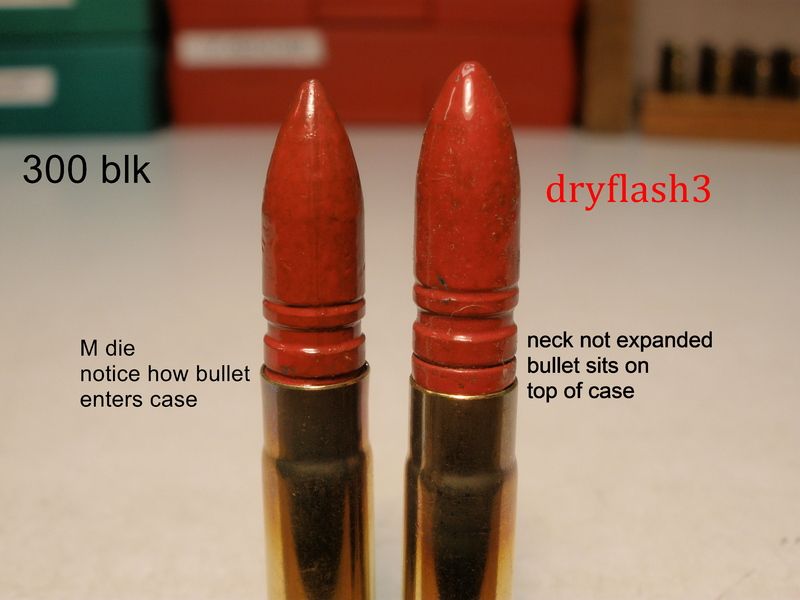
A sizing die reduces the neck diameter smaller than needed, sizes the sides of the case short of the base and sets the shoulder back.
When case is withdrawn from sizing die the sizing button expands the neck to .002 to .003 less than bullet diameter. Normally a loaded round will stick solid if run into a sizing die, lube or not if run in all the way. Too much compression of the bullet. You would of had to remove the sizing stem/ball before running loaded round into the sizing die in any case. If you did what you posted, you have reduced the diameter of the bullet quite a bit. Are you sure you used the sizing die? I'm thinking you used the seater/crimp die. You need to pick up a copy of ABC's of Reloading ($20) and learn the proper reloading techniques and not be in a hurry. |
|
The crimp die is a separate die and I did use the sizing die with the expander/decapper removed. It's a Lee 3-die set.
Yes, I understand about the bullet having changed dimensions and I my plan is to pull some of them down and see, measure, what the dimensional changes are. I know the case grew length-wise a bit but still need to measure the bullet diameter. Got the books and newer edition of the Hornady reloading book. |
|
Quoted:
I did contact the manufacturer, twice, and never received a reply. My first contact was with PSA and they referred me to the manufacturer. I finally just gave up on that line of action. I would spread that word far and wide. Out of spec factory ammo is a no go |
|
If you ran your loaded ammo fully into the sizing die you certainly won't have any trouble pulling the bullets. In fact I'm surprised that they didn't fall out of the casings already.
As dryflash3 correctly stated you have sized the bullets down within the case neck effectively destroying all of the neck tension. Grab one of rounds and see how easily you can spin the bullets inside the neck. I bet you can do it with just your bare fingers. At any rate those bullets are toast. Motor |
|
Gave the bullets the pull test and they stayed firmly within the case. I suspect that is because the lead flowed elsewhere in the bullet itself.
I also pulled four of the cartridges apart and measured the bullets. Indeed you guys are right about resizing the bullet. The bullets are pretty long and the case grips only the 1/4-inch or so just below the cannelure. I measured each bullet just below the cannelure and again at the base. The first measurement showed the bullets to be about .301/.302 while the bases of the bullets measured .309! Quite a difference. In effect the front part of the bullet has been sized down while the area near the base of the bullet is normal. Reminds me of the driving band on artillery projectiles. |
|
Welcome to the world of casted 300blk bullets.
The trick is to find a bullet ogive design that can be loaded to standard COL lengths, and not either embeds on loading, or having a country mile of jump to lands, while still allow for a clean loading up the ramps. Also that make this much harder, not all barrels are throated the same, so becomes a challenge to find a desirable mold for the barrel on hand as well. Hence why you are having with the Noe bullets in loaded ammo and may just need to run a reamer by hand to clean up the chamber throat to allow the ammo to load correctly without embedding in your barrel. |
|
Quoted:
You know what I mean, pick nits elsewhere. Quoted:
Quoted:
Never encounter as sizing die (outside of a push through for pistol) that reaches all the way to the head. The head is buried in the shell holder most of the time. Or why the sizing die marks stop well above the case head? And no. I still do not understand what you may have meant since no die reaches that far except a push though. |
Armory Sponsor