


Armory Sponsor


Posted: 1/7/2011 5:09:27 PM EDT
|
Im looking to start casting rounds for my 45 ACP 1911.
To slug my barrel what diameter lead ball to I use to begin with? Also, when ordering a bullet cast I hear that some people order one thousands up from the actual size of the bore. Why is this? Gas seal better? Should I go with the exact size of the barrel diameter or one up? Thanks for all help! |
|
Quoted:
To slug a barrel so with a slug or projectile slightly larger than what you think your barrel is. Try to use a pure lead projectile or pure lead ball as it will be easier to drive through with a wood dowel. jonblack it is not easy. you will have to work to get the slug down the barrel. i have done several pistols and they all were within specs, so i did not need to do it, but i did. i used soft lead, the softer the better. |
|
Find some .454" or .458" lead balls and grease them before slugging the barrel. Also, always slug from both ends of the barrel when possible to identify taper in the bore. Virtually anyone who shoots cast bullets uses a bullet at least .001" larger than "nominal" bore size for that caliber. If the bullet is too small, it won't seal and you'll get gas cutting along with leading in the bore. A common quote on another forum is that jacketed bullets are for lazy people. I'm pretty sure it isn't intended to be insulting, but it is true. Jacketed bullets will almost always shoot reasonably well in a given firearm, and leave little fouling. That same load will also generally shoot reasonably well in another firearm. The same is not true of cast bullets, and many people do not want to expend the time or effort in finding the optimal alloy and size for a particular load with a particular bullet in this gun or that gun. A load that leads the barrel of one gun so badly that you can't make out the lands/grooves after a couple of shots might not foul the barrel of an otherwise identical gun at all and shoot one hole groups. You just never know. I'm not trying to steer you away from cast bullets(cast is almost all I shoot in handguns), just warn you up front that it isn't always as easy as most jacketed bullet loads.  |
Buy a bullet mold for 45 ACP.
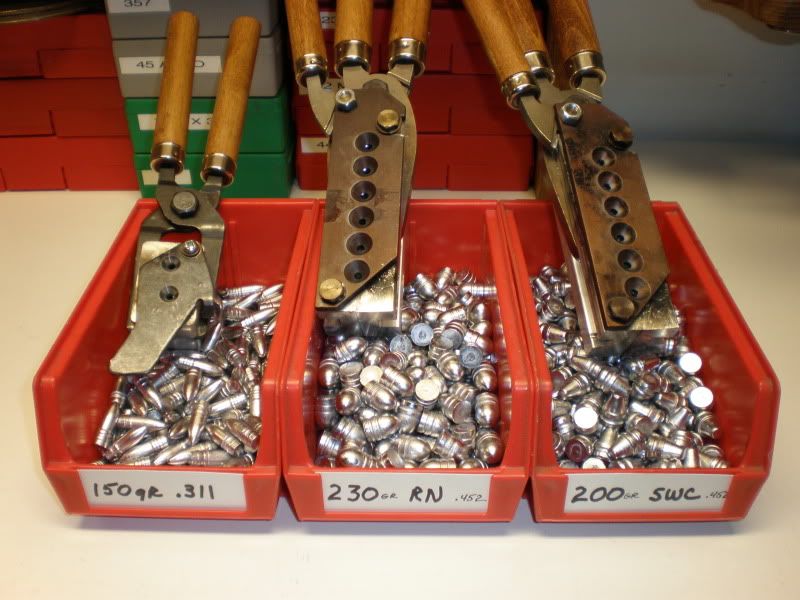
The bullet diameter is then determined by the diameter of the sizing die you run the bullet through. 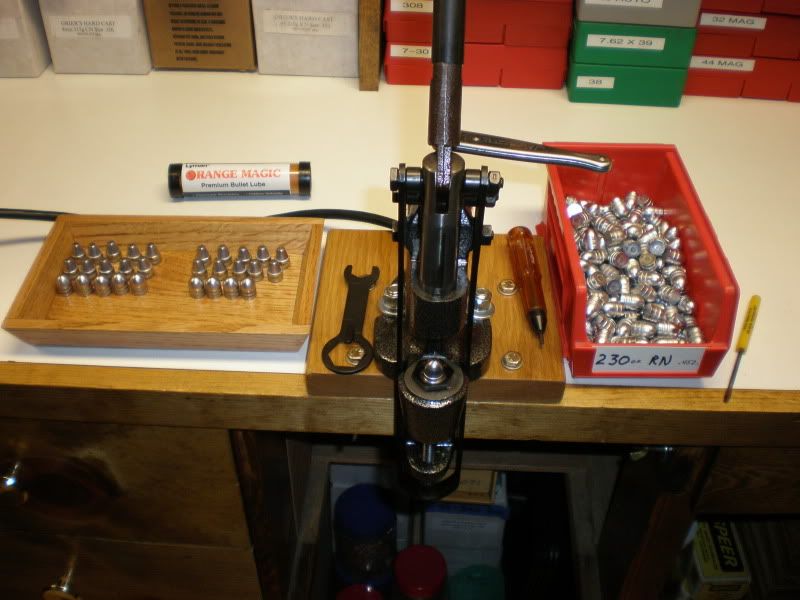
Here I am sizing and lubing some 45 cal bullets, RN and SWC to .452 for 45 ACP. Lyman heated lube sizer shown with a RN bullet in sizer. Cast Boolits is a great site to learn more. |
|
Quoted: Buy a bullet mold for 45 ACP. http://i250.photobucket.com/albums/gg272/dryflash3/Casting/P8220524.jpg The bullet diameter is then determined by the diameter of the sizing die you run the bullet through. http://i250.photobucket.com/albums/gg272/dryflash3/Casting/P8280529.jpg Here I am sizing and lubing some 45 cal bullets, RN and SWC to .452 for 45 ACP. Lyman heated lube sizer shown with a RN bullet in sizer. Cast Boolits is a great site to learn more.  Cast Boolits is also a good place to go broke buying custom molds.  Dryflash is right. You can size them larger or smaller if you buy your own equipment...to a point. A mold is going to be designed to drop a certain size bullet with a particular alloy, you can't make it any larger without some effort. Chances are that .452" bullet will be perfectly fine though. Moar .45 cal pron:  That's a 200 grain bullet, sized to .452. |
|
Be very cautious.
Sometimes the slug will get stuck along with the wooden dowel you are using. Then you'll get the Mensa idea to think that you drill out the wooden dowel...
$200 later you will have a Kart NM barrel installed on you Kimber that had <500 rounds though it... skink |
|
Quoted: I don't think it's necessary for a modern barrel from a reputable manufacturer. Size them .452 and make a test batch. If your barrel gets leaded up, then slug it and see if size is a problem. With autoloaders, this is good advice. Revolvers should have both the chamber throats and the barrel slugged. |

Armory Sponsor