


Armory Sponsor
Small Sample Testing (Page 1 of 2)

Posted: 8/30/2026 1:25:53 AM EDT
[Last Edit: Trollslayer][Edited]
|
When we test we base all our decisions on the results of small sample testing. We all do it. For a multitude of reasons, we have to do it. I've been developing a tool to explore the realities of small sample test results and comparing those results to the results when using truly large samples. So far, my "small samples" have been 20 shots or less. The large samples are 1,000 or more. I've been looking at a simulation of the "measured" velocities for the small sample and comparing those to the large sample. Currently, I'm using random sampling from a uniform velocity distribution. I might change my sampling plan (I'm reading up on Monte Carlo methods). Right now, I have two things to say. HOLY SMOKES!, what a difference the larger sample makes. Also, I will say this. Mean and standard deviation for a sample size of 3 or 5 is just this side of meaningless. Of the two, the mean value has more validity. This exercise has been "eye opening" - to actually see the numbers. It is also pretty clear to me that we have all thrown out perfectly good recipes based on small sample test results. It also points out the importance of continuing to test and evaluate your reloads long after that 5 round down-select and that 20 round verification test. That also applies to accuracy testing but I haven't yet used the tool on that particular problem. ETA - going to add this here, rather than at the end. 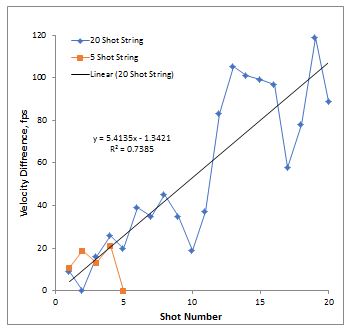 |
Joined:
Oct 2025
Posts:
1091
EE: 0% (0)
 KY, USA
|
Shooting is an exercise in compromise. And, so, is handloading. The goal is to create loads that do what we require- wether it be for hunting, benchrest, long range rifle, defensive pistol, etc... I use small sample sizes to quickly weed out what doesn't meet my criteria. Then, i stll use small sample sizes to narrow down the field. As I get close, I use larger samples until I arrive at a load, where I load up quite a few to shoot and verify. My sample sizes are determined by different factors- components I have on hand, components I can get, cost, my criteria for the ammo, etc... I spend a lot more testing on accurate rifle loads, or defensive pistol loads than I do on steel plate competition loads. Although, I shoot steel plates a lot, and tweak them between competitions, trying different powders, bullets, charges- I'm just interested to see what happens, not necessarily looking for a perfect load. Even using small sample sizes, you could shoot out a rifle barrel chasing perfection. There are too many variables. You have to compromise by limiting your scope. As you shoot more, you (hopefully) learn things that work. Benchrest shooters usually know what bullet, powder, and primer they are going to use before they start. They have learned to use different loads for different conditions. Long range rifle guys cannot afford to do large samples in load developement due to short barrel life. They find what works, and stick with it. So, your goal will determine your sample size, and what path you take. Enjoy the journey. |


|
For low CVs (under 35), your N needs to be at least 30. For higher CVs, you might need 75 -100 samples. One thing you should also calculate is the accuracy, preferably at the 95% confidence interval. |
ProTip: Never pick a fight with a tree planter. He swings a hoedad for 9 hours a day, carries 30-40 pounds of seedlings on his back, and has 12-14 friends just like him hiding out on the other side of the junk butt pile. They will fuck your shit up.
|
Originally Posted By MarkBinSC: My experience with statistical process controls and process validation is that the minimum sample size is 30. With that said, I normally measure SD, ES, and mean with at least 10 shots to get a ballpark estimate. Originally Posted By FredMan: For low CVs (under 35), your N needs to be at least 30. For higher CVs, you might need 75 -100 samples. One thing you should also calculate is the accuracy, preferably at the 95% confidence interval. Modern statistical software has lowered the required sample sizes to 7. As I stated earlier, it's a really small sample sized ruled world. |
|
Originally Posted By PoppaCapp: Shooting is an exercise in compromise. And, so, is handloading. Truly! Even using small sample sizes, you could shoot out a rifle barrel chasing perfection. This is a "hidden variable" underlying everything when we test - the condition of the barrel at the time of the test. So, your goal will determine your sample size, and what path you take. Enjoy the journey. Thanks. Both reloading and shooting have been and remain favorite hobbies of mine. |
|
Originally Posted By DoctorCAD: You'd shit your pants if you knew how small the sample size is on a nuclear power plant component during certification. Or a UL listed component. Or a high voltage disconnect switch. Small sample sizes rule the world. Many times the sample size is zero, relying on the customers to find the problems. If the margin of safety are large enough, if the factors of safety are large enough, if the failure modes are benign enough, if product quality is high enough, if reliability is proven, fewer samples can be practical. This is the mindset I have for internal pressure - you have to have margin. Margin is your friend. If your business plan is to sell product, offering a lifetime warranty, and then exit the market when the product is sold out, no testing is needed.  |
|
Originally Posted By FredMan: For low CVs (under 35), your N needs to be at least 30. For higher CVs, you might need 75 -100 samples. One thing you should also calculate is the accuracy, preferably at the 95% confidence interval. Right now, I am working on the velocity statistics. When that is done, I will do the stats for point of impact. I am pretty sure none of us can demonstrate 95% confidence interval or 99% confidence in our data, at least not until we exit load development and begin using the load in matches, etc. |

Global Warming Hoax Skeptic before it was cool
Joined:
Jun 2007
Posts:
73033
EE: 100% (1)
WA, USA
|
Originally Posted By FredMan: For low CVs (under 35), your N needs to be at least 30. For higher CVs, you might need 75 -100 samples. One thing you should also calculate is the accuracy, preferably at the 95% confidence interval. I really like your pic threads, the Hummingbirds were great. |
Selling agent for Algores carbon credit scam.
Shooting and Reloading, one hobby feeds the other.
Shooting and Reloading, one hobby feeds the other.
|
Originally Posted By lazyengineer: I'm not statistician But I do like Mean radius Also, is your goal to determine woth 99% confidence the sorting of "good" vs "bad" every load? For me, it is acceptable to reject "good" loads and find one that passed my acceptance of good enough? For me, yes. The stats for that will be next. I may buy a copy of the OnTarget or OnTarget TDS to facilitate that work. I would like to automate getting the individual shot hole locations, not just group sizes. I typically use group size because it's easy and "intuitive". I have been transitioning over to mean radius because it just makes more sense. Still, beware the vagaries of small sample sizes and the importance of separating the effect of the shooter and environment (such as, wind and mirage). All this statistical mumbo-jumbo is in support of developing a load for long range shooting where low velocity variations are a critical property to get a good group. The measured SD over the last few outings has puzzled me and my thinking on that has sent me down this path. I believe group size at 100 or 200 yards is less important, as long as it is decent (~1 MOA). It also introduces the inaccuracies of the shooter (me, and that's bad ).Thanks for the chat, everyone. |
|
Originally Posted By Trollslayer: After reading about Monte Carlo methods, it turns out I am already using the method. The difference is, I am using a small sample, not a large one as one might do for a typical Monte Carlo simulation. If you had Minitab, you could get by with 7 samples and get reliable results. The software "creates" 10s of thousands of samples for its Monte Carlo analysis. |
|
I’m not a statistician, but I’ve had courses in stats. I’ve omitted some gee-whiz stuff about my courses that just took up space, but I started with the calculus needed to derive the basic formulas, through how to set up experiments, to interpreting other people’s stats. Cool, geeky stuff, but way over the top for this discussion. Anyway, I wish I could find the article I read (ages ago) about using 10-shot groups. It started out trashing 3-shot groups as useless, then explained why, with the statistical science to back it up. Then the authors described how confidence intervals should be chosen. The article essentially pointed out that sampling an open-ended universe depends on how closely your results have to model the universe. The conclusion was that 10-shot groups worked out to provide a lot of bang for your buck. You can find tons of articles on using 10-shot groups for testing, and I won’t try to list even a few of them…that’s what Google is for. I’ll boil it down to say that 10-shot groups are a very good compromise that provide useful data without requiring excessive use of resources (components and time). |
|
The thing is, most people are using 3 or maybe five, at least to do the initial down-select. Modeling the larger universe is not the task I set for myself. The task is making sense of multiple, independant 5, 10 or 20 shot samples, none of which really appear, on their face, to agree with each other. Or maybe they do agree, in the composite, when viewed through the "lens" of proper small sample statistics? Making a composite group from multiple 3 - 5 round targets is something I do a lot. The stats for the composite group are almost always significantly different than those of any single target. |
|
Originally Posted By DoctorCAD: If you had Minitab, you could get by with 7 samples and get reliable results. The software "creates" 10s of thousands of samples for its Monte Carlo analysis. I've used Minitab but never applied it to this task. I've had people misuse Minitab, too. It is up to the user to do it correctly. |

|
Originally Posted By GHPorter: I You can find tons of articles on using 10-shot groups for testing, and I won’t try to list even a few of them…that’s what Google is for. I’ll boil it down to say that 10-shot groups are a very good compromise that provide useful data without requiring excessive use of resources (components and time). This. Especially if you have a rifle that is consistently producing results that are sub half minute. When you have a truly precise rig that does not have a wandering POI, there really isn’t a huge difference once you go beyond 10 shots. Yes, the larger the sample size, the greater the opportunity for the group to expand, but it’s not going to be dramatic unless you had an outlier round, have stress/heat in the barrel, or did something different with the shot. Even back to back 5 shot groups can give you great data if you don’t introduce noise into the data. Unless you have a test fixture, you would probably introduce more bad data just from shooter error than by true variability of a load during testing for precision. Velocity data is about all that most can collect on their own in large sample sizes since it isn’t shooter dependent. I tried listening to the Hornady podcast, but it was dry and lacked the visuals to really drive home what they were saying. I would have liked to know more about the firing schedule, i.e, was it non-stop allowing the barrel to heat up excessively? I think at one point they said that multiple 5 shot groups weren’t the same as a 30 shot group, but if shot consecutively, and a composite was made, what’s the difference?? It’s not like the target knew if they were broken out into segments. I’m sure I must be missing something, but I think ppl are getting overly worked up over statistical relevance vs what works for their needs/uses. |
|
Originally Posted By SuperJlarge: This. Especially if you have a rifle that is consistently producing results that are sub half minute. When you have a truly precise rig that does not have a wandering POI, there really isn’t a huge difference once you go beyond 10 shots. I do. Now, if only I was a sub-1/2 MOA shooter.  I think at one point they said that multiple 5 shot groups weren’t the same as a 30 shot group, but if shot consecutively, and a composite was made, what’s the difference?? It’s not like the target knew if they were broken out into segments. There should be none. I’m sure I must be missing something, but I think ppl are getting overly worked up over statistical relevance vs what works for their needs/uses. Personally, my use is trying to learn about long range (1,000 yard) shooting. Velocity variations (this topic), reading mirage and the wind seem to rule. Personally, I'm not "worked up". I'm just trying to respond to contributions in this thread, to capture what others are saying and fold that into my thinking. Right now, for this work, I am only concerned with velocity variations, not group size (not yet). Then again, I'm going to go shooting this week, so that will be fun and educational. Thanks to all who took the time to read and especially those who responded. |

|
Yes, I have seen the back/forth between Hornady and comp shooters in the last year concerning sample size testing and results. The whole conversation to me, is a little hard to provide full context to, in any meaningful way for a broad audience. The simple fact is that the sample size, will need to increase or decrease, based upon the possible number of variables contained in the system. Reloaders who go to great lengths to reduce variables, will need a much smaller sample size to exploit the total number of possible outcomes. Reloaders who introduce, or fail to remove variables, will need a greater sample size to exploit all possible outcomes. The sample size necassary to provide statistical value of your ammo, has a direct relationship to the quality of the process to make it. The number of reloaders willing to load ammo in a manner where small samples sizes are reflections of the total statistical value, is very low but very low is not zero. |
|
Originally Posted By WillieTangoFox: Yes, I have seen the back/forth between Hornady and comp shooters in the last year concerning sample size testing and results. The whole conversation to me, is a little hard to provide full context to, in any meaningful way for a broad audience. The simple fact is that the sample size, will need to increase or decrease, based upon the possible number of variables contained in the system. Reloaders who go to great lengths to reduce variables, will need a much smaller sample size to exploit the total number of possible outcomes. Reloaders who introduce, or fail to remove variables, will need a greater sample size to exploit all possible outcomes. The sample size necassary to provide statistical value of your ammo, has a direct relationship to the quality of the process to make it. The number of reloaders willing to load ammo in a manner where small samples sizes are reflections of the total statistical value, is very low but very low is not zero. Well said! And OP, I wasn’t meaning you specifically, I’ve just seen this topic come up in numerous conversations over the past 2 years. My suggestion would be to do like Litz suggests; get you a good enough load and practice at distance. The mental gymnastics and data analysis is nothing compared to actually learning to shoot and reading the wind. And I still think that 5shot load development is sufficient IF you break the shots half way clean. Composite of 5 charges from a new barrel and new bullet. I’d only used this bullet in 20rds the week prior with another of my 223’s. It shot great in that barrel as well, just fewer shots. One load was in the 0.12moa range. It’s certainly not doing that everytime, but it should produce a composite under the 0.4’s. If nothing else, it’ll be an interesting test. Attached File |
|
Originally Posted By SuperJlarge: My suggestion would be to do like Litz suggests; get you a good enough load and practice at distance. The mental gymnastics and data analysis is nothing compared to actually learning to shoot and reading the wind. In fact, that's what I'm trying to figure out. Is the load is actually "good enough". LOL, "mental gymnastics and data analysis" is what I do. Still, you are spot-on about the shooting. All this reloading and studying my results is all in support of the shooting. And I still think that 5 shot load development is sufficient IF you break the shots half way clean. We all do that, no? I'm just saying that after you make your selection, load a bunch and shoot some more but watch very carefully, record the data if you can. Get the data from ShotMarker. Check it. Make sure the load continues to do what you thought. Composite of 5 charges from a new barrel and new bullet. Now, you're making me feel bad! All kidding aside, that's truly great shooting. I came close once - 22 rounds in a single 1/2 MOA hole. |
|
I thought I would give an example, taken from real world shooting. This is the kind of thing that's causing me to give the velocity stats more thorough consideration, to make sure I know what I'm seeing and doing. Load development cycle using 5 shot strings yielded SD = 6 - 12 fps (powder charge dependent); ES <20 fps. Additional shooting yielded much higher numbers - SD ~ 35 fps, ES ~ 100 fps. Admittedly, a big chunk of the change was due to the combined effects of strong head and tail winds (+/- 10 mph = +/- 15 fps). Even so, that did not explain all of the change, not even half of the change. I started looking into small sample testing statistics and whether the 5 shot groups could have caused me to have unrealistic expectations about a super-low SD. The answer appears to be, yes, it did. It did not happen today, but some day soon I will get back to the range and get some more shooting done. All the "homework" is done. Now I get to go bang some steel and shoot some more holes in my ShotMarker target. |
|
Wow I need to up my game. Wow |
|
Originally Posted By Trollslayer: I thought I would give an example, taken from real world shooting. This is the kind of thing that's causing me to give the velocity stats more thorough consideration, to make sure I know what I'm seeing and doing. Load development cycle using 5 shot strings yielded SD = 6 - 12 fps (powder charge dependent); ES <20 fps. Additional shooting yielded much higher numbers - SD ~ 35 fps, ES ~ 100 fps. Admittedly, a big chunk of the change was due to the combined effects of strong head and tail winds (+/- 10 mph = +/- 15 fps). Even so, that did not explain all of the change, not even half of the change. I started looking into small sample testing statistics and whether the 5 shot groups could have caused me to have unrealistic expectations about a super-low SD. The answer appears to be, yes, it did. It did not happen today, but some day soon I will get back to the range and get some more shooting done. All the "homework" is done. Now I get to go bang some steel and shoot some more holes in my ShotMarker target. The problem with random repeated population sampling is that all you are proving is the existence of variables, you are not identifying them and isolating them. What if you shot these two 5 shot strings, one with good es/sd and the other with 100fps spread, and isolated those two groups of brass, walked over to a table and reloaded them. Shot again, and saw the same exact result? What if you color coded each piece of brass and saw the same exact piece of brass produced the 100 fps outlier? Have you proven large sample sizes are needed or that you need to throw away a piece of brass. |
|
Shotfusion looks great, but seems to be available only for iphone... anything as good for android? I admit I rely on 5-shot groups but try to aggregate them. @Trollslayer To overlay multiple targets you will need the TDS version of onTarget. I find on some days there is considerable V0 difference from ammo tests loaded at the same time but shot at different times... IMO the environmental conditions plus the shooter plus the variability of components all stack one way or another. As you get older, your eagle eye becomes a sparrow... |
|
Originally Posted By SyberSniper: Shotfusion looks great, but seems to be available only for iphone... anything as good for android? I’m not sure on the android front. I like ShotFusion, but it is tedious. Unless I haven’t found a feature, you have to scale each target and group, then form a composite. If you could mark all groups at the same time, it would be much better/faster. I’m also working with a member of the GAHTF to come up with a code to use with AI that will do the same thing, but in >1 min vs the 15-20mins it takes me. Initial runs look good, but it does appear to be target dependent to get accurate results. |
|
Originally Posted By WillieTangoFox: The problem with random repeated population sampling is that all you are proving is the existence of variables, you are not identifying them and isolating them. What if you shot these two 5 shot strings, one with good es/sd and the other with 100fps spread, and isolated those two groups of brass, walked over to a table and reloaded them. Shot again, and saw the same exact result? What if you color coded each piece of brass and saw the same exact piece of brass produced the 100 fps outlier? Have you proven large sample sizes are needed or that you need to throw away a piece of brass. It's a good thought but not consistent with what I did and what I'm seeing in the data. I see I did not explain the details. That's my fault, as I did not want to post a wall of text. The first five shots were brand new, freshly loaded cartridges. The second data set is from the same reloading production lot - the same brass, the same primers, powder and bullets, all loaded on the same day as the first five. I don't have a record on hand of when the second data set was collected but my recollection is it was follow-on testing a couple of years later. There is not single outlier in that second set of data. The data just shows higher dispersion of the data as more shots are fired and more data is collected. Barrel heating or fouling may play a part but that's unavoidable (real). My current thinking is this is just the natural consequence of larger sample sizes - 20 shots rather than just 5 shots. Looking at the 20 shot string, the first 3 shots yield SD = 8 fps. The first five shots yield SD = 20 fps. Use all 20 shots and SD = 37 fps. Over the 20 shots there is a slight upward velocity trend (correlation coefficient = 0.74). This is my issue with small sample testing that does not include a larger sample before mass production. All this TUBB brass was very nice but still carefully prepared - flash hole deburring, primer pocket uniforming, 3 way trimming. There seems to be no need to neck turn this brass (unlike the batch of Peterson brass). Regarding screening out individual pieces of brass, it may come to that. This testing was done to see if the ammo was "good enough" or whether additional case preparation work might be necessary to improve my 1,000 yard shooting. All this load development, shooting and data collection has dragged out, taken a lot of time (years) because of "life". Even today's range trip got scuttled. Also, I can explore and "mine" information out of the data I already have while sitting at home. I have not yet worked all the way through all the data but am certainly getting there. As I go through the data, I am resetting my expectations and developing my ideas for what is next, what is needed. Next range trip will include chronography at 25 and 1,000 yards and 1,000 yard accuracy data from ShotMarker. I'll be using the same ammo discussed above. I plan on 20 round groups. I also plan to thump some steel. It can't all be work, a guy's got to have some fun, too. |
|
Originally Posted By SyberSniper: Shotfusion looks great, but seems to be available only for iphone... anything as good for android? I admit I rely on 5-shot groups but try to aggregate them. @Trollslayer To overlay multiple targets you will need the TDS version of onTarget. I find on some days there is considerable V0 difference from ammo tests loaded at the same time but shot at different times... IMO the environmental conditions plus the shooter plus the variability of components all stack one way or another. As you get older, your eagle eye becomes a sparrow... Thanks, I will look into OnTarget TDS (unfortunate acronym for these times). Environmental conditions could easily play a role but the range is always HOT! Aging eyes should not affect internal ballistics (Vo, SD, etc). It could affect accuracy. Right now, accuracy is limited by mirage and wind, not my eyesight. |
|
Originally Posted By SuperJlarge: I’m not sure on the android front. I like ShotFusion, but it is tedious. Unless I haven’t found a feature, you have to scale each target and group, then form a composite. If you could mark all groups at the same time, it would be much better/faster. I’m also working with a member of the GAHTF to come up with a code to use with AI that will do the same thing, but in >1 min vs the 15-20mins it takes me. Initial runs look good, but it does appear to be target dependent to get accurate results. Talk about tedious, I use photos in Excel with calibrated, manually placed circles. It comes down to how much of the ripped paper part of the shot because the puncture is always smaller than the bullet. |
|
Into excel I enter info on the load data, gun, weather, chrono, target, range, primer,brass,pressure observations, fired case oal, h2o of that 5-shot sample, GRT base/final sim results and a few others (columns A->DY... 103 cells per load-not all are filled however). I photograph the targets then rename the pic to the load data and import that into OnTarget to place the shots and get the stats (which get entered in the target block of the excel load line). Take photos the primers and bundle it all up in a PDF of the load name... these get stored in a folder with range date and gun shot... then each gun has a folder with shortcuts linking to the load folder - so I can got to gun U14 (each gun has its own ID code) and look at load 62.fmj-a2460-24.3-s3 (string #3 that dat) and it opens the PDF with the onTarget pic/stats, primer pics and any other info I bundle with it. (scan of the range sheet I take and fill in as I shoot). I can filter the excel on any of the columns to show only similar data. I also use formulas to automatically color-code sub.moa, moa, avg &bad performance... all controlled from a changable control strip at the sheet header. Each caliber has its own tab.   |
|
Have you seen the Mitutoyo dial indicator with the data port? You can get machined cartridge comparators that it mounts to, and take measurements, push a button and it pushes the data to excel. So if you want to look at primer seating, case oal, etc, etc, you can just test case and case, push the button and it logs the data down a column. Pretty cool. |
|
LOL! If it weren't for my love of minutia, I might say we are off-topic. However, ... What else ya got? I did get my simulation finished and have been running it to see if it's just me or are small samples really problematic. It will no longer surprise me when I shoot 3 or 5 shots and get a really low SD value, only to have it increase by a lot when I shoot a lot more shots. Alternatively, I will no longer use a single unusual chrono reading (high or low) to decide a powder charge is poor. I've read about these phenomena but actually doing the math/stats makes it really sink in. Now, I have to adapt the stats tool to accuracy testing, as opposed to chronography. I'll stick to the two main variables on a fired target, drift and drop, otherwise it will get crazy. |
|
So what are these statistical formula and can you share the simulation test? I have a couple thousand shot groups I could play with and maybe help test your method some more... Currently i calc the AMR.moa (Average Mean Radius MOA) then the 95% Hi/Lo SD extremes (any outside that range are looked at as outliers) then the MAD (Mean Absolute Deviation) and the CV (Coefficient of Variation (CV %) aka % RSD (Relative Std. Deviation)  I would be interested in what other measures I could look at. |
|
If you did not already think I was nutz!, he's more "ammo" for you. <-- bad pun! I was watering my garden today. I was using the small diameter, pressure washing nozzle to maximize the water's throw. The water leaves the nozzle in a tight little stream and the water is moving very fast. As it travels across the 30-40 feet or so, the stream widens and widens and widens more until it is no longer a stream but a cone of water droplets. No longer a pencil point stream but a shower head. Also, it is no longer a continuous stream of water but it breaks up into discrete droplets. The stream and droplets slow tremendously as they move through the air. You can also see gravity causing both the stream and water droplets to drop. You have to point the nozzle higher than a direct line of sight from nozzle to plant. Close-in, the stream is barely affected by the wind gusts. Farther out, the wind is huge factor in where you point the nozzle to hit the plant you want to water. The water droplets land in a pattern, not a point. The thing is, you can watch the wind deflect the stream/spray of water. The other thing you can see is the combined effect of wind and gravity forcing the stream to start to spiral - simultaneously down and to the side. Now, re-read the above and think about replacing the "water" words with "bullet". You've got gravitational drop, wind drift and atmospheric drag. Ok, I'm going to work on my Point of Impact simulation again. |
| Interesting you bring this up. I loaded 1k rounds 223/556. Evert range trip i chrono and test the same batch and have been logging the data between two rifles and 18" and 16" AR. I'm only 60 rounds deep but plan to continue testing through winter, spring and next summer through 4 seasons and wildly different temperature ranges. |
|
At risk of some embarrassment, here is my first cut at adapting the Gaussian velocity routine to show point of impact, instead. What this attempts to show is the distribution of shots on the target face (~4 MOA diameter pattern). The distribution is the combined effect of variable drop due to muzzle velocity variations AND variable drift due to wind. I did not include any shooter related errors (perfect aim). The plot is for a SD=1 MOA variation in each of the drift and drop. I have not yet linked those back to distances, velocites or wind speed. I truncated the plot at +/- 2 MOA to emphasize the basic shape. For me, at 1,000 yards, if velocityy SD = 50 fps, that would cause a +/- 2MOA vertical dispersion all by itself. <-- So, SD = 50 fps is bad! Similarly, my wind call errors have to be within a net of +/- 1.6 mph to meet that 1 MOA drift criteria. <-- Oh boy, but that explains a lot. Velocity variations couple into the wind drift calc but I have not yet added that. It is a fairly small effect (0.03 MOA drift per fps). Like I said, a first cut at it. 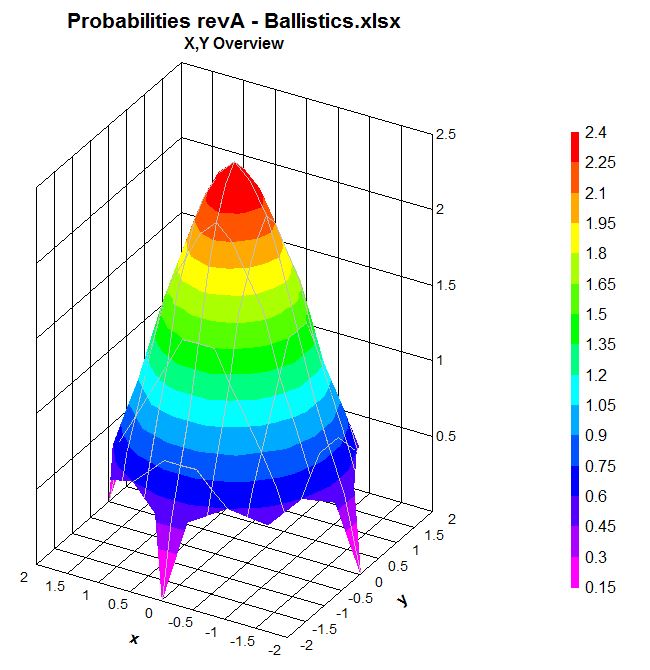
|

|
Originally Posted By SyberSniper: Shotfusion looks great, but seems to be available only for iphone... anything as good for android? I admit I rely on 5-shot groups but try to aggregate them. @Trollslayer To overlay multiple targets you will need the TDS version of onTarget. I find on some days there is considerable V0 difference from ammo tests loaded at the same time but shot at different times... IMO the environmental conditions plus the shooter plus the variability of components all stack one way or another. As you get older, your eagle eye becomes a sparrow... I've got ballistic-x. I've used it to analyze a few groups but I don't have enough experience with it and other apps to offer a comparison. |
I know I'll never go home.
So set fire to your ships, and past regrets, and be free.
So set fire to your ships, and past regrets, and be free.
|
Originally Posted By Trollslayer: Here's some artwork which might make this a tiny bit more interesting. I don't know how to read this graphic. Velocity differential increases linearly with number of shots fired perpetually? The differentials of a 20 shot group will be double that of a 10 shot group? I can't quite figure out what this graphic is saying. |
|
Originally Posted By SyberSniper: Doesn't look like a way to attach a file. I assume you have seen the ballistics toolkit at this link Some info from the guy who claims to have wrote it here You probably have seen those already being so deep down that rabbithole. I'm impressed - way above my pay grade... This is just me sitting in front of my computer because I need to be close to home. I'm trying to have some fun with reloading and shooting because I cannot get out to the range. It seems to me, these types of results explain a lot of what gets posted by all of us when we do load development testing. Whether a picture or table of data gets posted, many times the dispersion in the data is what is of interest (causes questions). It's the effects of small variations and typically small sample sizes and the dispersion and seems to cause confusion about the results. I thought I had an explanation but never confirmed it was valid, so I am working on validating it. |
|
Originally Posted By lazyengineer: I don't know how to read this graphic. Velocity differential increases linearly with number of shots fired perpetually? The differentials of a 20 shot group will be double that of a 10 shot group? I can't quite figure out what this graphic is saying. Further explanation and my interpretation - I often cannot figure out what my own data is saying. The plot merely presents the information. Perpetually? Almost certainly not. The straight black line is merely a linear curve fit to the 20 shot data set. Don't place too much stock in it, it just shows the upward trend I usually see in the data. This might be due to barrel & chamber heating (maybe, I don't know). I included it because the upward trend is evident in a lot of my prior data. The 20 shots were in successdion but not rapid fire. However, I made no attempt to ensure they were all shot at the same temperature. I've seen guys at the range with little blowers cooling thier bores between shots. That's not how I work. When using the ammo, as in a match, you don't get to do that. One observation is the first five shots of each data set are very similar in their dispersion. Also, they seem to show the generally increase. with successive shots. I also wanted to show how the data changes as you move from a five shot group to a 20 shot group. It goes from a 5 shot SD = 9 to a 20 shot SD = 37. The lower SD is believed to be "good", the higher is not so good. It was the same load in the same rifle but two different days. I was banging a 12" plate at 1,000 yards with this load. I always recommend to others to pick a load and shoot 20 shots to verify/confirm their small sample testing conclusion; to verify they picked a good load. I am showing you what I got. It's real data, not a simulation. I hope the above clarifies and not does not further confuse things. |
|
Originally Posted By Trollslayer: It goes from a 5 shot SD = 9 to a 20 shot SD = 37. The lower SD is believed to be "good", the higher is not so good. I was banging a 12" plate at 1,000 yards with this load. The "conventional wisdom" says that you can't hit the side of a barn with an SD of 37, yet the load performs adequately at 1K. Your testing shows that low SD's are not the most important aspect of performance or accuracy at distance. I quit chasing SD's ten years ago and focus on developing loads that maintain vertical stability at 300yds. If it performs well at 300, it will perform well enough at 1K. |
|
Originally Posted By smoothy8500: The "conventional wisdom" says that you can't hit the side of a barn with an SD of 37, yet the load performs adequately at 1K. Your testing shows that low SD's are not the most important aspect of performance or accuracy at distance. I quit chasing SD's ten years ago and focus on developing loads that maintain vertical stability at 300yds. If it performs well at 300, it will perform well enough at 1K. Exactly! In many aspects of shooting, my experience runs counter to "conventional wisdom" (so much of this is just "old wives tales"). I always go with what works for me but I also like to try and explain/understand the difference. Otherwise you are left with an unresolved mystery. Right now, all I'm after is a functional tool. I'll feed good inputs when development is done. |
|
Originally Posted By Trollslayer: Has anyone else seen this upward trend with increasing shots? What chrono was used that showed this to you? I'm speculating that some or all of it is the instrument, the chronograph. Is that possible or probable? What i would call an upward trend not really. I almost always see larger numbers with larger sample sizes. Sometimes the real es shows early sometimes it doesn't. The literal upward trend your plot shows i never seen that. I think my es numbers are the outliers because i throw charges 99% of the time. Very little hand thrown trickled up at my place. While i don't get the stupid low es / sd numbers i see people say they get never witnessed a 120 es even with thrown charges varget , 4350 , n140 etc.... I'd be curious what powder that is how much temp difference / full report on it etc i may have missed that if you posted it |
|
Originally Posted By smoothy8500: The "conventional wisdom" says that you can't hit the side of a barn with an SD of 37, yet the load performs adequately at 1K. Your testing shows that low SD's are not the most important aspect of performance or accuracy at distance. I quit chasing SD's ten years ago and focus on developing loads that maintain vertical stability at 300yds. If it performs well at 300, it will perform well enough at 1K. I ran an entire load ladder from the starting charge, 20 shots, all went into a 1" hole at 200 yards I think there was a 50 - 100 fps spread of MV's in that lot. I realized that SD isn't really an issue at shorter ranges. I remembered years ago a Palma shooter was next to me at a highpower match. I was asking him about load development. He stated that velocity variations are not all that important. Having said all that, I do work toward charge weight consistency in competition loads. My PRS ammo is all loaded with a powder trickler. |
I know I'll never go home.
So set fire to your ships, and past regrets, and be free.
So set fire to your ships, and past regrets, and be free.
|
If you look at the load result tables I posted above you will see some have high SD/ES and some much lower. Except for the oem loads and the 25.8/a2230, all of the loads were trickled by hand for testing using a lee dipper & a 10-10, or weighed only by a chargemaster supreme and rechecked with the 10-10, to as close as identical charges as my eye can see the pointer (with a magnifier). The only time I automate the charging cycle is when I'm loading a larger batch (100+) for "my inventory". I try for consistency and low SD (ES will follow) but am always foiled somehow. Brass is all the same HS, trimmed & 10 point prepped the same but not separated by weight. There always seems to be an outlier. I have also noticed ammo loaded at the same time but shot different days, from the same gun, can have an average V0 50-100 fps apart. I can't explain it. The only answer I can come up with is that the powder somehow burns different producing different amounts of pressure for whatever reason... If you can come up with something else, I'm all ears... |
|
I am having a hard time following some of the data shown. But something to consider. If you measure any data contained in a 5 shot group..... size, ES, SD, etc, etc. That data can only get bigger by shooting more shots. You cannot get a lower ES by shooting a 6th shot, you can for sure not make a 5 shot group smaller by shooting a 6th shot. If you give the data only one way to trend, it will trend that way. I might be missing something in the desired observation of the test. I guess maybe we are trying to determine the lowest sample size, to achieve statistical significance? That would bring me back to my original point, that the sample size is completely dependant on a non-constant, which is the consistency of the system the data is contained in. The rifle, ammo and environment, |
Small Sample Testing (Page 1 of 2)
Armory Sponsor