


Armory Sponsor

Posted: 12/12/2012 4:25:43 PM EDT
| I just laid in two new AR's and plan on reloading. I've never reloaded .223 before, and a guy at my rifle range mentioned I should get small base dies. I've noticed .223 dies and .223 small base dies. What is the difference, and which would be best for the AR? I have a RCBS RC and have always used RCBS dies for the other 5 calibers I load. |
|
Small base dies size the base of the cartridge about .001" smaller than a regular full length die. If you have a rifle with a smaller (tighter) chamber the small base die may be required.
Lots of good info here ===============================================================================================================
Q: Should I buy a small base or standard sizing die for brass to be shot in my AR type rifle? A: Buy standard sizing dies; millions of rounds of .223 Remington and .308 Winchester with brass sized in standard dies are fired every year in semi-auto rifles without trouble. Occasionally someone reports that brass sized in these dies will not chamber in their off the rack rifle, and small base dies cured the problem; I'm skeptical about whether their standard dies were adjusted correctly. The first objection to the use of small base dies is added work hardening of the brass and shorter case life. The second objection is degraded accuracy caused by the loose fit of the brass in the rifle's chamber. |
| I have small base dies, but only because that is all the lGS had when I went to go buy dies. You should not need small base dies. I would try with a regular FL resizing die, and see if they feed reliably, if so, you are G2G. If not, a small base die could help with a feeding issue. |
|
From that FAQ
Q: Should I buy a small base or standard sizing die for brass to be shot in my AR type rifle? A: Buy standard sizing dies; millions of rounds of .223 Remington and .308 Winchester with brass sized in standard dies are fired every year in semi-auto rifles without trouble. Occasionally someone reports that brass sized in these dies will not chamber in their off the rack rifle, and small base dies cured the problem; I'm skeptical about whether their standard dies were adjusted correctly. The first objection to the use of small base dies is added work hardening of the brass and shorter case life. The second objection is degraded accuracy caused by the loose fit of the brass in the rifle's chamber. ETA: already answered. |
|
There are uses for small base dies.
#1 when reforming brass from another caliber #2 to deal with brass fired in oversized chambers ie 308 brass fired in machine guns #3 to deal with brass fired in another chamber and then used in a smaller chamber ie having a stock factory chambered rifle and then getting it rebarreled with a tight chamber. RCBS came out with their AR series of dies, the ones in black box. The draw was that the seater die has taper crimp feature versus the standard roll crimp feature in the seater. A lot uniformed reloaders insist to NOOB reloaders that a Small Base sizer is requried, and they are passing out poor information. As pointed out above the Small Sizer over works the brass. And, in an autoloader why shorten your case short case life even more with excessive sizing. I have shot thousands of 30-06 out of M1 Garand all size with a FL sizer and never crimped the bullets! I shot one Krieger bbl in a M1A with over 10K of 308 with FL sizing the brass and never crimped a bullet, and gosh so many AR platforms in 223 all the same.... If you accept that case life of an autoloader is short you will do just fine. An Guard Armorer was of the opinion that brass should be fired 5 times and pitched in the scrap bbl. I have followed that advice for a long time. Of course there are some techniques to enhance the case life in an autoloader if you confine the brass to one chamber.... |

|
Quoted:
http://i250.photobucket.com/albums/gg272/dryflash3/Dies/PC290706.jpg For my 223 loads for my AR, I use standard FL dies that are properly adjusted. Part in blue is the key here. Dryflash, I assume those are Lee dies. Do you know if they are compatible with RCBS presses? I don't know if different manufacturers have different threads. It's been well over 10 years since I've reloaded, so I'm a bit rusty on these things. Again, thanks to all who have responded. It's impressive all the information and resources that are available on this site. |
|
Quoted:
Quoted:
http://i250.photobucket.com/albums/gg272/dryflash3/Dies/PC290706.jpg For my 223 loads for my AR, I use standard FL dies that are properly adjusted. Part in blue is the key here. Dryflash, I assume those are Lee dies. Do you know if they are compatible with RCBS presses? I don't know if different manufacturers have different threads. It's been well over 10 years since I've reloaded, so I'm a bit rusty on these things. Again, thanks to all who have responded. It's impressive all the information and resources that are available on this site. Those are Hornady dies, and yes, they are compatible with RCBS presses. Almost all dies are compatible with almost all presses(I did say ALMOST ALL) Standard 7/8"-14 thread is what most dies and presses use. |
|
Quoted:
Quoted:
http://i250.photobucket.com/albums/gg272/dryflash3/Dies/PC290706.jpg For my 223 loads for my AR, I use standard FL dies that are properly adjusted. Part in blue is the key here. Dryflash, I assume those are Lee dies. Do you know if they are compatible with RCBS presses? I don't know if different manufacturers have different threads. It's been well over 10 years since I've reloaded, so I'm a bit rusty on these things. Again, thanks to all who have responded. It's impressive all the information and resources that are available on this site. I should let Dryflash answer but no, I don't think those are Lee. They look like Hornady to me. Yes, The Lee dies are compatible with the RCBS press as are the Lee shell holders. As for small base dies. It is my understanding that they were originally made for rifles that had very little camming action in their bolt designs. One such rifle is the Remington line of pump action rifles. The Remington 760 was the most popular non-bolt action deer rifle in PA for many years. It probably still is. These rifles sometimes had trouble closing on rounds that were reloaded with standard dies so the reloading equipment companies started making the small base dies. Oh yeah. Forgot to mention. We haven't heard from the "other side" yet. They are by far the minority but are steadfast in the commitment. 
|
|
Quoted:
If your loading ammo for a Semi-auto Go small base! you will save yourself LOTS of frustration in the end. Learning to set-up and adjust dies is the way to go. Slow down, learn the basics and forget the crutch and band-aid approach. Unless someone is running a custom reamed/headspaced match chamber, like the kind you can't buy new over a gun counter, small base dies are pointless. If I did have a chamber requiring brass be loaded small base, my gunsmith and I would be having an intense discussion as to why ? I've got one chamber that's so close, anything less than perfectly sized brass using full length sizer die will not allow the bolt to close. If you're saying small base is the way to go for a cookie cutter AR or even a drop in match barrel my response is why ? Followed with, learn to set up and adjust your dies. There was a thread yesterday that caused pause for me. Reloading isn't plug and play. As hard as the folks making reloading equipment have tried, reloading requires you do your homework, load work and tuning work. Kool-Aid doesn't factor into the equation. This is a process, a process we all pretty much do the same. When one guy says something can't be done that everyone else is doing without special equipment. That individual stands out like a broken thumb. Your thumbs fellas, do as you please. Regards, dc. |
|
Quoted:
Quoted:
If your loading ammo for a Semi-auto Go small base! you will save yourself LOTS of frustration in the end. Learning to set-up and adjust dies is the way to go. Slow down, learn the basics and forget the crutch and band-aid approach. Unless someone is running a custom reamed/headspaced match chamber, like the kind you can't buy new over a gun counter, small base dies are pointless. If I did have a chamber requiring brass be loaded small base, my gunsmith and I would be having an intense discussion as to why ? I've got one chamber that's so close, anything less than perfectly sized brass using full length sizer die will not allow the bolt to close. If you're saying small base is the way to go for a cookie cutter AR or even a drop in match barrel my response is why ? Followed with, learn to set up and adjust your dies. There was a thread yesterday that caused pause for me. Reloading isn't plug and play. As hard as the folks making reloading equipment have tried, reloading requires you do your homework, load work and tuning work. Kool-Aid doesn't factor into the equation. This is a process, a process we all pretty much do the same. When one guy says something can't be done that everyone else is doing without special equipment. That individual stands out like a broken thumb. Your thumbs fellas, do as you please. Regards, dc. Ditto the whole post! regarding my red highlights, I have 3 custom barreled rifles made by the same smith. He likes them tight and it has caused me issues on resizing. My Redding S die setup barely contracts my brass enough. We had a discussion when I got to this point with my dies camming over in the press. He's a good friend and I respect his experience and wisdom on life and guns but that was one point we disagreed on, I don't them that tight! He's on the go gage with a touch of feel. I load for garands, m1a's and match AR's. I have never needed a small base die for any of them. I strip my bolts and size brass in increments to finger close the bolt with just a touch of feel, Measure that with my hornady tool, then set the shoulder back 0.002-0.004". You don't want 0.001" clearance in a clean gun because it will get dirty and you don't want 0.008" headspace either because you'll short your brass lifespan. Knowing where to put the shoulder for a particular rifle is what a knowledgable reloader does. I've been chastised for pushing this here in arfcom reloading before by folks who want all their ammo to fit all their guns every time. To each their own as long as they know the purpose and why of what they're doing. My milsurps are informal target guns so I load them as such and I'm not loading volume zombie ammo. 
|
|
Quoted: Quoted: http://i250.photobucket.com/albums/gg272/dryflash3/Dies/PC290706.jpg For my 223 loads for my AR, I use standard FL dies that are properly adjusted. Part in blue is the key here. Dryflash, I assume those are Lee dies. Do you know if they are compatible with RCBS presses? I don't know if different manufacturers have different threads. It's been well over 10 years since I've reloaded, so I'm a bit rusty on these things. Again, thanks to all who have responded. It's impressive all the information and resources that are available on this site. Hornady dies, thanks to all that answered before I got back to this thread. 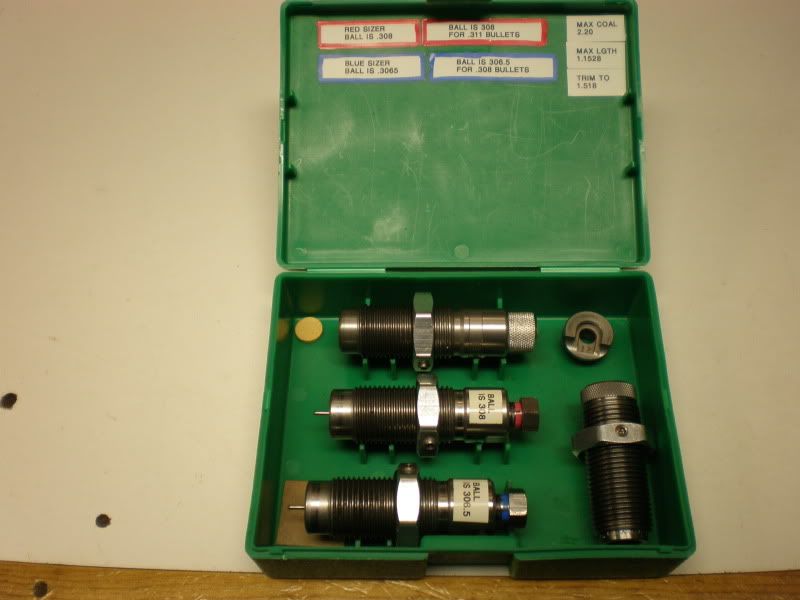 Lee dies look like this. They are in a RSBS box, as I don't like the Lee die box. |
|
Quoted: Quoted: Quoted: If your loading ammo for a Semi-auto Go small base! you will save yourself LOTS of frustration in the end. Learning to set-up and adjust dies is the way to go. Slow down, learn the basics and forget the crutch and band-aid approach. Unless someone is running a custom reamed/headspaced match chamber, like the kind you can't buy new over a gun counter, small base dies are pointless. If I did have a chamber requiring brass be loaded small base, my gunsmith and I would be having an intense discussion as to why ? I've got one chamber that's so close, anything less than perfectly sized brass using full length sizer die will not allow the bolt to close. If you're saying small base is the way to go for a cookie cutter AR or even a drop in match barrel my response is why ? Followed with, learn to set up and adjust your dies. There was a thread yesterday that caused pause for me. Reloading isn't plug and play. As hard as the folks making reloading equipment have tried, reloading requires you do your homework, load work and tuning work. Kool-Aid doesn't factor into the equation. This is a process, a process we all pretty much do the same. When one guy says something can't be done that everyone else is doing without special equipment. That individual stands out like a broken thumb. Your thumbs fellas, do as you please. Regards, dc. Ditto the whole post! regarding my red highlights, I have 3 custom barreled rifles made by the same smith. He likes them tight and it has caused me issues on resizing. My Redding S die setup barely contracts my brass enough. We had a discussion when I got to this point with my dies camming over in the press. He's a good friend and I respect his experience and wisdom on life and guns but that was one point we disagreed on, I don't them that tight! He's on the go gage with a touch of feel. I load for garands, m1a's and match AR's. I have never needed a small base die for any of them. I strip my bolts and size brass in increments to finger close the bolt with just a touch of feel, Measure that with my hornady tool, then set the shoulder back 0.002-0.004". You don't want 0.001" clearance in a clean gun because it will get dirty and you don't want 0.008" headspace either because you'll short your brass lifespan. Knowing where to put the shoulder for a particular rifle is what a knowledgable reloader does. I've been chastised for pushing this here in arfcom reloading before by folks who want all their ammo to fit all their guns every time. To each their own as long as they know the purpose and why of what they're doing. My milsurps are informal target guns so I load them as such and I'm not loading volume zombie ammo. Don't know if you guys shoot, time based competition. I'm shooting 3 Gun. if your gun hangs up,, your done. I have been loading, for 30 years. and other competitors. I know. recommend the same thing. %85 of all of my ammo problems, were eliminated. with small base dies. Once and a wile, one of my AR's in 223/5.56 would stick one that would not come out without a rod. and I had a DPMS LR-308, that was hell on earth, with all types of ammo. I put a new barrel on it, now it runs great! I have loaded ammo with all types of dies, and they all fall in and out of chamber gauges, Gun Smithing trying to get your gun un jammed. during a stage with the timer running.. BAD! if you shoot 3 Gun you know,, nothing goes wrong until the start timer, goes off! Then Murphy will come after you... if you don't shoot 3 Gun,,, time to get off the bench! |
I don't shoot 3 gun, but do shoot IDPA  and NRA Action pistol, open class. I load a lot of .223 and have zero tolerence for feed failures. The open class 1911 is .38 super comp, six inch barrel with thread on EGW compensator. This pistol has been considerably lightened in the slide, both receiver and slide cut for Acc-U-Rails and cycles 5" government model slide with 7# recoil spring. Everything about pistol and handloads are tuned for optimum feed and accuracy. I understand your emphasis for feedability but small base dies are a solution for poor tuning skills for most people using small base dies, given my experience. and NRA Action pistol, open class. I load a lot of .223 and have zero tolerence for feed failures. The open class 1911 is .38 super comp, six inch barrel with thread on EGW compensator. This pistol has been considerably lightened in the slide, both receiver and slide cut for Acc-U-Rails and cycles 5" government model slide with 7# recoil spring. Everything about pistol and handloads are tuned for optimum feed and accuracy. I understand your emphasis for feedability but small base dies are a solution for poor tuning skills for most people using small base dies, given my experience.
Like I said, your thumbs. Not wanting to disrespect your experience, you might rethink your loading operation or at least advocating small base dies for general use. Regards, dc |
|
Quoted: I don't shoot 3 gun, but do shoot IDPA and NRA Action pistol, open class. I load a lot of .223 and have zero tolerence for feed failures. The open class 1911 is .38 super comp, six inch barrel with thread on EGW compensator. This pistol has been considerably lightened in the slide, both receiver and slide cut for Acc-U-Rails and cycles 5" government model slide with 7# recoil spring. Everything about pistol and handloads are tuned for optimum feed and accuracy. I understand your emphasis for feedability but small base dies are a solution for poor tuning skills for most people using small base dies, given my experience.Like I said, your thumbs. Not wanting to disrespect your experience, you might rethink your loading operation or at least advocating small base dies for general use. Regards, dc Small base,,, for Semi guns,,, My Wife and 3 kids shoot 3 gun too. they all have their own rifle, so the ammo gets shot in,, different guns, we load alots of range brass. Who knows what you pick up, never know how many times I re-load brass. size, trim, wet tumble, ,,, We cast and load alot of 9mm too. 1000+ a month. Good thing my Wife shoots too. Or she would think, I was Dating Dillon! |
|
Here's what I suscribe to and teach to those needing instruction locally.
If cartridges gage inside an L.E. Wilson case gage, cartridges will gage inside the tightest SAAMI spec, go gaged, custom reamed/headspaced chamber. What I do see a lot of, is small based dies bought to correct problems floating tool heads and shellplates create. Once again, we are back to the classic debate of crescent wrench vs size specific end wrench. If a crescent works for you, great ! Just pardon the rest of us while we use and teach the use of size specific end wrenches. I too load a ton of ammunition on Dillon equipment. One quasi-550, 650 and shooting teams 1050. Between the two houses the closest thing to small base die is a Lee 9mm regular full length sizer I have. |
|
With a name like Morris Ammo you probably know your way around the reloading room just fine. For me my way is more work but it does increase my confidence in the overall quality of my ammo.
Running unknown history range pickup brass is a risk. Over resizing is a risk for loose headspace issues/ head seperations. If you are happy with accepting those risks for your method ok by me. I know guys that are ok with that as they shoot too much ammo to bother with sorting and inspecting. They just pick up, clean and run through the progressive. I am not ready to do so with rifle as I don't need 40k PSI in my face. Now if you were talking for .45 ACP or .38 special, I wouldn't worry much at all as they're milder pressures. I shoot only my brass or brass I know the history of and the quality of the chamber it was in. I may be overly cautious but it keeps me safe. Happy reloading to you. <-- I mean that sincerely. |
|
I don't adjust my full length die(s) like SteelonSteel describes. I understand his purpose but don't have the need to. I have a lot of brass and my accuracy is very acceptable.
I can also see "morrisammo's" reason for using small base die but as 1911smith pointed out this is not the norm. This is being done for a specific competition related purpose. A competition where speed and reliability is more important than accuracy. Kind of like a race engine that needs rebuilt after every race but not that extreme. I've been loading since the 1980's too and load for around 40 calibers. I haven't run into a situation where a small base die was needed yet. I did accidentally get a small base die in a .308 Win die set once and did not notice until I started to get case head separations after 3 to 4 reloads. Besides, they, small base dies, are available every day. If I end up needing one I'll buy it. For now I'll stick with what is working. |
|
Great!!! Now, I've got to get rid of my brand new RCBS small base X die. I bought it according to the recommendation from RCBS. As soon as, you tell them it's for an AR, they would tell you to get the small base die. I'm hoping to get at least 5-6 loadings out of my LC brass.
GlockMonk |
|
Quoted:
Great!!! Now, I've got to get rid of my brand new RCBS small base X die. I bought it according to the recommendation from RCBS. As soon as, you tell them it's for an AR, they would tell you to get the small base die. I'm hoping to get at least 5-6 loadings out of my LC brass. GlockMonk 5-6 might be a bit optimistic. Figure on 4 and move on from there, since 223 brass is pretty cheap. Anything's possible, but the violent extraction found with semi autos is not too kind on brass. I don't feel the need to use X dies. You'd be better off buying the Hornady headspace gages and setting up your sizing dies properly. Trimming is part of the reloading process. Chris |
|
Quoted:
Great!!! Now, I've got to get rid of my brand new RCBS small base X die. I bought it according to the recommendation from RCBS. As soon as, you tell them it's for an AR, they would tell you to get the small base die. I'm hoping to get at least 5-6 loadings out of my LC brass. GlockMonk Not really. Just disable the X die function by backing off a bit on the X bushing. And, behold, you essentially have a plain Small Base die functionally. As a side note: I did some measurements recently comparing factory fresh ammo, (Federal Gold Metal Match) and some Small Base die sized cases and some Standard die sized cases using all RCBS equipment. The SB sized case is somewhere in between the FGMM and the Standard die sized cases with respect to body diameters. |
|
Quoted:
5-6 might be a bit optimistic. Figure on 4 and move on from there, since 223 brass is pretty cheap. Anything's possible, but the violent extraction found with semi autos is not too kind on brass. I don't feel the need to use X dies. You'd be better off buying the Hornady headspace gages and setting up your sizing dies properly. Trimming is part of the reloading process. Chris Thank you, I have been reloading pistol rounds only, and rifle rounds are some what new to me. In pistol world, you pretty much keep reloading the same brass, until you lose them...  I use Dillon's 223 case gauge, as it seems easier for me. I use Dillon's 223 case gauge, as it seems easier for me.
GlockMonk |
|
Quoted:
Not really. Just disable the X die function by backing off a bit on the X bushing. And, behold, you essentially have a plain Small Base die functionally. As a side note: I did some measurements recently comparing factory fresh ammo, (Federal Gold Metal Match) and some Small Base die sized cases and some Standard die sized cases using all RCBS equipment. The SB sized case is somewhere in between the FGMM and the Standard die sized cases with respect to body diameters. Thank you for the info. Did you keep track of how many times, you have reloaded the same brass with the small base dies? GlockMonk |
|
Thank you OP for starting this thread. After much research on the internet, I've also come to the conclusion, that small base dies are not necessary for most firearms, and it is just a band aid to mask the improper adjustment of the regular FL dies. Also, thank you to all the experienced re-loaders for chiming in, as usual.
GlockMonk |
|
Quoted: Quoted: If your loading ammo for a Semi-auto Go small base! you will save yourself LOTS of frustration in the end. Not necessary 99.998% if the time. Like lots have said, learning how to properly adjust full length is the key. After you spend $300+ on a match fee, drive 12 hours one way. spend 3 or 4 nights in a hotel. food and other expenses. having your gun, jamb, not being able to finish a stage,, timing out with penalties.., on that .001 is that worth worrying about how many times you can reload brass. I'll small base,,, size... If your just shooting for fun at the range,, its no big deal,, you can run a rod in your gun, You can't do that in a match. and it kind of messes up your day. If you shoot time based scoring, you get it,, if you don't you have no clue. now multiply that by 3 guns and 3 types of shotgun ammo. pistol and sometimes two types of rifle ammo. that .001% gets allot bigger exponentially. |
|
Quoted:
Thank you OP for starting this thread. After much research on the internet, I've also come to the conclusion, that small base dies are not necessary for most firearms, and it is just a band aid to mask the improper adjustment of the regular FL dies. Also, thank you to all the experienced re-loaders for chiming in, as usual. GlockMonk It certainly wasn't my intention to start such an emotionally charged thread, but I have to say I'm learning quite a lot about reloading the .223. I basically will be loading for the field and range; I don't shoot competitively. I'll be going with just a standard set of .223 dies. If I start running into issues, I now know small base dies might be an option. Again, thanks to all that have posted. This site continues to impress me with all the knowledge its' members have. From lubing cases with a home made concoction, brewing my own bore cleaner, selecting the right components for my gun, etc., this is a great resource for someone that's just starting to shoot an AR. |
|
Quoted:
Quoted:
Not really. Just disable the X die function by backing off a bit on the X bushing. And, behold, you essentially have a plain Small Base die functionally. As a side note: I did some measurements recently comparing factory fresh ammo, (Federal Gold Metal Match) and some Small Base die sized cases and some Standard die sized cases using all RCBS equipment. The SB sized case is somewhere in between the FGMM and the Standard die sized cases with respect to body diameters. Thank you for the info. Did you keep track of how many times, you have reloaded the same brass with the small base dies? GlockMonk I have stashed so many 1X LC cases, both 5.56 and 7.62, that I do not worry about anything over 3X. Visually, my 3X SB stuff looks good to go. I expect that if I run hot loads, the first malady in 5X and above will be primer pocket fit to primer is going to get loose. That will occur regardless of body sizing. My main supply of 5.56 1X cases now is shooting up my XM193 and M855 surplus ammo. |
|
Quoted:
Quoted:
Quoted:
If your loading ammo for a Semi-auto Go small base! you will save yourself LOTS of frustration in the end. Not necessary 99.998% if the time. Like lots have said, learning how to properly adjust full length is the key. After you spend $300+ on a match fee, drive 12 hours one way. spend 3 or 4 nights in a hotel. food and other expenses. having your gun, jamb, not being able to finish a stage,, timing out with penalties.., on that .001 is that worth worrying about how many times you can reload brass. I'll small base,,, size... If your just shooting for fun at the range,, its no big deal,, you can run a rod in your gun, You can't do that in a match. and it kind of messes up your day. If you shoot time based scoring, you get it,, if you don't you have no clue. now multiply that by 3 guns and 3 types of shotgun ammo. pistol and sometimes two types of rifle ammo. that .001% gets allot bigger exponentially. I get the $300.00 plus entry fee, hours of practice and loading for multiple guns. Your deal, just like anyone else you set your bar based on your expectations or compensate as needed. I paid $300.00 plus for Bianchi Cup competion and never thought once about small base dies, nor would I need small base for 3 gun. Fact is you've made a choice to use small base dies. Like other folks, I have opted to check cartridges with case gage, insuring feed ability and as stated don't have feed issues. Once my dies are dialed in, case gaging becomes cheap insurance and rare for a cartridge not to gage after sized in full length dies, set correctly. Anyways, wish you all the best, just making the point, I do know where you're coming from and still disagree with your generalized statement regarding small base dies. dc. |
|
Quoted:
Great!!! Now, I've got to get rid of my brand new RCBS small base X die. I bought it according to the recommendation from RCBS. As soon as, you tell them it's for an AR, they would tell you to get the small base die. I'm hoping to get at least 5-6 loadings out of my LC brass. GlockMonk Not necessarily GM, As far as headspace length/shoulder bump, just unscrew the die body to increase headspace. You may want to reset the mandrel portion too. (I have a FL .308 Xdie set) This should also since it's a tapered case not size the web quite as tight. If the die is cut for a smaller diameter at the shoulder you're stuck with it but I'm not sure the SB dies are cut any tighter for that diameter. Ah, I also remember I am mistaken, I do technically have one SB die set; Dillon .223 dies even though I never intentionally purchased any as SB. They're not marked as SB dies but they are cut as SB which I learned long after I owned them. FWIW, I discovered if I set them up according to the directions I'd get gross free headspace of around 8 thousandths. I backed them off and they're running about 4 thousandths free headspace for my standard non match AR's. I load my 55 FMJ hornady loads with ball powder on the dillon for training, practice, and general plinking but this I feel is much higher quality than most plinker reloads. That's my concession to progressive volume loading I guess. My true match loads are done on my single stage with RL15 powder and 69 or 77 grain SMK's or Nosler match bullets. For match purposes I really don't want to reuse the brass too often in an autoloader anyhow. The rims get tweaked, no big deal for plinking but for a 600 yard load it can certainly be. I've proved this to myself on the range. I keep going back to headspace issues because it's a real thing I learned the hard way with the m1a reloading brass camming over the press like I thought I was supposed to for military gun ammo for reliability purposes. Short brass life with partial case head separations quickly learned me something was wrong with that . A full case head separation would have likely left the neck and shoulders stuck in a chamber. In a highpower rapid string, that'd mess up your day along the lines of what Mr. Morris is talking about. If it's your SHTF ammo it could F up your life. Anyways for matches it's pretty important to make reliable loads. For SHTF loads, you're likely better off with factory ammo that's never been stressed. There's a reason pro staff folks with sponsors generally run new ammo in matches. |
|
Thank you sir, for your insight. I'll follow your recommendation, and size the brass incrementally, until it properly head spaces in my rifle.
GlockMonk Quoted:
Not necessarily GM, As far as headspace length/shoulder bump, just unscrew the die body to increase headspace. You may want to reset the mandrel portion too. (I have a FL .308 Xdie set) This should also since it's a tapered case not size the web quite as tight. If the die is cut for a smaller diameter at the shoulder you're stuck with it but I'm not sure the SB dies are cut any tighter for that diameter. Ah, I also remember I am mistaken, I do technically have one SB die set; Dillon .223 dies even though I never intentionally purchased any as SB. They're not marked as SB dies but they are cut as SB which I learned long after I owned them. FWIW, I discovered if I set them up according to the directions I'd get gross free headspace of around 8 thousandths. I backed them off and they're running about 4 thousandths free headspace for my standard non match AR's. I load my 55 FMJ hornady loads with ball powder on the dillon for training, practice, and general plinking but this I feel is much higher quality than most plinker reloads. That's my concession to progressive volume loading I guess. My true match loads are done on my single stage with RL15 powder and 69 or 77 grain SMK's or Nosler match bullets. For match purposes I really don't want to reuse the brass too often in an autoloader anyhow. The rims get tweaked, no big deal for plinking but for a 600 yard load it can certainly be. I've proved this to myself on the range. I keep going back to headspace issues because it's a real thing I learned the hard way with the m1a reloading brass camming over the press like I thought I was supposed to for military gun ammo for reliability purposes. Short brass life with partial case head separations quickly learned me something was wrong with that . A full case head separation would have likely left the neck and shoulders stuck in a chamber. In a highpower rapid string, that'd mess up your day along the lines of what Mr. Morris is talking about. If it's your SHTF ammo it could F up your life. Anyways for matches it's pretty important to make reliable loads. For SHTF loads, you're likely better off with factory ammo that's never been stressed. There's a reason pro staff folks with sponsors generally run new ammo in matches. |
Armory Sponsor