


Armory Sponsor

Posted: 2/12/2013 4:55:18 PM EDT
|
I purchased 125g Missouri Bullet Company 0.356" lead bullets for my 9mm Sig P226. I loaded up the following loads:
- 3.0g Bullseye with 125g LSWC - 3.1g Bullseye with 125g LSWC - 3.2g Bullseye with 125g LSWC - 3.3g Bullseye with 125g LSWC - 3.4g Bullseye with 125g LSWC - 3.5g Bullseye with 125g LSWC I shot the 3.0g and 3.1g Bullseye loads. After checking the barrel with 3.0g of Bullseye there was fouling and leading present within the first inch of the barrel. I shot a few plated bullets before shooting the 3.1g Bullseye loads. Again, I looked at the barrel and noticed fouling and leading present within the first inch of the barrel. I am trying to determine what I should do next. I plan to slug the barrel but have to consider that I have 0.356" diameter bullets from MBC to use for now. What is the best velocity to achieve for lead? Most reloading manual entries I found for pistol lead bullets stated not to exceed 1000fps. Is a fast powder causing the fouling and leading within the first inch? Would a slower powder help reduce the fouling and leading? I plan to shoot the other rounds I loaded. Maybe increasing the powder weight will help with the fouling and leading I'm seeing. These are the first lead bullets I've loaded up and plan to start casting my own boolits in the future. |
|
The "Don't exceed 1000FPS" generally protects you from soft lead with poor lube. Hardcast lead, with good, modern lube, is good to much more than that.
Now, leading: First, there needs to be a balance between the pressure and the hardness of the lead. If your lead is quite hard, try running hotter loads. Second, clean your barrel out. And I mean CLEAN YOUR BARREL OUT. Not just powder deposits, but copper fouling as well. Copper fouling is abrasive, and will wear at the lead as your cast bullets go down the bore. Work the copper solvent until you've got nothing but steel, and go higher on the charge weight, provided that load data and general safety allow for it. It's a different caliber, but in my P220 and some fairly hard bullets, I have best luck with cast bullets running toward the high end of load data. But, if your 9mm is anything like my P220, there will always be a little bit at the throat, because the throat is QUITE generous and long on them. My assumption is that it is to help handle +p ammunition, but either way, a generous throat probably means a bit of flame bypass and melted lead for the first tiny bit. |
|
I shoot lead through various different handguns.
2x Springfield 1911s Taurus PT92AF Bersa 380 Ruger GP 100 with 6 inch barrel Glock 22 I have noticed they will all lead to some degree. Some being worse than others. The 1911s seem the least effected. Powder and velocity will make a difference. The 380 does better with a slower bullet. The 1911s don't care. The 9mm like a faster bullet. The 9mm is kinda strange because the rifling in the barrel is odd. It seems to kinda fade in from the chamber area. Seems to taper in more than my other guns do. The Glock leads the most of all with the 380 right behind it. I hard scrub the bore on the Glock every 50 rounds when shooting lead. I dont want to lose any fingers. The 380 shoots great with lead even with considerable leading. The GP 100 leads the least. It is the one gun that I would almost consider a clean lead shooter. I get about a half inch of leading only on 2 grooves maybe half an inch outbound from the forcing cone. I can only guess maybe rough spots in those two groves are causeing this. In my own experience the bullets I cast that are more soft than hard seem to lead less than more hard bullets. I only shoot lead because lead keeps me shooting. I haven't pushed any to high velocites yet because I dont have a chrono. If this thread takes off or if requested I might post some lead bullet pictures. I think they are a great option and casting is a nice hobby. I get to shoot a lot more than my friends especially at the current time. I keep my guns clean and I also try to have reasonable expectations. My hints: slug your bore. ensure your barrels are clean...gotta get out any copper man...lead will catch that copper fouling and smear like heck. Try different combinations and different powders. I will absolutely NOT use unique with lead bullets. If you are loading auto's you may have to seat the bullet deaper than you think so your chamber wont hang on the forward driving band. And remember lead bullets require less propellant. |
|
Leading in the first inch suggests excessive pressure, not velocity. Pressure greater than the compressive strength of the bullet material can cause excessive obturation of the bullet which increases the friction of the bullet on the bore. Which leads to fouling. But lowering the pressure can decrease the interior ballistics consistency. I would try a slower powder. I got better accuracy with Unique in .45 ACP using cast lead bullets than with Bullseye. |
| Try using a good hard cast bullet like Oregon Trail, with a gas check. You can also get tool from, Lyman, Lee, etc. to add GC's to your home rolled bullets. A little more work, but in my experience you can generally get notably higher velocities with them. I regularly load 30-30's up to 2000-2100 Fps. Get a copy of Lyman's Casting Lead Bullets, have at it. Best of luck, 44-40 |
|
It appears that there is an art to shooting lead bullets, balancing the bullet lead hardness with optimal powder charge, shooting a properly sized bullet and having an optimal lube (and maybe there's more).
The bullet hardness of the these 125g Missouri Bullet Company bullets are 18BHN. I think I will also get my hands on slower powder to see what the difference is within the barrel. |
|
Quoted:
I'll argue it's exactly the opposite.
Leading in the first inch suggests excessive pressure, not velocity. Pressure greater than the compressive strength of the bullet material can cause excessive obturation of the bullet which increases the friction of the bullet on the bore. Which leads to fouling. If the pressure is too low, the bullet is slow to obturate in the bore and fails to seal quickly - thus you and you get gas cutting and leading. Leading is seldom causes by an excessively soft alloy, especially at 9mm velocities. It is caused by bullets that are to small relative to the bore or the throat, and it is caused by bullets that are too hard and slow to obturate, especially with slower burning powders. And the two working together will lead the bejeezus out of a bore. --- First, .358 diameter bullets will help. Provided they do not make the case overly large and cause chambering issues, there is no reason not to start with .358 diameter bullets in a 9mm. Second, see what it does at a heavier load of Bullseye. 3.5 grains of Bullseye should produce about 950-1000 fps at around 21,000 CUP in a 9x19mm and leading due to excessive velocity is just not going to be an issue. A BHN of 18 is a bit hard for what is still a moderate load, and a BHN of 15 or 16 would be better, but at 3.1 grains you're way under optimum for what you've got. A gas check is also a supreme waste of money at that velocity. Third, a slower powder will reduce the initial pressure, but it won't solve an obturation problem, and if your alloy is too hard and the bullet too small, it will just aggravate the leading and let it migrate farther up the bore. Quoted:
It's always fun to try new things, but I think you'd be moving in the wrong direction, especially if the bullets are under sized relative to your bore.
It appears that there is an art to shooting lead bullets, balancing the bullet lead hardness with optimal powder charge, shooting a properly sized bullet and having an optimal lube (and maybe there's more). The bullet hardness of the these 125g Missouri Bullet Company bullets are 18BHN. I think I will also get my hands on slower powder to see what the difference is within the barrel. |
|
During your experimentation you will need to do a good job of getting the lead from the previous firing out of the barrel. Lead tends to attract more lead. Get a "Lewis Lead Remover" from Brownells and the job will be easy. http://www.brownells.com/gun-cleaning-chemicals/patches-mops/lead-remover/lewis-lead-remover-prod21587.aspx?ttver=1 |
|
First, are you sure what you saw was Lead and not lube/powder fouling? Lead can only be seen after the barrel is cleaned of other fouling.
http://www.reloadingtips.com/pages/leading-degrees.htm Second, Do not attempt to clean/remove lead from the bore by shooting plated bullets over the top. Third, and most important your loads are waaaay under powered. According to Lyman 124gr RCBS CN 9mm with Bullseye has a Start charge of 3.7gr 125gr Lyman HP 9mm has a Start charge of 4.2gr of Bullseye. Fourth, you did not mention OAL, what was yours and did you test like this? 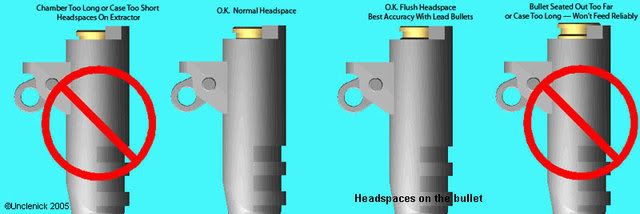
|
|
rca2222 - Since firing these bullets I have taken a 9mm copper brush and wrapped it with copper Chore Boy to do a good scrubbing within the barrel. Before shooting the 3.0g and 3.1g loads I did clean the barrel very well.
steve4102 - I should have taken a picture of the barrel post shooting and before cleaning the barrel. Since this was my first time shooting lead bullets out of the Sig, after the 3.1g load, I stopped shooting any further because I have not been familiar with severe leading/fouling. After cleaning the barrel out on these two loads I was able to see small lead slivers coming out with my enhanced copper Chore Boy brush. I could slowly see lead/debris being removed from the corners of the lands when I put the brush through the barrel as I cleaned. steve4102 - Before I begin to sit down and crank out reloaded rounds I typically pull the barrel of the applicable pistol and check where the reloaded round sits when entered into the chamber. These reloaded lead bullets sit just below the surface of the barrel chamber end. The COAL was 1.120" for these reloaded lead bullets. I used this COAL to seat the bullet far enough where the bullet lube was positioned within the brass. This 125g lead bullet had one lube groove. |
|
Quoted:
rca2222 - Since firing these bullets I have taken a 9mm copper brush and wrapped it with copper Chore Boy to do a good scrubbing within the barrel. Before shooting the 3.0g and 3.1g loads I did clean the barrel very well. steve4102 - I should have taken a picture of the barrel post shooting and before cleaning the barrel. Since this was my first time shooting lead bullets out of the Sig, after the 3.1g load, I stopped shooting any further because I have not been familiar with severe leading/fouling. After cleaning the barrel out on these two loads I was able to see small lead slivers coming out with my enhanced copper Chore Boy brush. I could slowly see lead/debris being removed from the corners of the lands when I put the brush through the barrel as I cleaned. steve4102 - Before I begin to sit down and crank out reloaded rounds I typically pull the barrel of the applicable pistol and check where the reloaded round sits when entered into the chamber. These reloaded lead bullets sit just below the surface of the barrel chamber end. The COAL was 1.120" for these reloaded lead bullets. I used this COAL to seat the bullet far enough where the bullet lube was positioned within the brass. This 125g lead bullet had one lube groove. Good, but your charge is still way to low. At the very least bump the charge up to Minimum. Your loads are severely under pressure and that ain't good. |
| steve4102 - What does Lyman state for the velocity of the 125g RCBS bullet with the Bullseye load in the manual? My seventh edition Hornady manual does not have a fast burning powder listed with the 124g LRN Hornady bullet. It only states that lead bullets should be kept under 1100fps. |
|
CAUTION: The following post includes loading data beyond currently published maximums for this cartridge. USE AT YOUR OWN RISK. Neither the writer, AR15.com, nor the staff assume any liability for any damage or injury resulting from use of this information.
Old Alliant data list a maximum of 4.8 gr with lead. Lyman cast lists 4.9 gr maximum with hard cast using Bullseye powder. The 18 BHN your shooting should hold up well under more pressure. I find some leading to be normal. If accuracy is lost, then you have real leading. Barrels can look really bad, but still be accurate with very hard bullets. See 45 acp barrel photos |


|
SInce we are finally moving in the right direction, light loads with slower powders in straight walled cases also tend to be incredibly dirty as they result in a large quantity of gas coming back into the pistol, due to the lack of pressure needed to immediately expand the case and seal the breech.
If you really want a light load (for a steel plate match for example), then by all means use a fast powder like Bullseye or Red Dot along with a heavy crimp to allow for increased pressure to expand the case before the bullet leaves the case. ------ As for the actual load and how light is too light, I think we all agree 3.0-3.1 grains of Bullseye with a 125 gr cast bullet in a 9x19mm is probably too light. I'd expect the normal range with Bullseye to be between 3.5 gr and 4.5 gr with a 125 gr cast bullet, based on a rough average of the load data that is out there. I'm a big fan of both Bullseye and Unique in the .380, 9mm and .45 ACP and I've looked at a lot of data and loaded a lot of cast bullets in all 3 calibers with Bullseye over the last 25 years or so. What the load should be with a cast bullet becomes a lot less exact than with a jacketed bullet using the bullet manufacture's data. Cast bullets of the same weight vary greatly in terms of lube grooves, bearing surface area, and alloy hardness, so not all 125 gr bullets will have the same starting or maximum loads. Your best bet generally is to start in the middle of the average you get from looking at a number of sources for that weight of cast bullet and then work up to see what works in your particular firearm. I generally either buy one of the Loadbooks USA manuals for a caliber: Loadbook USA 9mm And/or I look at data on loaddata.com ($29.00 per year) Loaddata.com in order to get a feel for the "average" loads for a particular cast bullet weight when I don't have the specifics on a particular cast bullet. ---- Anytime you are using an unknown component, the goal is to get the first shot down range with no indications of excess pressure, etc to give you a firm place to start. |

|
I appreciate all the feedback!
Before I started with these bullets I referenced all my manuals and could not find any a starting point for my Bullseye powder (although I could find people had success with 9mm lead bullets and Bullseye). I only found load data in my Hornady manual for medium and slower powders for 124g lead bullets. My starting point was based upon statements found from various sources stating that lead bullets should begin XX% below jacket bullet data.w On the next batch I will increase the powder charge and keep an eye on the barrel. dryflash - My Sig I acquired used and was manufactured in the 90's. Since my ownership I have shot about 700 jacketed/plated rounds through it. |
|
Quoted: I appreciate all the feedback! Before I started with these bullets I referenced all my manuals and could not find any a starting point for my Bullseye powder (although I could find people had success with 9mm lead bullets and Bullseye). I only found load data in my Hornady manual for medium and slower powders for 124g lead bullets. My starting point was based upon statements found from various sources stating that lead bullets should begin XX% below jacket bullet data.w On the next batch I will increase the powder charge and keep an eye on the barrel. dryflash - My Sig I acquired used and was manufactured in the 90's. Since my ownership I have shot about 700 jacketed/plated rounds through it. That should be enough jacketed rounds through the barrel to smooth it out. Problem with Hornady lead bullet data is it's for Hornady's soft swaged bullets. I use several of their bullets and they work great at under 1000 fps and are very accurate. So not knocking their data, just doesn't translate over to cast bullets well. For cast bullet data you need Lyman 49 or Lyman Cast bullet Handbook #4. Both current manuals for about $20 ea. Lyman 49 page 342, 9mm, 120 gr Cast TC, 9mm, OAL 1.110. Bullseye start 3.8 grs for 1047 fps, Max 4.2 for 1124 fps. Lyman 49 page 342, 9mm, 120 gr Cast RN, 9mm, OAL 1.065. Bullseye start 3.4 grs for 939 fps, Max 4.2 for 1175 fps.
|
| Use Dryflash data, its newer than my old data. Lead bullets can be made by swagging with soft alloy. Swaged will lead sooner than a hard cast bullet of 18 BHN at the same pressure. Pressure is what makes an alloy fail. The Hornady bullet (i would guess) are swagged/soft alloy. Slower powder, with less pressure, may work better with swaged bullets. |
|
When I first started shooting cast bullets in my guns I had an issue with a barrel having slivers of lead left behind like those in the picture after the first magazine fired through the gun.
I made a few changes in my loading process and cured the problem...has not recurred. I reduced my crimp ever so slightly. So basically I was over crimping. You may not think it will cause any problems but with cast bullets is most certainly will. Anymore all I get is just a light gray residue in the grooves. |
|
Howdy Captain!
I was thinking that is another change I should incorporate into my process, changing the amount of crimp. I did use the same crimp setting that I use for my plated/jacketed reloads. I should spend some time setting the crimp die to "just enough" to ensure that the lead bullet diameter isn't changed when seating and crimping. I would like to have another 9mm and 45ACP die set because I would like to have a set solely for plated/jacketed bullets and then another set for reloading cast lead bullets. Maybe I should buy another T-7 turret head to have just for reloading cast bullets too. 
|
|
Quoted:
steve4102 - What does Lyman state for the velocity of the 125g RCBS bullet with the Bullseye load in the manual? My seventh edition Hornady manual does not have a fast burning powder listed with the 124g LRN Hornady bullet. It only states that lead bullets should be kept under 1100fps. 4 Inch barrel Bullseye 125gr RCBS 1.050 OAL 3.7gr= 1036fps 4.1gr= 1136fps. |
|
Got an update with some range time. I shot the following loads:
- 125g LSWC w/3.6g Bullseye @ 1.120"COAL - 125g LSWC w/3.7g Bullseye @ 1.120"COAL - 125g LSWC w/3.8g Bullseye @ 1.120"COAL - 125g LSWC w/3.9g Bullseye @ 1.120"COAL Here are some pictures of the barrel after a (7) seven shot string of each load above. It appears that the amount of leading was the same as my initial loads that I shot at 3.1g & 3.2g of Bullseye but the leading moved further down the barrel. I cleaned out the barrel prior to shooting the next (7) seven shots. A question that I have, how much leading is required to make a gun go "kaboom"? 3.6g Bullseye http://i37.photobucket.com/albums/e53/greasewood/IMAG0452_zps32e1a584.jpg 3.7g Bullseye http://i37.photobucket.com/albums/e53/greasewood/IMAG0450_zps35426e70.jpg 3.8g Bullseye http://i37.photobucket.com/albums/e53/greasewood/IMAG0449_zpse98bea2d.jpg 3.9g Bullseye http://i37.photobucket.com/albums/e53/greasewood/IMAG0448_zps9020a55d.jpg |
|
Quoted:
you have a long way to go(in your pic the grooves are plainly visible) for a kaboom happens from lead buildup in standard rifling. Dont do that to a glock though. Would you expound more on this? If I were to shoot several of these lead bullet rounds, should I start cleaning the barrel out when the rifling becomes hard to see? |
|
Quoted:
Quoted:
you have a long way to go(in your pic the grooves are plainly visible) for a kaboom happens from lead buildup in standard rifling. Dont do that to a glock though. Would you expound more on this? If I were to shoot several of these lead bullet rounds, should I start cleaning the barrel out when the rifling becomes hard to see? well, if it were me, from the results of your pics, even though not ideal, I would continue shooting. I would certainly try to impove but you arent in danger with standard rifling. there is more to your pic than just leading. I think you have some crimping issues as well and maybe some powder issues. dude, try a different powder and see if the results change. I was using unique and had results exactly like that. dont be afraid of change. see what happens, borrow some powder from a friend... if you went out and shot 100 rds I think you would be fine. clean your gun after every range visit. change a few things, experiment....see what happens...just be safe. you shouldnt have much worry with standard rifling...polygonal rifling is another story. heres what I do...when my accuracy starts to suffer...such as an expanding group...I stop shooting and clean the bore. and dont try shooting that out with jacketed rounds. you will see lots of people suggesting that but it is a bad practice. |
|
I see some mention of downloading Unique. I wouldn't go below published lows with Unique, that's experience talking. Either Bullseye or IMR 700x are great choices for downloading below published lows. In fact either powder can be loaded down to 400 fps with a 185 grain bullet in .45acp without any adverse pressure effects. Downloading Unique generates what feels to me to be a slow build in pressure with a sudden spike before peak pressure drives bullet through bore. Someday I'll have pressure testing equipment, until then I suggest you at least take my word on Unique to be spooky shit when downloaded.
Regards, dc. |
|
I haven't tried downloading Unique as far as 1911smith, but I've had good results with low to mid-range loads in 9mm, .45, and .38 Special. The .38 loads were a bit on the dirty side, probably due to the low pressure, but I really like Unique behind a 230 LRN in the .45. I need to experiment with the 9mm a bit more once I run out of 231.
As for the OP, I definitely recommend trying a few different powders until you find the one you like. I'd say the 3 of the most commonly used powders are Bullseye, Unique, & 231. I know you already have Bullseye, but if you can find the other two, I'd recommend giving them a try. You never know which one you might like the best, and with all the load data available for them, I doubt they will go to waste in the long run. |
|
I have also had good luck with Unique, and Clays.
I think the newer Unique is a lot cleaner then the old formulation. I even use Unique in my G34 with plated bullets and minimum power factor loads because I like the recoil "feeling"- and since it is strictly a range toy I don't clean it- have 3500 rounds + and still no issues from the Unique. Its pretty stinky looking though. 
|
|
for what its worth those pictures are exactly how my barrel looked when I was using unique. I switched to 231 and started running my loads toward the faster end of the spectrum and most all of my leading problems went away.
I think cast lead bullets like to be driven fast without being overdone. thats just my experience with them and it gets better the more effort I put into it. |
|
I sat down and changed a few items for my reloading session today. A few mentioned that I should check my crimping process. I thought this would be a step to change before switching powders. I still had a few rounds from my initial efforts that I measured the case diameter.
First Lead Bullet Reloads - 1.120" COAL - 0.375" diameter near the case mouth after crimp Modified Crimp for Lead Bullet Reloads - 1.120" COAL - 0.378" diameter near the case mouth after crimp I sat down and measured the lead bullet diameters and saw 0.355-0.356". I also measured the case thickness at the mouth on my Federal and Starline brass and saw anywhere from 0.010"-0.013". If I sum the bullet diameter and two times the case thickness I calculated ~0.380". I don't know what reloading manuals mean when semi-auto pistols should have a "light" crimp. After setting the modified crimp setting on my die, I also compared the change in COAL when pressing the bullet against my table, no change. A few questions that I have after today's session: - For seating lead bullets, how far down should the expander die be set? If the lead bullet diameter is 0.356" before seating, will the seating process change the diameter if the case mouth is slightly expanded only towards the case mouth and not to a certain depth? - For the calculated diameter above, given the lead bullet diameter and case thickness, how should the amount of crimp be determined? Some manuals state semi-auto pistols require no crimp due to head space on the case mouth, some state a "light" crimp. - Is it acceptable to seat a lead bullet even though the bullet lube groove is not within the case? The COAL I use is 1.120" which is the minimum depth to seat the bullet so the bullet lube groove is within the case. - Would a difference of 0.003" in diameter from my initial effort compared the crimp modified effort be enough to cause slightly more leading in the barrel when these bullets are shot? http://i37.photobucket.com/albums/e53/greasewood/820b3811-43c0-4bcd-8dee-0c79631806c5_zps5c97f477.jpg http://i37.photobucket.com/albums/e53/greasewood/082f0051-e17e-473c-9899-535b1b355105_zpsd2ff84ce.jpg |
|
Range update -
I made a change to my powder charge for the 125g LSWC from Missouri Bullet Company. - 6.1g Herco with 125g LSWC, 8 round average velocity = 948.1ft/s For those of you shooting lead bullets, what velocity do you shoot for when factoring in bullet hardness? What should be the desired velocity with the Missouri Bullet Company bullet's having 18BHN? I am very happy with the reduction in fouling within the barrel, this is more acceptable than with Bullseye. I picked up some Alliant Power Pistol that I will be trying with these bullets in the future. Here's a picture of the barrel after shooting (8) rounds: http://i37.photobucket.com/albums/e53/greasewood/9mmReloading/IMAG0465_zpsab25b624.jpg |
|
etz_cutter,leading can be a complicated issue and can be caused by many variables.bullet to bore fit,velocity,pressure,lube,etc.etc.. Bullet to bore fit is the first thing to consider if it doesn't fit the bore dia. and fill the grooves to begin with before being loaded into the case nothing else will matter especially if your using a commercial cast bullet with a high BHN.
BHN is an important number as it determines how much pressure you load will need to generates to cause obturation/bump up the bullets base and help seal the bore. If the BHN is to hard and the pressure your load generates doesn't cause obturation then most likely you will get leading to one degree or another unless your just lucky enough to have a load combination and bore that works with that bullet dia. Not all groove to groove diameters as well as lands are standard across the board especially with handguns. My particular 9mm requires a .358 dia. bullet to not lead and shoot accurately,believe me I've tried every combination of home cast and commercial bullet in different BHN's as well as powder combination and nothing worked till I started casting my own and sizing them to .358" Also take into consideration how much taper crimp you apply no point in finding or sizing a bullet that fits the bore properly and then turn around and undersizing it by applying to much taper crimp. It appears that you have discovered that with that hard of a BHN bullet it requires a hotter load/pressure to cause the bullet to obturate. |
|
I was able to get some more reloading/range time this weekend for my 125g Missouri Bullet Company bullets.
9mm, 0.356" diameter 125g MBC LSWC Velocity Data 4.1g Herco - 962.7, 15.2 4.2g Herco - 989.8, 13.3 4.3g Herco - 1008.9, 18.7 4.4g Herco - 1013.9, 15.5 4.5g Herco - 1024.6, 11.2 4.6g Herco - 1045.1, 11.6 4.7g Herco - 1061.1, 7.8 4.8g Herco - 1065.0, 19.8 (powder charge, powder type, average velocity, standard deviation) Ten (10) shot strings Here's a picture of the barrel after eighty (80) rounds: http://i37.photobucket.com/albums/e53/greasewood/9mmReloading/037c980f-cb58-4939-af29-883fd0042ace_zpsd5a4b04c.jpg |
Armory Sponsor