


[ARCHIVED THREAD] - Best MBT (Page 1 of 3)
Posted: 3/27/2008 3:40:37 PM EDT
|
Who has the Worlds best Modern MBT? I was watching a film on youtube and they concluded the Germans. What do you think? And list anything you felt that I left out, ie; T90 Youtube link ETA: poll and youtube link |


|
It probably has to be choice between the K2 and the Type-10 (Not on your list), but neither are in service yet. Merkava IV likely comes third, and Leo2A6 fourth. Fifth is going to be the upgraded Challenger 2, with sixth going to the M1A2SEP, barely ahead of Leclerc. After that, it becomes a bit of a tossup, with the bog-standard M1A1 as currently used by most of the Army bouncing around somewhere above Ariete and Type-88 (Korea), but somewhere below Leo2A5, Challenger 2 (Current) and near Type-90 (Japan) or the latest Russian gadgets, and definitely above Type 90 (China) or T-80U, and possibly Type 99 (China). NTM |

Thats what shocked me about the video I honestly thought we had the number one tank or close to it. 
|
I just read the wiki entry on the K2. Has some very interesting features, including the suspension and top attack round. |
Light-world is running the Army right now... Gen Shinseki & Gen Schumaker ensured that one for the near-term... The result is a 25T 'Tank' (FCS tank variant) that at one time was supposed to have the same chassis/profile as the howitzer & PC variants... Basically a heavier/tracked Stryker 'common vehicle' system... And a continuation of the 'Communications/Networked Awareness is the most important feature' mentality... Which (As an outside observer) I'd expect from leadership that came up through the world of SF & light infantry (where your commo is your #1 most potent weapon).... That said, I'd agree with MM on the 'age' issue with the M1... It has been said that OVER A TON of tank weight could be eliminated on the Abrams by switching from copper-wire to a fiber-optic data bus.... |
|
I'm not sure where the love of the merkava keeps coming from. It's huge (has to be to fufill secondary roll of troop carrier) It's slow Targeting system max's out at 3000 meters (okay, possibly useable to 3500) Gun Stabilization - puhleeze armor is great, on the front and bottom track system that's a mechanical nightmare. It was designed JUST so that the Israelis were'nt totally dependent on foreign suppliers (much like the Kfir). It was a stopgap measure and even the Israeli's acknowledge that fact. |
|
It's hard to really evaluate western MBTs fairly, since most have never seen 'equivalent' combat action... For example, the M1 has seen the most tank-v-tank combat... The Merk has mostly been used against the Palis, and it's one 'prime-time' battle (Lebanon) was against a guerrilla enemy, which did a pretty good number on the Merks in question.... The Challenger & Leo 2 have (IIRC) seen some use in Iraq... And the French have used their armor in N Africa... All under different conditions and different threat environments... It would take WWIII on a conventional battlefield to definitively prove which one is better... Subjectively, it depends on what 'features' you want.... |

Technology, mainly. The Japanese make the most expensive tanks in the world, you don't think they're loaded with every electronic gizmo known to man? Face it, Abrams is nearly a 30-year-old design, which has been upgraded only as much as the US defense budget has allowed, which isn't as much as it could be. On the other hand, Leo2, also about 30 years old, has had the advantage of being more appealing to smaller countries (Mainly due to local compatibility and logistical tail), but has had the advantage of being continually upgraded by market funds, not by the government. What started out as more or less equivalent tanks have separated by R&D. Now move to designs which are the absolute latest things off the drawing boards. No matter how much you upgrade a 1979 Trans Am, it's not going to compete with a 2008 Mistubishi Evo. Even simple stuff like creature comforts. Track tension for the M1 takes about five minutes per track, more if the grease gun is causing you trouble. Challenger 2 takes about 5 seconds per track, and is no more effort than pushing a button. To go from eyeball defilade to nametape defilade in the M1 requires a bit of climbing, folding down of seats/seat backs and so on, and even then you'd better hope it's set for the right height for you. Want to raise yourself up in a Merkava IV? Push a button, the hydraulic platform lifts you to exactly the height you want at that moment and time. Running water for the crew? Not in the American tank. Aircon? Well, M1A2 has it for the computers. The track is an easy fix, but as it stands, American tankers have to walk the track and bash in end connectors every now and then. End connectors don't 'walk' off on the British track. Even if you were to rectify some glaring deficiencies in the Abrams, such as the pathetic roof armour, you still have some fundamental things that Abrams can't do. For example, even the latest M1A2SEP(V2) has 100% gunner-input fire control system. Merkava (amongst others) has an adaptive (i.e. it learns) fire control system combined with automated target tracker. To hook up an M1 to a simulator (AFIST) takes about eight hours, and needs to be done indoors. More importantly, unhooking it takes about four hours. Merkavas can be networked for simulations in the field because their databuses were designed for it, and if Syrian tanks come over the border, they're back in fighting order in about 20 minutes. The M1 was fairly much avant-garde with the blow-off panels. Not only are these standard now on most modern tanks but these days (even some with human loaders, such as Merk IV) the 'door' is about six inches circular, not three feet by two as on Abrams. Don't want to get hit with that door open. How many modern tanks are being built using hydraulics to move the gun and turret? Answer? None. Even Leo 2, which started out with hydraulic drive has gone to electric in the later versions. Not so the M1 in any version. The new Japanese and Korean tanks do 'tricks' that Abrams can't do. They are not reliant on bridges to cross rivers, and can just drive along the bottom. Plus, they're a few tons lighter as well, so can use bridges that Abrams can't, but because they're smaller (3-man-crews), they achieve this without a reduction in armour value. The suspension systems allow an increased range of elevation for the main gun, and should a move to emergency mode gunnery be required, it eliminates the cant problem that Abrams gunners will have to deal with. You get the idea. Abrams is simply a very old tank given all sorts of upgrades. The fact that it is still as competetive as it is is a testament to the original design but does not make up for its age. NTM |
It has? Unless the UAE's been doing something I don't know about, the closest the Leclercs have gotten to Iraq has been Lebanon.
You making this up? About the only thing I'll give you is that it's slower on flat ground than the M1, mainly due to gearing. And even at that, not by much. Turret roof is 20cm higher, mainly because they actually put armour on the thing, but hull length and width are as near the same as makes no difference. (And the tank is overall shorter, making it handier in towns) To give you an idea, compare the development of roof armour for the Leo 2. This is what it was, and is more or less what M1 is.  Compare with what it is these days, with the extra roof armour. 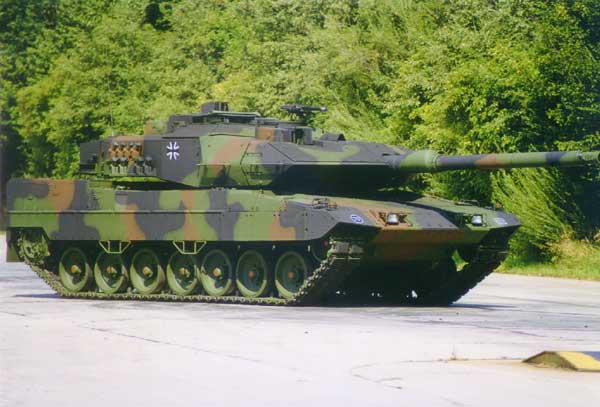 NTM |
|
"You making this up? About the only thing I'll give you is that it's slower on flat ground than the M1, mainly due to gearing. And even at that, not by much. Turret roof is 20cm higher, mainly because they actually put armour on the thing, but hull length and width are as near the same as makes no difference. (And the tank is overall shorter, making it handier in towns)" Nope, not making it up. For one thing, it's significantly slower than an M1 or M1A1 on ANY type of terrain. On flats I'd put it close to 20 mph slower. The height difference is because of the requirement to put infantrymen inside. The armor choices were based on what the tank was designed for. I've crewed an M1 (but not an M1A1) and granted, I've got a lot more experience on an M60A3. I've also driven a Merk (twice - no long term experience). You're right the Merk is handier in towns - but it was designed to be a low intensity conflict tank. That's what the israelis needed at the time - remember, it was designed at a time when they were still recieving a large number of M60 and M60A1s but they were retiring Shermans. BTW - you might want to do some reading up on the leclerc and Iraq. |
Bear in mind that Merk's engine has been upgraded a few times. When Merk came out, top speed was a whopping 45km/h powered by a 900hp engine. Merk IV's got a 1,500hp engine, the same as M1 does: M1 has gotten slower over the years as the tank's gotten heavier and the engine weaker, Merkava's gotten faster. Note also that the Israelis have gone from the Centurion-style bogie suspension of early Merkavas to an independent spring system, whilst M1 has retained the same torsion bar system all the way through.
Merkava was initially designed as a result of the 1967 war, hardly a low intensity conflict. The first prototype was built in 1974 with the lessons of 1973 very reasonably much in mind, and were used in Israel's first low-intensity fight in Peace for Galillee. The troop compartment was not originally designed to carry troops, but to allow resupply and crew evac without anyone having to stand on top of the tank visible to all and sundry. They then figured out that the space could also be used to carry extra ammunition, a toilet, and finally, troops.
Where should I be looking? The last time the French were involved in Iraq was 1991, when they were still using AMX-30s. The only export customers have been UAE, but I am unfamiliar with any UAE involvement in Iraq. NTM |
Not wishing to cause offense, but if your hands-on dates back to the Merkavas which were around back in the US Army's IPM1/M60A3 days, then no, not particularly. They've been drastically upgrading the tank since then, far more so than we've been upgrading M1 and the qualitative comparisons of the time just don't apply today. If the topic was a comparison between IPM1 and Merkava I/Merkava II your hands-on would be a lot more applicable.
Please. I'm fairly sure I'm not wrong, but I'd rather suffer the embarassment of being proven incorrect than continue posting false info.
Good night, so. NTM |
And the best cross country mobility of any MBT. Its front tube depression used to be one of the best. It was designed and built specifically for their needs. They could have had M1s but preferred the Merkava. |
Having the best tank isn't what is important. The most important things about tanks are logistics, training, good tactics, and leadership. Most nations can barely afford to train or supply their tank forces effectively because its SOOOOO expensive. Mediocre tanks in well trained tanks will beat a poorly trained tanks with best shit most of the time. History has proven this time and again. |
qft |
Surprisingly, no, not really. With the long front overhang, max depression is limited to 8.5 degrees in the Merk I, dropping to 7 degrees in Merk III. Compare to 12 degrees for Type 74, 10 degrees in M1, Challenger 1, Chieftain, M60A3, K1, and 9 degrees for Leopard 2 and 8 degrees for AMX-30 and Leclerc.
The Israelis themselves don't claim to have the best tank in the world. They claim to have the best tank for Israel.
This is very true. However, it's not the tank designer's fault if the government who buys it doesn't bother training the crewmen right. NTM |
| leo2 have seen some use in Afghanistan, Canada has bought and deployed a few...If your military is on a budget, theres lots to be said for buying your MBT off another country and let them do all the R&D. I dont think Canada even has a factory anymore that could even produce a MBT if we wanted to as I think the last one closed down in the 70s? |

Somewhere i read it had a cranking front tube depression. SPecifically for reverse slope and using hills for cover. hmm, was it in combination with user adjustable suspension? |


If the FCS program ever ends up fielding more then power-point presentations I will be very surprised. |
At least they are working on something 
|
My main problem with the FCS is they started with the goal of building an army that could be more rapidly deployyd anywhere in the world. To do this they decided to size the vehicles to our existing airlift assets. That is not the way to build a more capable force. The better way to go about the problem would have been to build a more traditional next generation MBT and invest the lions share of the funds in next generation high speed transports for the Navy or develop blue sky solutions like Lockheed Martins 'Walrus' hybrid airship proposal or Boeings 'Pelican' Wing in Ground Effect proposal. |
Exactly... And note that I said *STARTED* because at one time 'common chassis' a-la Stryker was a goal... FCS = tank cheaper, smaller, faster... With an infantry-style 'commo uber allis' attitude, as if the tank's primary weapon should be it's moving map & comm system... 'Network Centric' & all... Survivability gets a back-seat to all of that... |
|
The M1 series are excellent tanks. However, the Challenger II's are newer, and have Chobham II armor, called Dorchester. It has a lot of hunter-killer improvements in targeting, and seems to be heavily armored 360 degrees. It also has "kits" to add extr armor to the sides, and over the tracks for urban warfare. One suffered a mobility kill, and took something like 37 RPG hits, the veiw ports were all ko'ed, but the armor held, and the crew was uninjured, and that tank was recovered, and fixed. Merkava, supposedly was designed with crew survivabilty as the top priority. It is supposed to have unmatched rough terrain agility. The Merk also mounts a 60mm mortar that can be fired from inside the turret, for self defense. Kits enable it to mount additional remote controlled MG's. Both the Challenger II and Merkava also have A/C for the crew. Not to mention the Merk has a 50 gallon water chiller. Kind've important when fighting in ungodly hot areas. The Leopard 2A5, excellent gun. Heavily armored turret. With bolt on modular armor. It has good speed. 1,500 hp diesel goodness. Uses less fuel than an Abrams undermost conditions. The Abrams seems to be weaker against side/rear threats than some of the other tanks. Gunnery, all use the similar 120mm guns. Although the Germans are putting longer guns in some of their tanks. The Abrams was designed at a time when the US was worried about waves of USSR armor sweeping through Europe. It would be at it's best fighting in a massive tank battle. In a 360 degree battle, the Challenger II or Merkava III/IV are better protected. |
 I think Manic_Moran is about the last person on ARFCOM that you would try to educate on military armor.  |
You do know that M1's had higher top speeds than M1A1's, because the rear gearing ratio was changed when M1A1 production was started. The govenors were also made tougher to remove. Some M1's that were rebuilt into M1A1's kept the M1 spec final gearing howeever. The Merk has it's engine up front, not so infantrymen could be stowed in the rear, but because the Israeli's wanted the engine up front to make it tougher for a round to pentrate the front of the tank, and get into the crew compartment. That 900-1200 or 1500 diesel is is suppoed to take a round instead of the driver. They put it up there as "extra armor". When they moved it up there, it meant there was open space in the rear. That can be used to carry troops or supplies, but generally isn't. Extra ammo can be stowed there. |
I've been proven wrong before on this site. As far as FCS is concerned, I remain cynically unconvinced. Still, I'll be attending the Armor Conference here in Knox next month, well, month and a week, so I'll see what they can do to give me faith with the latest and greatest public info.
You sure you weren't thinking of the Japanese tanks? NTM |