


Posted: 10/3/2014 9:33:11 PM EDT
|
Edit
I bring you a new problem. 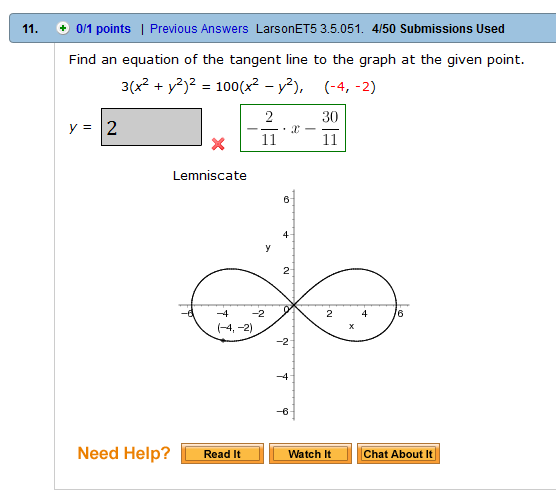
|


|
Ok, you want to use your calculated slope and the point they provide in conjunction with the point slope formula for a line for part a.
Part B you can easily rule out the two lines that are not tangent to the curve. To decide on the answer plug in 0 for x and know that the sine of 0 is 0. |
|
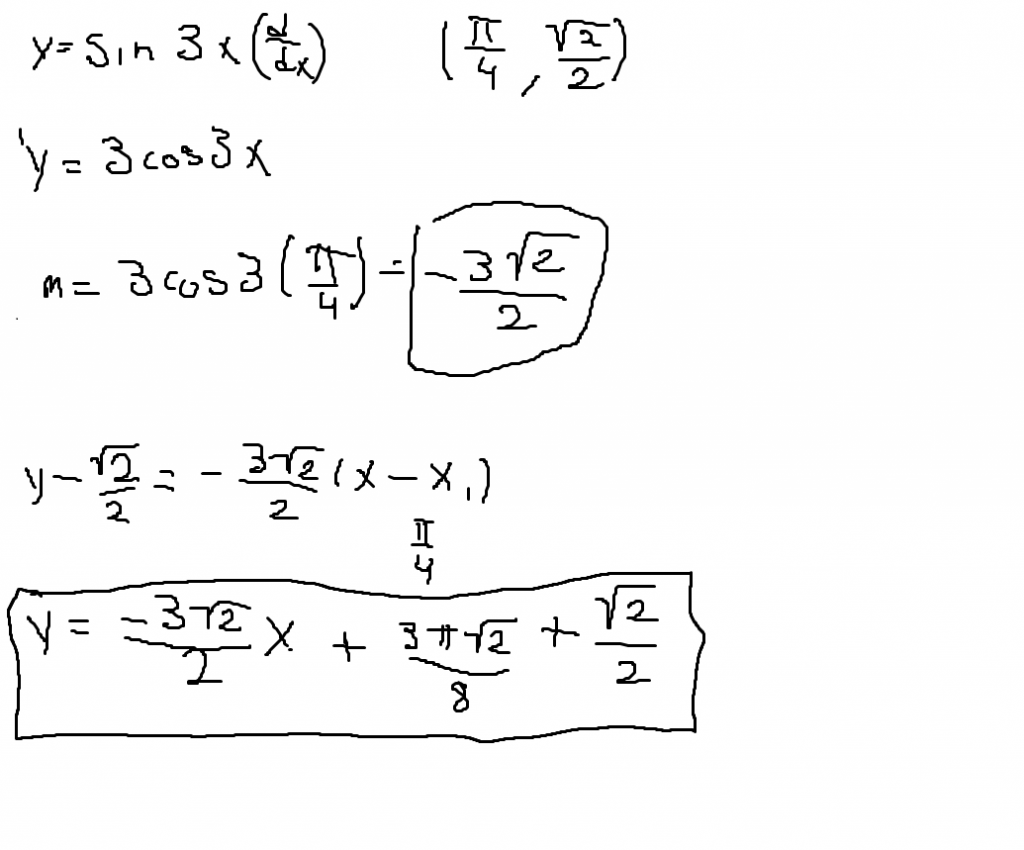
The derivative of sin(3x) = 3cos(3x)
[I think you show it as 3sin(3x) if I am reading your solution correctly.] So the slope m of your tangent at the point y=pi/4 is 3cos(3pi/4), and it must go through the given point, which you can plug into m(y2-y1)=x2-x1 and solve for y2 in terms of x2. But I don't have a calculator handy. I think the top right graph is the right answer because it goes trough the given point and is tangent to the curve at that point. Not sure. |
|
The original equation does not have an amplitude of 3, so graph a is incorrect. If so, it would be 3sinx. Graph b is the only other one that has a tangent line to the graph at pi/4, so graph b it is And the derivative of the sine function is cosine And you write d/dx in front of the expression you are differentiating. |
|
Quoted:
The original equation does not have an amplitude of 3, so graph a is incorrect. If so, it would be 3sinx. Graph b is the only other one that has a tangent line to the graph at pi/4, so graph b it is And the derivative of the sine function is cosine And you write d/dx in front of the expression you are differentiating. turned out my answer was correct. i just forgot to put a negative in front, and devided by 3 instead of 2 because of a type. when you pull ou the d/dx you bring it to the front to multiply |
|
Do you even rise over run, bro? |
|
Quoted:
Edit I bring you a new problem. http://i1270.photobucket.com/albums/jj606/roebuck1020/Capture_zps453fa638.png its pretty obvious the tangent line is going to be negative... you loose points for problem awareness there... |
|
for your new problem:
Take derivative with respect to x and make sure to chain rule the y^2 (that is, d[y^2]/dx = 2y*y') solve for y' with (x,y)=(-4,-2) (you get -2/11) solve y = (-2/11)x+b for b with (x,y)=(-4,-2) The end. OP, please take note: the process for these problems is ALWAYS the same. 1) take derivative 2) solve for y' 3) solve for b. It doesn't matter what the equations are. ETA: InfiniteGrim: he put y=2 as his answer. |

|
I'd do it!
Quoted:
A seXy potato http://images.sodahead.com/polls/001559173/301659831_sexy_potato_answer_2_xlarge.jpeg Quoted:
Quoted:
Umm, potatoe, what do I win!  A seXy potato http://images.sodahead.com/polls/001559173/301659831_sexy_potato_answer_2_xlarge.jpeg |