


Posted: 1/6/2010 2:52:10 PM EDT
|
So I'm having a new house built, and the basement floors are poured concrete. Slab is about 4" thick, over about 6" of gravel, with rebar and a 6 mil vapor barrier in between the rock and the 'crete.
While checking things out yesterday I noticed that the floor has developed several cracks, typiclly forming at a corner (like corner of chimney, corner of poured concrete wall). The cracks are "hairline" in character. Builder says it's normal, and "the only way to keep your conceret floor from cracking is not pour one". I trust the guy, but wonder what the hive opinion is. Do I need to be worried? Also, most of the floor will eventually be covered with carpet, the only exception is the laundry room where we're leaving it bare. Here's what the floor looked like a few days after pouring. No pics of the cracking, will get them soon. 
|
| I've heard the same thing...a slab of concrete that big is on top of something as 'fluid' as dirt is going to flex a little and cracks are inevitable. We have them in our house and when we bought it, the home inspector pointed them out to us and said "you'll see these in every single home of this age...nothing to worry about". The house was 15 years old at the time. |
|
He's pretty much right. If you have concrete that doesn't have a crack in it anywhere just give it a little while.
Of course unless you pour a slab with over the top rebar and add fiber to the mix, well I take that back, I've seen those cracked as well. Hairlines are no big deal. If they open up to 1/2" plus in the near future you may have settlement issues that weren't properly addressed during the ground prep. (Shitty compaction) Posted Via AR15.Com Mobile |
|
Quoted:
After the ground work was done, how long had it settled before the foundation was poured? And how long has the foundation been down? I'm gonna say it was several weeks after the gravel has been laid that it was poured. Footings were poured seperately, a few weeks before that. Aagin, there's 4" of concrete and about 6" of gravel under that. Dirt under that looked like this (NO fill, basement was cut into the hillside. I assume compaction won't be a major issue): 
Here's the footings. 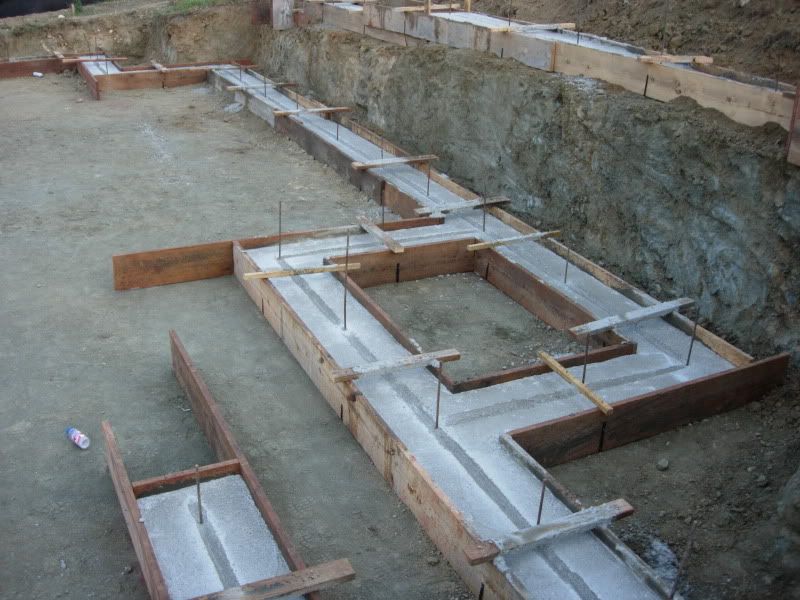
Here's the gravel 
|

| I tested concrete as a technician for a while and superficial cracks are normal, so long as they are small/shallow. Your description of hairline makes me think they are. If you are afraid they will get water in them and grow you can just seal them with a thin layer of silicon I would suppose but I wouldn't worry too much. Generally speaking, the concrete in a home foundation is much stronger than necessary. |
|
A concrete slab will usually crack from a inside corner like the chimney if there is no saw cut. I see it looks like they saw cut joints in the slab, these are to control the cracking (Try to make it crack along the cuts and not just wherever it wants.) I'm a building inspector for a private engineering and testing company and I see new slabs all the time and yes they do crack even when saw cut just after finishing. |
|
Quoted:
One thing I am not seeing is supplemental grey beams ... and basically that is simply a small "footer" that runs thru the interior or the footings themselves, and is there a reason that they didnt dig any of the footers and were lazy and formed em on top ? Forming them up is more labor intensive. Just "digging them & ground forming" is the lazy way. |

|
Quoted: Back in the day I seem to remember that the basement floor wasn't poured until after the house was weather tight. This is how we did my basement and garage. I had almost no cracking in either one at first, but the garage ended up cracking right along it's joints after awhile just as the guys that poured it said it should. They've both held up great. OP, are you going to pour the walls too? I was nervous when I found a hairline crack all the way down in mine and my poured wall guy said it would be ok. 12 years later now and it hasn't changed nor has it leaked. |
28 years as a Construction Manager. I seen a few slabs poured 
As others have said, concrete cracks. It's the nature of the beast. The key to minimize cracking (beyond the proper mix design) is proper soil/sub base prep and proper curing. The sub base needs to be sufficiently compacted. If it was warm/hot after the slab was poured your contractor could have "wet cured" (poly cover with periodic sprinkling of water) and the use of a curing compound. Control joints should be sawcut approx. every 10 feet (for a 4" slab) taking into account columns, your chimney base, etc. Apart from the control joints (couldn't really see them in your pics) it sounds like your contractor did the right job for you. IM if you have any questions. |
|
Hairline cracks on the finish of the slab are normal and inevitable. Saw-cutting control joints will help, but are not practical for residential foundations. Deep cracks, however, are not. Those are due to either a bad geotech survey (or ignoring a good one), poor design (based on said survey) or improper reinforcing steel. |
|
Quoted:
I believe wobblin-goblin is a concrete guy. Shoot him a pm...he's good people. Posted Via AR15.Com Mobile Thanks, bud. 
As far as cracking goes, your contractor is correct: Concrete naturally cracks and it almost always cracks off inverted corners like your chimney. There are ways to cut down on the risk factors (pour the concrete stiffer, make sure the material under the concrete is good quality and compacted well, put expansion material such as rigid insulation around the perimeter of the floor against the walls and pour against that- it allows the floor to move, and using reinforcement such as fiber, rod, or wire). From my perspective looking at the picture it looks like you've got a decent floor and I wouldn't worry about the cracks off your chimney, etc. |
|
As has been said, these are probably shrinkage cracks, and nothing to worry about. Normal.
HOWEVER: If they get larger than hairline, get in touch with the builder (or sub, if you're the GC). Especially if, at any point, the sides of the cracks develop a height difference of more than a sixteenth or so ( the sections divided by the crack become obviously out of plane) then you've got an issue with poor compaction & differential settlement. That's a problem. Just as an aside, is the builder providing you with Releases of Lien from the subs when you make progress payments? |
|
Quoted:
One thing I am not seeing is supplemental grey beams ... and basically that is simply a small "footer" that runs thru the interior or the footings themselves, and is there a reason that they didnt dig any of the footers and were lazy and formed em on top ? Forming vs. dug footers are largely a regional variation, I wouldn't be too worried about that, either way. When I built houses, we'd get a footing contractor in with a backhoe, and he'd dig and pour 'em. Occasionally the framing crew needed work, and they'd build the forms and pour. I'd save some backhoe time, and the same guys that poured were going to be framing on top of the foundation later. And they didn't want the headache of out-of-square walls to deal with, so they were careful with the layout. Regarding graDE beams..... If the floor system involves I-joists or floor trusses engineered to handle long spans (from foundation wall to foundation wall), there would be no need for a basement bearing wall, and therefore no grade beam would be required. |
| I am a contractor and have built alot of houses.Concrete does crack due to setteling,but it is not usual for it to crack rite away like yours.It is the freezing of water under ground that usually causes the concrete to raise up and crack or the ground sinking like a pothole unevenly.If your slab is getting cracks as soon as it was poured then I would guess the ground had fill you dident know about or the area your house sets has another type of recent ground changes.In my openion it is not normal for an inside slab to crack so fast.Usually with new construction work like yours the interior slab will not crack at all.I have lived in 2 of the houses I have built for several years and still live in one.Neither have any cracks on the lower floor slab.When people tell you concrete cracks and that is what to expect ,it is common knowledge,That is true but on exterior concrete that is not protected from freezing.Interior concrete protected from freezing will not crack if the ground is prepared correctly. |
|
Quoted:
One thing I am not seeing is supplemental grey beams ... and basically that is simply a small "footer" that runs thru the interior or the footings themselves, and is there a reason that they didnt dig any of the footers and were lazy and formed em on top ? The footers shown in the pic are actually on top of a trench dug that had concrete poured in it. Then, once that cured they set up the forms and poured the footing on top of that. Then, they came back and set up the forms for the poured basement. Here's the area after the walls are up but before the floor is poured. Also shows the trenches they dug in the gravel for support for the interior load bearing walls. 
|
|
Quoted:
As has been said, these are probably shrinkage cracks, and nothing to worry about. Normal. HOWEVER: If they get larger than hairline, get in touch with the builder (or sub, if you're the GC). Especially if, at any point, the sides of the cracks develop a height difference of more than a sixteenth or so ( the sections divided by the crack become obviously out of plane) then you've got an issue with poor compaction & differential settlement. That's a problem. Just as an aside, is the builder providing you with Releases of Lien from the subs when you make progress payments? Yes, we get the lien releases. |
|
I cut concrete for a living. All concrete cracks period!
Where you are located, Is it required to put rebar in a 4" basement slab? 4" concrete with bar will tend to crack where the bare is. Wire mesh in the bottom 1" of the slab would have been a better choice. Though that shit can make it a real PITA to cut and demo a slab. From the pictures your slab looked good. Did he use a Soff-Cut saw to cut in the joints or did they green saw it? I see the slurry from the cuts in the pics. |
|
like lightning link said, I am also an inspector for a large engineering firm and test lab. I also have years of experience placing concrete, both commercial and residential.
I can tell you this. You can run a compactor, plate or roller, over crushed stone all day and it won't do much other than consolidate a few minute voids. That being said, the base material dosn't seem to be the culprit. Slabs on grade are usually poured on a processed stone up here, generally with a proctor of 155+p.s.f., again, that being said, that base material looks like crushed stone and not gravel, i.e. few small particles to fill the voids between the bigger pieces...i.e. "well graded material", when you would really want a "poorly graded material" i.e. pieces of all different sizes as opposed to all uniform pieces. I have a distinct feeling that with better fine grading of the stone, or by adding some fines and running a compactor over it, you wouldn't have the spider cracks around the chimney. You basically have this large structure with a great bearing pressure. Any slight imperfections in the base will be reflective through the 'crete, very similiarly to asphalt that has been overlaid over raveled pavement. Was the brick laid directly on the slab, or was it placed on a seperate footing and then poured around by the slab? Im not saying anything is wrong, but I'd bet it could have been prevented with more careful planning. It's after the fact, but this is a home, and the cracking is in the basement, who cares...if it bothers you, fill 'em in with fine grout. |
|
Where you are located, Is it required to put rebar in a 4" basement slab? 4" concrete with bar will tend to crack where the bare is. Wire mesh in the bottom 1" of the slab would have been a better choice. Though that shit can make it a real PITA to cut and demo a slab.
From the pictures your slab looked good. Did he use a Soff-Cut saw to cut in the joints or did they green saw it? I see the slurry from the cuts in the pics. Now that i think about it, the only rebar in the floor is around the edges, where they've got that hard foam insulation. I have no idea about the joints, or even if there's joints. There's certainly no visible joints now. Was the brick laid directly on the slab, or was it placed on a seperate footing and then poured around by the slab?
Well, the brick's a veneer. walls are sold poured concrete. But yes, the walls are on seperate footings and were poured before the "slab". |
|
Quoted:
Quoted:
Quoted:
just noticed that last pic- was that base rock compacted before they poured? Well, they did drive a tracked Bobcat over it to spread; I wasn't on site but it looked like it was packed pretty well. Hmmm... Tracked vehicles don't compact material worth a shit. A regular wheeled bobcat compacts much better. Having said that, you can't really compact crushed stone as it simply just moves around like marbles. |
|
Quoted:
the masons I work with say concrete does 2 things: it dries, and it cracks they usually cut relief lines to control where the cracks are though I work for one of the largest construction companies in the world. We build roads, bridges, dams with hundreds of thousands of yards of concrete every year. Trust me, the above is true. |