


[ARCHIVED THREAD] - DI vs Piston (Page 1 of 2)
Posted: 11/16/2008 11:28:52 AM EDT
|
I have got into an argument with a friend who is Special Forces about whether the M16/M4 would be greatly "improved" or not if it had a piston. My case is that, the DI system is just fine, and the only times when I was in the Army that we had problems with our weapons was when the parts got worn out, or when someone didn't keep the bolt wet.
His argument is that the DI system gums up the bolt and such and allows for the weapon to fire alot more rounds without needing to be cleaned and such, plus he says that a Piston helps to make SBRs bullets fly at greater velocity than the DI system. So my counter is that well, Stoner was asked about whether the DI system had a major flaw in that it would gum up the bolt, and he simply said that it can only gum up so much as the rest of blow out of the ejection port or something like that. I also explained that all of our Machine guns operation on gas pistons, and these things would sometimes jam more often than our M4s, and if the gas piston was so great, they should never jam. But whatever. Who is right? Or are there strong cases for both systems and both have their own flaws? Personal preference maybe is all the difference is as far as performance? Again, I've never had a problem with the DI AR-15/M4 unless I didn't wet the bolt or a part was worn out and needed to be replaced? |
|
Quoted:
Quoted:
Quoted:
plus he says that a Piston helps to make SBRs bullets fly at greater velocity than the DI system. QUE? 
LOL. I know... I was thinking the same thing. Less gas diversion away from the projectile, I'm guessing is his line of thinking. Never seen anything to verify that. |
|
Quoted:
Quoted:
Quoted:
Quoted:
plus he says that a Piston helps to make SBRs bullets fly at greater velocity than the DI system. QUE?
LOL. I know... I was thinking the same thing. Less gas diversion away from the projectile, I'm guessing is his line of thinking. Never seen anything to verify that. Yeah, of course, that is what he ment, but I don't think it makes much of a difference at all. |
|
The M16 is a rifle, not a submachine gun, not a crew served weapon. One could not carry enough ammo to make it "gum up".
As far as external dirt, MODIFICATION of the Stoner M16 to use a piston has one major problem, it IS NOT THE GAS SYSTEM THAT JAMS FROM EXTERNAL DIRT. It is the bolt, carrier and locking lugs. No piston conversion substantially changes these parts to confer greater resistance to EXTERNAL dirt. And lastly, piston modifications place asymmetric loads on the carrierr, causing it to "pitch up" in the upper receiver due to clearances between the carrier and the upper/buffer tube. Aluminum uppers work because as designed, there are minimal asymmetric loads. Piston conversions place high bearing loads on the upper, accelerating wear. Lastly, the dirt on the bolt face proper is considerable. Since the spent case is IN CONTACT with the bolf face until long after the carrier key unports the gas tube, the dirt in the action cannot be from the gas tube alone but also from the bore. This is well-known in artillery like that on tanks. To prevent such "backwash", tanks employ a device known as a bore evacuator. Such a system would prove far more effective to reducing chamber/action debris from firing than any "piston" conversion. |
|
Quoted:
Quoted:
Quoted:
Quoted:
plus he says that a Piston helps to make SBRs bullets fly at greater velocity than the DI system. QUE?
LOL. I know... I was thinking the same thing. Less gas diversion away from the projectile, I'm guessing is his line of thinking. Never seen anything to verify that. There are studies to the contrary. Where a valved gas system modification was fired over a chronograph with the gas system shut off an normal. Bullet velocity was HIGHER when the gas system was functional than with it off. High pressure gas physics are strange. |
|
Quoted:
Quoted:
Quoted:
Quoted:
Quoted:
plus he says that a Piston helps to make SBRs bullets fly at greater velocity than the DI system. QUE?
LOL. I know... I was thinking the same thing. Less gas diversion away from the projectile, I'm guessing is his line of thinking. Never seen anything to verify that. Yeah, of course, that is what he meant, but I don't think it makes much of a difference at all. If you set about producing a piston system with that goal in mind you could probably produce verifiable results, probably not enough to bother thought. Remember the Nagant "Gas seal" revolver. Specialized ammo and sealed cylinder actions produced about 50fps difference. Not really A relevant gain. |
|
Quoted:
I have got into an argument with a friend who is Special Forces about whether the M16/M4 would be greatly "improved" or not if it had a piston. My case is that, the DI system is just fine, and the only times when I was in the Army that we had problems with our weapons was when the parts got worn out, or when someone didn't keep the bolt wet. Piston guns offer significant advantages when you use a lot of full auto, when you need to run a shorter than M4 configuration, or when you need to run a suppressor. Piston guns don't crud up the action OR burn off lube like DI guns do. Somewhere around this site there are pics from AR discussions moderator KevinB's H&K 416 with 1,000 suppressed rounds through it vs a DI AR with a lower count of suppressed rounds through it. The difference is stark. Users that have to be farther away from lines of support may well find that the longer service life of critical components offered by piston guns to be a significant advantage. Fewer cracked bolts would be a good thing if you're the kind of guy sitting on a hillside overlooking an AQ stronghold. The M4 configuration is a good setup for a DI AR...but when you cut the gas system in half, put a suppressor on it and start shooting lots of FA through it you start to encounter problems. Piston systems like the 416 do offer some significant advantages for some folks. |
|
I prefer the system the gun was originally designed to work with. I'm no more interested in a gas impingement AK than I am in a piston AR. I've learned my lesson on re-engineering existing products, or buying kits that do it. You're spending your money to do someone else's beta testing, turning a mature, battle tested product into an untested, immature one, and you're winding up with a machine that will be either difficult or costly, or both, to get parts for. |
|
There is NO imperical evidence (that I know of) showing that a piston-converted AR15 is more reliable than standard DI.
In fact the ONLY evidence I've seen in the piston's favor is that the H&K's 416 did better than the M4 in the Govt's sand test. But with all the changes H&K made to the AR15 to get to the "416", I doubt that one can say that it "proves" a piston to be the better choice. Only that the H&K 416 might be the better choice. Anyone heard of the scientific method? (it was jr. high, I know....) Is there evidence out there that I don't know of? I like the theory of a piston-AR, so if there is, someone please tell me! Tex78 |

|
Quoted:
Piston. Just because I think they're aesthetically and technically very neat. 
It's sort of how full-length guide rods on a 1911 look cool, but don't really offer any real advantage. 
What? How is a pistol AR any different aethetically any different from a DI AR? You can't see the difference if you've got standard handguards and if you have rails you actually need to peer into the holes to see the piston. |
|
Quoted:
Quoted:
Piston. Just because I think they're aesthetically and technically very neat.
It's sort of how full-length guide rods on a 1911 look cool, but don't really offer any real advantage.
What? How is a pistol AR any different aethetically any different from a DI AR? You can't see the difference if you've got standard handguards and if you have rails you actually need to peer into the holes to see the piston. I think pictures like this are pretty neat: 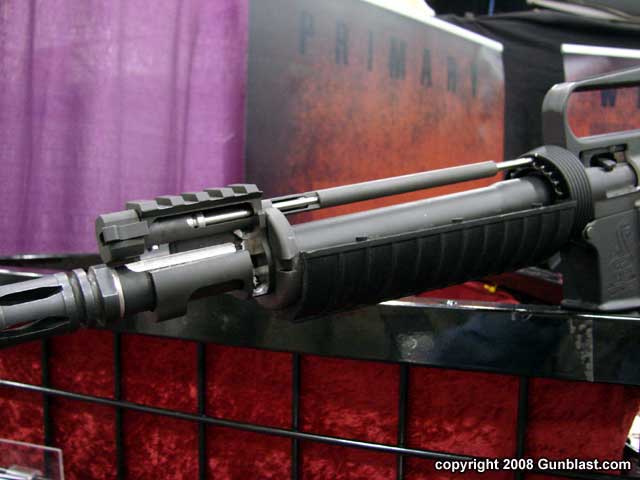
|
|
the real advantage of pistons, is that less heat/pressure is transferred to the bolt carrier.
there are disadvantages to piston designs -decreased accuracy -increased amounts of parts -more complicated takedown procedure -parts are subjected to increased stress -increased recoil -increased weight im not against piston designs. they have their place, but are not as perfect as others claim them to be. |
|
I like how there is no piston to fuck with. My FS2000s little piston is a PITA. You also save some weight up front. The AR fires really smooth compared to my AKs and my FS2000. The latter two have a more abrupt kick to them.
It doesn't get much more simple than a 12" tube. |
|
Quoted:
the real advantage of pistons, is that less heat/pressure is transferred to the bolt carrier. there are disadvantages to piston designs -decreased accuracy -increased amounts of parts -more complicated takedown procedure -parts are subjected to increased stress -increased recoil -increased weight im not against piston designs. they have their place, but are not as perfect as others claim them to be. The AK is simple to take down, but it's an outdated weapons system. You can't really do much with it in terms of technological add-ons |
|
Quoted: Bologna. I have a number of gas piston ARs. Accuracy is not worse than any of my equivalently outfitted DI ARs.the real advantage of pistons, is that less heat/pressure is transferred to the bolt carrier. there are disadvantages to piston designs -decreased accuracy -increased amounts of parts -more complicated takedown procedure -parts are subjected to increased stress -increased recoil -increased weight im not against piston designs. they have their place, but are not as perfect as others claim them to be. |

|
Heat on the bolt/carrier? The M16 isn't designed for that kind of fire rate. M60s and M2s are also not able to take sustained FA without barrel changes and they have Stellite lined bores to cope with the erosion.
Design intent of Gene Stoner was a RIFLE, not a machine gun. And a lightweight rifle using modern materials. For example, the lower, if made of steel, would be over a pound heavier. The barrel profile is such to minimize weight and DI removes any firing time deformation from reciprocating masses above or below the barrel centerline. The gas tube imparts minimal force off the neutral axis of the bore and keeps all moving masses axial to the bore, that is the key to accuracy. Sure, it can take a LITTLE automatic fire. But it is a RIFLE, not a machine gun. Primary purpose dictates design. Even the M231 FPW was designed for limited use, accuracy was NOT a primary purpose and the lack of sights reflects this. As in the requirement for 100% M196 tracer as that is how fire was directed, through the sighting ports immediately above the firing port. Now that the Bradley has lost all but the rear ports and massed infantry tactics are passe, it holds on only out of legacy. |


|
Quoted:
Please excuse my lack of knowledge on this subject, but, do you guys see the piston system going anywhere other than the commercial market? No way. The original system has but 8 unique components. Far more unique parts in any external piston system. Besides, the dirt that stops the system isn't from the gas tube. Most of the omplaints over the DI system is from the cleaning chore. This wouldn't change with a piston, there still will be dirt in the piston which has to be cleaned. Some of the piston shapes would be very hard for GI Joe or Grunt to clean easily. One of the changes in design over the years was the drilled pivot pin. This was done to ELIMINATE one tool in the unit armorer's tool kit, that being the pivot detent removing tool as a small pin punch, already in the tool kit, can be used. Trust me, the US Army Ordnance likes to make things simple. |
|
Quoted:
The only people who are going to notice a degradation in precision are precision shooters who are already at the edge of the design and are shooting 1/2 moa. Remember, when Stoner was developing the rifle, the barrel was 20" in length and quite lightweight. Shorter barrels are stiffer, reducing the effects of an externally mounted gas piston system. Plus, many of the external piston designs have heavier, shorter barrels. |
|
Quoted:
Lastly, the dirt on the bolt face proper is considerable. Since the spent case is IN CONTACT with the bolf face until long after the carrier key unports the gas tube, the dirt in the action cannot be from the gas tube alone but also from the bore. This is well-known in artillery like that on tanks. To prevent such "backwash", tanks employ a device known as a bore evacuator. Such a system would prove far more effective to reducing chamber/action debris from firing than any "piston" conversion. I now so want a barrel with a bore evacuator. 
|
|
Quoted:
Quoted:
Bologna. I have a number of gas piston ARs. Accuracy is not worse than any of my equivalently outfitted DI ARs.
the real advantage of pistons, is that less heat/pressure is transferred to the bolt carrier. there are disadvantages to piston designs -decreased accuracy -increased amounts of parts -more complicated takedown procedure -parts are subjected to increased stress -increased recoil -increased weight im not against piston designs. they have their place, but are not as perfect as others claim them to be. i have not experienced the higher priced guns, but have shot some of the retrofit kits, all with 16" barrels. they have all shot consistently less accurate than DI from a rest. maybe it was the kits, but its just my experience. |
|
Piston is a gimmick that answers a question that doesn't really need to be asked.
Seriously if you keep your weapon clean and you should it is not a problem. People who do not clean weapons are idiots. Even AK47 should be kept clean. The mythical weapon that has been laying around in a mud puddle has never been in my hands. In the Corps and out my weapons are clean. |
|
Heres my humble take:
If the firearm was designed from the start with a piston, good. I prefer piston guns, i put all my eggs behind a swissed up AK, the Sig 556. AR's need to be DI, i think the extra weight of adding a piston to the top of the bolt throws off the balance of the rifle. |
John Q. Public might consider the Stoner system a direct impingment system, but it is a long way away from a pure DI rifle. This is a DI rifle:

The MAS system is also a direct gas system. The AR has a piston, it's called the bolt. The gas is simply transported to a rear gas chamber otherwise known as the carrier. Would a true DI weapon have piston rings? PS: This is a pet peeve of mine... |
|
Quoted:
Quoted:
The only people who are going to notice a degradation in precision are precision shooters who are already at the edge of the design and are shooting 1/2 moa. Remember, when Stoner was developing the rifle, the barrel was 20" in length and quite lightweight. Shorter barrels are stiffer, reducing the effects of an externally mounted gas piston system. Plus, many of the external piston designs have heavier, shorter barrels. Good point. Have you ever seen wear on the inside of a piston upper from carrier tilt? |
|
the only reason there is any debate on this subject is because 90% of the folks who have any kind of exposure to the AR15/M16 series have little understanding of how it actually works; most *mistakenly* think that the gas travels down the tube and "squirts" the carrier back (i can't tell you how many people i've met that think this). even worse is the throngs of folks who have NO exposure to the system who repeat what they've been told by the folks that don't know what they are talking about. |
|
Quoted:
Quoted:
Anybody have photos of a DI and Piston upper from inside the chamber? I would like to see the difference because I never have before. Why would the chambers be any different? I don't know that is why I asked. Is there a difference when looking from inside the chamber? |
|
Quoted:
Quoted:
Quoted:
Anybody have photos of a DI and Piston upper from inside the chamber? I would like to see the difference because I never have before. Why would the chambers be any different? I don't know that is why I asked. Is there a difference when looking from inside the chamber? Nope. I don't know about uppers that are purpose built to run pistons, but as far as conversion kits go the only difference is the gas port. Some of the kits require that you ream out the gas port before you install the piston assembly, but as far as the chambers go they are identical. |
|
Quoted:
Piston is a gimmick that answers a question that doesn't really need to be asked. Seriously if you keep your weapon clean and you should it is not a problem. People who do not clean weapons are idiots. Even AK47 should be kept clean. The mythical weapon that has been laying around in a mud puddle has never been in my hands. In the Corps and out my weapons are clean. I have a POF & I am an idiot.  I clean it, but sometimes weeks after a trip to the range, or after several trips to the range. Never misfires though. I clean it, but sometimes weeks after a trip to the range, or after several trips to the range. Never misfires though.

|
|
Quoted:
John Q. Public might consider the Stoner system a direct impingment system, but it is a long way away from a pure DI rifle. This is a DI rifle: http://img.photobucket.com/albums/v477/DriftPunch/ag42b.jpg The MAS system is also a direct gas system. The AR has a piston, it's called the bolt. The gas is simply transported to a rear gas chamber otherwise known as the carrier. Would a true DI weapon have piston rings? PS: This is a pet peeve of mine... More than a few still believe it. We call them "obama voters" |