


Posted: 10/31/2013 6:34:12 PM EDT
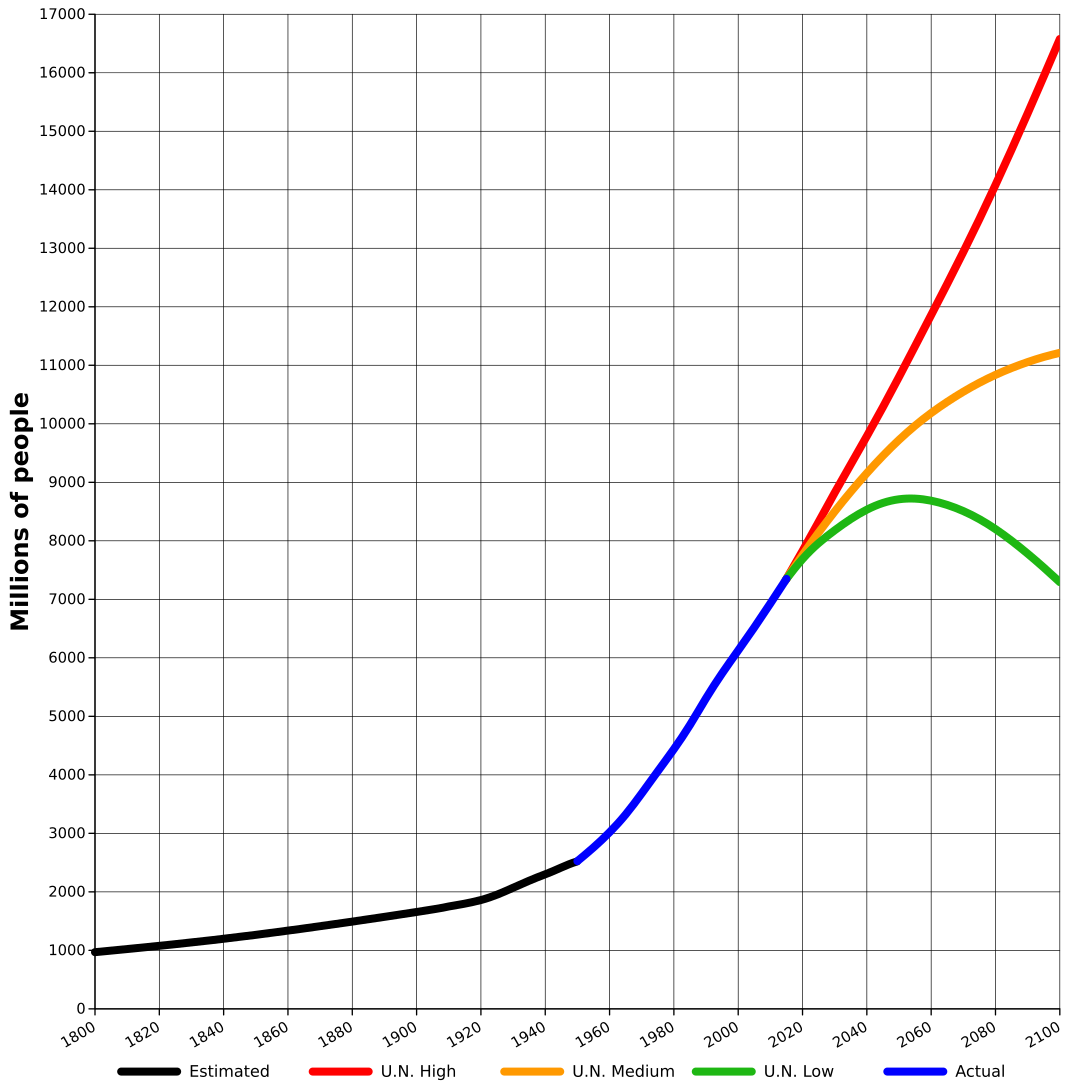
We've more than doubled our population since 1960. Is this a problem? If so, how should we address the issue?
|

|
Population growth?
Well, that's part of it, but the bigger issue is population density. Plenty of land for the world population to spread out on, but it doesn't. It concentrates in the same damn areas creating super cities that are more and more difficult to administer. These densely populated areas will be breading grounds for new viruses and especially in third world nations like India and China I think we're going to see some pretty bad diseases popping up. |
|
Quoted:
Nope. Most first world countries the population growth is negative. It'll catch up around the world. Secondary question: Why would the "third world" population be growing when they lack the medical technology and food production of "first world" nations? |
|
Quoted:
Secondary question: Why would the "third world" population be growing when they lack the medical technology and food production of "first world" nations? Quoted:
Quoted:
Nope. Most first world countries the population growth is negative. It'll catch up around the world. Secondary question: Why would the "third world" population be growing when they lack the medical technology and food production of "first world" nations? No family planning and no birth control. Dependence on large families to help with agricultural production on their poorly managed family farms. Lack of any financial knowledge or government social security like plan for retirement also means the parents in third world nations are more dependent on large numbers of children to support them in the elder years. |
|
Quoted:
Secondary question: Why would the "third world" population be growing when they lack the medical technology and food production of "first world" nations? Quoted:
Quoted:
Nope. Most first world countries the population growth is negative. It'll catch up around the world. Secondary question: Why would the "third world" population be growing when they lack the medical technology and food production of "first world" nations? High infant mortality rate, parent's need for their labor, and lack of education/availability on/of birth control. |
|
If people who can't afford to raise kids keep having them at ever increasing rates, it will become a self-correcting problem. Of course, the suffering will also be enormous. But I don't see another path so long as we contine down the road of socialism on a global scale. Let the free markets loose, and stop subsidizing everything and everyone, and the problem probably wouldn't even become a problem.
|
|
Quoted: Population growth? Well, that's part of it, but the bigger issue is population density. Plenty of land for the world population to spread out on, but it doesn't. It concentrates in the same damn areas creating super cities that are more and more difficult to administer. These densely populated areas will be breading grounds for new viruses and especially in third world nations like India and China I think we're going to see some pretty bad diseases popping up. That is largely due to the fact that most of the earths land is "useless", either too hot, too cold, too dry, or too wet. Obviously this is an older map and is very high level, but in general the green areas grow most of the food for everywhere else. If you don't live in a green area, then things could get interesting in your future. 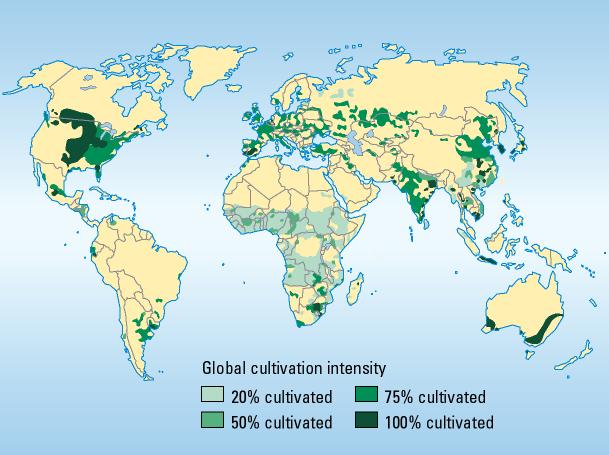 |
|
Quoted:
We've more than doubled our population since 1960. Is this a problem? If so, how should we address the issue? http://upload.wikimedia.org/wikipedia/commons/5/56/World-Population-1800-2100.svg Just that data? Just that question? Nope. And I don't understand why anyone would just point to a number all by itself and freak out about it just because of how much bigger it is now than it was in the past. The planet is not over-populated. It is over-managed. |
|
Quoted:
No family planning and no birth control. Dependence on large families to help with agricultural production on their poorly managed family farms. Lack of any financial knowledge or government social security like plan for retirement also means the parents in third world nations are more dependent on large numbers of children to support them in the elder years. Quoted:
Quoted:
Quoted:
Nope. Most first world countries the population growth is negative. It'll catch up around the world. Secondary question: Why would the "third world" population be growing when they lack the medical technology and food production of "first world" nations? No family planning and no birth control. Dependence on large families to help with agricultural production on their poorly managed family farms. Lack of any financial knowledge or government social security like plan for retirement also means the parents in third world nations are more dependent on large numbers of children to support them in the elder years. Don't the higher mortality rates and shorter lifespans balance the growth with these non-developed nations? AFAIK, that isn't true to all areas in under developed countries. Larger families can be a liability for subsistence agriculturists in areas with limited arable land and large (poor) populations. |
|
Quoted:
Just that data? Just that question? Nope. And I don't understand why anyone would just point to a number all by itself and freak out about it just because of how much bigger it is now than it was in the past. The planet is not over-populated. It is over-managed. Quoted:
Quoted:
We've more than doubled our population since 1960. Is this a problem? If so, how should we address the issue? http://upload.wikimedia.org/wikipedia/commons/5/56/World-Population-1800-2100.svg Just that data? Just that question? Nope. And I don't understand why anyone would just point to a number all by itself and freak out about it just because of how much bigger it is now than it was in the past. The planet is not over-populated. It is over-managed. I'm not freaking out, and I realize that it is just one number from wikipedia. I'm simply asking a question. 
|
|
Not an issue.
In 1997, the world's population would've been able to fit inside the city limits of Jacksonville, Florida. 4sq feet per person. At that point .5 percent of all inhabitable land mass on earth was being used. So let's throw this out there and say we've grown in population 30% since then. The world is not overpopulated. Also in the early 1990s, VP Albert Gore was quoted in saying that current food production would be unable to feed the world's population by 2000. Last I checked, the US still the most overweight country in the world. |

|
Too many people. I live outside a small town. About 20 years ago one of my teachers in HS told us "in 50 years you'll be telling your grandkids something they won't believe. You used to be able to head just outside town and shot a gun." I'm worried that might actually be true someday. |
|
Quoted: It's very sustainable, just not at our current levels of consumption. Quoted: Quoted: It is not sustainable. It's very sustainable, just not at our current levels of consumption. |

|
Quoted:
Not an issue. In 1997, the world's population would've been able to fit inside the city limits of Jacksonville, Florida. 4sq feet per person. At that point .5 percent of all inhabitable land mass on earth was being used. So let's throw this out there and say we've grown in population 30% since then. The world is not overpopulated. Also in the early 1990s, VP Albert Gore was quoted in saying that current food production would be unable to feed the world's population by 2000. Last I checked, the US still the most overweight country in the world. No, its mexico. At that rate of growth, there would be one person per acre on earth in 60 years. In 80 years one person for every half acre. In one hundred years one person for every quarter acre. This is assuming people can live in the arctic on one acre or less. Not sustainable |
|
Quoted:
Nothing a worldwide economic collapse, world war, famine and the like wont solve. These problems take care of themselves. Places like Russia and Canada though you can walk for days and not see a living soul so i dont think we are even close to breakpoint. Malthusian. Population exponential growth is very rapid at the end. If the population doubles every 10 yrs, and that population is currently at 1/2 carrying capacity (whatever that is). The it will be only 10 yrs until carrying capacity is reached and exceeded. |