


[ARCHIVED THREAD] - Light years. (Page 1 of 2)
Posted: 4/17/2014 5:16:40 PM EDT
Ok dumb question.... but... How is it possible for scientist to see hundreds of light years into the galaxy? Obviously with magnified optics, but what kind of magnification is required to see trillions, even quadrillions of miles away? A recent thread talked about an earth like planet 490 light years away. How the hell were they able to see that 3 quadrillion miles away? I sometimes have trouble seeing 5.56mm holes at 100yds with a 10x scope. 
|
|
Quoted:
They aren't seeing lightyears away in real-time. They are seeing the light hitting our planet when they are looking. It takes 8 minutes for light to get to earth from the sun. It takes years for light to get here from neighboring stars. Lots of things that we see now, aren't there anymore. |
| they are not seeing in real time with optics, they are seeing light that has traveled millions and billions of years to reach the lens of said telescope. and with scientific techniques we can gauge how distant the light is or more accurately, how old the light is. |
|
1) shit in space is fucking big. Nebula featured in the ooohh-ahhhh Hubble pictures are hundreds and thousands of light years across. Galaxies are on the order of a hundred thousand light years across, more or less.
2) planets are not detected directly, but by the absolutely tiny luminosity effects on their parent stars, or the absolutely tiny displacement effects the gravity of the planet has on the parent star. Interesting note, if the Andromeda galaxy were bright enough throughout its entirety to see with the naked eye, it would be several times larger than the full moon. We can only barely see the core with the naked eye, and long exposures are required to bring enough light to bear for the cool pictures you see of it. |
|
I think he is asking more about how it is possible rather then about time.
A photon of light will travel in a straight line unless something stops it. (Or bends it). In space there isn't a whole lot of actual stuff to stop it. You are probably thinking how hard it is to see light even a mile away on earth. Well that's because there is a lot of stuff in our atmosphere. This is why space telescopes can get a much better picture than ones on earth. |
|
Quoted:
Lots of things that we see now, aren't there anymore. Quoted:
Quoted:
They aren't seeing lightyears away in real-time. They are seeing the light hitting our planet when they are looking. It takes 8 minutes for light to get to earth from the sun. It takes years for light to get here from neighboring stars. Lots of things that we see now, aren't there anymore. This |
|
Quoted:
they are not seeing in real time with optics, they are seeing light that has traveled millions and billions of years to reach the lens of said telescope. and with scientific techniques we can gauge how distant the light is or more accurately, how old the light is. So if the light traveled here means it isn't over there anymore, the how can we tell how far it came? |
|
Quoted:
Ok dumb question.... but... How is it possible for scientist to see hundreds of light years into the galaxy? Obviously with magnified optics, but what kind of magnification is required to see trillions, even quadrillions of miles away? A recent thread talked about an earth like planet 490 light years away. How the hell were they able to see that 3 quadrillion miles away? I sometimes have trouble seeing 5.56mm holes at 100yds with a 10x scope. We observe light and radio waves when they get here. You can see for yourself, look at the stars that are visible without aids. Most of the planets we know about have not been seen directly, we know they are present by inference from watching the other objects around them; the way a star wobbles, or how its light diminishes when a planet (or a companion star) passes between us and the star are two methods. |
|
A lot of the telescopes also look at spectra other than visible light - x-rays and gamma rays and stuff being collected by some of the observatories are harder for the (rare) intervening particles to deflect or refract (I think). Lots of "pictures" from space are false-color images.
Also, in space, without the atmosphere or the spinning of the earth to get in your way, and with the great distance involved, it's easier to plan well ahead of time how your "target" is going to move relative to you and compensate for it, so you can take super long "exposures", or numerous short exposures and stack them together, so even extremely distant, extremely dim objects can be imaged. ETA: according to wikipedia, the smallest block of time it's possible to get on the hubble telescope is 45 minutes, so you can imagine that taking a picture with one of these things ain't no 1/60 sec. snap with your pocket cam - these are some long-ass exposures. ETA2: OP's ain't no dumb question, either. This kind of shit has only become possible at these scales and these distances in the last couple of decades - this stuff is crazy, and it's good to ask about it! |
|
Quoted:
So if the light traveled here means it isn't over there anymore, the how can we tell how far it came? Quoted:
Quoted:
they are not seeing in real time with optics, they are seeing light that has traveled millions and billions of years to reach the lens of said telescope. and with scientific techniques we can gauge how distant the light is or more accurately, how old the light is. So if the light traveled here means it isn't over there anymore, the how can we tell how far it came? red/blue shift |
|
Quoted:
Yes, there is always one asshole that has to take a poke at religion in a thread completely about something else. In this thread, that would be you. Quoted:
Quoted:
in before god squad shows up  Yes, there is always one asshole that has to take a poke at religion in a thread completely about something else. In this thread, that would be you. and I am okay with it |
|
They're not really seeing those planets like you could see the moon, or Saturn with an optical telescope. They're making inferences based on spectometery and other measurements using x-ray and radio telescopes, and other things that I don't completely understand.
ETA: A little light reading. |
|
Quoted: So if the light traveled here means it isn't over there anymore, the how can we tell how far it came? Quoted: Quoted: they are not seeing in real time with optics, they are seeing light that has traveled millions and billions of years to reach the lens of said telescope. and with scientific techniques we can gauge how distant the light is or more accurately, how old the light is. So if the light traveled here means it isn't over there anymore, the how can we tell how far it came? |
|
Quoted:
So if the light traveled here means it isn't over there anymore, the how can we tell how far it came? I didn't know this either, so I found this on wikipedia: http://en.wikipedia.org/wiki/Cosmic_distance_ladder Fascinating! |
|
Quoted:
and I am okay with it Quoted:
Quoted:
Quoted:
in before god squad shows up Yes, there is always one asshole that has to take a poke at religion in a thread completely about something else. In this thread, that would be you. and I am okay with it for some reason when I read your reply I hear your avatar speaking it.
|
|
Quoted: They're not really seeing those planets like you could see the moon, or Saturn with an optical telescope. They're making inferences based on spectometery and other measurements using x-ray and radio telescopes, and other things that I don't completely understand. ETA: A little light reading. |
|
There's some really beautiful images on that page. 
Damn. |

|
Quoted:
red shift Quoted:
Quoted:
Quoted:
they are not seeing in real time with optics, they are seeing light that has traveled millions and billions of years to reach the lens of said telescope. and with scientific techniques we can gauge how distant the light is or more accurately, how old the light is. So if the light traveled here means it isn't over there anymore, the how can we tell how far it came? The light gets tired, loses energy, and gets redder. 
|
|
Quoted:
Quoted:
They're not really seeing those planets like you could see the moon, or Saturn with an optical telescope. They're making inferences based on spectometery and other measurements using x-ray and radio telescopes, and other things that I don't completely understand. ETA: A little light reading. As one of its most noteworthy observations, in 2005, SST became the first telescope to directly capture the light from extrasolar planets, namely the "hot Jupiters" HD 209458b and TrES-1. (It did not resolve that light into actual images though.)[22] This was the first time extrasolar planets had actually been visually seen; earlier observations had been indirectly made by drawing conclusions from behaviors of the stars the planets were orbiting. I'll be damned. I though they were still making inferences based on the exoplanets' gravitational effects on the stars they orbit. Do you know if they have actually resolved any pictures of expoplanets? Other than what I quoted above, the article only speaks of evidence that suggests the presence of exoplanets. |
|
Quoted:
for some reason when I read your reply I hear your avatar speaking it.
Quoted:
Quoted:
Quoted:
Quoted:
in before god squad shows up Yes, there is always one asshole that has to take a poke at religion in a thread completely about something else. In this thread, that would be you. and I am okay with it for some reason when I read your reply I hear your avatar speaking it.
hahahha mr. Anderson,,, |
|
There is no atmosphere in between to get in the way. The light can just go and go and not bump into anything. We have directly observed a few extrasolar planets but not many. Most planets are found indirectly by either seeing the light output of their star dim a little as the planet passes between us and the star blocking some of the light or by watching the star wobble due to the pull the planet orbiting it has on it. Combinations of these methods and splitting the light we get into spectrums can reveal things like: the mass, the period of the orbit around the star, whether it has an atmosphere, what its atmosphere is made of if it has one. The color of the star and its spectrum reveal how hot it is and what its made of and we can tell from that where a planet would need to be for it to be able to have liquid water. Capable of having water and know that it does in fact have water are 2 different things. The James Webb space telescope will be wonderful for direct planetary observations. But what we really need is the interferometry mission that has several telescopes linked together to simulate a truly massive sized telescope.   |
|
Quoted:
So if the light traveled here means it isn't over there anymore, the how can we tell how far it came? Quoted:
Quoted:
they are not seeing in real time with optics, they are seeing light that has traveled millions and billions of years to reach the lens of said telescope. and with scientific techniques we can gauge how distant the light is or more accurately, how old the light is. So if the light traveled here means it isn't over there anymore, the how can we tell how far it came? Standard Candles. Type I Supernova ALWAYS produce the same (within a narrow range) magnitude of light. If a Type I Supernova is in the galaxy you are looking at, just reading the magnitude of the light gives you a very good estimate of the distance. |
|
Quoted:
Ok dumb question.... but... How is it possible for scientist to see hundreds of light years into the galaxy? Obviously with magnified optics, but what kind of magnification is required to see trillions, even quadrillions of miles away? A recent thread talked about an earth like planet 490 light years away. How the hell were they able to see that 3 quadrillion miles away? I sometimes have trouble seeing 5.56mm holes at 100yds with a 10x scope. A science degree comes with a voucher for free lasik. You should try it. |
|
Quoted:
There is no atmosphere in between to get in the way. The light can just go and go and not bump into anything. We have directly observed a few extrasolar planets but not many. Most planets are found indirectly by either seeing the light output of their star dim a little as the planet passes between us and the star blocking some of the light or by watching the star wobble due to the pull the planet orbiting it has on it. Combinations of these methods and splitting the light we get into spectrums can reveal things like: the mass, the period of the orbit around the star, whether it has an atmosphere, what its atmosphere is made of if it has one. The color of the star and its spectrum reveal how hot it is and what its made of and we can tell from that where a planet would need to be for it to be able to have liquid water. Capable of having water and know that it does in fact have water are 2 different things. The James Webb space telescope will be wonderful for direct planetary observations. But what we really need is the interferometry mission that has several telescopes linked together to simulate a truly massive sized telescope. http://www.nasa.gov/images/content/614445main_013526_white2.jpg http://i.imgur.com/Z8hz5S3.jpg Imagine a constellation of telescopes all around the solar system, say about the same distance as Pluto. We could see CLOUDS and maybe even continents on planets in other star systems. |
|
Quoted:
red shift Quoted:
Quoted:
Quoted:
they are not seeing in real time with optics, they are seeing light that has traveled millions and billions of years to reach the lens of said telescope. and with scientific techniques we can gauge how distant the light is or more accurately, how old the light is. So if the light traveled here means it isn't over there anymore, the how can we tell how far it came? No, it isn't red shift. Red shift is a way of telling the relative velocity of an object that is moving away from the observer. Blue shift calculates objects that are moving closer to an observer. The way they tell the distance is several methods. One is simply triangulating it based on the positions of known objects. This is the Pythagorean Theorum. The other way is to measure the apparent luminosity if the original is known. As others have said, the way most extra solar planets are discovered is through luminosity shifts and wobble of parent stars. |
|
Quoted:
Imagine a constellation of telescopes all around the solar system, say about the same distance as Pluto. We could see CLOUDS and maybe even continents on planets in other star systems. Quoted:
Quoted:
There is no atmosphere in between to get in the way. The light can just go and go and not bump into anything. We have directly observed a few extrasolar planets but not many. Most planets are found indirectly by either seeing the light output of their star dim a little as the planet passes between us and the star blocking some of the light or by watching the star wobble due to the pull the planet orbiting it has on it. Combinations of these methods and splitting the light we get into spectrums can reveal things like: the mass, the period of the orbit around the star, whether it has an atmosphere, what its atmosphere is made of if it has one. The color of the star and its spectrum reveal how hot it is and what its made of and we can tell from that where a planet would need to be for it to be able to have liquid water. Capable of having water and know that it does in fact have water are 2 different things. The James Webb space telescope will be wonderful for direct planetary observations. But what we really need is the interferometry mission that has several telescopes linked together to simulate a truly massive sized telescope. http://www.nasa.gov/images/content/614445main_013526_white2.jpg http://i.imgur.com/Z8hz5S3.jpg Imagine a constellation of telescopes all around the solar system, say about the same distance as Pluto. We could see CLOUDS and maybe even continents on planets in other star systems. Interferometry would be a real challenge. It is a challenge when the individual telescopes are in fixed locations on the same planet. |
|
A light particle is emitted in a given point in time. It travels at a given speed. The time a photon takes to travel in one year, is a light year.
Therefore, when light has been emitted millions of years ago, it took that long to get here (to be observed). The farther away something is, the "farther" into the past we are looking, because we are observing light particles emitted long ago, that have been traveling. You also have to keep in mind that for light photons, since they travel at the speed of light, their time scale is not the same as anything not traveling at the speed of light (relative time passes slower). To illustrate this, if you put a man in a light-speed craft and sent him to the sun and back, his "age" would be less than that of humans on earth, by approximately the time it took for him to get to the sun and back. Since time doesn't stop on either end, it's a relativistic problem. |
|
Quoted:
Interferometry would be a real challenge. It is a challenge when the individual telescopes are in fixed locations on the same planet. with increases in computational abilities, it becomes less of a challenge. You need really accurate clocks (more accurate than those on the GPS satellites), and a method of accurately tracking the orbits of each telescope, and the alignment of each. difficult, even problematic today. but becoming less so over time. |
|
Quoted:
with increases in computational abilities, it becomes less of a challenge. You need really accurate clocks (more accurate than those on the GPS satellites), and a method of accurately tracking the orbits of each telescope, and the alignment of each. difficult, even problematic today. but becoming less so over time. Quoted:
Quoted:
Interferometry would be a real challenge. It is a challenge when the individual telescopes are in fixed locations on the same planet. with increases in computational abilities, it becomes less of a challenge. You need really accurate clocks (more accurate than those on the GPS satellites), and a method of accurately tracking the orbits of each telescope, and the alignment of each. difficult, even problematic today. but becoming less so over time. Don't you also need your individual telescopes to "hold still" within a fraction of a wavelength of light? |
|
Quoted:
1) shit in space is fucking big. Nebula featured in the ooohh-ahhhh Hubble pictures are hundreds and thousands of light years across. Galaxies are on the order of a hundred thousand light years across, more or less. 2) planets are not detected directly, but by the absolutely tiny luminosity effects on their parent stars, or the absolutely tiny displacement effects the gravity of the planet has on the parent star. Interesting note, if the Andromeda galaxy were bright enough throughout its entirety to see with the naked eye, it would be several times larger than the full moon. We can only barely see the core with the naked eye, and long exposures are required to bring enough light to bear for the cool pictures you see of it. From 2009 : Planet Imager It's the faint red object, not the bright white one that might be a historic find. The white object is surely a brown dwarf star. Quite possibly, however, the red object is the first direct image of a planet beyond our Solar System. 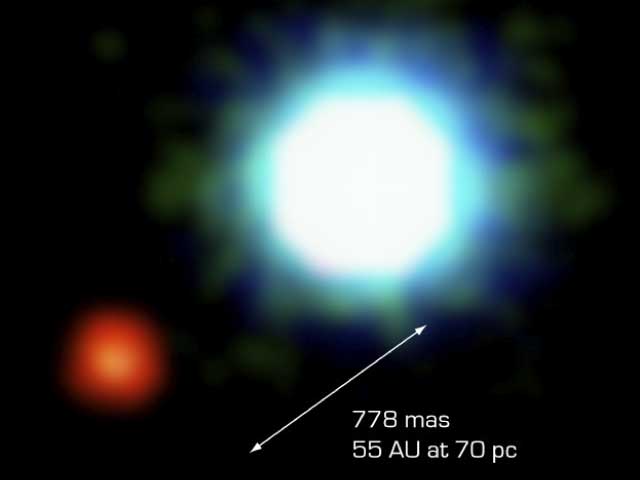
and 
|
|
Quoted:
Interferometry would be a real challenge. It is a challenge when the individual telescopes are in fixed locations on the same planet. Quoted:
Quoted:
Quoted:
There is no atmosphere in between to get in the way. The light can just go and go and not bump into anything. We have directly observed a few extrasolar planets but not many. Most planets are found indirectly by either seeing the light output of their star dim a little as the planet passes between us and the star blocking some of the light or by watching the star wobble due to the pull the planet orbiting it has on it. Combinations of these methods and splitting the light we get into spectrums can reveal things like: the mass, the period of the orbit around the star, whether it has an atmosphere, what its atmosphere is made of if it has one. The color of the star and its spectrum reveal how hot it is and what its made of and we can tell from that where a planet would need to be for it to be able to have liquid water. Capable of having water and know that it does in fact have water are 2 different things. The James Webb space telescope will be wonderful for direct planetary observations. But what we really need is the interferometry mission that has several telescopes linked together to simulate a truly massive sized telescope. http://www.nasa.gov/images/content/614445main_013526_white2.jpg http://i.imgur.com/Z8hz5S3.jpg Imagine a constellation of telescopes all around the solar system, say about the same distance as Pluto. We could see CLOUDS and maybe even continents on planets in other star systems. Interferometry would be a real challenge. It is a challenge when the individual telescopes are in fixed locations on the same planet. The could place an array of JWST's at the L2 point and potentially rigidly link them together to form a massive array. Of course, they could also manufacture in space an even larger scope but both cases will take many separate launches. |
|
Quoted: We observe light and radio waves when they get here. You can see for yourself, look at the stars that are visible without aids. Most of the planets we know about have not been seen directly, we know they are present by inference from watching the other objects around them; the way a star wobbles, or how its light diminishes when a planet (or a companion star) passes between us and the star are two methods. |
|
Quoted: Magnification is incidental ... it is light gathering, enabling us to photograph fainter objects, which allows us to "see farther". This is why we keep building larger telescopes. This. The magnification factors aren't huge, really. While the space telescope doesn't really have a magnification factor in the traditional sense, it's sort of works out to around 4,800x magnification... Of course, you can buy a 600x scope for about $100 at walmart. Which will suck. Even the largest and most impressive earth based scopes are limited to about 500x magnification. Light gathering and resolution are the important factors.
|
|
Quoted:
Lots of things that we see now, aren't there anymore. Quoted:
Quoted:
They aren't seeing lightyears away in real-time. They are seeing the light hitting our planet when they are looking. It takes 8 minutes for light to get to earth from the sun. It takes years for light to get here from neighboring stars. Lots of things that we see now, aren't there anymore. |
|
Quoted:
So, if you're a person of faith, you don't know about or believe in space/time continuums, worm holes, black holes, dark matter or how fast light travels?  Quoted:
in before god squad shows up So, if you're a person of faith, you don't know about or believe in space/time continuums, worm holes, black holes, dark matter or how fast light travels? Amen, brother. God and science are not mutually exclusive. We all not all backwoods, inbred hillbillies thumping on "The Good Book." I have no problems with the age of the universe as 16 billion years (or whatever the current estimate is) or the Earth at 4 billion. I have no problem with evolution as a mechanism in the greater context of the ongoing process of creation. |
| NASA launched many telescopes into space then aligns all of them together to magnify deep space objects. At the end of the telescope chain they put a microscope, located on the Moon in a building to look closly at the multi-scopic image. The Hubble is the last telescope, shoots it's processed image to the Moon unit and uses a large computer controlled lens called an electrono-phase generator amplifier to gather and align all of the other 'scope images. |
|
Quoted:
? A recent thread talked about an earth like planet 490 light years away. How the hell were they able to see that 3 quadrillion miles away? 490 lightyears is practically on our doorstep. Our own galaxy is about 100k lightyears across. For seeing stuff extremely far away, it's not so much about magnification as it is using sensitive instruments and staring at the same spot for a very long time. They can also use gravitational lensing. Go look up an article on the Hubble ultra deep field images. |