


Posted: 9/1/2006 2:43:57 PM EDT
|
So if we took a Homo Sapiens new born baby (that is us) from 10,000 years ago, a time before any known civilization, domestication, etc., and raised him today do you think he would be just like any other normal and modern human? Genetically we should be identical. But would you be able to tell? Would he be able to learn complex language and technology just like any other modern human child? Or would there be an evolutionary gap which would make the lack of 10,000 years of genetic development obvious? What do you think? |

|
interesting question. i'm gonna leave it at that though because i realized my answer would draw out the god fearing folk in droves. not that there is anything wrong with religious people, but i don't want to be responsible for turning this into another religious debate. |

I'm not even going to sarcastically mention YEC, so here's a serious response: He would likely be shorter, and maybe not even that if you raised him on modern foods. 10,000 years ago we had spread into North America already. We may, according to the Anatolian Hypothesis, already have been speaking the precursor to Indo-European languages, and common languages had been around for at least 30,000 and as many as 2,000,000 years ago. 10,000 years ago was roughly the beginning of the Mesolithic Era (Middle Stone Age). We'd long been using tools, and they were becoming more and more complex. Agriculture had started. Really, once we reached the Mesolithic, the only differences were very gradual changes in skin tone (far less than had already happened), the rise of civilization (that happened as the populations grew larger and banded together more, became less nomadic; it also may have happened earlier, but the earliest recognized civilization is Sumer, about 4000 BCE), and the growth of technology. If we treated him as any modern child, he would be exactly as us. |

|

|
I am going to say that the child would be able to learn just as any "modern" human child today. Although, I read something recently about the "brain gene" that seems to differntiate us from the rest of the great apes that indicated that the human brain is still growing larger (or perhaps it was still changing....can't recall) generation by generation. If that holds true, then I don't know. It may be a wiring difference more than a physical size difference though so the changes may be dramatic or may be hardly noticable. So yeah, I'm going with the child would be able to be raised normally. |

But, the interarwebnet promotes the use of simplified and incorrectly spelled language...are we devolving? [example]pls xkooz me whil I go and scratch my @zz and pwnz0r summat fer fud...[/example]  |
That is the exact point of my post. Genetically we should be identical. But there is still a 10,000 year developmental gap. I'm wondering if it would be noticable at all or manifest itself in any way. Or would a 10,000 year old baby raised in a modern environment be using computers like everyone else. |

I would think so. If raised from an infant of only a few months old I can't imagine the child would have any problem integrating into modern society, in all it's facets. At the very worst, I doubt the child would be any worse off than the slow kids in Special Ed that were bright enough, but just couldn't seem to learn from a book. But I doubt it. |
|
I think that the child would be different, mainly because I believe that our brains are constantly evolving, tracking, and passing on things to our offspring. Whether it's obvious on the outside or not, I think there's a collective unconscious that we all share. Many humans have irrational fears that can be linked to things that happened to humanity in the past. For example, rats, pus from infected wounds, and cockroaches all disgust people at a visceral level. In modern society we have little reason to learn disgust or fear of those things. Why do they bother us? They signal disease, uncleanliness, and sickness. Our species has learned that association over many generations, and it gets passed on just like the desire to suckle at a breast or to pull back a hand from a burning fire. So, a child from our hunter & gatherer times would be missing much of that invisible evolution. He'd have a deathly fear of rhinos, but no concept of the dangers of playing in traffic. |
I don't buy that, maybe it's just a bad analogy though. I mean, I've seen lots of modern kids (my own included  ) that run out into the street car or not until they are taught that it is dangerous. I've seen those same kids scared stiff at a coyote pack howling in the night. They get uptight about the 'yotes because it is an ingrained primitive instinct telling them to be quiet or they wind up as dinner. Modern perils, such as automobiles, have not been around long enough to cause an instinctive fear and therefore must be learned about with every new generation. I think that the main difference between now and ten thousand years is we don't have to reinvent the wheel with every generation thanks to the complex language abilities mentioned earlier by someone (sorry can't recall and if I hit back to look I'll lose all my ramblings) especially in the form of a written language. With writing we are able to preserve first hand accounts of inventions, observations, and accountings of a time period and therefore have a longer societal memory. Physically, there is no evidence that we are any different except perhaps being larger framed and that mostly due to (as I understand it) nutrition. ) that run out into the street car or not until they are taught that it is dangerous. I've seen those same kids scared stiff at a coyote pack howling in the night. They get uptight about the 'yotes because it is an ingrained primitive instinct telling them to be quiet or they wind up as dinner. Modern perils, such as automobiles, have not been around long enough to cause an instinctive fear and therefore must be learned about with every new generation. I think that the main difference between now and ten thousand years is we don't have to reinvent the wheel with every generation thanks to the complex language abilities mentioned earlier by someone (sorry can't recall and if I hit back to look I'll lose all my ramblings) especially in the form of a written language. With writing we are able to preserve first hand accounts of inventions, observations, and accountings of a time period and therefore have a longer societal memory. Physically, there is no evidence that we are any different except perhaps being larger framed and that mostly due to (as I understand it) nutrition.
|

|
There would be complete genetic homology, so taking a baby would result in a modern human. Taking a 6 year old could be a different thing entirely. Never having to twist something before, our counterfactual human would have to learn a million little things, language being the least of them. Got one in the basement? |

|
There may be some changes in food allegeries and tollerences (think about natives of the Americas and how they react to modern American diets differently than Americans of European ancestry). Diets high in milk products and simple carbohydrates could be problimatic. Mark Post Count = Post Count +1 |
I think, His immune system would be (using your dating) 10,000 years behind ours. I don’t think he would live long without special care. Ripak Be Safe Have Fun |
+1 |

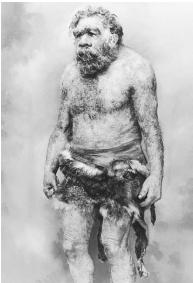  it would be interesting if we found a lost tribe of Neanderthal man some modern people still look and act like a Neanderthal man... I dont think that a child of 10,000 years ago would be identicle to a modern day child probably have more instinctive behavior buit in, probably be more prone to violence, or uncivillized behavior ?
|
I've never seen anybody who looks like Homo neanderthalensis, and we really have very little idea how they acted, although we've been able to piece together some information. For example, they likely would have had speech slightly less complex as H. sapiens sapiens of the time (H. neanderthalensis were fully extant from 130,000 to 50,000 years ago in Asia, becoming fully extinct about 30,000 years ago), but sharper, higher pitched, and more nasal due to their physiology (it wouldn't have been the ape-like grunts stereotyped). They had tools that were somewhat less extensive than paleolithic H. sapiens toolkits and hand-held weapons (no missile weapons (likely due to a different hunting method rather than lower technology). Their burials were slightly ritual but somewhat uncomplicated, simple but with a few grave goods and flowers. They practiced a sort of folk-medicine, similar to what H. Sapiens practiced early on, taking care of wounds and using plant compounds to treat some diseases. It was advanced enough that they knew how to set bone breaks. They tended to suffer from arthritis, hypoplasia and malnutrition, and other diseases. It is believed they had a relatively advanced society for the time, forming tribal units and even practicing a sort of religion. They seem to have formed family units, practiced group hunting, took care of the elderly. Is that what you mean by "acting like a neanderthal?" To whom were you referring? |
You are right to think that. You cannot suddenly jump a species several thousand years into the future without experiencing these problems. These undesireable traits have not had time to be bred out, or killed off. They might make good football players! |
People 10,000 years ago were not H. neanderthalensis. Neanderthals died out no later than ~30,000 years ago, and we are not descended from them. We share a common ancestor (H. erectus, if I'm not mistaken). 10,000 years ago was the end of the range of [H. sapiens cro-magnon, and some time after the beginning of H. sapiens sapiens. H. sapiens idaltu is thought to have arisen 200,000-250,000 years ago. Modern man already existed in the time-frame SteyrAUG is talking about. |
Additionally I specifically stated modern Homo Sapiens in my post. |
