


Posted: 4/23/2011 3:33:29 PM EDT
|
In World War II movies they frequently mention that if someone shoots the tank of a flamethrower, it will explode.
Is there any truth at all to this? Shooting a tank of gasoline will not get it to ignite. Why would a flamethrower be any different? |
|
Quoted: In World War II movies they frequently mention that if someone shoots the tank of a flamethrower, it will explode. Is there any truth at all to this? Shooting a tank of gasoline will not get it to ignite. Why would a flamethrower be any different? A tank of gas in not under pressure. |
|
Quoted: Quoted: Quoted: Extremely flammable liquid under pressure with a pilot light on the wand....... I thought the M2 didn't have a pilot light, it used igniter cartridges? ETA: didn't they use thickened diesel? They used thickened gas, napalm gasoline, diesel, napalm (the real stuff that had benzene or some such in it), etc ETA: Modern napalm is composed primarily of benzene and polystyrene, and is known as napalm-B,[url=http://en.wikipedia.org/wiki/Napalm#cite_note-GS_Napalm-1][2][/url] super-napalm, NP2, or also Incendergel. The commonly quoted composition is 21% benzene, 33% gasoline (itself containing about 1.0 to 4.0 percent benzene to raise its octane number), and 46% polystyrene. This mixture is difficult to ignite. A reliable pyrotechnic initiator, often based on thermite (for ordinary napalm) or white phosphorus (for newer compositions), must be used.[url=http://en.wikipedia.org/wiki/Napalm#cite_note-globalsecurity.org-3][4][/url][url=http://en.wikipedia.org/wiki/Napalm#cite_note-emed-4][5][/url] The original napalm usually burned for 15 to 30 seconds while napalm-B can burn for up to 10 minutes.[url=http://en.wikipedia.org/wiki/Napalm#cite_note-emed-4][5][/url] Napalm 877 was used in flamethrowers and bombs by American and Allied forces to increase the deadliness of its predecessors. This substance is formulated to burn close to a specified rate and also to adhere to surfaces. Napalm B is mixed with gasoline in various proportions to achieve this. Another deadly effect of napalm B, primarily in its use in firebombs, is that napalm "rapidly deoxygenates the available air" and it also releases large amounts of deadly carbon monoxide. Napalm bombs were notably used during the Vietnam War |
|
FLAMES! MAYHEM! TEAM ONLY!
Certainly doesn't answer the question, but it's a flamethrower! I'm only through page four but...OMG.  
|
|
Quoted:
Another question, why are they not still fielded? Easier to throw a nade down a hole than burn it out? Incendiary weapons are regulated by the chemical weapons convention, IIRC. We can use them, just not against people who are not enemy combatants...I remember reading it somewhere so take it with a grain of salt. |
|
Quoted:
Another question, why are they not still fielded? Easier to throw a nade down a hole than burn it out? Jimmy Carter, signed them into the dust bins history along with our future use of Napalm. Still legal, but we'll never use it again in war, unless another President backtracks on his work. |
|
I may be wrong, but I recall someone mentioned (in the last thread on this subject) that grenades and thermobaric weapons are now the weapons of choice for bunker clearing and the like. Apparently the Russian (interior?) forces like to fuck up militants in Dagestan with thermobaric warheads launched from RPGs.  |
|
Not sure how easy it would be to catch moe gas or napalm on fire with sparks....?
Though if someone was waffening flames on the sides of the road and a tracer penetrated the container of fuel... probably not a good situation http://www.blm.gov/pgdata/etc/medialib/blm/wy/information/newsreleases/2009.Par.83645.Image.-1.-1.1.gif |
|
Quoted:
Quoted:
If shooting a propane tank makes it explode, why would this be any different? The pressure is probably higher in a flamethrower too. I thought you needed a secondary ignition source to make a propane tank go up? Flame throwers were pressurized with just compressed air in WWII so they were wearing the fuel and oxygen, all that was needed to make them explode was a spark which was readily supplied by the steel jacketed ammo used in WWII. Steel jacketed ammo really throws sparks when it hits steel. Try it some time, just shoot at a steel drum or any kind of steel that's a little substantial. The first time I noticed it was before I even knew there were steel jacketed bullets. I was shooting at a 55gal. drum with my AK right after I got it and after every hit it was throwing sparks. Being curious to see if it would ignite gas I put a Lipton iced tea bottle full of gas on the barrel. Then I shot the bottle and let the gas splash all over the 55gal. drum. After the drum was soaked in gas I started shooting the drum, it took a few hits to get the gas to ignite but it did. I even tried it multiple times, strictly for scientific purposes  each time it took between 3-5 shots it always ignited the gas. each time it took between 3-5 shots it always ignited the gas.
|
|
Quoted:
If shooting a propane tank makes it explode, why would this be any different? The pressure is probably higher in a flamethrower too. The pressure vessel has about 1,500 psi in it. That pressure is then regulated down to about 200psi feeding the main fuel tanks. What you never see on TV is the start and the end of the flame thrower burst. It pumps all four gallons out in about 7 seconds and you're done. Tony 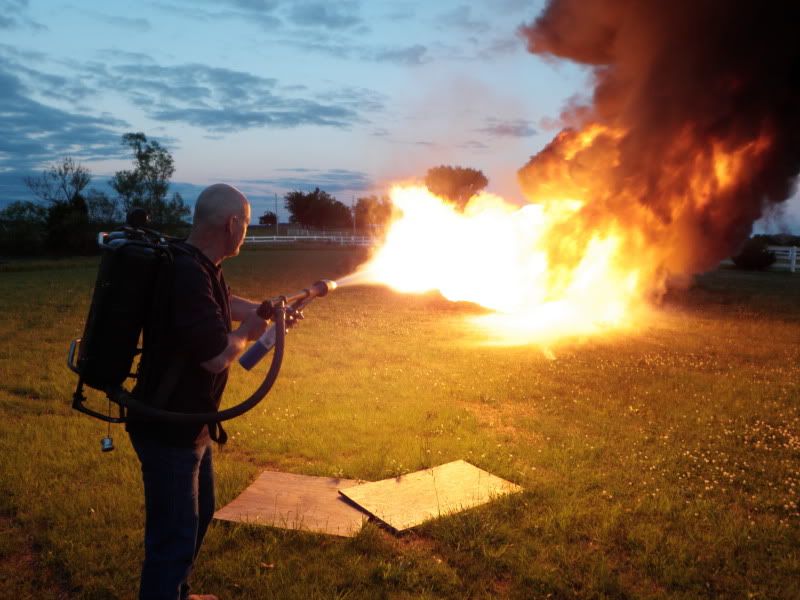
|