


Posted: 12/5/2007 1:15:45 PM EDT
Would a discussion of the book, "The God Delusion" be appropriate for this forum? 
|

That covers it nicely.  I'm not familiar with the book in question, but as long as the discussion itself remains on-topic and respectful of all I see no problem with it. As I've said here before many times, you don't have to agree with someone else's beliefs in order to respect them and/or their right to have them. |
|
I'm ready for a serious argument. Not "well, since I've never experienced God, and can't understand the arguments for his existence from Aristotle, Aquinas to the modern era, he/it can't possibly exist and therefore those who believe in God are stupid pooh pooh heads..." Because of course, that particular arguments' criteria is the ability of the arguer to understand the basic concepts. Similarly those who want God to come down and sit on a scale so he can be measured are asking the wrong question. It would be refreshing to have a serious atheist give a solid argument for God's non-existence that doesn't bring up the question of evil too - inasmuch as that old chesnut is incredibly easy to answer: evil doesn't disprove the existence of good - so it doesn't disprove the existence of God. It only proves that WE would do things differently. Finally, I think the argument has to include the evidence for man's own soul and deal with cause and effect or rather whether it's common for effects to be greater than their causes. |
|
Alright: Every human is, by default, an Atheist. Atheist is the natural state of man until a mythology is taught to them. An Atheist is merely someone who has not been indoctrinated into some type of pagan (wiccan, christian, muslim, jewish, hindu, etc) mythological construct. Religion(s) and the god(s) they idolize are invented by men, retold by men, and eventually discarded by men. A person born into an environment without any concept of god(s) or religion(s) and raised by robots will not spontaneously be a Christian or Muslim. Christianity, Islam, Judaism, et al must be taught and learned. They do not exist on their own, and as such, are invalid from the "they are the truth!" standpoint. |
|
To clarify; Being an Atheist doesnt require active thought processes or decisions. It's a natural and default state. There is no "disbelief" which would require someone to invent a god or religion and then dismiss it based on some kind of logical deconstruction of why that mythology doesnt exist in reality. It's the same as why a Christian doesnt believe in Quetzalcoatl. The typical Christian doesnt spend every day deciding "Quetzalcoatl doesnt exist!" and justifying it in various ways because Quetzalcoatl is meaningless to a Christian and they likely dont know of his existence (as a possible god) so he never even enters their mind for deliberation. This is how Atheists are. The religions active today are classified (by us, generally) identical to the religions of 3000 years ago. We dont actively disbelieve in Jesus or Muhammad the same way Pat Robertson and Osama bin Laden dont actively disbelieve in Apollo or Ragnarok. Succinctly put, it's passive. |
But *wonderment* is a natural quality. We have some instinctive *curiosity* about where we came from, what (if anything) in the way of a greater Intelligence created us and everything around us, and we are either very curious, very hopeful, or very fearful about what will become of us when we die. My point is not leading to the conclussion that any particular religion is somehow "natural" to us, but that the questions which lead people to come up with "answers" in the form of religious belief -- are indeed instinctive. Are there any people on this earth, since the beginning of humankind, who have not -- as a culture -- developed a system of what we call religion? The hunger to "know" the answers to these questions has led all peoples to come up with answers one way or another, some more fanciful than others. |
I would go so far as to say that religion is a failed attempt at science.  |
|
Well, haha. But it's not accurate. Man is not naturally an atheist at all. He's naturally a wonderer. And wonder leads to asking questions about origins, where it all comes from, where I come from, where Mom came from....and where we're all going? From basic questions about origin humanity has sought that whose essence is to exist, not merely to be made. To find a ground or being that is uncaused. So from this phenomenological perspective, the wonderers go from the inchoate to a deduction that something must have always existed for anything to exist now. And that something we can call "creator" or God, or Ipsum esse subsistens. Now what we DO with this knowledge - religion - is an entirely DIFFERENT question. Knowing or believing in God is NOT the same thing as worshipping him. So for starters, theism is not religion. and the absence of religion is not atheism. Take away all religious traditions but give a human upbringing to a child, (as opposed to a robot) and the child will eventually wonder about origins. The question of soul - or that which remains constant while all else changes, that part of us that is our "who" and not "what", our identity - the question will inevitably be asked - 'is this body me? Am I just my body and nothing more? It may lead to a distinction between our perceptual understanding and conceptual knowledge and another deduction that if there's something in our intellect that defies time and space it act, it can't be entirely material itself. Hence I can't be entirely material either. So far belief in God, angels, heaven, hell, judgment and redemption have nothing to do with this line of thinking. But thoughts about our immaterial souls will lead the wonderer in us to ask about the possible existence of non-material persons. Phenomena like possession or holiness will force us to come up with a non- or not entirely materialistic understanding of man. One hypothesis will be that non-material spirits exist that somehow can effect change in matter. An experiment would be our own thinking and how it affects our moods. How can a thought of the future (yet to exist and hence not experienced) dying of our mother provoke tears? The thought has no spatial or material substance. If it's imaginary, it's a creative imagination as it doesn't represent a current or past perceptive experience at all. It's full of meaning, not atoms. And yet while not 'material' it has definate material effects in our mood and body. If then our intellect can effect change in our bodies might not some other intellect also have the ability to mess with us? Not claiming this is so, but this is an example of reasoning from our own experience to the potential existence of something we can't perceive. In reality - and ironically - atheism is as much a construct as religion is. It's an attempt to explain reality, to define it. To close a door and insist there's nothing there. But all human cultures have shown evidence of man the wonderer pondering the beyond...almost needing that there be a beyond. And why would that be? If we are disposed to believe - while also have this great capacity for 'cold hard reason'...what a paradox. Archbishop Fulton Sheen had a great line about materialists who think atoms is all there is. Well, if atoms make them believe God doesn't or can't exist, then atoms are what makes us believe He does exist. Since matter is doing both, what's it to them that we are different?
|
"Cute" pictorial swipe at all people of any faith.  I'll leave it up and give it a pass this time, but I seriously recommend not posting that in this forum again.  And, FTR, considering/contemplating man's "evidence" (which many of us do) and then still believing through faith that a limitless God is simply beyond man's limited thinking/understanding, or that God's power trumps man's science, is not "ignoring contradicting evidence" no matter how many times you assert such. |
I can see a great degree of wisdom to that. However, religions fill two other needs which Science fails to fulfill: 1) Emotional wellbeing: 1A) People have a deep need to know/feel that they somehow "matter" in the greater scheme of things -- that there is meaning and purpose to their very existence. 1B) A sense of Justice -- that even if they are subjected to terrible pain and harm in this life, that they will recieve wellbeing in the postmortem condition (afterlife),and that the evildoers will be punished. 1C) A deep - I say instinctive -- desire to feel that we will be reunited with loved ones in the postmortem condition. Some religions address issues 1B and 1C through a favorable afterlife, others through reincarnation. Religions fulfill emotional needs which Science in and of itself generally does not. As a Deist, I find the sense of wonderment at the very orderliness of Nature sufficient to my needs, but most people do not. 2) Social order: 2A) Religions are excellent ways for societies to structure themselves to promote the common good. We see this every day through charitable works, such as the Salvation Army. This in and of itself should be reason enough for we skeptics to both admire and to respectfully fellowship with our countrymen of faith. Much, much, MUCH of what we see actually being *done* by people of faith is extremely GOOD for society in general. On the other hand, there much of religion (some religions much more than others) used to bad, greedy, and harmful end, of course. 2B) Religions allow societies to function with a general commonality of the ethics expressed in harmony by most religions, ie the Golden Rule. We skeptics may well find our personal emotional needs met outside of religion. But we are wise to acknowledge the deep debt we our to our fellowman of faith for the commonality of ethics we cherish in harmony with them. 
|
|
Humans are a very social species. What that does for us is create an uneasy feeling when we think we are alone. We become lonely, and feel a need to have a companion. The reason I mention this is because this is where I believe religion comes from. As stated, all cultures on earth at this time, and all cultures that have passed, have had some kind of religion. I believe this religion is to fill the need that I mentioned above. I agree with the post that said Christianity is not natural. Of course it is not. Christianity was developed to fill the need above by a few men a couple thousand years ago. This particular belief caught on for a specific population, and just happens to be the religion that was very successful at obtaining followers. If you look at the religions of the world, they are as different as the cultures are themselves. Sure, there are similarities, but there are also similarities in culture as well, and it makes sense that when a species creates something (no matter how far apart they are from each other), genetics leads them to the same frame of thought. This could explain a similarity in religion (a God figure). Specific religions in and of themselves are not natural, but I believe the need to have one is. As a side note, sometimes I feel people who are atheist catch some slack from “true” religions, and are labeled as being lazy, angry, etc. for not believing in God. I think you will find that many atheists like myself, have put a lot of thought into how, and what they believe. Being an atheist is not a default setting I have, I feel my decision to become an atheist is an educated decision I have made, and just as much thought has gone into it (if not more) as the people who choose to follow their particular religious belief. I enjoy discussing religion, and the reasons people choose to believe one way or the other intrigue me. |
Nah I just followed Jesus blindly since the day I was born because my parents told me so.  NOT. NOT.
|
At the time and the place of Christianity coming into being as a religion, people had plenty of what one could call perhaps 'otherwordly companions' to choose from -- Mithra, Mars, Athena, Venus, etc. These gods met specific emotional needs for those wanting otherworldly support in ways of Strength, Bellicosity, Knowledge, Eroticism, but... What they perhaps instinctively hungered for was a sense of, well, what I would have to call 'Kindness' for lack of a better word. The first century world was one of brutality which we can scarcely imagine. Even the old Roman sense of the Virtues had been vacated and corrupted to remove all sense of compassion by the fall of the Republic. Yet *individuals* still often felt an urge toward Kindness. And that is what the man named Jesus taught and personified. Yes, humankind does have a general desire towards otherworldly companionship. But that is not our only need which the various faiths often fill. Nowadays we live in an 'all-soft', touchy-feely sort of larger culture. So I am not at all surprised at the renaissance of the much more primal and masculine Odinism and general Heathenry we are seeing nowadays. Whenever an aspect of humankind is unmet by the ambient culture, a religion will arrive or blossom anew to fill that need. |
I would agree with that..... |
JJREA, I think you missed my point. I generally feel, that Christians feel, that atheists have not put very much thought into what they believe. They feel that we are SUPPOSED to believe in God, and that it is incredibly wrong not to believe in God. The point I was trying to make is that we atheists put just as much thought, and relate just as many personal experiences into what (and why) we believe. No, I am not saying that is how I feel here on ARFCOM, I am just saying in general around the world, this is the GENERAL belief about atheists. I was not saying that you or any other Christians follow God blindly. That was not my intention at all. Sorry if there was confusion. Sometimes I have the point I want to make in my head, but it is hard to type it out and it just comes out confusing......  Also, I completely understand that Christians put lots and lots of thought into why they believe how they do as well. It would be ignorance to think otherwise. |

I was an atheist at one time too. We, friends and such, waxed eloquent for hours and hours about religion and philosophy and I did think about that sort of thing alot. Then God struck me down and blinded me on my way to kill some christians in damascus, so to speak. Thank you for your response. My post was more pointed toward the graph that whoever that was posted. It was implying you guys think / thought about it more than we do. |
I dont see it as a "swipe at all people of any faith" merely a graphical representation of my personal opinion. How is my personal opinion acceptable in typed format but not pictorial? I, too, fail to see how it could be construed as offensive since it doesnt posit that religious persons are stupid, but merely regard faith as superior to the scientific method, as is illustrated with the "Intelligent Design"(sic) neo-Creation movement. Proponents of "Intelligent Design" refuse to acknowledge any amount of scientific evidence of evolution (actual evolution, not macro Evolution) as being "insufficient" for their personal criteria solely based on the fact that any amount of evidence, small or seemingly infinite, contradicts their personal faith and that science is a direct affront to their beliefs. |
|
Furthermore, the devoutly Christian scientist and professor Ken Miller has interesting things to say about the mutual exclusivity between "Faith" and "Science" and from a religious standpoint, they dont (either) negate validity or acceptability of any religion(s). My comment and illustration were against blind faith masquerading as something else, and that religion (in the context of me saying it is a failed attempt at science) is a good thing, as it strives to satiate the natural human desire for answers and clarity. |
No, if it "merely" did that it wouldn't be problematic. It doesn't say that believers of any/all faiths "merely regard faith as superior to the scientific method" -- it has symbols representing almost every major religion and says explicitly "Ignore contradicting evidence." That statement is incorrect, condescending, and IMO intellectually dishonest. If you made the blanket statement here textually that all religions/believers are willfully ignorant, ignoring science/"evidence," I would call you on it just the same. The fact that you did so graphically makes it no less offensive and no more acceptable. As I already pointed out above, the vast majority of believers do not "ignore"science at all (how can one in today's society?) and many of us are well-versed in the sciences -- they simply don't trump faith/belief/doctrine for us and/or we can reconcile them acceptably for us. IMO, that image is insulting to anyone of those faiths represented and, in this particular forum, lends itself much more to disruption/offense than it does in any way to illustrate a point or further the discussion. As such, please don't post it again. |
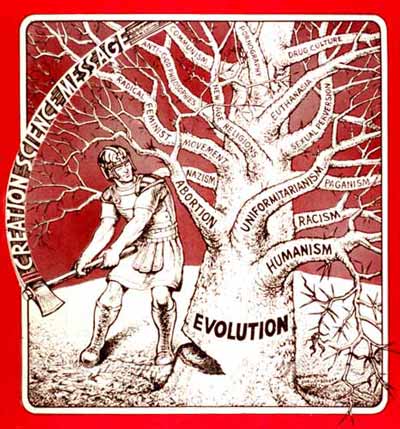
Uh, I'm kind of wondering why people promoting Creation Science chose a Roman soldier in garrison dress -- wielding the specific symbol of Republican-era Roman military power -- as their emblem.  www.livius.org/fa-fn/fasces/fasces.html The point being -- Symbols often convey something other than one might wish them to imply. |
I'll admit it -- I don't get it? Are you making another point, testing boundaries, or something else entirely?
|
Okay. Not being familiar with "Creation Science" ( ) and not having the time nor inclination to look it up & learn about it right now (I'm posting from a laptop in various shopping center parking lots all over town during "stops" -- I took the day off to drive my wife around Christmas shopping so she wouldn't have to drag three small children in with her everywhere she went  ) I'll just assume it somehow relates to the topic at hand and wasn't the eqivalent of you sticking your tongue out at me... ) I'll just assume it somehow relates to the topic at hand and wasn't the eqivalent of you sticking your tongue out at me... 
|
|
Using the snarky image, explain how "atheism" corresponds to "science" and not a religion? Idea: there is no God Experiment: First, we need to define our subject matter. "God" as opposed to 'gods' such as the Greco/Roman/celtic deities that are depicted as just super-human beings physically living in Olympus or some other dimension but being otherwise affected by gravity, time, space, etc. The latter could be studied 'scientifically' whereas the former "God" as the creator of all reality is either too big (as the cause of the universe itself) to be studied or is a being that does not allow for direct observation. His believers claim this is because he's a spirit - an intelligent principle of order, whose essence is to exist. But by this definition, since "God" is spirit, there's no physical experiment you can do to measure him or his action. So how to conduct an experiment using the Physical sciences? Do we use Philosophical metaphysics? um, no, because the "Enlightenment" says Metaphysics isn't a science. Can we take a survey of all human cultures, use phenomenology, etc? No, because again neither of these are "science" according to "the enlightenment". So we can't do experiments, and our PHILOSOPHY of science tells us that "science" is only what is measurable and nothing more....so um, we must conclude God doesn't exist because, um, well, because we say so. Ain't we scientific! |
|
So atheists don't actually TEST their "idea" that God doesn't or can't exist? If "science" as they believe it to be cannot conduct an experiment on something do they conclude that it can't exist? That seems to be begging the question and not proving it. If the idea is "reality is co-terminous with what can be measured" then alot of ideas - like freedom or responsibility or justice vanish too. And yet they are 'real' albeit not material. So what have Atheists got to go on other than an assumption rather than a studied conclusion? In otherwords, disbelief in God's existence is NOT a "scientific conclusion" but an apriori. It's that 'idea' that hasn't been tested to take that picture literally. As for "most atheists" - when it comes to practical atheism, I think by far the greatest indicator or motivator is not philosophical or 'scientific' speculation but personal morality and the need to posit that nothing exists except what can be seen and touched. It just makes life 'easier' for some people to believe - without proof either way - that God can't exist or can't care about their actions, than to suspect that there just might be something to the universal human experience in all cultures from all time that something exists that mere matter can't account for. |
|
Do you "test" the idea that Fraggles dont live behind your walls and have a comprehensive thesis deconstructing how Fraggles do not coexist with Doozers and live underneath your house and in your walls? Do you "test" whether or not Thor really was the only god that could lift Mjolnir? It's hypothesized by many that Loki could weild it as well. |
|
Let me try and explain it one final time before you confuse being an Atheist (which is passive) to being some kind of Pagan (christian, wiccan, muslim, jewish, hindu, shinto, et al). Being Atheist is passive. There are some that actively disbelieve in god(s) but that is not what an Atheist does. An Atheist is a person that, for lack of better terms, is without a mythology, religion, or dogmatic indoctrination. An Atheist is not someone who consciously says "HEY THERE IS NO GOD!!!" An Atheist is a person who lives their life as if the concept of god(s), demon(s), afterlives, etc dont exist, dont matter, and have zero bearing on their life. The same way that Jerry Falwell or the Pope doesnt walk around everyday chanting "THOR ISNT REAL" or "QUETZALCOATL ISNT REAL" is the same way an Atheist doesnt go through their day chanting "JESUS ISNT REAL" or "ALLAH ISNT REAL" When you understand why you do not believe in millions of gods that have come before whichever ones you believe in right now then you will understand why I (and most other Atheists) dont believe in yours. Atheists and Christians disbelieve(sic) in the same gods except one. Atheists are just a step further. I dont mean to presume to speak in absolutes, as there is variance and exception in everything. I am merely coming from the perspective of myself and most Atheists that I've talked to. Agnostics are another story altogether. |
Your pretty busy being "passive" about your disbelief in God. Why would you even argue, philosophize, or debate about it then? Hmmmm....... Regardless, He's not just my God. He's yours too. You have just rejected him  I didn't have an experience with Quetzalcoatl. I had an experience with the one True God. Yes, like I've said, I'm biased and have no qualms about it. Praise be to God! I didn't have an experience with Quetzalcoatl. I had an experience with the one True God. Yes, like I've said, I'm biased and have no qualms about it. Praise be to God!
|
|
One can live and above all THINK without needing a theory about Fraggles in the walls. But to look at the universe and just not wonder where it all came from or who is responsible for the rise of people, is to not think things to their ultimate conclusion. The 'god of the philosophers' - as the ground of all being - is not fundamentally distinct from the same concept of the God of Abraham. In fact, we consider the uncaused cause, the unmoved mover of Aristotle to BE, to exist. But also, insofar as we are intellectual, and 'effects' of this universe which was caused, the unmoved mover must be intellect as well. If we are persons, so must He be persons. It's an argument from what we know - reality - to a cause for all reality. Ergo, God. I think we might make a distinction between philosophical atheists and practical atheists. You seem to be the latter - to live as though God doesn't exist. Others need to account for there not 'needing' to be an ultimate ground for reality or an eternal unmoved mover to 'cause' the Big Bang. It seems that they 'don't need' God to satisfy the question 'where did I come from'? but that's not the same thing as proving God couldn't possibly exist. Whether or not faeries or dwarves exist really 'doesn't matter' but whether or not there's an intellectual being out there to deal with both in life and after death does sort of 'matter'. At least to those who want to know more. |
Well, that can obviously be turned around 180 degrees. Religion makes life easier for some religious people. There is a certain percentage of the population who just don't really feel secure without somebody telling them how to live and what to do. I don't mean any disrespect in that, it's just the way they are. Really, for those people in particular, religion is a very good thing. It gives their lives purpose, it gives them something to do with their free time, and makes them happy. For one reason or another, I am not one of those people. I appear to lack that "Faith" thing, whatever that is. I spent my youth in church, growing up Baptist, then later Catholic. I have had years of Sunday School, revivals, Catholic conversion and confirmation training. Yet, I never really saw the big deal. I learned the data intellectually, but that was it.
|