


[ARCHIVED THREAD] - Solar guys, a bit of help please. (Page 1 of 2)
Posted: 4/13/2014 5:17:45 PM EDT
|
Okay, I'm finally ready to pull the trigger on a grid tied PV array. We live in a fairly small town but there are a couple of installers. I had "the guy" come out and take a look at what our site involves, what our electrical usage is, etc. He came up with the following. I'm just curious if this is an appropriate price for install or if there is anything that jumps out that I need to be concerned with.
Note: I'm not looking for a debate on why solar is evil, etc. I'm just looking for some opinions on the overall proposed package and price from professionals in the business or those that have had systems installed. Thanks "I've included an itemized cost estimate, a shade/production report for a Pole Mount solar installation. Summary Central Inverter: 6000 Watt Solar Array (24) 250 Watt Solar Modules (1) Central 6 KW Inverter 2 Top of Pole Mounts, Angle Adjustable Site Efficiency 90.19% Un-shaded area 94% Utility Analysis: Estimated usage over 2013 is 600-700 KWH per month Estimate Monthly Solar Production 682 KWH This quote is for an installation of two top of pole mounts. We can explore more options in regards to different ground mounting solutions; as well we can scale this system down or up depending upon your expected energy needs. Note* Pole mounts require a good amount of steel and concrete. The shift from a 10 module mount to a 12 module mount requires schedule 80 steel vs. sch. 40. Sch 80 steel is nearly double the cost of sch 40. We could reduce a good amount of cost by going with a 20 Module system (5KW). Design: (2) Top of Pole Mounts • 12 Modules Each • Schedule 80 8” Steel Pipe • 5 feet below grade • 10 feet above grade • Estimated concrete per mount = 1.07 Yards There is more cost associated with Pole mounts due to the hefty mounts that are required for a safe and durable installation. The benefits are easy seasonal adjustment. Ease of snow removal, and independence from the home structure. Usually from the time of singing the contract, we can have the system up and running within 6-8 weeks (weather permitting). There are some financing options available, and if you are interested we can direct you to the appropriate channels. Thank you for your consideration." 
|
|
I'm an electrician, not a solar installer. Regarding the 6000watts, is that what the panels are putting out at 24volts or is that how much energy you will be getting at 120volts? 6000watts at 120volts equals 50amps of current which is a decent amount of power.
I'm using 100% efficiency for ease of calculation but you will lose some energy during conversion. $18,300.00 divided by a blended Kwh rate of .07 equals 261428. Divide that by 700Kwh per month and that equals 373 months which equals 31 years. If your Kwh rate is higher then your ROI will be shorter. |
|
Quoted:
I'm an electrician, not a solar installer. Regarding the 6000watts, is that what the panels are putting out at 24volts or is that how much energy you will be getting at 120volts? 6000watts at 120volts equals 50amps of current which is a decent amount of power. I'm using 100% efficiency for ease of calculation but you will lose some energy during conversion. $18,300.00 divided by a blended Kwh rate of .07 equals 261428. Divide that by 700Kwh per month and that equals 373 months which equals 31 years. If your Kwh rate is higher then your ROI will be shorter. It will take more than 31 years to pay off. What is the life span on one of those inverters? 5 years maybe? |
|
Quoted:
I'm an electrician, not a solar installer. Regarding the 6000watts, is that what the panels are putting out at 24volts or is that how much energy you will be getting at 120volts? 6000watts at 120volts equals 50amps of current which is a decent amount of power. I'm using 100% efficiency for ease of calculation but you will lose some energy during conversion. $18,300.00 divided by a blended Kwh rate of .07 equals 261428. Divide that by 700Kwh per month and that equals 373 months which equals 31 years. If your Kwh rate is higher then your ROI will be shorter. Thanks for the reply. It would be 120v. I have enough room in the circuit box to accommodate it, so that's good. Actually, the cost to me will be 2/3rds the overall cost. So, more like $12k. I know, I'm FSA. |
|
Quoted:
Who makes the panels? That doesn't seem like a bad price at all to me if they are quality panels. Can you add batteries later to the inverter he quoted? I went with micro inverters and wish now I had just got a string inverter so I could add batteries later. Batteries won't be an option without further significant expenses. I'm not sure on the brand of panel. They changed their website and removed the names of the ones they use and I can't remember. They claimed that they were high end. |
|
Quoted:
Batteries won't be an option without further significant expenses. I'm not sure on the brand of panel. They changed their website and removed the names of the ones they use and I can't remember. They claimed that they were high end. Quoted:
Quoted:
Who makes the panels? That doesn't seem like a bad price at all to me if they are quality panels. Can you add batteries later to the inverter he quoted? I went with micro inverters and wish now I had just got a string inverter so I could add batteries later. Batteries won't be an option without further significant expenses. I'm not sure on the brand of panel. They changed their website and removed the names of the ones they use and I can't remember. They claimed that they were high end. The brand is REC. Looks like they are 30volt panels. http://www.solarelectricsupply.com/rec-solar-rec250pe-blk-solar-panels |
|
Quoted:
The brand is REC. Looks like they are 30volt panels. http://www.solarelectricsupply.com/rec-solar-rec250pe-blk-solar-panels Quoted:
Quoted:
Quoted:
Who makes the panels? That doesn't seem like a bad price at all to me if they are quality panels. Can you add batteries later to the inverter he quoted? I went with micro inverters and wish now I had just got a string inverter so I could add batteries later. Batteries won't be an option without further significant expenses. I'm not sure on the brand of panel. They changed their website and removed the names of the ones they use and I can't remember. They claimed that they were high end. The brand is REC. Looks like they are 30volt panels. http://www.solarelectricsupply.com/rec-solar-rec250pe-blk-solar-panels Yup, just found that on their site and on the estimate. 
|
|
I would request the name of panel manufacturer for starters so you can do your own research. Nevermind that the installer is saying they are "high end". Then find out who makes the inverter and do some research.
What about permit fees? Can you sell unused power back to the POCO? What is the warranty on this project? How long has the installer been installing solar? Where did he get his training? Is he licensed/bonded/insured? Any references? My roof is a good setup for solar but here in Illinois we do not get enough sunshine to make the ROI work. ETA: Just saw he has the permit fee included. |
|
Quoted:
Yup, just found that on their site and on the estimate. Quoted:
Quoted:
Quoted:
Quoted:
Who makes the panels? That doesn't seem like a bad price at all to me if they are quality panels. Can you add batteries later to the inverter he quoted? I went with micro inverters and wish now I had just got a string inverter so I could add batteries later. Batteries won't be an option without further significant expenses. I'm not sure on the brand of panel. They changed their website and removed the names of the ones they use and I can't remember. They claimed that they were high end. The brand is REC. Looks like they are 30volt panels. http://www.solarelectricsupply.com/rec-solar-rec250pe-blk-solar-panels Yup, just found that on their site and on the estimate. I saw the part number on the estimate. 
|
|
Quoted:
I would request the name of panel manufacturer for starters so you can do your own research. Nevermind that the installer is saying they are "high end". Then find out who makes the inverter and do some research. What about permit fees? Can you sell unused power back to the POCO? What is the warranty on this project? How long has the installer been installing solar? Where did he get his training? Is he licensed/bonded/insured? Any references? My roof is a good setup for solar but here in Illinois we do not get enough sunshine to make the ROI work. ETA: Just saw he has the permit fee included. Looks like a good price on those panels. 30 year 80% warranty. |
|
Quoted:
I would request the name of panel manufacturer for starters so you can do your own research. Nevermind that the installer is saying they are "high end". Then find out who makes the inverter and do some research. What about permit fees? Can you sell unused power back to the POCO? What is the warranty on this project? How long has the installer been installing solar? Where did he get his training? Is he licensed/bonded/insured? Any references? My roof is a good setup for solar but here in Illinois we do not get enough sunshine to make the ROI work. ETA: Just saw he has the permit fee included. He's NABCEP certified and been installing since 2005. The inverter is a Fronius. Northwestern Energy will not pay me for any extra power I generate. But, I will get a 1 for 1 credit on any power generated. The hope would be to come into the winter with plenty of credit gained from the summer. Then, maybe have one month of a very low bill n the spring. Or, in a perfect world a "0" balance over the year. |
|
Why pole mounted and not roof mounted?
Around here in Bozeman, there seems to be a guy selling a lot of automated sun tracking systems. However, given the cost of panels vs the pole mounted tracking system, it makes more sense to buy extra panels instead of the sun tracking system. |
|
Quoted:
Why pole mounted and not roof mounted? Around here in Bozeman, there seems to be a guy selling a lot of automated sun tracking systems. However, given the cost of panels vs the pole mounted tracking system, it makes more sense to buy extra panels instead of the sun tracking system. My roof lines don't lend themselves to a great south facing array. Also, although more expensive, I'd prefer to keep them off my roof to ease repairs and minimize leaks. I wasn't thinking of going with a tracking system to ease the maintenance and repairs. I'm not far from Bozeman. Any good installers there? |
|
I'm no expert on home setups, but I did build a little portable solar charging kit a couple of summers back and became familiar with some of the big names, while reading up on my different options.
Most solar panels makers will give you a two tier warranty. Say...10 years at 90% rated output and then 25 years at 80%, which sounds pretty good. The problem is not in the warranty, but whether these 'unfamiliar' solar panel companies are even going to be in business 10 years down the road, to handle your warranty claim, let alone 25 years. These days, Chinese solar panel makers are dropping like flies, now that the EU subsidies are DOA, so be careful in choosing a brand. Here's a site I had bookmarked, which shows a bunch of different and recognizable names. EcoDirect Solar Panels Don't cheap out on panels...not because you'll pay less, or not because you'll still get a good warranty, but because those companies like Sanyo, Canadian Solar, LG, Kyocera and Samsung (among others) will still be around if something craps out on you 15 years down the road. Your local installer, or some of these Chinese start ups, maybe not so much so. Chris |
|
Seems like a fair price. I own a solar company. We are < $15K on a 5KW residential system.
Make sure he is providing structural engineering for the wind loading on the panels up on the pole. Make sure the electrical is engineered as well with stamp seal on both engineering. Central inverter is good. Ask the installer about SMA to run small loads if you lose the grid. The Fruonuis will not function without the grid he is quoting you. Outback is another inverter to look at for grid down functioning. If your county/city has not adopted NEC 2014 ask the installer to install to the NEC2014 code. Lot of good requirements in the new code for you. With your one to one credit and the FSA you ROI is good. We build most of our systems for DOD and the utilities which are in the MW range and less expensive than retail power. NABCEP is a plus. I am one and EE PE. Let me know if you have any more questions. Sails. |
|
Quoted:
Seems like a fair price. I own a solar company. We are < $15K on a 5KW residential system. Make sure he is providing structural engineering for the wind loading on the panels up on the pole. Make sure the electrical is engineered as well with stamp seal on both engineering. Central inverter is good. Ask the installer about SMA to run small loads if you lose the grid. The Fruonuis will not function without the grid he is quoting you. Outback is another inverter to look at for grid down functioning. If your county/city has not adopted NEC 2014 ask the installer to install to the NEC2014 code. Lot of good requirements in the new code for you. With your one to one credit and the FSA you ROI is good. We build most of our systems for DOD and the utilities which are in the MW range and less expensive than retail power. NABCEP is a plus. I am one and EE PE. Let me know if you have any more questions. Sails. Awesome. This is the kind of info i am looking for. I will ask about all of this. The Outback inverted sounds like a good option. I'm going to see what he thinks. On the structural wind supports on the pole, other than a anti rotational wing in the cement, what should I be looking for? I didn't realize the was a code change. I'm off to google that. Thanks much! |
|
Quoted:
Awesome. This is the kind of info i am looking for. I will ask about all of this. The Outback inverted sounds like a good option. I'm going to see what he thinks. On the structural wind supports on the pole, other than a anti rotational wing in the cement, what should I be looking for? I didn't realize the was a code change. I'm off to google that. Thanks much! Quoted:
Quoted:
Seems like a fair price. I own a solar company. We are < $15K on a 5KW residential system. Make sure he is providing structural engineering for the wind loading on the panels up on the pole. Make sure the electrical is engineered as well with stamp seal on both engineering. Central inverter is good. Ask the installer about SMA to run small loads if you lose the grid. The Fruonuis will not function without the grid he is quoting you. Outback is another inverter to look at for grid down functioning. If your county/city has not adopted NEC 2014 ask the installer to install to the NEC2014 code. Lot of good requirements in the new code for you. With your one to one credit and the FSA you ROI is good. We build most of our systems for DOD and the utilities which are in the MW range and less expensive than retail power. NABCEP is a plus. I am one and EE PE. Let me know if you have any more questions. Sails. Awesome. This is the kind of info i am looking for. I will ask about all of this. The Outback inverted sounds like a good option. I'm going to see what he thinks. On the structural wind supports on the pole, other than a anti rotational wing in the cement, what should I be looking for? I didn't realize the was a code change. I'm off to google that. Thanks much! The structural Engineer will spec what you need on the pole for wind and in your case snow loads as well. He may ask for soil test to design concrete footer. Depends on your locations, building codes and the engineer's local knowledge. |
|
If you are going to go pole mounted I would suggest refrigerant based trackers. Very little maintenance (greas zerks on the pillow blocks once a year.) I prefer pole mounts as they are much easier to clean the panels as opposed to roof mounts and really maximize solar panels efficiency throughout daylight hours. Below is a picture of a grid tied self tracking installation I did for a client. 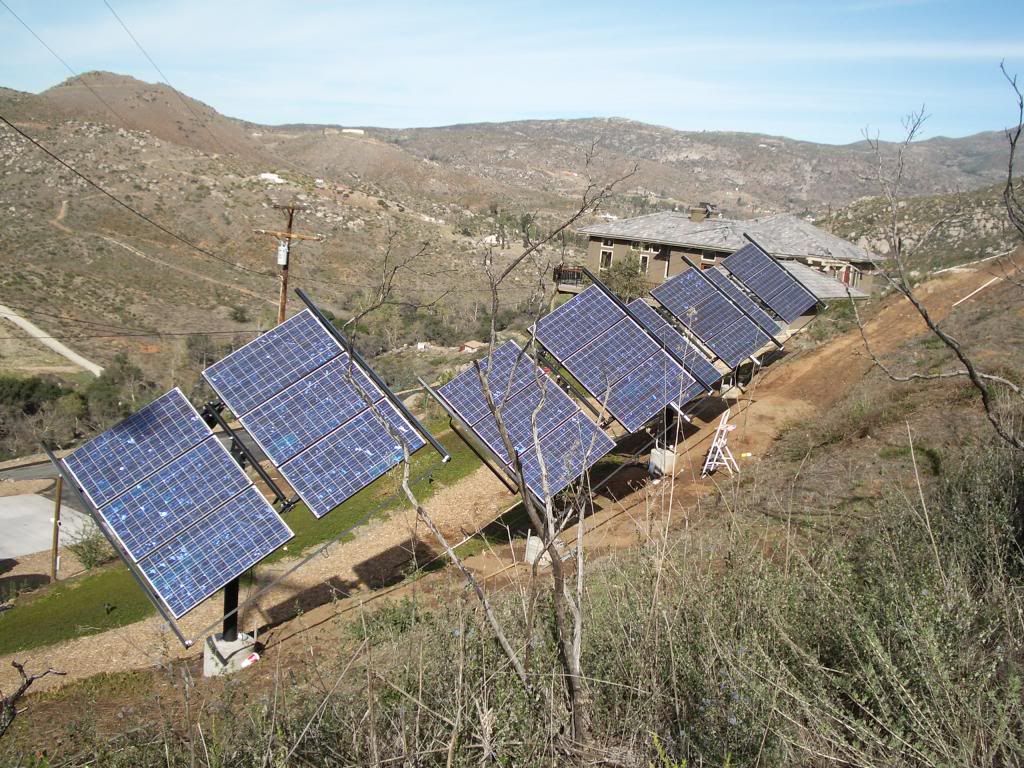 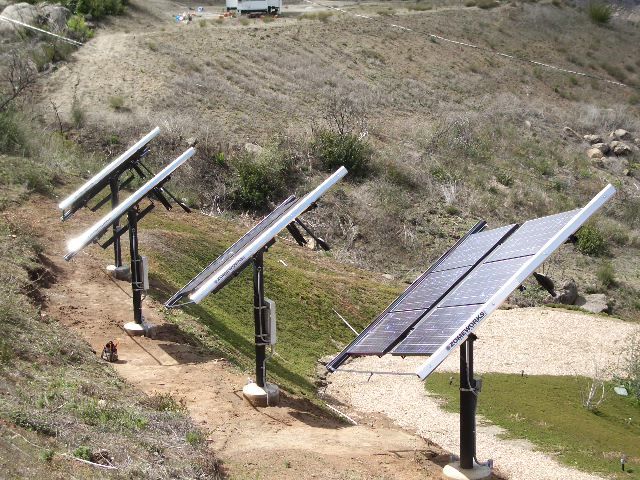 |
|
Quoted:
If you are going to go pole mounted I would suggest refrigerant based trackers. Very little maintenance (greas zerks on the pillow blocks once a year.) I prefer pole mounts as they are much easier to clean the panels as opposed to roof mounts and really maximize solar panels efficiency throughout daylight hours. Below is a picture of a grid tied self tracking installation I did for a client. http://i1282.photobucket.com/albums/a525/EasyMoney4u/Solar_zps2936cf12.jpghttp://i1282.photobucket.com/albums/a525/EasyMoney4u/solar1_zpscc65414e.jpg How does that track the sun? Is it real time sun based tracking or is it computer based estimates based on calendar and location? |
|
Quoted:
If you are going to go pole mounted I would suggest refrigerant based trackers. Very little maintenance (greas zerks on the pillow blocks once a year.) I prefer pole mounts as they are much easier to clean the panels as opposed to roof mounts and really maximize solar panels efficiency throughout daylight hours. Below is a picture of a grid tied self tracking installation I did for a client. http://i1282.photobucket.com/albums/a525/EasyMoney4u/Solar_zps2936cf12.jpghttp://i1282.photobucket.com/albums/a525/EasyMoney4u/solar1_zpscc65414e.jpg That doesn't look anything like what I remember SC looking like.
In your experience, how much more cost am I looking at by going with a tracking system? Also, any concerns with these systems in high wind areas (60-80mph)? Thanks! |
|
So I talked with the installer today and asked him many questions you guys helped me come up with.
On the SMA or Outback inverters he recommend against it as the cost and issues with the battery backup and electrical work to pinpoint the barebones power circuits would cost more than it is worth in an area that doesn't get many long term power outages. He recommended a generator if I was that worried as it would be more cost effective As for the wind reinforcements int the pipe/concrete, he said he could do whatever I want but felt that the SCH 80 pipe would be sufficient as is because it is more beefy than what the manufacturer recommends. He did not advise to go with a tracking system for two reasons. First was that I don't have a flat open site. If I did then adding a tracker might be worth it to get maximum efficiency. Since I have partial blockage he felt that adding more panels would be a better investment, if I was concerned with this. Second, he said the trackers are not ideal in high wind areas because they are side loaded when the wind blows and that can lead to issues. He predicts a ROI of 8% with a payoff in roughly 13 years. We pay $.11 per kwh. He has only had one issue with the Fronius inverters. They warranted it without question. He hasn't had any problems with the REC panels. Is there anything else I should be asking about? Thanks |
|
I'll weigh in on the inverter issue with possible battery backup later. It's not that much more upfront cost to get an inverter that can handle battery backup later. You don't have to add batteries now. Like I said, I wish I had spent the extra money to get an inverter that could do that. I can count the times on half a hand my power has gone out last year.....doesn't mean that will hold true for next year. I also wish I had it for a SHTF scenario. Now I know everyone doesn't believe in planning for that type stuff.....I didn't at the time....but I do now and wish I had thought about it when I purchased my system. |
|
Quoted:
I'll weigh in on the inverter issue with possible battery backup later. It's not that much more upfront cost to get an inverter that can handle battery backup later. You don't have to add batteries now. Like I said, I wish I had spent the extra money to get an inverter that could do that. I can count the times on half a hand my power has gone out last year.....doesn't mean that will hold true for next year. I also wish I had it for a SHTF scenario. Now I know everyone doesn't believe in planning for that type stuff.....I didn't at the time....but I do now and wish I had thought about it when I purchased my system. Right on. In the 20 years of living here (MT) I cannot think of a single time I've been without power for more than an hour. I can see going that route in GA due to snow/ice storms and living in hurricane country. I'm thinking a $500 generator would be sufficient for my needs. The problem I have with upgrading to that style of inverter now is that I know I will never finish getting the batteries and circuits plugged in later.
|
|
Quoted: Right on. In the 20 years of living here (MT) I cannot think of a single time I've been without power for more than an hour. I can see going that route in GA due to snow/ice storms and living in hurricane country. I'm thinking a $500 generator would be sufficient for my needs. The problem I have with upgrading to that style of inverter now is that I know I will never finish getting the batteries and circuits plugged in later. Quoted: Quoted: I'll weigh in on the inverter issue with possible battery backup later. It's not that much more upfront cost to get an inverter that can handle battery backup later. You don't have to add batteries now. Like I said, I wish I had spent the extra money to get an inverter that could do that. I can count the times on half a hand my power has gone out last year.....doesn't mean that will hold true for next year. I also wish I had it for a SHTF scenario. Now I know everyone doesn't believe in planning for that type stuff.....I didn't at the time....but I do now and wish I had thought about it when I purchased my system. Right on. In the 20 years of living here (MT) I cannot think of a single time I've been without power for more than an hour. I can see going that route in GA due to snow/ice storms and living in hurricane country. I'm thinking a $500 generator would be sufficient for my needs. The problem I have with upgrading to that style of inverter now is that I know I will never finish getting the batteries and circuits plugged in later. . Batteries would seem pretty easy to scavenge from cars though... |
|
Quoted:
How does that track the sun? Is it real time sun based tracking or is it computer based estimates based on calendar and location? Quoted:
Quoted:
If you are going to go pole mounted I would suggest refrigerant based trackers. Very little maintenance (greas zerks on the pillow blocks once a year.) I prefer pole mounts as they are much easier to clean the panels as opposed to roof mounts and really maximize solar panels efficiency throughout daylight hours. Below is a picture of a grid tied self tracking installation I did for a client. http://i1282.photobucket.com/albums/a525/EasyMoney4u/Solar_zps2936cf12.jpghttp://i1282.photobucket.com/albums/a525/EasyMoney4u/solar1_zpscc65414e.jpg How does that track the sun? Is it real time sun based tracking or is it computer based estimates based on calendar and location? Nope. Those bar looking things on the side have "anti-freeze" in them, the sun hits one side and it causes the fluid to run to the other side, offsetting the weight and causing it to tilt toward the sun. Personally, as a 7 year builder of these, Im not a fan. I did a large field of them in VT. There are systems available that operate both ways you describe. |
|
Sounds good OP, seems like you have your questions answered for the most part. FWIW though, I'd get another quote or two and see what his competitors can offer. This stuff is largely variable depending on region and a lot companies bullshit their shading anaysis'.
Im not a fan of Outback, we stopped using their stuff 6ish years ago. Fronius is one of the only central inverters we use, Aurora being the next most common. REC is a good panel - see if they can get SolarWorlds, its U.S. made. How far from the house will the array be? |
|
6Kwatts * $0.10 /KwH = $0.60 per hour
$0.60 * ~8 hours of sun a day (not caclulating for change of season) = $4.80 $/day = ~$144/month. 18k/144 = 125 months or 10.4 years. I would ask around.Drive around and find people in your area with panels and ask them about the energy they make out of them. |
|
The trackers in the photos are Zomeworks and mounted on the side of a hill because the homeowners didn't want them visible in their view of the lake. They are rated for 60mph winds if memory serves me correctly. The installation was done in 2005 when I lived in East County San Diego and everything is still functioning with no problems to date. I like them (trackers) and used them on many installations including solar powered well pumps. They do fall asleep clocked over to the west but clock fully to the east in about 45 minutes when the sunrises. They are a fair bit more expensive than fixed pole mounts, but I prefer them personally. |
|
Quoted:
Sounds good OP, seems like you have your questions answered for the most part. FWIW though, I'd get another quote or two and see what his competitors can offer. This stuff is largely variable depending on region and a lot companies bullshit their shading anaysis'. Im not a fan of Outback, we stopped using their stuff 6ish years ago. Fronius is one of the only central inverters we use, Aurora being the next most common. REC is a good panel - see if they can get SolarWorlds, its U.S. made. How far from the house will the array be? I think the only other person in town that can do it is a large electrical company. I will check with them but I have to guess that the original estimate will be at a better price and by a guy that take his time to make sure his customers are happy. I'm not sure ill get that going that other route. The array will be 100 feet from my house. No major obsticals other than a propane line to contend with. Are the Solar Worlds panels better quality? Or is the big difference that they are US made? Thanks |
|
Quoted:
6Kwatts * $0.10 /KwH = $0.60 per hour $0.60 * ~8 hours of sun a day (not caclulating for change of season) = $4.80 $/day = ~$144/month. 18k/144 = 125 months or 10.4 years. I would ask around.Drive around and find people in your area with panels and ask them about the energy they make out of them. I can live with that. Especially with my FSA which should bring the total to $11,810. |
|
Quoted:
I think the only other person in town that can do it is a large electrical company. I will check with them but I have to guess that the original estimate will be at a better price and by a guy that take his time to make sure his customers are happy. I'm not sure ill get that going that other route. The array will be 100 feet from my house. No major obsticals other than a propane line to contend with. Are the Solar Worlds panels better quality? Or is the big difference that they are US made? Thanks Quoted:
Quoted:
Sounds good OP, seems like you have your questions answered for the most part. FWIW though, I'd get another quote or two and see what his competitors can offer. This stuff is largely variable depending on region and a lot companies bullshit their shading anaysis'. Im not a fan of Outback, we stopped using their stuff 6ish years ago. Fronius is one of the only central inverters we use, Aurora being the next most common. REC is a good panel - see if they can get SolarWorlds, its U.S. made. How far from the house will the array be? I think the only other person in town that can do it is a large electrical company. I will check with them but I have to guess that the original estimate will be at a better price and by a guy that take his time to make sure his customers are happy. I'm not sure ill get that going that other route. The array will be 100 feet from my house. No major obsticals other than a propane line to contend with. Are the Solar Worlds panels better quality? Or is the big difference that they are US made? Thanks They are heavier physically, but very slick looking and of great quality. When it comes time to do my place I will be going with either SolarWorlds or SunPowers. If there is no shade contention it should be a solid layout. Otherwise Id look into micro inverters. A 100 foot run is easy enough to run back AC or DC. But if the run were like 500ft I wouldn't recommend micro inverters. |
|
Not that you asked...but here is my opinion. When something requires a government subsidy it means it could not stand alone in the free market.
OK, here is an idea, devil's advocate, if you will. Take the $12,000 you would have spent after government subsidies and put that money in the bank. Every month when you get an electric bill, take $144 out of the account and apply that to the electric bill. Then, just as you would have done if you had a solar system, reach in your back pocket and pay the difference. For the next 10.4 years this (assuming energy rates remain constant, just as I am assuming that the solar system will not require additional expense) it would cost you exactly what a solar system would have cost you. On a side note, will ALL components of a solar system last 10.4 years or will you have to replace a panel, inverter, or other component along the way? jonblack Quoted:
I can live with that. Especially with my FSA which should bring the total to $11,810. Quoted:
Quoted:
6Kwatts * $0.10 /KwH = $0.60 per hour $0.60 * ~8 hours of sun a day (not caclulating for change of season) = $4.80 $/day = ~$144/month. 18k/144 = 125 months or 10.4 years. I would ask around.Drive around and find people in your area with panels and ask them about the energy they make out of them. I can live with that. Especially with my FSA which should bring the total to $11,810. |
|
Quoted:
Not that you asked...but here is my opinion. When something requires a government subsidy it means it could not stand alone in the free market. OK, here is an idea, devil's advocate, if you will. Take the $12,000 you would have spent after government subsidies and put that money in the bank. Every month when you get an electric bill, take $144 out of the account and apply that to the electric bill. Then, just as you would have done if you had a solar system, reach in your back pocket and pay the difference. For the next 10.4 years this (assuming energy rates remain constant, just as I am assuming that the solar system will not require additional expense) it would cost you exactly what a solar system would have cost you. On a side note, will ALL components of a solar system last 10.4 years or will you have to replace a panel, inverter, or other component along the way? jonblack Quoted:
Not that you asked...but here is my opinion. When something requires a government subsidy it means it could not stand alone in the free market. OK, here is an idea, devil's advocate, if you will. Take the $12,000 you would have spent after government subsidies and put that money in the bank. Every month when you get an electric bill, take $144 out of the account and apply that to the electric bill. Then, just as you would have done if you had a solar system, reach in your back pocket and pay the difference. For the next 10.4 years this (assuming energy rates remain constant, just as I am assuming that the solar system will not require additional expense) it would cost you exactly what a solar system would have cost you. On a side note, will ALL components of a solar system last 10.4 years or will you have to replace a panel, inverter, or other component along the way? jonblack Quoted:
Quoted:
6Kwatts * $0.10 /KwH = $0.60 per hour $0.60 * ~8 hours of sun a day (not caclulating for change of season) = $4.80 $/day = ~$144/month. 18k/144 = 125 months or 10.4 years. I would ask around.Drive around and find people in your area with panels and ask them about the energy they make out of them. I can live with that. Especially with my FSA which should bring the total to $11,810. 25 year minimum warranty on most components, especially panels. So your idea just went flying out the window. System is paid for in ten years, then profits for 15+ more. The electricity you use now, however it is produced, is subsidized. At no point in time has energy production ever stood on its own. How do you feel about flying? Or education?
|
|
Quoted:
25 year minimum warranty on most components, especially panels. So your idea just went flying out the window. System is paid for in ten years, then profits for 15+ more. The electricity you use now, however it is produced, is subsidized. At no point in time has energy production ever stood on its own. How do you feel about flying? Or education? Quoted:
Quoted:
Not that you asked...but here is my opinion. When something requires a government subsidy it means it could not stand alone in the free market. OK, here is an idea, devil's advocate, if you will. Take the $12,000 you would have spent after government subsidies and put that money in the bank. Every month when you get an electric bill, take $144 out of the account and apply that to the electric bill. Then, just as you would have done if you had a solar system, reach in your back pocket and pay the difference. For the next 10.4 years this (assuming energy rates remain constant, just as I am assuming that the solar system will not require additional expense) it would cost you exactly what a solar system would have cost you. On a side note, will ALL components of a solar system last 10.4 years or will you have to replace a panel, inverter, or other component along the way? jonblack Quoted:
Quoted:
6Kwatts * $0.10 /KwH = $0.60 per hour $0.60 * ~8 hours of sun a day (not caclulating for change of season) = $4.80 $/day = ~$144/month. 18k/144 = 125 months or 10.4 years. I would ask around.Drive around and find people in your area with panels and ask them about the energy they make out of them. I can live with that. Especially with my FSA which should bring the total to $11,810. 25 year minimum warranty on most components, especially panels. So your idea just went flying out the window. System is paid for in ten years, then profits for 15+ more. The electricity you use now, however it is produced, is subsidized. At no point in time has energy production ever stood on its own. How do you feel about flying? Or education? Plus you're assuming electricuty rates will remain constant - they will not |
|
Quoted:
Just playing devils advocate again.....gasoline doesn't fall from the sky in a SHTF scenario .Yep. In a SHTF scenario, I'd feel pretty stupid looking at a 6 KW solar array sitting in my back yard that was completely useless. 
FWIW, 6 KW of generator power will require around 1.2 gallons of gasoline per hour. |
|
Oh, on the 2014 NEC changes, he said he had not read up on them. He said he would look into it but assumed most of the changes would be geared toward off-grid/battery systems and something to do with a type of inverter (if forgot to write it down). Can anyone familiar with the updates give me the highlights that would apply to my system. Is there anything to them that I should demand be done?
Thanks |
|
Quoted:
Oh, on the 2014 NEC changes, he said he had not read up on them. He said he would look into it but assumed most of the changes would be geared toward off-grid/battery systems and something to do with a type of inverter (if forgot to write it down). Can anyone familiar with the updates give me the highlights that would apply to my system. Is there anything to them that I should demand be done? Thanks Im not entirely brushed up yet, either, but they've added the necessity for a rapid disconnect on roof mounted DC systems (on/off switch) Im not sure about pole mounted, especially since there is a disconnect there anyways. They just call for one at the array now. I'd be interested to know if someone could chime in on that as far as ground mounts go, theres already to supposed to be a disconnect there, anyways. The other revisions are just grounding chatter, racking and micro-inverters grounding differences between standard and integrally grounded models, some stuff on wire marking and labeling. Nothing really to concern yourself with, so long as the integrator is doing his job properly and/or the inspector knows what he's looking at (which they generally do not when it comes to PV). They also added some design parameters as far as roof mounted systems go. The days of packing in and filling the whole roof are basically gone. They are going to call for a 3' path up one side or the middle of the roof, and across the peak. It has to do with firefighters having access, which is also why they want the rapid disconnect at the roof (and my uncertainty if necessary on a ground mounted array). I can't remember right now if that was the NEC code, a local building ordinance, or just a new company policy. Edited: Revised for clarity |
|
Quoted:
Yep. In a SHTF scenario, I'd feel pretty stupid looking at a 6 KW solar array sitting in my back yard that was completely useless.
FWIW, 6 KW of generator power will require around 1.2 gallons of gasoline per hour. Quoted:
Quoted:
Just playing devils advocate again.....gasoline doesn't fall from the sky in a SHTF scenario .Yep. In a SHTF scenario, I'd feel pretty stupid looking at a 6 KW solar array sitting in my back yard that was completely useless.
FWIW, 6 KW of generator power will require around 1.2 gallons of gasoline per hour. Except in a SHTF scenario it won't be useless if you know what you are doing, and you won't require a big genny. |
|
Quoted:
They are heavier physically, but very slick looking and of great quality. When it comes time to do my place I will be going with either SolarWorlds or SunPowers. If there is no shade contention it should be a solid layout. Otherwise Id look into micro inverters. A 100 foot run is easy enough to run back AC or DC. But if the run were like 500ft I wouldn't recommend micro inverters. Quoted:
Quoted:
Quoted:
Sounds good OP, seems like you have your questions answered for the most part. FWIW though, I'd get another quote or two and see what his competitors can offer. This stuff is largely variable depending on region and a lot companies bullshit their shading anaysis'. Im not a fan of Outback, we stopped using their stuff 6ish years ago. Fronius is one of the only central inverters we use, Aurora being the next most common. REC is a good panel - see if they can get SolarWorlds, its U.S. made. How far from the house will the array be? I think the only other person in town that can do it is a large electrical company. I will check with them but I have to guess that the original estimate will be at a better price and by a guy that take his time to make sure his customers are happy. I'm not sure ill get that going that other route. The array will be 100 feet from my house. No major obsticals other than a propane line to contend with. Are the Solar Worlds panels better quality? Or is the big difference that they are US made? Thanks They are heavier physically, but very slick looking and of great quality. When it comes time to do my place I will be going with either SolarWorlds or SunPowers. If there is no shade contention it should be a solid layout. Otherwise Id look into micro inverters. A 100 foot run is easy enough to run back AC or DC. But if the run were like 500ft I wouldn't recommend micro inverters. I'm going to ask him about the two US panel makers you recommend. Can you explain the part that I highlighted in red to me a little more? What would be the advantage of a micro inverter and why would shading affect their use? When he did the proposal he came up with a 94% on the shading deal. Unfortunately I couldn't be there when he came for the site visit and my wife gave him some bad info. If he were to go about 20 feet uphill of where she said I wanted them, they will get more sun throughout the day. As for any shading, I can cut down any trees that might effect things. My house might shade them a tad in the am but other than that they will be unobstructed throughout the entire day. Thanks again. |
|
Assuming you go with 20 panels:
With a central inverter its likely going to be wired in two sets of ten panels. Generally, if one of those ten panels gets shaded, that whole string goes down for the duration a panel is in the shade. (It used to be the whole inverter goes down, but technology is catching up.) In the case with a central inverter, you'd mount the inverter back at the house and its much cheaper to run DC back the 100'. Its just some #10 (or 8) THHN wires and the ground, relatively cheap. General rule of thumb for "shade out" is 15% of the panel - if 15% of it gets shaded that panel stops producing- when its wired in series with the other panels (most common with central inverters) all other panels in that string stop producing, too. (You will find it still produces voltage, but the amperage drops way off) If he intends to mount the inverter at the pole(array), than it would be hugely advantageous as he'd be running AC back anyhow. FWIW, in the event of equipment failure, like a panel breaks or the inverter dies, the whole array is SOL until the issue is repaired. With micro inverters, only that specific set goes down, the rest are un-affected. (I jumped into this too soon, it will make more sense as you read on) If you use micro inverters, theres an inverter for every panel (or two panels), so if one panel gets shaded, you only lose production in that one (or two) panels. The rest of the panels continue to operate fine. The problem with this is you are now running AC back to the house, which needs an upsize in wire. We just installed a 10Kw ground mount that was 540' from the house. The engineers went with micro inverters, which is great and all, but to account for voltage drop running AC back that whole 540' - engineering called for 4-0 sized wire, at around $3/ft.  To me it would have made much more sense to do a DC system at that distance and saved ~$3.5k on the wire bill. Like you said, you can always just clear out trees to achieve constant and consistent full sun (this particular array saw no shade whatsoever). To me it would have made much more sense to do a DC system at that distance and saved ~$3.5k on the wire bill. Like you said, you can always just clear out trees to achieve constant and consistent full sun (this particular array saw no shade whatsoever).
For a 100' run, if you're going to see shade at all, it could be very advantageous to go the micro inverter route. A 100' run for AC shouldn't call for anything more than a 2-0 sized wire, much more reasonable than 4-0. Im not there and am not doing the shading analysis, layout, site design etc, so its incredibly hard for me to say from where Im sitting. But its worth considering. This isn't really relevant to your situation, but since you seem interested: The other HUGE advantage to micro inverters, which isn't really in play here, is they can be placed on different azimuths and not fuck with a central inverter by throwing varying voltages at it. Ie; different roof surfaces that face different directions. The new Aurora central inverters are great at handling different load sizes. Until recently you couldn't have two different string sizes, like a 10 panel and 12 panel string, running into the same inverter. It would see the higher voltage/amperage and compare it to the lower and assume the lower was caused by an error, ground fault etc, and kill production to be safe. Same thing with the different azimuths - if you had an array that faced south and one that faced east, the east will produce less and send back a weaker load, likely triggering a ground fault sginal on the inverter. Aurora fixed that and now you can have varying string sizes but I think it needs programming. SMA and Solectria are both working on that, too, last I heard. It all ties back to having equal sines coming back - Im assuming the new Auroras just alter the sine wave to balance it as it comes in - but I don't know as thats pretty new to me. ETA: From my earlier post - SunPower is Malaysian I believe, but they are the highest efficiency panel on the consumer market right now. 19% efficiency, almost all of the red band of the light spectrum. |
|
Quoted:
Assuming you go with 20 panels: With a central inverter its likely going to be wired in two sets of ten panels. Generally, if one of those ten panels gets shaded, that whole string goes down for the duration a panel is in the shade. (It used to be the whole inverter goes down, but technology is catching up.) In the case with a central inverter, you'd mount the inverter back at the house and its much cheaper to run DC back the 100'. Its just some #10 (or 8) THHN wires and the ground, relatively cheap. General rule of thumb for "shade out" is 15% of the panel - if 15% of it gets shaded that panel stops producing- when its wired in series with the other panels (most common with central inverters) all other panels in that string stop producing, too. (You will find it still produces voltage, but the amperage drops way off) If he intends to mount the inverter at the pole(array), than it would be hugely advantageous as he'd be running AC back anyhow. FWIW, in the event of equipment failure, like a panel breaks or the inverter dies, the whole array is SOL until the issue is repaired. With micro inverters, only that specific set goes down, the rest are un-affected. (I jumped into this too soon, it will make more sense as you read on) If you use micro inverters, theres an inverter for every panel (or two panels), so if one panel gets shaded, you only lose production in that one (or two) panels. The rest of the panels continue to operate fine. The problem with this is you are now running AC back to the house, which needs an upsize in wire. We just installed a 10Kw ground mount that was 540' from the house. The engineers went with micro inverters, which is great and all, but to account for voltage drop running AC back that whole 540' - engineering called for 4-0 sized wire, at around $3/ft. To me it would have made much more sense to do a DC system at that distance and saved ~$3.5k on the wire bill. Like you said, you can always just clear out trees to achieve constant and consistent full sun (this particular array saw no shade whatsoever).
For a 100' run, if you're going to see shade at all, it could be very advantageous to go the micro inverter route. A 100' run for AC shouldn't call for anything more than a 2-0 sized wire, much more reasonable than 4-0. Im not there and am not doing the shading analysis, layout, site design etc, so its incredibly hard for me to say from where Im sitting. But its worth considering. This isn't really relevant to your situation, but since you seem interested: The other HUGE advantage to micro inverters, which isn't really in play here, is they can be placed on different azimuths and not fuck with a central inverter by throwing varying voltages at it. Ie; different roof surfaces that face different directions. The new Aurora central inverters are great at handling different load sizes. Until recently you couldn't have two different string sizes, like a 10 panel and 12 panel string, running into the same inverter. It would see the higher voltage/amperage and compare it to the lower and assume the lower was caused by an error, ground fault etc, and kill production to be safe. Same thing with the different azimuths - if you had an array that faced south and one that faced east, the east will produce less and send back a weaker load, likely triggering a ground fault sginal on the inverter. Aurora fixed that and now you can have varying string sizes but I think it needs programming. SMA and Solectria are both working on that, too, last I heard. It all ties back to having equal sines coming back - Im assuming the new Auroras just alter the sine wave to balance it as it comes in - but I don't know as thats pretty new to me. ETA: From my earlier post - SunPower is Malaysian I believe, but they are the highest efficiency panel on the consumer market right now. 19% efficiency, almost all of the red band of the light spectrum. Wow, great post! Thank you.I had no idea about any of this. A couple follow up questions, if I may. So other than the added cost of the AC line running back to the house (not a problem in my case), is there any other disadvantage to the micros? Do the micro inverters add more parts to the system that will fail? Approximately how much additional cost is there by going micro over a central system (wire to panel excluded)? Here is a photo to give you some idea of what my site looks like. Like I said, I'm not attached to any of these trees so I will level anything that gets in the way. Oh, south is approx on a line from the center of the photo to the left hand side of the detached garage. The photo makes it look like its in a gully but in fact the small gully is to the west about 60 feet. 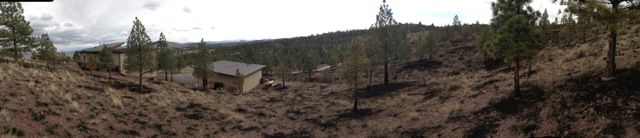
|
|
Quoted:
Wow, great post! Thank you.I had no idea about any of this. A couple follow up questions, if I may. So other than the added cost of the AC line running back to the house (not a problem in my case), is there any other disadvantage to the micros? Do the micro inverters add more parts to the system that will fail? Approximately how much additional cost is there by going micro over a central system (wire to panel excluded)? Here is a photo to give you some idea of what my site looks like. Like I said, I'm not attached to any of these trees so I will level anything that gets in the way. Oh, south is approx on a line from the center of the photo to the left hand side of the detached garage. The photo makes it look like its in a gully but in fact the small gully is to the west about 60 feet. http://i897.photobucket.com/albums/ac180/AssSupt/Random/d92d2a13e48b877807029c01335b21bc_zpsf7f206b4.jpg WOW, Im jealous.  Beautiful plot. Beautiful plot.
Theres really nothing but advantages to the micros, IMO. Yes, obviously there will be 20 micro inverters as opposed to the one central, that can be looked at as a disadvantage I suppose. The benefits far outweigh any cons someone could come up with. You can monitor individual panel and inverter output to see what they are doing, as opposed to a central inverter where you can only monitor the string outputs. The big advantage again being all your eggs aren't in one basket. If that central inverter goes down, thats it for production until its replaced. You can lose a micro and still produce with the other 19 panels. Enphase micros are going for ~$250 each, those are the only ones I know off hand as thats what we deal with daily. Central inverters can be anywhere up to $6k, maybe even a bit more. So cost is fairly even. From the picture, so long as you drop any trees that cause shading issues, it doesn't look like there will be any production benefits as far as micro inverters ago. A central inverter will do just fine. The production gains come in to play for us over my way as there are far more tall trees and shading issues. Thats not to say micro's won't have their benefits for you, but production won't really be one of them. Another benefit is the ease of which the array can be added to. Its as simple as adding more panels and micros. Also, if you do really well for yourself and feel the desire, you can stock a couple of micros for not that much money. If one breaks 30 years down the road, its literally as easy as unplugging the dead one, bolting on the new one and plugging it in. A guy I work with buys a micro and a panel every couple months and adds it to his roof. Its a lot easier for someone like him as he's versed in installation etc, so he can really tinker (which I don't recommend for the inexperienced). But this way he doesn't have any bulk downpayment or monthly payments. He's just kind of building an array as he goes. Pretty awesome, I can't wait for my SO and I to stop renting so I can start doing it, too. It can be done with a central inverter, but its far more involved and complicated. Thats just a benefit for a guy like me. 
|